Source: Teacher Xu (ID: xuguanghong76)
1. Basic Conclusions of the 45°–90° Half-Angle Model
The 45°–90° Half-Angle Model is one of the most important models in junior high school geometry, involving knowledge points such as the criteria and properties of congruent triangles; isosceles triangles; area transformation; Pythagorean theorem; criteria and properties of parallelograms; cyclic quadrilaterals; rotation; similarity, etc. It encompasses almost all the geometry exam points in junior high school. Its characteristics include complex figures, many variations, and numerous conclusions. Students’ practice is often scattered, which is not conducive to mastery. Here, I have organized some commonly used conclusions for everyone’s convenience in learning.
Proof Strategies: Rotation method, folding method, and the method of cutting long to make short.
1. Find equilateral triangles with a common vertex. 2. Rotate the triangle containing the equilateral sides so that the two equilateral sides coincide, constructing half-angle congruence. 3. Pay attention to whether three points are collinear.
❖
Basic Conclusion 1 of the 45°–90° Half-Angle Model
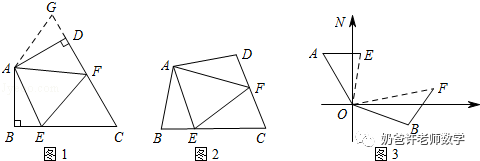
Basic Conclusion 1:In square ABCD, points E and F are on BC and CD respectively, and ∠EAF=45°, AH⊥EF. Prove that: (1) EF=BE+DF (2) CΔECF=2AB
(3) AH=AB (4) S△ABE+S△ADF=S△AEF
(5) ∠BEA=∠BEF ∠AFE=∠AFD
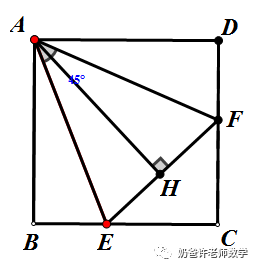
Conclusion 1
Method 1: Rotation Method
Method 1:As shown,1, rotate triangleADF clockwise around pointA by 90° to obtain triangle ABG (also can rotate triangle ABE)
∴∠DAF=∠GAB
∵∠BAD=90°,∠EAF=45° ∴∠BAE+DAF=90°-45°=45°
∴∠GAE=∠BAE+∠GAB=45°=∠FAE, ∠ABC=∠D=∠ABG=90°
∴∠ABC+∠ABG=180° ∴PointsG,B,E are collinear.
∴△AEF≅△AEG(SAS) ∴EF=GE,
That is, EG=GB+BE,∴EF=BE+GB.
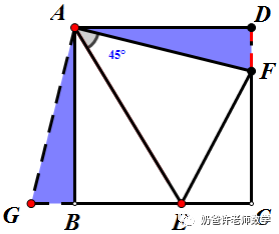
Conclusion 1
Method 2: Cutting Long to Make Short Method
Method 2: Cutting Long to Make Short Method (proof omitted)
Proof: ExtendCB to pointG, makingGB=DF, connectAG.
1. ProveΔABG≅ΔADF(SAS)
2. ∠GAE=∠BAE+∠GAB=45°=∠FAE
3. Prove△AEF≅△AEG(SAS),∴EF=BE+GB.
(Also can extend CD to point M, making DM=BE, connect AM)
Conclusion 1
Method 3: Folding Method
Method 3:Fold triangle ABE alongAE to get triangle AEG, connectGF.
∴AB=AG=AD,BE=GE,∠BAE=∠GAE.
∵∠BAD=90°,∠EAF=∠EAG+GAF=45°
∴∠BAE+DAF=90°-45°=45°
∴∠GAE+∠DAF=45° ∴∠GAF=∠DAF
∴ΔAGF≅ΔADF(ASA)
∴∠AGF=∠D=90°,GF=DF.
∴∠AGF+∠AGE=180°
∴PointsE,G,F are collinear.
∴EF=EG+FG=BE+DF.
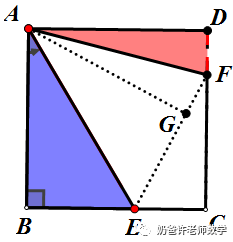
Conclusion 2
Proof: From (1) we know:EF=BE+DF
∴CΔECF=EC+CF+EF
=EC+CF+BE+DF
=BC+CD
=2AB
Conclusion 3
Proof: From the folding method in (1), we know: AH=AB
Conclusion 4
Proof:
∵SΔABE=1/2AB•BE SΔADF=1/2AD•DF SΔAEF=1/2EF•AH
From (1) we know:EF=BE+DF
∴S△ABE+S△ADF=S△AEF
Conclusion 5
Proof:From the folding method in Conclusion 1.
Actual Exam Practice
(2017 Changsha) As shown, fold squareABCD so that vertexA coincides with a pointH on the edge ofCD (H does not coincide with endpointsC,D), the crease intersectsAD at pointE, intersectsBC at pointF, and edgeAB after folding intersects edgeBC at pointG. Let the perimeter of squareABCD bem, and the perimeter of triangleDHG ben, then the value of n/m is______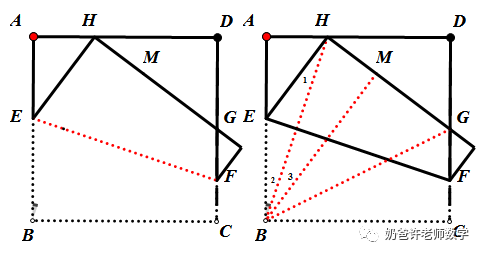
Solution: Connect BH, BG, and make BM⊥HG through point B.
1. By the properties of folding, EH=EB, thus ∠1=∠2.
2. By the properties of folding, ∠EHG=∠BMG=90°, thus EH∥BM, therefore ∠1=∠3=∠2
3. It is easy to prove that ΔBAH≅ΔBMH(AAS), ΔBMG≅ΔBCG(HL), thus ∠MBG=∠CBM
4. From (3) we know: ∠HBG=45°, by the basic conclusion of the half-angle model, n/m=0.5
Basic Conclusions of the 45°–90° Half-Angle Model 2
Basic Conclusion 2: As shown, in triangleABC, AB=AC, ∠BAC=90°, points D and E are on BC such that ∠DAE=45°.
Conclusion:BD2+CE2=DE2
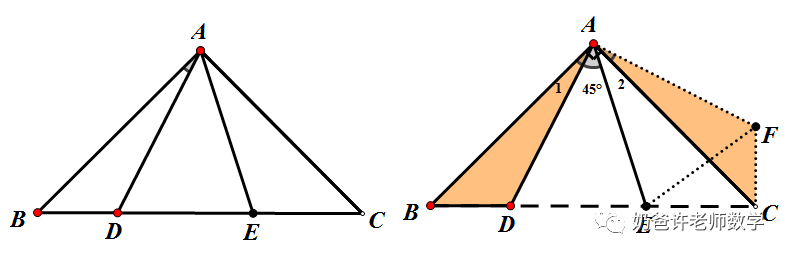
Method 1
Rotation Method
Proof:
1. Rotate triangleABD around pointA counterclockwise by 90° to obtain triangleACF, connect EF.
2. ∠1=∠2, thus ∠1+∠DAC=∠2+∠DAC=90°=∠DAF.
3. ∠DAE=45°, thus ∠DAE=∠FAE.
4. AD=AF, thus ΔAED≅ΔAEF.EF=ED.
5. In right triangle EFC, FC2+CE2=EF2, thus BD2+CE2=DE2
(Also can consider rotating triangle ACE)
Method 2
Folding Method
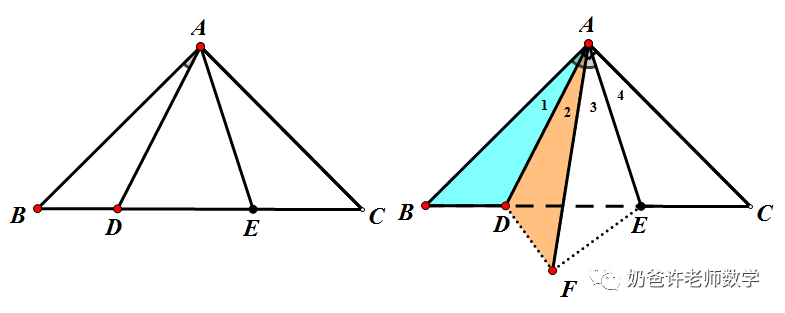
Proof:
1. Fold triangleABD alongAD to get triangleAFD, connect EF.
2. ∠1=∠2, AB=AF=AC, DB=DF.
3. ∠2+∠3=∠1+∠4=45°, thus ∠3=∠4.
4. ΔAEF≅ΔAEC, thus EC=EF.
5. In right triangle EFE, FD2+FE2=ED2, thus BD2+CE2=DE2

Variation: As shown, in triangleABC, AB=AC, ∠BAC=90°, point D is on BC, point E is on the extension of BC,
and ∠DAE=45°, then BD2+CE2=DE2
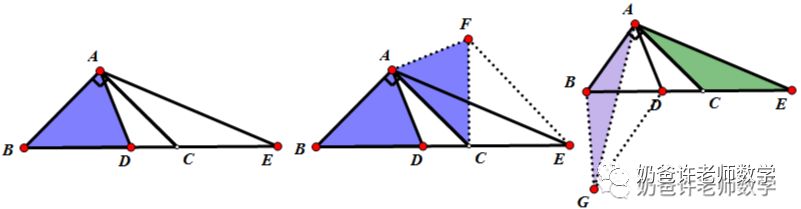
Method 1
Rotation Method
Proof:
1. Rotate triangleABD around pointA counterclockwise by 90° to obtain triangleACF, connect EF.
2. ∠BAD=∠CAF, thus ∠BAC=∠DAF=90°.
3. ∠DAE=45°, thus ∠FAE=45°.
4. AD=AF, thus ΔAED≅ΔAEF.
5. BD=FC.DE=FE.
6. ∠FCE=180°-∠FCE=90°
7. In right triangle EFC, FC2+CE2=EF2, thus BD2+CE2=DE2
(Also can consider rotating triangle ACE)
Method 2
Folding Method
Proof:
1. Fold triangleABD alongAD to get triangleAFD. ConnectEF.
2. ∠1=∠2, AB=AF=AC, DB=DF.
3. ∠2+∠3=∠1+∠4=45°, thus ∠3=∠4.
4. ΔAEF≅ΔAEC, thus EC=EF.
5. In right triangle EFE, FD2+FE2=ED2, thus BD2+CE2=DE2
Actual Exam Practice
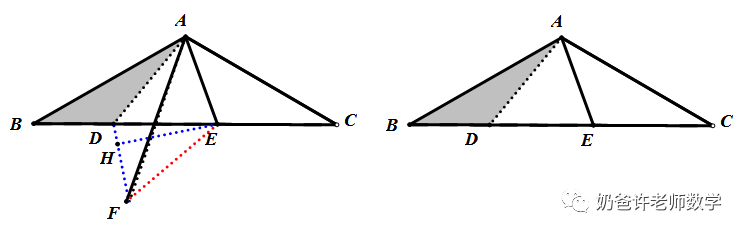
(2017 Wuhan with slight changes) As shown, in triangleABC, AB=AC, ∠BAC=120°, points D and E are both on edge BC, ∠DAE=60°.If BD=5, CE=8, then the length of DE is_______
Proof Method 1
Rotation Method
Proof:
1. Rotate triangleABD around pointA counterclockwise by 120° to obtain triangleACF. ConnectEF.
2. ∠FCG=60° and FC=BD=5, thus GC=2.5.
3. In right triangle FGC, FG=(5/2)√(3). In right triangle FGE, EF=7
4. ΔAED≅ΔAEF, thus DE=EF=7
Proof Method 2
Folding Method
Proof:
1. Fold triangleABD alongAD to get triangleAFD. Fold triangleAEC along AE to get triangle AEF.
Connect EF, FD, and make FD⊥EH through point E.
2. ∠EFD=60° and FE=EC=8, thus HF=4, DH=1
3. In right triangle FEH, FG=4√(3). In right triangle FGE, DE=1
Half-Angle Model Basic Conclusions
α–2α Half-Angle Model Basic Conclusions
α—2α Half-Angle Model is one of the most important models in junior high school geometry, it generalizes the previous models. Its characteristics include complex figures, many variations, and numerous conclusions. Students’ practice is often scattered, which is not conducive to mastery. Here, I have organized some commonly used conclusions for everyone’s convenience in learning.
Proof Strategies: Rotation method, folding method, and the method of cutting long to make short.
1. Find equilateral triangles with a common vertex. 2. Rotate the triangle containing the equilateral sides so that the two equilateral sides coincide, constructing half-angle congruence. 3. Pay attention to whether three points are collinear.
Basic Conclusion:
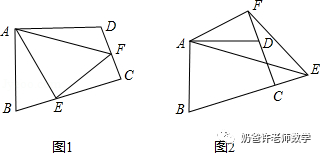
As shown in quadrilateralABCD, AB=AD, ∠B+∠D=180°, points E and F are on edges BC and CD respectively, and ∠BAD=2∠EAF.
1. Prove: EF=BE+DF;
2. In (1), if triangle AEF is rotated around point A counterclockwise, when points E and F move to the extensions of BC and CD respectively, as shown in (2), explore the numerical relationship between EF, BE, DF.
Conclusion 1 Proof Method 1
Rotation Method
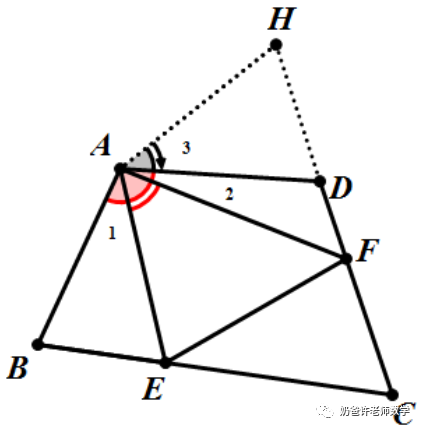
Proof:
1. Rotate triangleABE around pointA counterclockwise so that AB coincides with AD, obtaining triangleADH.
2. ∠B=∠ADH, ∠B+∠D=180°, thus ∠ADH+∠D=180°, hence points H.D.C are collinear.
3. ∠1=∠3, thus ∠1+∠2=∠EAF, hence ∠2+∠3=∠EAF=∠HAF.
4. ΔEAF≅ΔHAF(SAS).
5. EF=HF=HD+DF=BE+DF.
Conclusion 1 Proof Method 2
Cutting Long to Make Short Method
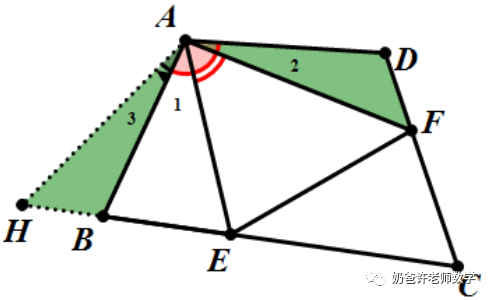
Proof:
1. On the extension of CB, take point H such that BH=DF, connect AH.
2. ∠B+∠D=180°, ∠ABH+∠B=180°, thus ∠ABH=∠D.
3. ΔABH ≅ΔADF(SAS), AH=AF, ∠3=∠2.
4. ∠1+∠2=∠EAF, thus ∠2+∠3=∠EAF=∠HAF.
4. ΔEAF ≅ΔHAF(SAS).
Conclusion 2 Proof Method 1
Rotation Method
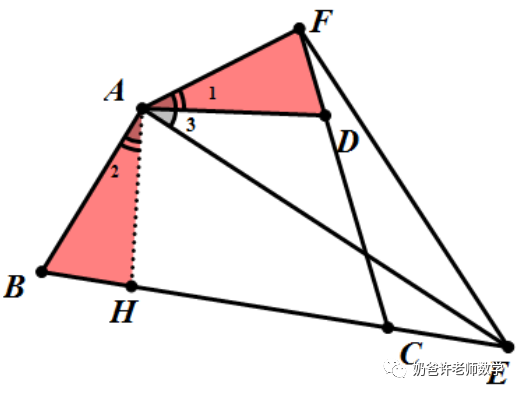
Proof:
1. Rotate triangleADF around pointA clockwise so that AD coincides with AB, obtaining triangleABH.
2. ∠B+∠D=180°, ∠B=∠ADF, hence points H.D.C are collinear.
3. Prove ΔAEF≅ΔAEH(SAS)
4. EF=HE=BE-BH=BE-DF.
Conclusion 2 Proof Method 2
Cutting Long to Make Short Method
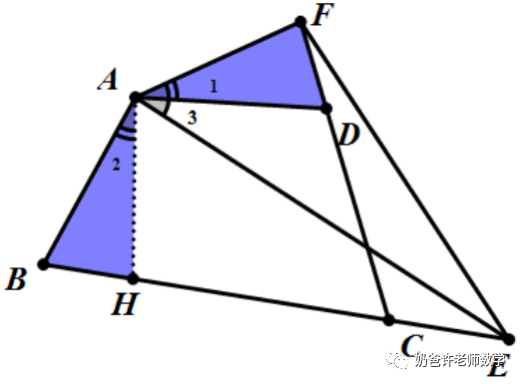
Proof:
1. On EB, take point H such that BH=DF, connect AH.
2. ∠B+∠D=180°, ∠ADF+∠D=180°, thus ∠ADF=∠B.
3. ΔABH≅ΔADF(SAS), AH=AF, ∠1=∠2.
4. ∠3+∠2=∠EAF, thus ∠1+∠3=∠EAF=∠HAF.
4. ΔEAF≅ΔHAE(SAS).
Actual Exam Practice
(2014•Dezhou) Background: As shown in Figure 1: in quadrilateralABCD,AB=AD, ∠BAD=120°, ∠B=∠ADC=90°, pointsE andF are points on edgesBC and CD, and ∠EAF=60°. Explore the numerical relationship between segmentsBE,EF, andFD.
Student Wang’s method to explore this problem is to extendFD to pointG, makingDG=BE. ConnectAG, first prove triangleABE≌triangleADG, then prove triangleAEF≌triangleAGF, he should conclude thatEF=BE+FD;
Exploration Extension:
As shown in Figure 2, if in quadrilateralABCD,AB=AD, ∠B+∠D=180°, pointsE andF are points on edgesBC and CD, and ∠EAF=∠BAD, does the above conclusion still hold? Explain the reason;
Practical Application:
As shown in Figure 3, during a military exercise, ship A is at point A, which is 30° north of west from the command center (point O), and ship B is at point B, which is 70° south of east from the command center, and both ships are equidistant from the command center. After receiving the action order, ship A moves east at a speed of 60 nautical miles/hour, while ship B moves at a speed of 80 nautical miles/hour at a direction of 50° north of east. After 1.5 hours, the command center observes that ships A and B reach points E and F respectively, and the angle between the two ships is 70°. Find the distance between the two ships at this time. (Answer: 210KM)
Proof: Refer to example questions
Recommended Reading
-
【Junior High Exam Special】 Junior High Review | Three Major Transformations of Rotation (Half-Angle Model)
-
【Junior High Review】 Square II: When Half-Angle Meets Three Perpendiculars
-
【Junior High Exam Special】 45-Degree Series IV: The Half-Angle Model in Squares
-
【Junior High Micro-Special】 Lecture 3: Half-Angle Model, Midpoint Model
-
【Junior High Exam Special】 Existence of Parabolas and Half-Angles—Transforming Angles, Solving with Tangents
-
【Junior High Exam Special】 12 Conclusions of Half-Angle Models, How Many Do You Know?