Breakthrough Progress: 3D Porphyrin-Based Covalent Organic Frameworks Achieve Efficient Solar Energy Conversion
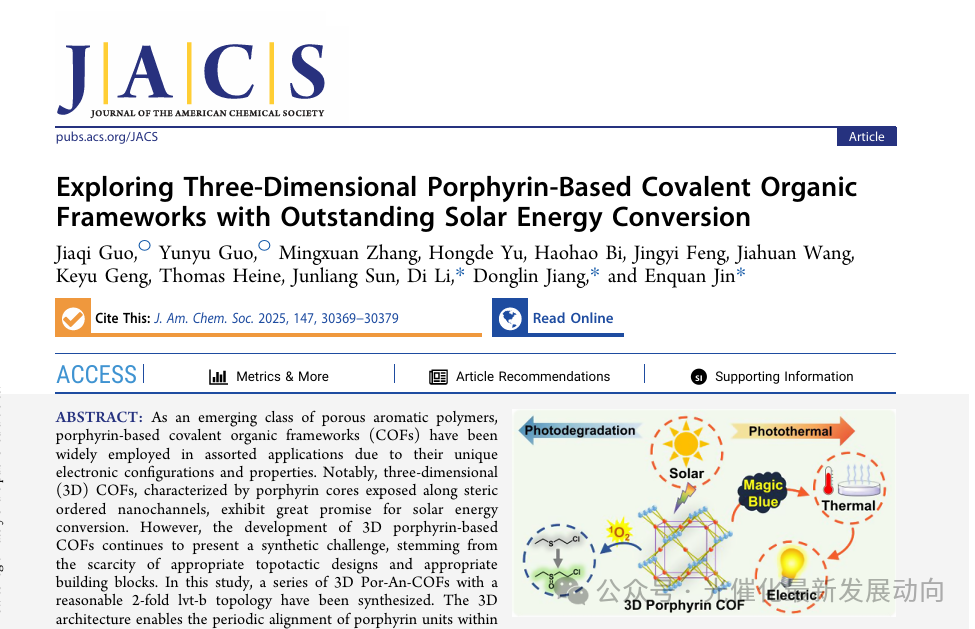
- Recently, a research result published in the Journal of the American Chemical Society (JACS) has attracted widespread attention. Scientists successfully synthesized a series of novel three-dimensional (3D) porphyrin-based covalent organic frameworks (Por-An-COFs), which exhibit excellent performance in photodegradation of pollutants and photothermal conversion, providing new ideas for the efficient utilization of solar energy.
Research Background: Why 3D COFs?
Covalent organic frameworks (COFs) are a class of porous aromatic polymers with tunable structures and unique electronic properties, especially with great potential in the field of solar energy conversion. However, traditional two-dimensional (2D) porphyrin-based COFs often suffer from limited active sites due to their layered stacking structure, which hinders charge transport. Three-dimensional (3D) COFs can expose the porphyrin core through spatially ordered nanochannels, enhancing light capture and molecular diffusion efficiency, but their synthesis is challenging, and few reports exist.This study successfully constructed a 3D Por-An-COF with a double interpenetrating lvt-b topology through clever topological design, achieving a periodic arrangement of the fully conjugated framework.
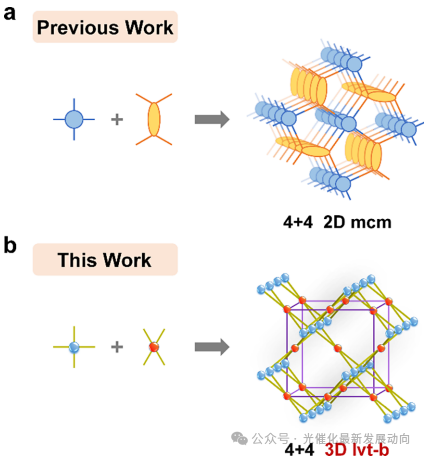
Innovative Synthesis and Structural Characterization
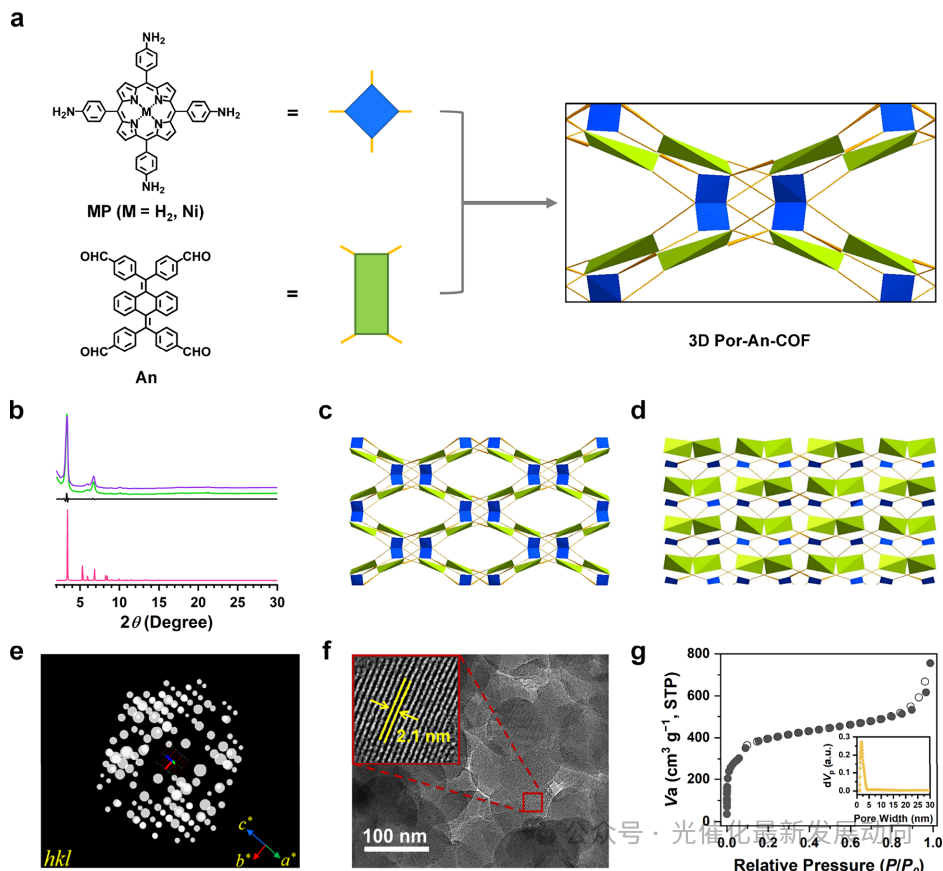
The research team used D4h symmetric nickel-coordinated porphyrin (NiP) and C2 symmetric anthracene-based units (An) as linkers to synthesize 3D NiP-An-COF via solvothermal methods. Under optimized conditions, the product achieved a crystallinity of up to 88% and exhibited a high specific surface area (1302 m²/g) and uniform pore size of 2.1 nm.Powder X-ray diffraction (PXRD) and continuous rotation electron diffraction (cRED) analyses confirmed the material’s 3D crystal structure, with a space group of Iba2 and cell parameters of a=54.4991 Å, b=29.5005 Å, c=29.7506 Å. High-resolution transmission electron microscopy (HR-TEM) images clearly displayed the ordered porous architecture.
Outstanding Photodegradation Performance: Rapid Purification of Pollutants
Using the chemical warfare agent simulant 2-chloroethyl ethyl sulfide (CEES) as a target, the 3D H2P-An-COF can completely degrade CEES into non-toxic products CEESO under white light irradiation within 6 minutes, with a half-life of only 2 minutes, far exceeding the 40 minutes required by the 2D COF control group (e.g., COF-366). Its high activity is attributed to the exposed porphyrin sites in the three-dimensional structure, which can efficiently generate singlet oxygen (¹O₂) to promote oxidation reactions.Cycling experiments showed that the material maintained over 95% conversion rate after 10 uses, demonstrating excellent structural stability. Electron paramagnetic resonance (EPR) spectra verified the generation mechanism of singlet oxygen.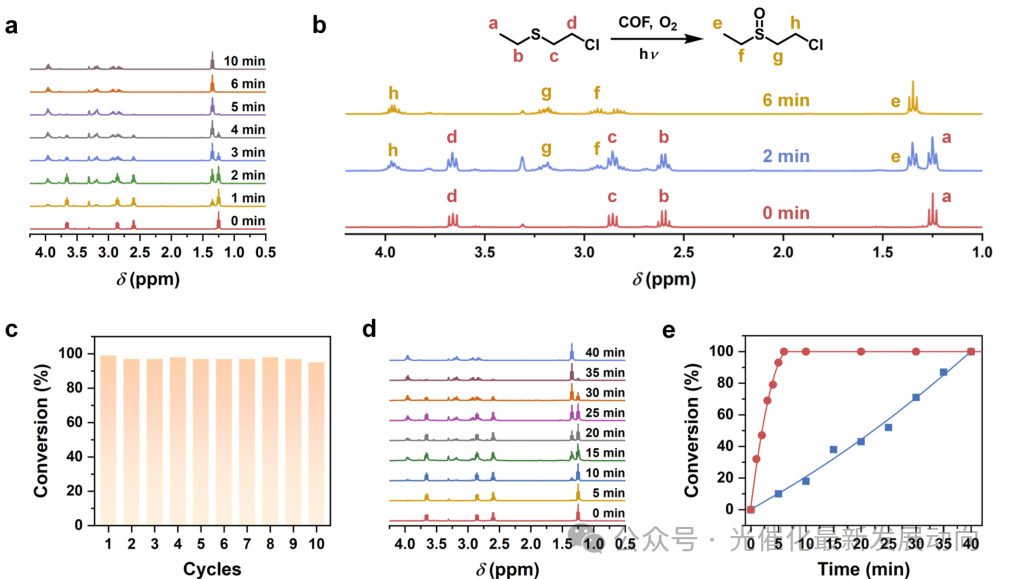
Efficient Photothermal Conversion: From Solar Energy to Thermoelectric Output
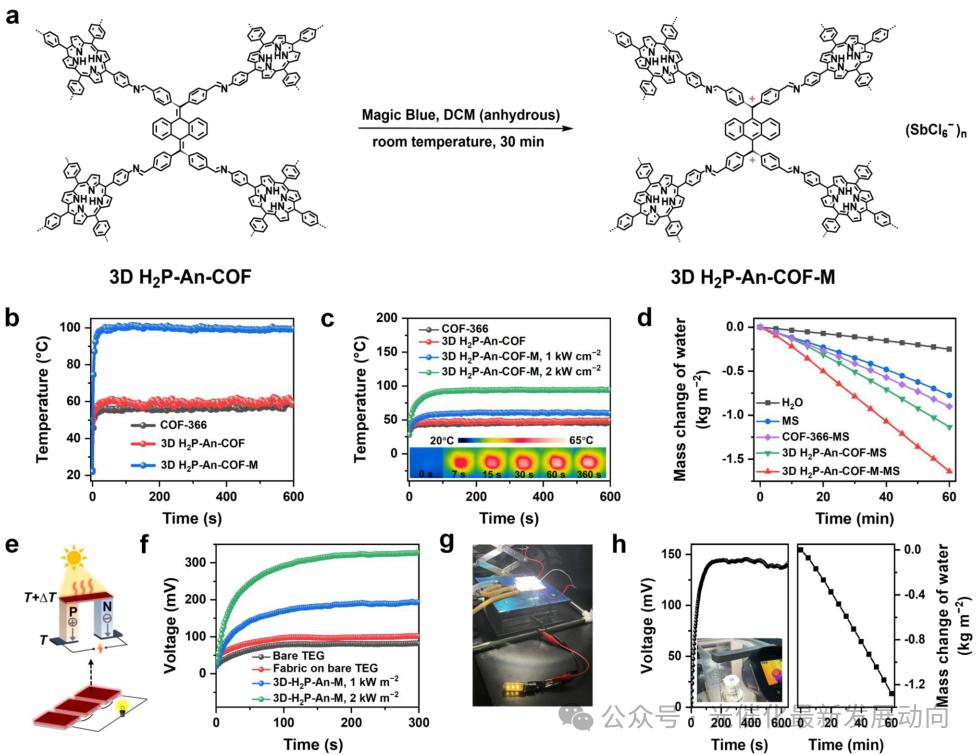
Through oxidation treatment (using Magic Blue), the absorption range of 3D H2P-An-COF-M was extended to 2000 nm, significantly enhancing its photothermal conversion capability in the near-infrared region. Under 808 nm laser irradiation (0.25 W/cm²), its temperature can rise to 100°C in a short time, while the original COF only reached 60°C. Under simulated solar irradiation (1 kW/m²), the equilibrium temperature of 3D H2P-An-COF-M reached 61°C, much higher than that of 2D materials.The research team further developed a water evaporation and thermoelectric system based on this material:
- Solar Water Evaporation: The 3D H2P-An-COF-M loaded on melamine sponge (MS) evaporator achieved an evaporation rate of 1.64 kg/m²/h, with an efficiency of 93.4%, and showed stability in saline and dye solutions.
- Thermoelectric Power Generation: Combined with a thermoelectric generator (TEG), the output voltage reached 195 mV (1 kW/m²), which could light up an LED lamp through series connection, demonstrating the potential for waste heat utilization.
- Water-Electricity Co-Generation System: The integrated design simultaneously achieved water evaporation (1.28 kg/m²/h) and power generation (140 mV), providing a new solution for sustainable energy applications.
Conclusion and Outlook
This study not only expands the structural diversity of 3D porphyrin-based COFs but also reveals the dimensionality-dependent mechanism of light-responsive behavior. The material’s fully organic composition, high stability, and ease of scalable preparation provide broad application prospects in environmental remediation (such as pollutant degradation) and energy conversion (such as solar thermoelectric). In the future, through further optimization of topological structures and oxidation strategies, such materials are expected to become design templates for multifunctional photosensitive materials.References: J. Am. Chem. Soc. 2025, 147, 30369-30379. DOI: 10.1021/jacs.5c09844Follow us for more exciting content, stay tuned for future updates!