
Xing Li, Yan Deng, Jinlei Lai, Gai Zhao, Shengyi Dong, and others successfully designed and prepared a novel supramolecular adhesive composed of low-molecular-weight monomers. This adhesive achieved strong and long-lasting adhesion on various surfaces (from hydrophilic glass and metal iron to highly hydrophobic polytetrafluoroethylene and polymethyl methacrylate), with a maximum adhesion strength of 4.174 MPa. It exhibited robust and stable adhesion characteristics in high humidity environments (relative humidity > 95%) and underwater (including seawater), indicating its potential application as a marine adhesive. Additionally, the application of electrospinning technology in the preparation of the coating for this supramolecular adhesive was explored, revealing that this method can save materials, time, and costs. 🎉🎉🎉 The related results “Tough, Long-Term, Water-Resistant, and Underwater Adhesion of Low-Molecular-Weight Supramolecular Adhesives” were published in the Journal of the American Chemical Society! 🎉🎉🎉 The corresponding authors are Gai Zhao and Shengyi Dong.

Modern functional adhesives have attracted attention due to their reversible adhesion capabilities and stimulus-responsive adhesion behavior. However, most functional adhesives currently rely on polymer structures to achieve adhesion performance, and supramolecular adhesives composed of low-molecular-weight monomers have not been widely recognized. Compared to polymer adhesives, low-molecular-weight supramolecular adhesives still face significant challenges in achieving high-strength adhesion on wet surfaces or even underwater. Although the development of supramolecular self-assembly has promoted research on constructing supramolecular adhesives from low-molecular-weight monomers, these adhesives also possess reversibility and stimulus responsiveness that traditional polymer adhesives struggle to achieve. However, most low-molecular-weight supramolecular adhesives are not water-resistant, and water significantly weakens their adhesion effects. The water sensitivity severely hinders their functionalization and further development, creating an urgent demand for low-molecular-weight supramolecular adhesives that are water-resistant, humidity-insensitive, or usable underwater.
In this research context, the authors designed and prepared a novel low-molecular-weight supramolecular adhesive (represented by P1) by rationally introducing the non-adhesive building block dibenzo-24-crown-8 (DB24C8) into a tetravalent pentaerythritol structure. Four monomers, P1-P4, were synthesized through esterification reactions, and their characterization, mechanical properties, and adhesion performance (including adhesion effects on different surfaces, under varying temperature and humidity, in water, and seawater) were systematically studied. The adhesion mechanism was analyzed using density functional theory (DFT) simulations and molecular dynamics (MD) simulations. The effects of two coating methods, electrospinning and hot-melt, on the adhesion performance of P1 were also explored, and the practical application effects of P1 in repairing flasks, centrifuge tubes, and water pipes were tested.

(1) Experimental reagents include dibenzo-24-crown-8 (DB24C8), tetravalent pentaerythritol, and related reagents for the reactions (such as reactants for esterification, chloroform for dissolving the adhesive, etc.), as well as various substrate materials for testing (glass, steel, wood, polytetrafluoroethylene (PTFE), polymethyl methacrylate (PMMA)), seawater (containing 3.5 wt% sodium chloride), hydrochloric acid (2 N), sodium hydroxide (2 N), etc.
(2) Experimental steps: First, four monomers P1-P4 were synthesized through esterification reactions, following the synthetic route shown in Scheme 1. After preparing the adhesive, two methods were used for coating adhesion: one was the hot-melt method, where P1 was slightly heated (utilizing its low melting point of 52°C) to convert it into a high-viscosity liquid, coated on the substrate surface, and after applying pressure, cooled to transform into an amorphous adhesive for adhesion; the other was the electrospinning method, where a 400 mM P1 chloroform solution was uniformly coated on the substrate surface (such as glass) using electrospinning technology to achieve adhesion. During performance testing, the adhesive samples were placed in different environments (varying temperature and humidity, water, seawater) for a period before relevant performance characterization.
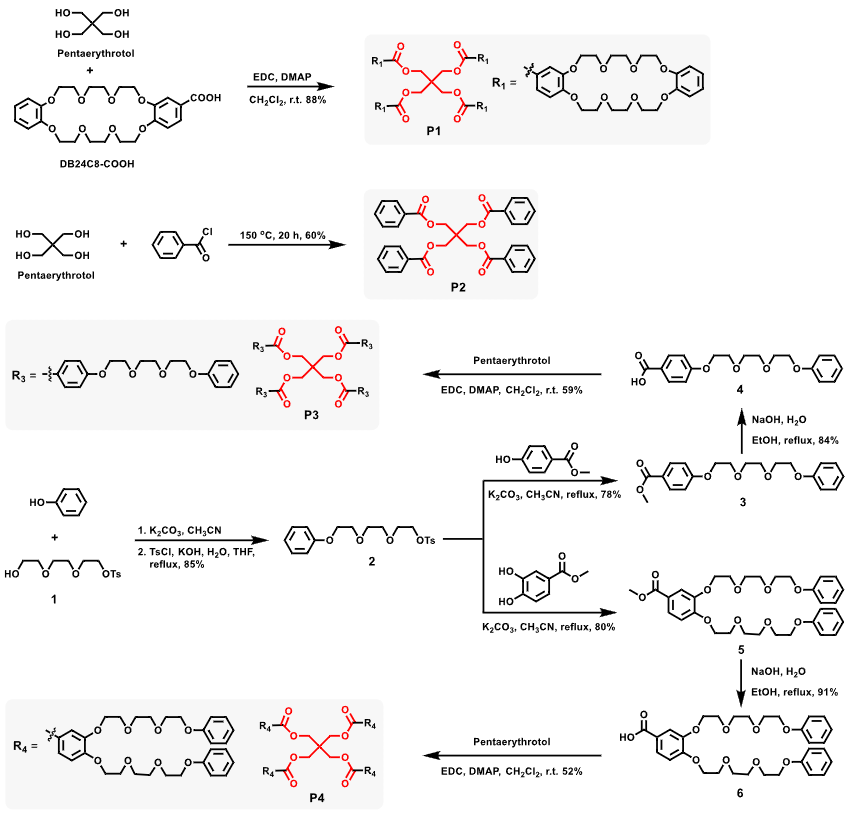 ▲ Scheme 1. Synthetic routes for P1, P2, P3, and P4
(3) Testing and characterization methods include: using powder X-ray diffraction (PXRD) to analyze the phase structure of P1 after cooling; observing the surface morphology of P1 using scanning electron microscopy (SEM); determining the decomposition temperature of P1 using thermogravimetric analysis (TGA) to assess its thermal stability; analyzing the mechanical strength and viscosity of P1-P4 through rheological measurements (determining the storage modulus G’ and loss modulus G” as a function of frequency and temperature); quantitatively measuring the adhesion strength of the adhesive on different substrate surfaces using lap shear tests; testing the reusability of P1 through multiple cycles; calculating the Gibbs free energy of binding between the monomer and the glass surface using density functional theory (DFT) simulations, and calculating the interfacial interaction energy between adhesive clusters and the glass surface using molecular dynamics (MD) simulations; while also using macroscopic observations (such as observing the state and load-bearing capacity of samples in different environments) to assist in evaluating the adhesive performance and stability.
Q:What is the role of each component? The paper primarily prepared four monomers P1, P2, P3, and P4, among which P1 is the core functional component. The structure of P1 incorporates the dibenzo-24-crown-8 (DB24C8) unit, which endows it with a specific molecular geometry. The tetravalent pentaerythritol structure combined with DB24C8 allows P1 to have a low melting point (52°C), making it easy to convert into a viscous liquid upon heating, and upon cooling, it forms an amorphous adhesive that can bond with various surfaces through supramolecular interactions such as hydrogen bonding, van der Waals forces, π-π stacking, hydrophobic interactions, and even metal complexation, achieving strong and long-lasting adhesion, as well as excellent water resistance, underwater adhesion performance, and thermal stability. P2, as a comparative component, has a rigid structure without flexible crown ether units, making it easy to form a dense aggregation structure, resulting in weaker interaction with surfaces and significantly inferior adhesion effects and longevity compared to P1, highlighting the rationality of P1’s structural design. P3 and P4 are oily liquids that cannot solidify at 25°C and exhibit almost no adhesion performance, serving as negative controls to further emphasize the key role of P1’s structure (low melting point, cooling solidification characteristics) in achieving effective adhesion.

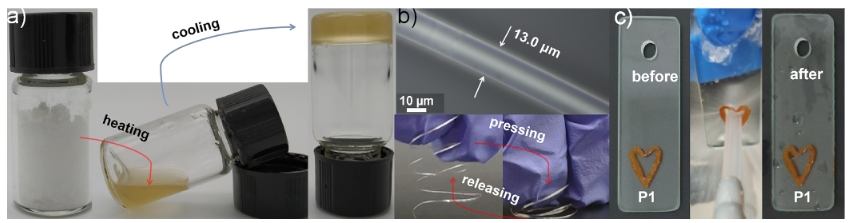 ▲ Figure 1a shows the three states of P1: glassy solid, fluid liquid after heating, and gel-like adhesive after cooling; Figure 1b presents rod-like fibers and elastic springs made from P1; Figure 1c shows the spray test of P1 (2 bar, 10 min), with dye added for clear observation.
Figure 1 primarily presents the macroscopic characteristics and preliminary water resistance of P1: Figure 1a shows that P1 undergoes three state changes, being a glassy solid at room temperature, transforming into a fluid liquid upon heating, and becoming a gel-like adhesive upon cooling. This characteristic makes it suitable as a hot-melt adhesive; Figure 1b indicates that P1 can be processed into rod-like fibers and elastic springs, demonstrating good processability; Figure 1c’s spray test (2 bar pressure, lasting 10 min) shows that the P1 adhesive layer mixed with dye was not washed away, proving its certain resistance to water erosion.
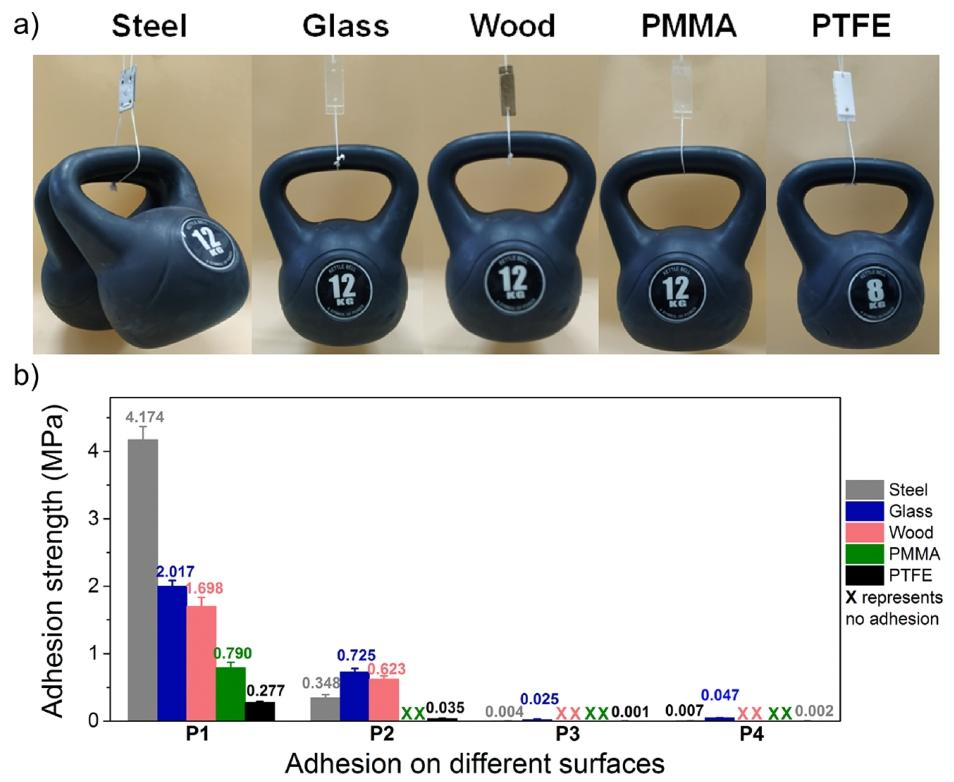 ▲ Figure 2a shows the macroscopic adhesion test results of the adhesive on different substrates (steel, glass, wood, PMMA, PTFE) (with the adhesion area of each substrate labeled); Figure 2b presents the adhesion strength data of different adhesives (P1-P4) on various substrate surfaces (with specific strength values labeled, X indicates no adhesion).
Figure 2 focuses on the comparison of adhesion performance of different adhesives on various substrates: The macroscopic tests in Figure 2a show that on steel, glass, wood, PMMA, and PTFE substrates with adhesion areas of 15, 18, 9, 18, and 9 cm² respectively, P1 achieved stable adhesion, such as a steel sheet suspended with a weight of 24 kg for 24 months (0-35°C, 40-80 RH%) without separation or misalignment. P1 could also suspend 8-12 kg on PTFE and PMMA substrates without falling off for 24 months, while P2’s adhesion effect was weaker and shorter-lasting (only 1/8-1/10 of P1), and P3 and P4 exhibited no macroscopic adhesion performance. The lap shear test data in Figure 2b (25°C, 50 RH%, stretching rate 100 mm/s) shows that P1’s average adhesion strength on wood, glass, and steel surfaces was 1.698, 2.017, and 4.174 MPa respectively, while on PMMA and PTFE surfaces it was 0.790 and 0.277 MPa respectively. Although the strength on hydrophobic surfaces was lower, it still exceeded that of most reported supramolecular adhesives. P2’s strength on steel and glass surfaces was only 1/12 and 1/3 of P1’s, while P3 and P4’s strength approached the detection limit.
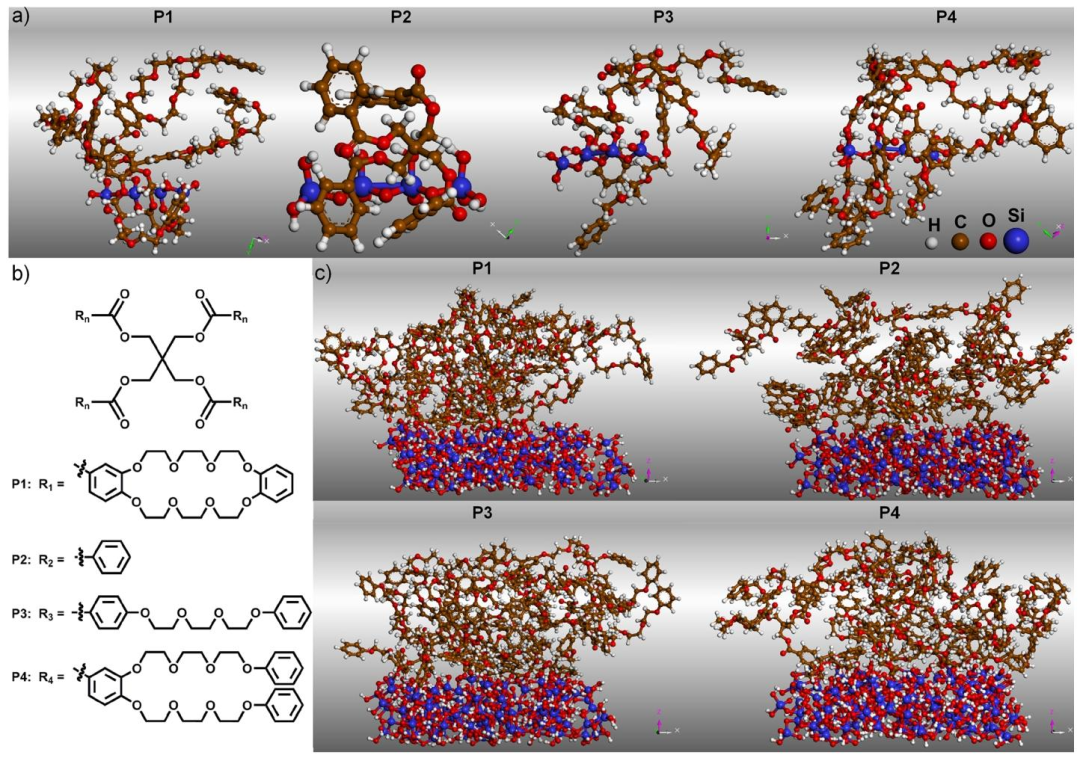 ▲ Figure 3a shows the interaction patterns of P1-P4 with glass (using (HO)₃SiOSi(OH)₂OSi(OH)₃ as a model); Figure 3b presents the chemical structures of P1-P4; Figure 3c shows the most stable configurations of P1-P4 clusters with glass at minimum energy (with the simulation unit size labeled as 3.0×3.0×3.0 nm³).
Figure 3 analyzes the interaction between the adhesive and glass at the molecular level: The DFT simulation results in Figure 3a show that P1’s binding Gibbs free energy with glass is -51.2 kcal/mol, lower than that of P2 (-33.3 kcal/mol), P3 (-42.7 kcal/mol), and P4 (-43.6 kcal/mol), indicating that P1 has the strongest interaction with the glass surface. Figure 3b clearly presents the chemical structure differences of P1-P4, with P1 containing the DB24C8 unit, P2 lacking the crown ether unit, and P3 and P4 being different structural oily monomers. Figure 3c’s MD simulation (3.0×3.0×3.0 nm³ unit) displays the most stable configurations of P1-P4 clusters with glass at minimum energy, providing an intuitive molecular model for understanding interfacial interactions.
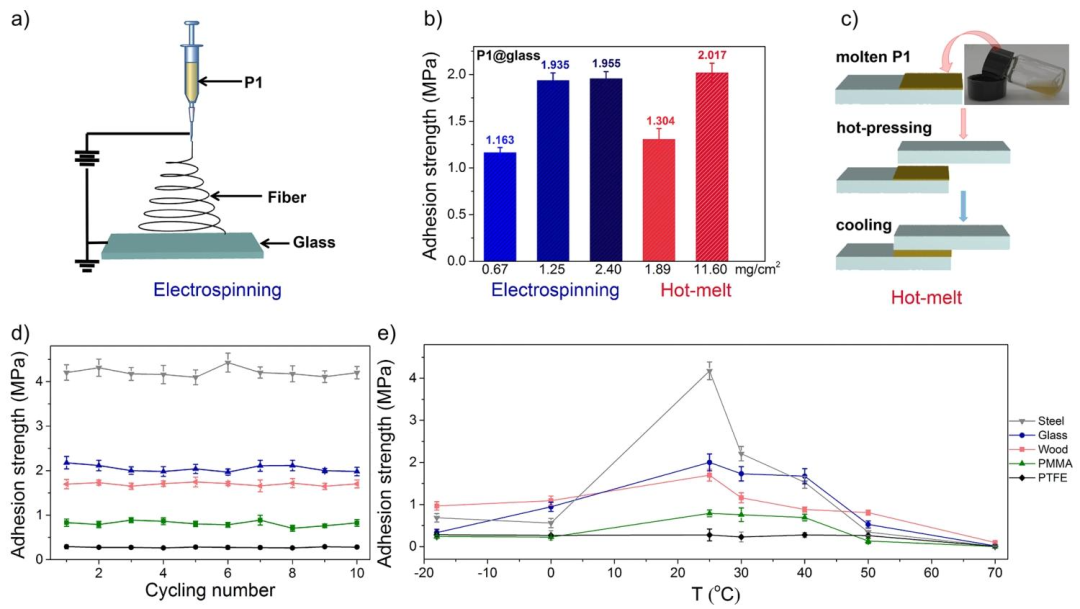 ▲ Figure 4a is a schematic diagram of the P1 coating prepared by electrospinning; Figure 4b compares the adhesion strength data of P1 prepared by electrospinning and hot-melt methods on glass surfaces; Figure 4c is a schematic diagram of the hot-melt adhesion process; Figure 4d presents the cyclic adhesion test data of P1 on different substrate surfaces (with the number of cycles and adhesion strength labeled); Figure 4e shows the data of P1’s adhesion strength on different substrate surfaces as a function of temperature (with the temperature range and strength values labeled).
Figure 4 explores P1’s coating methods, cyclic performance, and temperature sensitivity: Figure 4a is a schematic diagram of the electrospinning preparation of P1 (400 mM CHCl₃ solution) coating, demonstrating the principle of this coating method; Figure 4b shows that P1 prepared by electrospinning achieved an adhesion strength of 1.935 MPa on glass surfaces (using 1.25 mg/cm²), and even when the amount was reduced to 0.67 mg/cm², it still had 1.163 MPa, which is more material-efficient than the hot-melt method (2.017 MPa, using 11.6 mg/cm²), and the coating of a 20×20 cm² area only took 1 min, significantly faster than the hot-melt method, which takes over 1 hour. Figure 4c is a schematic diagram of the hot-melt adhesion process, clearly showing the heating-coating-pressing-cooling steps; Figure 4d’s 10-cycle test indicates that P1’s adhesion strength on steel, glass, PMMA, PTFE, and other substrate surfaces showed no significant decline, reflecting good reusability; Figure 4e shows that temperature significantly affects P1’s adhesion strength, with almost no adhesion at 70°C, and at -18°C, the strength on wood surfaces dropped to half of that at 25°C (0.967 MPa vs 1.697 MPa), and P1 is more sensitive to high temperatures, with P1@PTFE showing relatively good high-temperature resistance, retaining 94% strength at 50°C (0.261 MPa vs 0.277 MPa at 25°C), with 25°C being the optimal temperature for P1 adhesion.
 ▲ Figure 5a presents the adhesion strength data of P1 on different substrate surfaces in varying humidity or underwater environments; Figure 5b is a macroscopic display of P1’s water-resistant adhesion performance on different surfaces; Figure 5c is a schematic diagram and macroscopic observation results of P1’s adhesion process in seawater over 12 months (comparing the adhesion effects of the commercial adhesive ergo and P1).
Figure 5 tests P1’s adhesion performance in different humidity, water, and seawater: The data in Figure 5a (25°C) shows that as humidity increased from 5% to 95%, P1’s adhesion strength on various substrate surfaces only lost 0.3%-8.4%; after soaking in water for 24 hours, the strength on glass and steel surfaces dropped from 2.017 and 4.174 MPa to 1.902 and 3.820 MPa, with a loss of less than 10%; during underwater adhesion, the strength on glass, steel, and PMMA surfaces was 1.562, 3.237, and 0.618 MPa respectively, although lower than in dry and water-resistant states, it still exceeded that of most reported underwater adhesives. The macroscopic tests in Figure 5b show that samples adhered with P1 suspended a weight of 2 kg for 12 months without displacement or separation, and a structure made of three PMMA blocks adhered with P1 could withstand over 65 kg in water; Figure 5c demonstrates P1’s long-lasting adhesion effect in seawater, where during the 12-month test, the commercially available adhesive ergo’s hooks fell off 6 times, while the two glass pieces adhered with P1 remained firmly bonded, proving its potential as a marine adhesive.
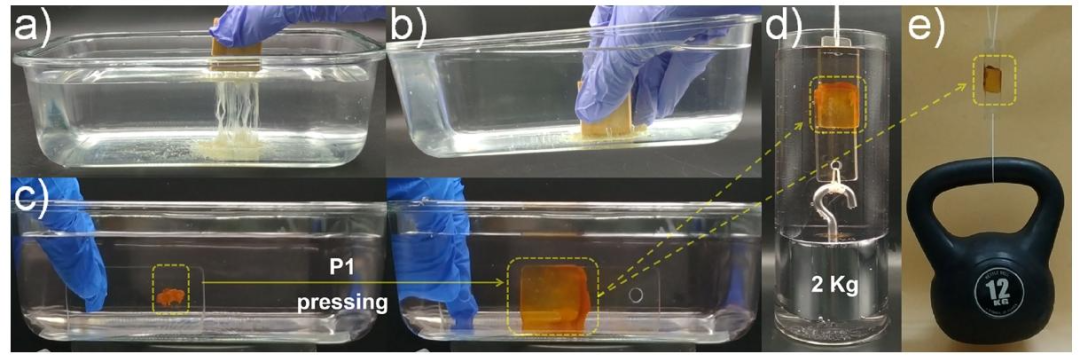
 ▲ Figures 6a and 6b respectively show the underwater adhesion of wood blocks and glass containers adhered with P1, and the adhesion situation of P1 with another object; Figure 6c is a schematic diagram of the underwater adhesion process of P1; Figures 6d and 6e are the macroscopic testing situations of P1’s underwater adhesion behavior in water or air (with red dye added for clear observation).
Figure 6 visually demonstrates P1’s underwater adhesion effects: Figures 6a and 6b are macroscopic photos showing the stable adhesion state of wood blocks and glass containers adhered with P1 underwater, while Figure 6c is a schematic diagram of the underwater adhesion process, clearly presenting the steps of coating P1 underwater, placing another substrate, and applying pressure for 10 minutes. Figures 6d and 6e show the macroscopic testing situations (with red dye added for observation), further confirming that P1 can achieve effective adhesion underwater, with only the wood surface exhibiting poor adhesion due to the porous structure of the wood forming a water layer, leading to suboptimal underwater adhesion effects after more than 24 hours, but short-term underwater adhesion (0.5-1 hour) is feasible.
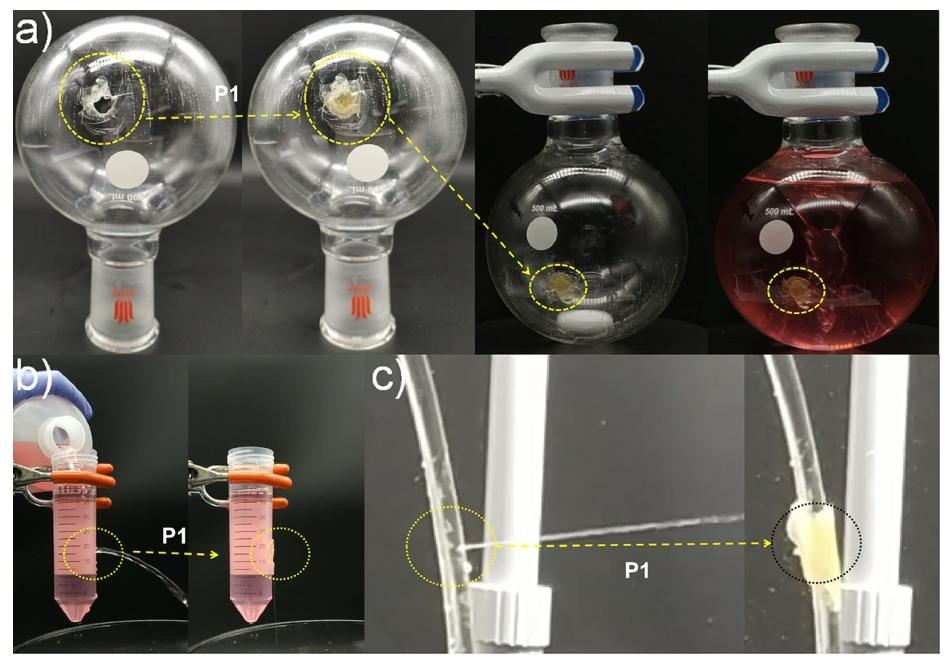
▲ Figure 7a, 7b, and 7c respectively show the round-bottom flask, centrifuge tube, and water pipe repaired with P1.
Figure 7 showcases practical application cases of P1: Figures 7a, 7b, and 7c respectively show the round-bottom flask, centrifuge tube, and water pipe repaired with P1, where the repaired flask held water at 25°C for 12 months, and the P1 patch remained firmly adhered without leakage. The repaired water pipe could withstand 2 bar water pressure, demonstrating P1’s practical value in equipment repair scenarios.

Q: Why does the material prepared in this paper exhibit excellent performance?🟢️The materials prepared in this paper (represented by P1) exhibit excellent performance primarily due to their unique structural design and supramolecular interaction mechanisms. Structurally, P1 incorporates dibenzo-24-crown-8 (DB24C8) into the tetravalent pentaerythritol structure, forming a closed-loop crown ether structure that provides an extended molecular geometry, unlike the flexible ethylene glycol chains of P3 and P4 that easily fold. This extended structure facilitates bonding with various surfaces through multiple supramolecular interactions such as hydrogen bonding, van der Waals forces, π-π stacking, hydrophobic interactions, and even metal complexation, enhancing interfacial adhesion. Additionally, P1 has a low melting point of 52°C, making it easy to convert into a viscous liquid upon heating, allowing for uniform coating, and upon cooling, it forms an amorphous structure that can closely adhere to the substrate. Scanning electron microscopy observations show that its surface is free of pores or fibers, resulting in a high-density structural form that further enhances adhesion stability. From a stability perspective, thermogravimetric analysis indicates that P1’s decomposition temperature reaches 370°C, demonstrating high thermal stability, and it remains stable without decomposition when treated with water, acid (2 N HCl), base (2 N NaOH), and UV irradiation (254/365 nm, 20 W) for 12 months, indicating excellent environmental stability. Its hydrophobic properties allow it to reduce water interference in water and seawater, achieving long-lasting stable adhesion. Furthermore, DFT and MD simulations confirm that P1 has the highest binding energy with substrates (such as glass), ensuring strong adhesion performance at the molecular level. Moreover, P1’s dynamic reversible supramolecular interactions allow it to maintain adhesion performance without degradation after multiple cycles, demonstrating good reusability.
In summary, the innovation of this paper is primarily reflected in three aspects: first, it breaks through the limitations of traditional supramolecular adhesives that rely on polymer structures or contain catechol units, successfully designing and preparing a supramolecular adhesive based on low-molecular-weight monomers (P1) for the first time. This adhesive can achieve strong and long-lasting adhesion on various surfaces (covering both hydrophilic and highly hydrophobic surfaces) without requiring a polymer framework or catechol units, with a maximum adhesion strength of 4.174 MPa, filling the gap in strong adhesion for low-molecular-weight supramolecular adhesives. Second, it addresses the common water sensitivity issue of low-molecular-weight supramolecular adhesives, with the prepared P1 exhibiting robust and stable adhesion performance in high humidity (>95 RH%), water, and seawater, with underwater adhesion strength (e.g., 3.237 MPa on steel surfaces) comparable to reported catechol-based polymer underwater adhesives, and capable of achieving long-lasting adhesion in seawater for over 12 months, providing a new direction for marine adhesive development. Third, it innovatively applies electrospinning technology to the preparation of low-molecular-weight supramolecular adhesive coatings, which not only significantly reduces adhesive usage (e.g., only 1.25 mg/cm² for adhesion on glass surfaces, far lower than the 11.6 mg/cm² required by the hot-melt method) but also greatly shortens coating time (only 1 min for a 20×20 cm² area), reducing costs and providing a new strategy for efficient coating and practical application of supramolecular adhesives.
https://dx.doi.org/10.1021/jacs.0c00520
