First Author: Yu Zhao (Xiamen University)Corresponding Authors: Jin-Chao Dong, Shisheng Zheng, Yue-Jiao Zhang, Jian-Feng Li (Xiamen University)
Research BackgroundCu is the only pure metal capable of electrochemically reducing CO₂ to multi-carbon (C₂⁺) products, but its product selectivity is low. It has been recognized that metal cations can stabilize key intermediates such as *OCCO and modulate the interfacial electric field; interfacial water serves as a proton source and participates in the hydrogen bond network, determining the competition between protonation of *CO and dimerization. However, there is still a lack of direct evidence from in situ experiments and theoretical coupling on how the cation-water “synergy” precisely regulates the C₁/C₂ pathways at the atomic scale.
Research ObjectiveUsing a single crystal Cu(hkl) model system, combined with in situ shell-isolated Raman spectroscopy (SHINERS) and ab initio molecular dynamics (AIMD) simulations, we aim to synchronously capture the interfacial water configurations, *CO intermediate, and product distribution on a millisecond to second scale, revealing the regulatory mechanism of the “K⁺-water complex” on C₂ selectivity.
Experimental MethodsIn a 0.1 M KHCO₃ saturated CO₂ electrolyte, a series of potentials from -0.8 to -1.4 V (vs. RHE) were applied to Cu(100), Cu(110), and their mildly oxidized surfaces; in situ SHINERS analyzed the O–H stretching vibrations in the 3100–3600 cm⁻¹ range, distinguishing three water configurations: 4HB-H₂O, 2HB-H₂O, and K-H₂O; synchronous monitoring of characteristic peaks such as *CO₂⁻, *CO, and *OCCO in the 200–2200 cm⁻¹ range; AIMD calculations were performed to assess the orientation of interfacial water, hydrogen bond network, and the protonation and dimerization energy barriers of *CO in the presence or absence of K⁺.
Main Findings
-
The content of K-H₂O increases in parallel with the C₂ yield. On Cu(100), when the K-H₂O ratio increases from 0% to 17%, the C₂ selectivity is significantly higher than that of C₁; after mild oxidation of Cu(110), K-H₂O increases from 10% to 14%, and C₂ selectivity rises from 16% to 38%.
-
K-H₂O disrupts the hydrogen bonds between *CO and water. The Raman Stark slope indicates that K-H₂O is most sensitive to the electric field; AIMD reveals that its “one H down” configuration blocks the hydrogen bonds between *CO and adjacent water molecules, inhibiting the conversion of *CO to *COH (C₁ pathway).
-
K⁺ directly coordinates with *CO and *CO, lowering the dimerization energy barrier. AIMD shows that without K⁺, the hydrogenation and dimerization energy barriers of *CO are similar; with the addition of K⁺, the dimerization barrier slightly decreases while the hydrogenation barrier significantly increases, making C–C coupling the dominant pathway.
-
Validation of cation size effect. As the ionic radius increases from Li⁺ to Cs⁺, the content of K-H₂O analogs at the interface increases, and C₂ selectivity monotonically rises, further confirming that “cation-water synergy” is a universal principle.
Figure Interpretation
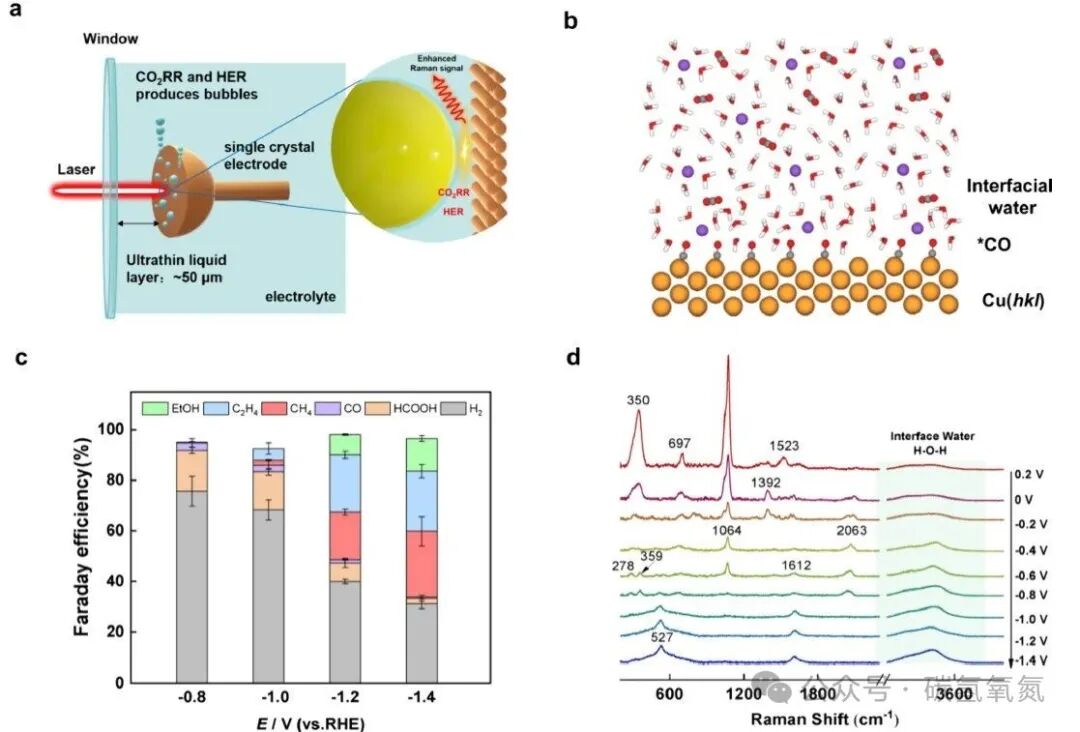
Figure 1 | Experimental and Spectral Schematica Schematic of the in situ SHINERS setupb Theoretical model: K⁺-water-*CO interfacec Product distribution on Cu(100): C₂ increases with negative shift in potentiald In situ Raman: *CO₂⁻, *CO, *OCCO appear sequentially
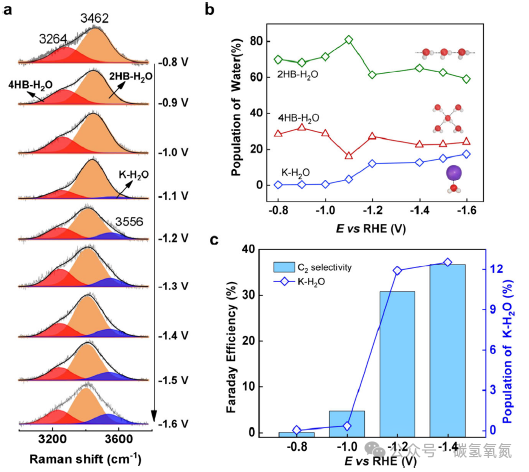
Figure 2 | Evolution of Interfacial Water Configurationsa Gaussian peak fitting of O–H stretching region: 4HB-H₂O, 2HB-H₂O, K-H₂Ob Potential-dependent content: K-H₂O increases, 4HB-H₂O/2HB-H₂O decreasesc K-H₂O content vs. C₂ selectivity shows a positive correlation
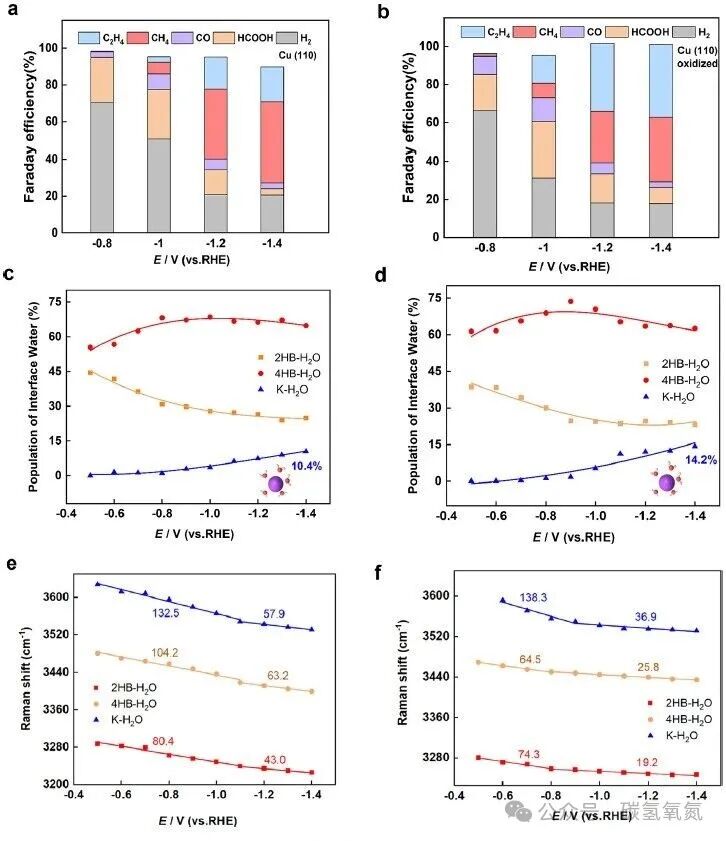
Figure 3 | Comparison Before and After Oxidation of Cu(110)a,b Product distribution: C₂ doubles after oxidationc,d K-H₂O content increases after oxidatione,f Stark slope: The slope of K-H₂O on the oxidized surface drops sharply, indicating a weakened hydrogen bond network
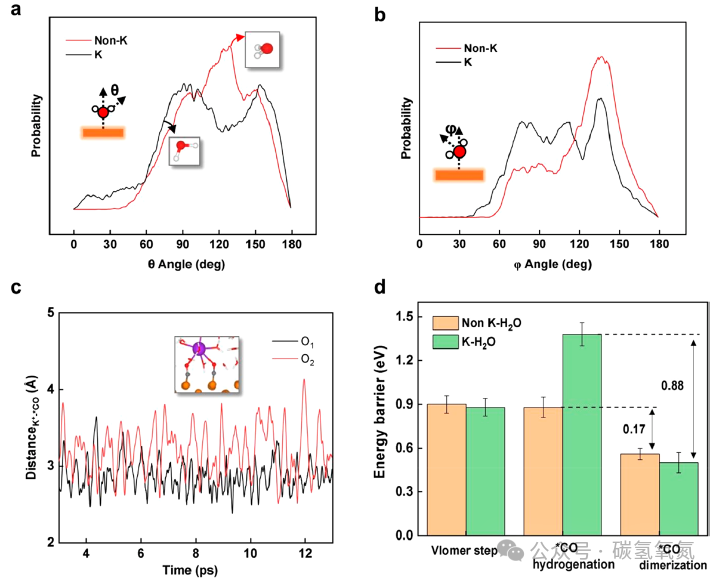
Figure 4 | AIMD Resultsa,b Water orientation distribution: K⁺ makes water “lie flat”c K⁺-O(*CO) distance statistics: direct coordinationd Energy barriers: *CO hydrogenation increases, dimerization decreases, Volmer step always higher than dimerization
Conclusion and OutlookThis study first confirms at the atomic-molecular level that K⁺, by directly coordinating with *CO and reshaping the interfacial water network, creates a “hydrogen bond-deficient” microenvironment, thereby precisely inhibiting the C₁ pathway and promoting the dimerization of *CO to generate C₂ products. This “cation-water synergy” strategy provides a universal approach for designing highly selective CO₂RR catalysts and electrolyte engineering.
Reference: Zhao, Y., Li, Q.-Q., He, Q.-F., Ren, P.-W., Zhang, D.-A., Wang, Y.-H., Dong, J.-C., Zheng, S., Zhang, Y.-J., Yang, Z.-L., & Li, J.-F. (2025). In Situ Raman Spectroscopy Reveals the Multifunctional Role of Interfacial Water in Electroreduction on Cu(hkl) Surfaces. Journal of the American Chemical Society, 147, 30230–30238. https://doi.org/10.1021/jacs.5c08922
Please open in the WeChat client