Author | Yangcheng Investment Research TeamThe full text contains4085words, reading will take about8minutes
1
Introduction
With the continuous advancement of intelligent driving, the traditional distributed electronic and electrical architecture of automobiles is gradually evolving towards a centralized architecture due to its inability to meet the demands of OTA (Over the Air) upgrades, low computational efficiency, and insufficient information integration. On November 5, 2025, at the 8th China International Import Expo, Volkswagen and Horizon jointly announced the launch of their joint venture, CoolCore, which will focus on the independent design and development of intelligent driving SoC chips for the Chinese market.The intelligent driving SoC plays a crucial role as the “brain” of intelligent driving hardware systems, supporting high computational power, high heterogeneity, and high integration, enabling concurrent multitasking and processing of massive data, as well as hardware acceleration for various scenarios.
Source: Horizon Official Website
Figure 1: Promotional image of the collaboration between Horizon and Volkswagen Group
2
What is Intelligent Driving SoC?
The System on a Chip (SoC) for intelligent driving is an integrated circuit that integrates the electronic system required to achieve intelligent driving functions into a single chip, responsible for processing complex computational tasks within the intelligent driving system.
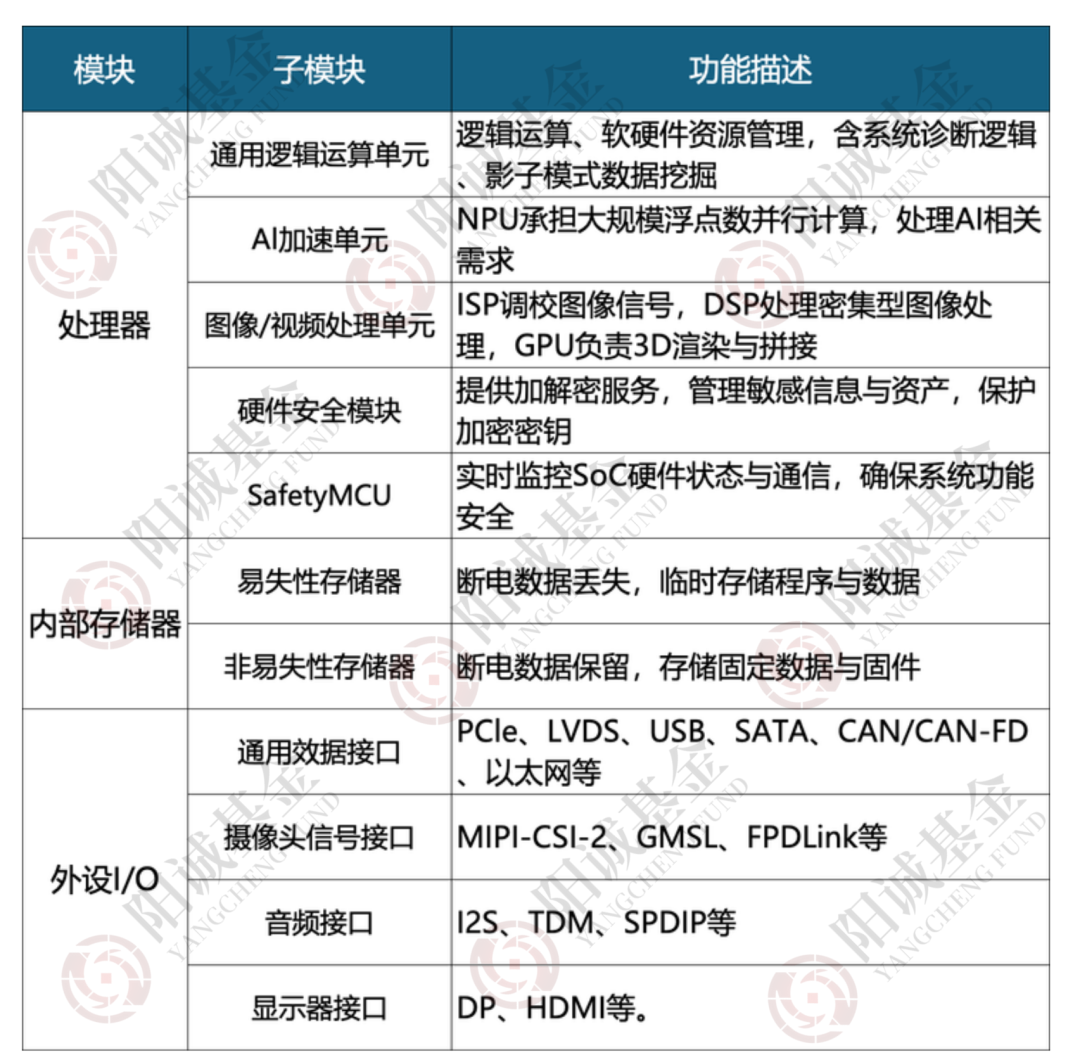
The intelligent driving SoC consists of three main functional modules: processor, memory, and peripheral I/O. The processor module is responsible for executing complex logical operations, AI algorithm processing, real-time control, and image/video data processing tasks; the memory module is used for storing large amounts of data and enabling high-speed data access; the rich interfaces of the peripheral I/O module ensure efficient data transmission and interconnectivity between the in-vehicle SoC chip and external devices.
Source: Everbright Securities, Yangcheng Compilation
Table 1: Components of SoC
3
Comparison of Main Features of MCU and SoC
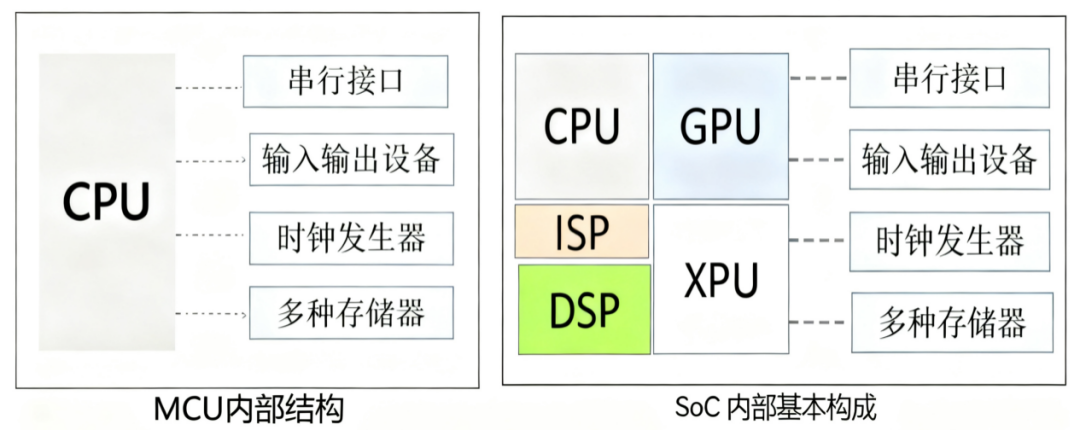
The SoC chip is a system-level chip, a highly integrated semiconductor product that integrates all components required for a complete electronic system into a single chip.This integrated design breaks through the limitations of traditional multi-chip discrete architectures, forming a complete system on a chip that can independently run an operating system and perform complex tasks. The traditional MCU, known as a “microcontroller unit,” is an integrated circuit that includes a processor core (usually a microprocessor), memory (such as flash and RAM), and input/output (I/O) interfaces.
Source: Guoyuan Securities
Figure 2: Comparison of Internal Structures of MCU and SoC
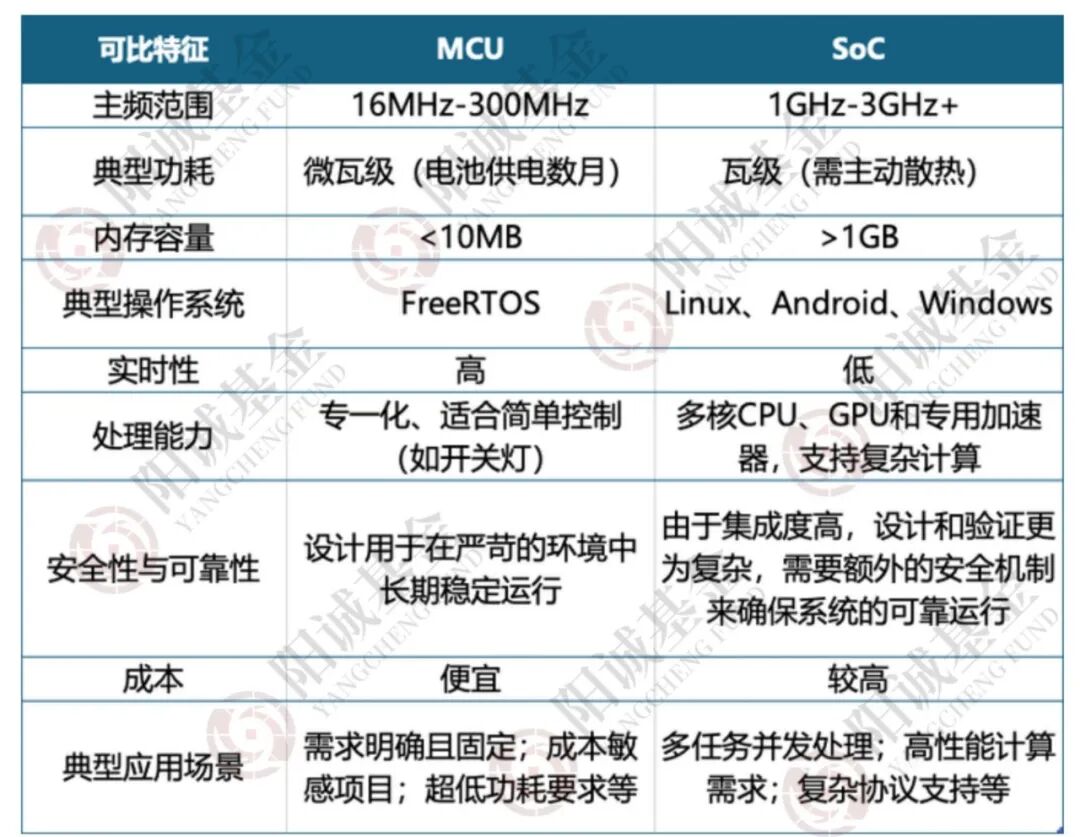
The design concept of SoC is “All in one,” serving as a super platform for system integration, with a more complex structural design and stronger processing and computational capabilities. Its characteristics of high performance, low power consumption, small size, and high reliability make it suitable for multitasking and more complex computational applications, such as advanced driver assistance systems, autonomous driving, and in-vehicle infotainment systems. The design concept of MCU, on the other hand, is “minimalism,” specializing in single-task execution, characterized by a single-core CPU, basic storage units, and necessary peripheral interfaces.
Typically, MCUs are used for real-time tasks and directly control hardware; whereas SoCs run complete operating systems, processing complex algorithms such as image recognition, voice interaction, and autonomous driving.
Therefore, in intelligent driving, SoCs and MCUs often coexist in a collaborative manner. For example, in autonomous driving, the MCU is responsible for executing real-time control and high-reliability tasks such as engine control, steering control, and braking control, while managing in-vehicle communication; the SoC, on the other hand, supports parallel computing and complex algorithms, processing multi-sensor perception data and performing motion control. Due to the high complexity, additional mechanisms are often required to ensure safety. Therefore, it is common for MCUs responsible for safety redundancy to exist in intelligent driving domain controllers.
Source: CSDN, Guoyuan Securities, Yangcheng Compilation
Table 2: Comparison of Main Features of MCU and SoC
4
Applications of Intelligent Driving SoC
(1) Intelligent Driving SoC Embedded in Front View Integrated Machine
The basic L2 level (partial automation) functions are generally implemented by front view integrated machines equipped with low-power SoCs. If the vehicle needs to achieve L2+ and above autonomous driving functions, it requires a domain controller equipped with a medium to high-power SoC.
The front view integrated machine is an intelligent driving integrated device that provides visual perception and decision control, consisting of a camera, SoC, MCU, storage module, power supply module, and interface module. It is used to implement ADAS functions (such as ACC/AEB/LKA, etc.) at L2 and below, generally equipped with low-power SoCs below 10 TOPS. The front view integrated machine captures images of the front using a camera, then utilizes image processing algorithms to preprocess the images (such as denoising, enhancement, etc.), and through feature extraction and recognition algorithms, identifies important information such as road signs, traffic signals, and obstacles, and locates and tracks them. After obtaining environmental information, the front view integrated machine combines the vehicle’s own state information (such as speed, acceleration, etc.) and data from other sensors (such as radar, LiDAR, etc.) to calculate appropriate driving strategies (such as acceleration, deceleration, steering, etc.) to achieve driving assistance functions.
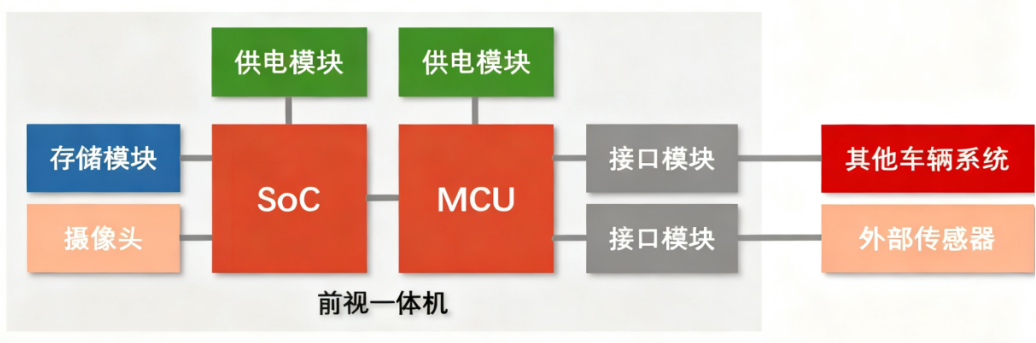
Source: Everbright Securities
Figure 3: Architecture of Front View Integrated Machine
(2) Intelligent Driving SoC Embedded in Domain Controller
Due to the inability of front view integrated machines to meet the computational demands of multi-sensor fusion for intelligent driving, domain controllers have become the mainstream solution for medium to high-power SoCs, aiming to achieve L2+ and above intelligent driving functions (such as highway NOA, urban NOA, etc.). The domain controller is the core computing and control unit for implementing intelligent driving functions in centralized EEA. Compared to front view integrated machines that only process forward visual information, domain controllers are no longer integrated with cameras, allowing them to receive, process, and fuse data from various external sensors, often equipped with more powerful SoCs and built-in complex deep learning AI algorithms to achieve mid to high-level intelligent driving operations.
The structure of the domain controller is relatively complex, mainly including SoC, Safety MCU, storage chips, etc.
1. SoC

Mainly used for camera image processing, running deep learning algorithms, outputting recognition results, performing sensor fusion, and trajectory prediction.
2. Safety MCU

Mainly processes data with high functional safety requirements, performing logical operations, including processing data from radar and other external interfaces, vehicle regulation, communication, etc.
3. Storage Module

Used for data storage, including eMMC, NorFlash, Memory chips, etc.
4. Others

Passive components such as resistors and capacitors, heat dissipation components, sealed metal enclosures, PCBs, interfaces, gateways, power management chips, etc.
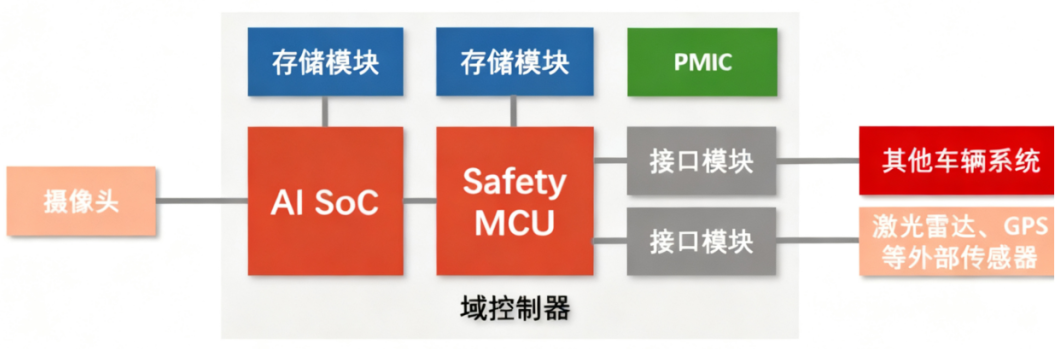
Source: Everbright Securities
Figure 4: Architecture of Domain Controller
5
Market Analysis of Intelligent Driving SoC
(1) Overall Market Analysis
The global automotive-grade SoC market is experiencing explosive growth. According to data from Western Securities, the compound annual growth rate (CAGR) of the global intelligent driving SoC market from 2020 to 2024 is expected to reach 36.2%, achieving nearly fourfold growth in just four years, soaring from 23 billion yuan to 79 billion yuan. This year marks the beginning of the “accelerated explosion period,” with predictions that the global automotive-grade SoC market will exceed 100 billion yuan by 2025, reaching 108.2 billion yuan, and by 2026, the incremental growth will approach 30 billion yuan, expected to reach 138 billion yuan.
The high growth of the global automotive-grade SoC market is driven by a dual logic of technological iteration and demand sinking.
Firstly, the intelligent driving technology is advancing from L2 to L3+, with algorithms evolving from CNN to Transformer + BEV and then to large models on the edge, leading to exponential growth in computational demand.
Secondly, the “equalization of intelligent driving” has become an industry consensus, with car manufacturers like BYD and Geely decentralizing high-level intelligent driving functions to models priced at 100,000 yuan, making mid-power chips a standard configuration for mainstream models, thus expanding the market scale.
Thirdly, the trend of cabin and driving integration is accelerating, with single-chip integration of cabin and intelligent driving functions reducing hardware costs by 20-30%. Cross-domain chips like NVIDIA Thor and Horizon J6 have become the first choice for car manufacturers, opening up new growth spaces.
Fourthly, robotics and intelligent driving chip technologies share a common origin, with technologies from Tesla FSD and Horizon’s Digua robot achieving technology transfer, breaking through the growth ceiling across scenarios.
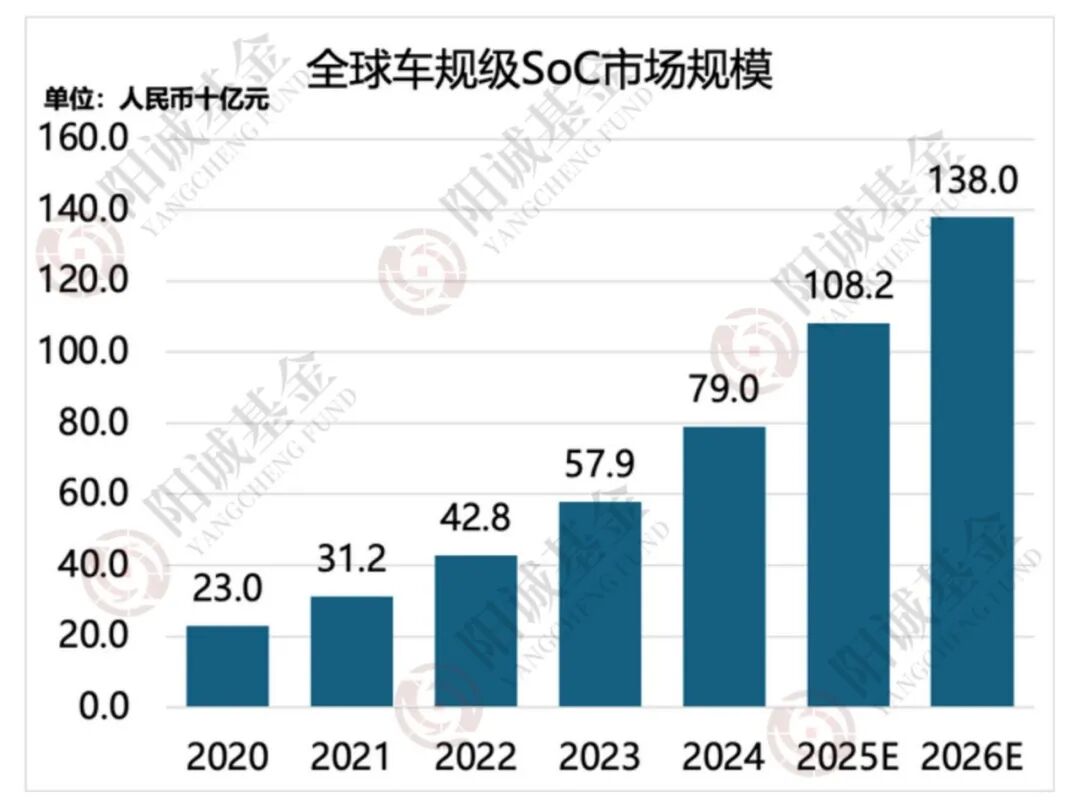
Source: Western Securities, Yangcheng Compilation
Figure 5: Global Automotive-Grade SoC Market Size
(2) China Market Analysis
The scale of the automotive-grade SoC market in China is showing a sustained high-speed growth trend. According to analysis from Western Securities, the scale of China’s automotive-grade SoC market is expected to rise from 8.6 billion yuan in 2020 to 38.1 billion yuan in 2024, with a CAGR of 45.2%, growing faster than the global level. Year by year, the incremental growth continues to expand, with an increase of 4 billion yuan in 2021 compared to 2020, and by 2024, the increment is expected to triple. It is predicted that by 2025, it will exceed 50 billion yuan, and by 2026, the scale of China’s automotive-grade SoC market will approach 70 billion yuan.
The explosive growth of China’s automotive-grade SoC market is the result of the resonance of policy, technology, and ecology.
Firstly, the policy side has deepened the implementation of the “Intelligent Connected Vehicle Technology Roadmap 2.0,” clarifying the goals for intelligent development, and coupled with supply chain security needs, car manufacturers prioritize choosing local suppliers, opening up replacement space for domestic chips.
Secondly, on the technology side, domestic manufacturers have achieved differentiated breakthroughs, with companies like Horizon and Black Sesame adopting ASIC architectures, customized designs for intelligent driving scenarios, achieving energy efficiency 1.2-1.4 times higher than NVIDIA’s GPU route, with significant cost advantages; at the same time, through a “software-first, hardware-backward” collaborative model, they adapt to car manufacturers’ algorithm needs, accelerating mass production.
Thirdly, on the ecological side, a parallel pattern of “third-party chip manufacturers + self-developed car manufacturers” has formed, with third-party manufacturers like Horizon and Black Sesame binding Tier 1 and car manufacturers through open toolchains, while self-developed chip manufacturers like Xiaopeng and NIO focus on high-end scenarios, jointly promoting market scale expansion and technological iteration.
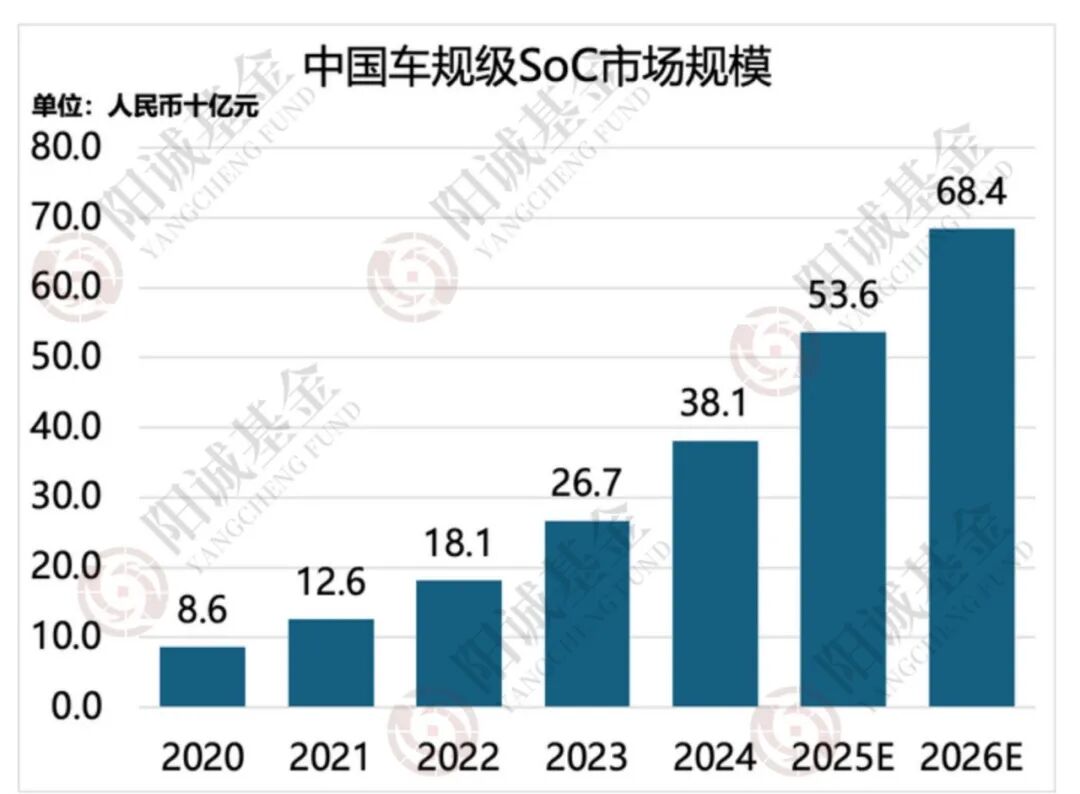
Source: Western Securities, Yangcheng Compilation
Figure 6: Scale of China’s Automotive-Grade SoC Market
6
Industry Chain
(1) Overview of the Industry Chain
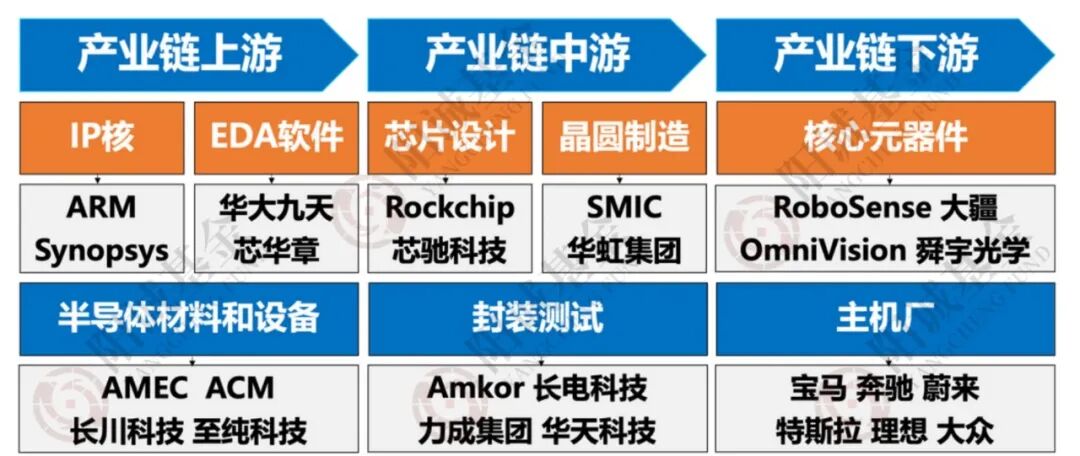
Source: Guoyuan Securities, Yangcheng Compilation
Figure 7: Intelligent Driving SoC Industry Chain
1. Upstream

The upstream of the SoC chip industry chain mainly includes IP core licensing, EDA (Electronic Design Automation) software and other design tool manufacturers, semiconductor materials, and equipment. Among them, IP core licensing and EDA software and other design tool manufacturers empower chip design manufacturers, helping them accelerate the chip development cycle and time to market. Semiconductor materials and equipment manufacturers provide the basic materials and advanced equipment for chip manufacturing, ensuring high efficiency and quality in chip production.
2. Midstream

The midstream of the SoC chip industry includes three main stages: chip design, chip manufacturing, and packaging/testing. Some companies have vertically integrated, covering all stages, while others only participate in one stage. Depending on the stages involved, these semiconductor companies’ business models are generally divided into vertical integration (IDM model), wafer foundry (Foundry model), and fabless (Fabless model).
3. Downstream

Tier 1 and car manufacturers belong to the downstream of chip design companies. In the past industry chain model, the entire supply chain was linear, with chip design companies as Tier 2, having close contact and cooperation with Tier 1, and little interaction with car manufacturers. However, now many car manufacturers actively seek communication and cooperation with leading chip companies to jointly research user needs and customize chips suitable for their own needs. This cooperation model benefits both the competitiveness of car manufacturers’ products and ensures the stability of chip supply.
(2) Related Enterprises in the Industry Chain
1. Zhongwei Company (688012.SH)

A leading domestic semiconductor equipment manufacturer, with etching equipment covering 5nm and more advanced processes, and MOCVD equipment holding the largest global market share, with clients including TSMC and SMIC. In 2024, revenue is expected to reach 9.065 billion yuan, with new orders exceeding 11 billion yuan, breaking the overseas monopoly.
2. SMIC (688981.SH)

The largest and most advanced wafer foundry in mainland China, with a global market share of over 20% for mature processes of 28nm and above. Revenue is expected to exceed 100 billion yuan in 2025, with a global share expected to reach 10%, serving as a core support for domestic chip independence.
3. Weir Shares (603501.SH)

The third largest CIS manufacturer globally, with the largest market share in automotive CIS, core products such as the OV50 series supplied to Huawei and Tesla. In 2024, CIS revenue is expected to reach 19.11 billion yuan, covering multiple scenarios such as mobile phones and automobiles, with over 4,600 patents.
7
Development Prospects and Challenges
The development prospects of intelligent driving SoC are very broad, entering a golden period of accelerated growth. Policy support and supply chain security needs have opened up replacement space for domestic chips, with local manufacturers rapidly rising through technological breakthroughs and collaborative hardware-software models, accelerating the process of localization. As intelligent driving evolves from lower levels to higher levels, and intelligent driving functions are decentralized to more price-competitive models, the market demand for high computational power and high integration chips will continue to expand. At the same time, the trend of cabin-driving integration and cross-scenario technology migration further expands the application boundaries of intelligent driving SoC, bringing new growth opportunities to the industry.
However, the development of intelligent driving SoC still faces multiple challenges. On the technical level, the complexity of chip design and verification is extremely high, requiring a balance of high performance, low power consumption, and high reliability, while meeting stringent functional safety requirements, which poses a high threshold for R&D capabilities. In terms of market competition, there are both international giants with technological and ecological advantages and fierce competition among domestic manufacturers, requiring companies to form core competitiveness in technological differentiation, cost control, and mass production capabilities. Additionally, the difficulty of industry chain collaboration is significant, as the adaptation and collaboration efficiency of various links from upstream IP licensing and equipment supply to downstream car manufacturers’ customization needs directly affect the commercialization process of chips.
References
[Guoyuan Securities] Intelligent vehicles lead evolution, SOC chips accelerate localization
[Open Source Securities] Intelligent driving solution leader, hardware-software collaboration builds core competitiveness
[Western Securities] Intelligent driving is on the rise, domestic intelligent driving SoC chip suppliers are about to break through
[Huibo Information] In-depth analysis of the intelligent driving SoC chip industry: market space, competitive landscape, industry chain, and related companies
[Intelligent Vehicle Expert] In-depth report on the intelligent driving SoC industry, automotive architecture transitioning from centralized to distributed
Disclaimer:
1. This article is published for the purpose of investor education and communication, and does not constitute any investment advice. Investors operate at their own risk based on this.
2. This public account’s original articles are prohibited from being reproduced without authorization, and legal rights will be pursued.
3. Non-original articles of this public account are owned by the original authors, and this public account publishes them for the purpose of disseminating information. If there is any infringement, please contact for deletion.
Yangguang Selection Integrity and Win-Win
Guangdong Yangcheng Venture Capital Co., Ltd., private equity and venture capital fund manager (registration number: P1073504), is a professional equity and venture capital management brand under Yangcheng Holdings. Yangcheng Venture Capital is headquartered in Guangzhou, Guangdong Province, focusing on equity investment in industries such as new energy, semiconductors, high-end manufacturing, and biomedicine.
Zhuhai Hengqin Yangcheng Holdings Co., Ltd. (referred to as “Yangcheng Holdings”) was established in November 2016, originally named Zhuhai Hengqin Yangcheng Fund Management Co., Ltd., and was previously registered with the Asset Management Association of China as another private investment fund manager (original registration number: P1061568), having historically issued a series of excellent management and well-regulated private fund products.
Adhering to the core values of “Yangguang Selection, Integrity and Win-Win,” the Yangcheng team has deepened its roots in the Guangdong-Hong Kong-Macao Greater Bay Area, leveraging over ten years of professional asset investment management experience, strictly controlling risks, operating in compliance, supporting the real economy, continuously investing in quality projects, and becoming a trusted asset management brand for investors.
Click “Looking” before you go~