Recently,
we have been testing a project,
which included a special requirement: to detect whether materials on the PCB are missing..
Due to budget constraints, we initially opted for a 2D camera solution.
By capturing images of the PCB surface, analyzing the imaging changes, and using specific algorithms to complete the detection.
However, during batch testing, we found that this solution exposed several issues:
- Poor imaging stability, making it difficult to ensure detection accuracy;
- Complex debugging of 2D algorithms, requiring more manpower costs;
- Overall, the entire setup of a 2D camera with a light source is also not cheap, resulting in low cost-effectiveness.
Upon reevaluating the solution, we recalled the 3D profiler from Deep Vision Technology that we had used in previous mobile phone testing projects, which performed well.
Additionally, many fans and friends recommended their point laser displacement sensors,
so we took this opportunity to conduct an in-depth test of Deep Vision Technology’s laser displacement sensors and share our findings with everyone.
After comprehensive comparison, we ultimately chose the Deep Vision Technology SD-C series laser displacement sensor, model SD-C100.
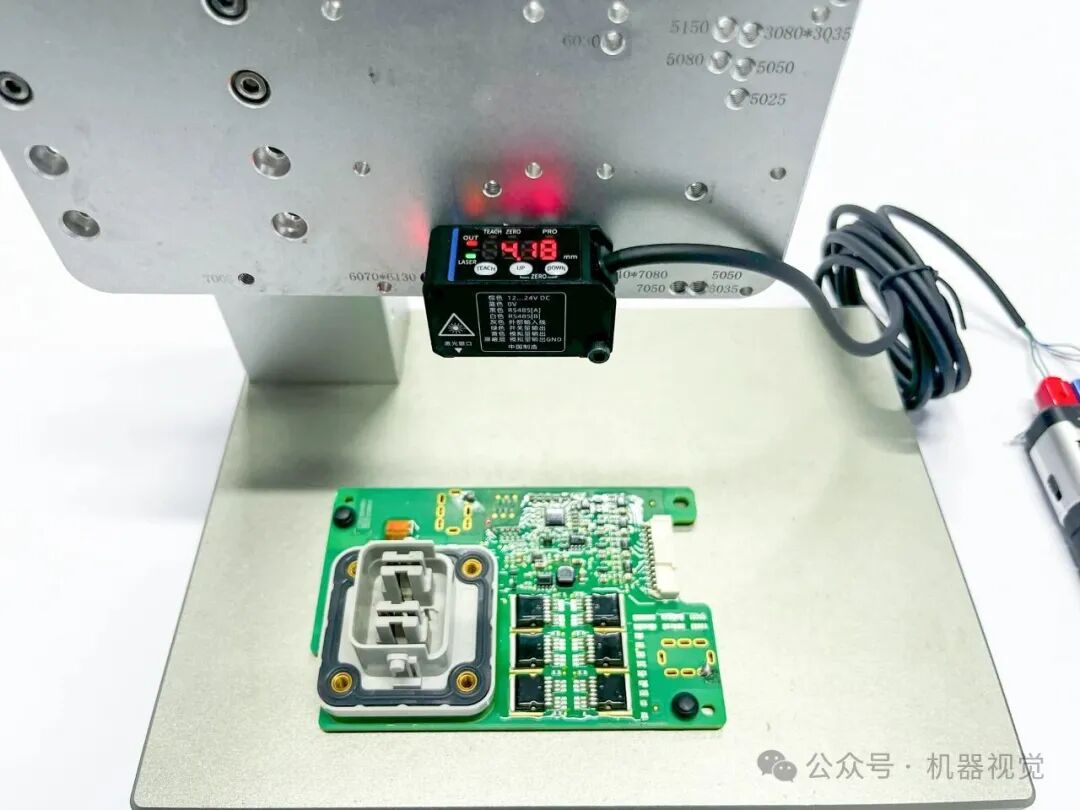
The above image shows the test results of the laser displacement sensing scheme.
However, at the beginning of the project, we faced a challenge:
With numerous parameters and brands for laser displacement sensors, how do we select and compare them?
We only knew that we needed to meet the detection requirements of the project, but we were clueless about the deeper details.
We suspect that most people who have not been exposed to or are just starting to use laser displacement sensors would likely feel confused by these parameters.
Today, we will share some insights on selecting laser displacement sensors based on our practical testing experience, hoping to help everyone.
01
First, let’s briefly introduce the working principle of laser displacement sensors.
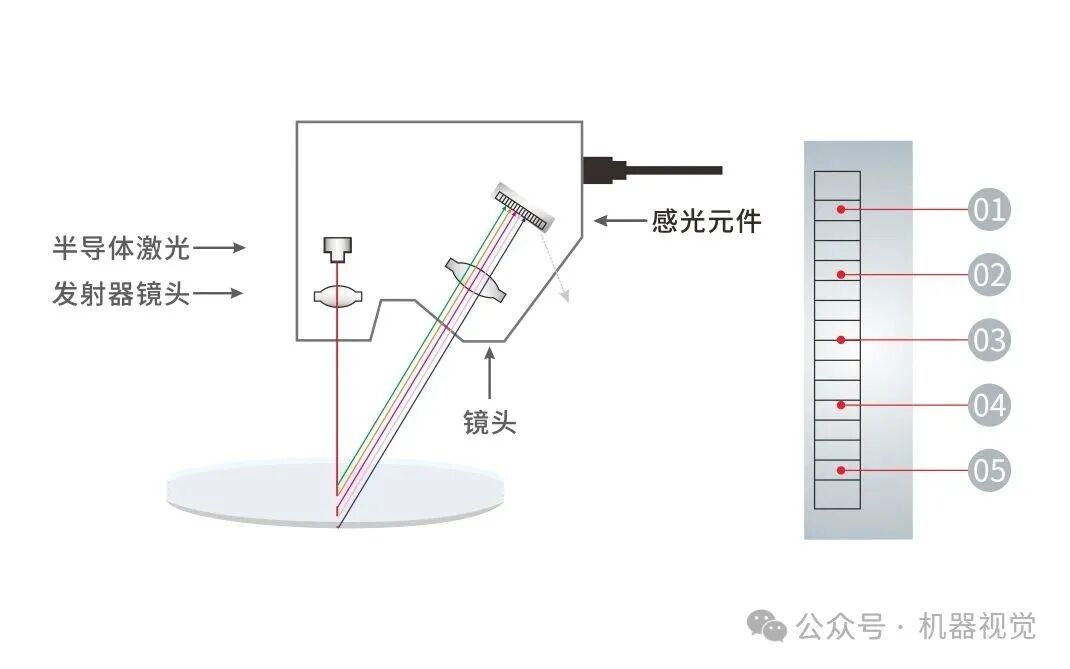
The measurement principle is based on triangulation:
The position of the light spot on the photosensitive element changes with the distance of the target object, and the system estimates this change to convert it into a measurement result of the target object’s position, as illustrated in the following diagram.
In terms of optical systems,
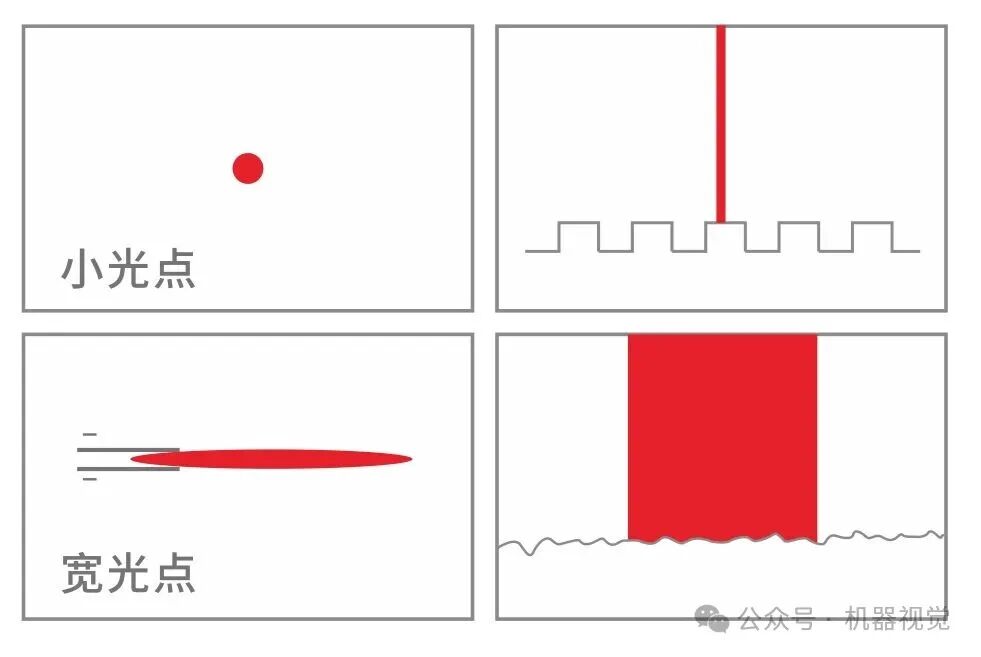
common laser displacement sensors have two types of light spot diameter schemes:
small light spot type and wide light spot type, which are suitable for different measurement scenarios.
Typically, the small light spot type is suitable for capturing subtle height changes of objects, allowing for precise measurement of the object’s surface profile; the wide light spot type is suitable for surfaces that are rough and irregular, smoothing out data fluctuations caused by surface roughness to ensure measurement data stability.
This is quite understandable; you can refer to the following diagram to appreciate the differences in application scenarios between the two types.
Next, let’s focus on the core parameters to consider during selection.
02
Initially, we only focused on repeatability and measurement range, but after further understanding, we found that these are just basic requirements.
An excellent laser displacement sensor should be evaluated based on the following core factors, which are the key points we want to share today.
1. Full stroke error guarantee
A good sensor should maintain measurement accuracy error stability within the specified measurement range.
This should ideally be verified through actual testing to ensure the accuracy of subsequent measurements.
As we know, laser displacement sensors are based on triangulation principles; the smaller the measurement distance, the higher the detection accuracy. Therefore, when selecting, choose a range that matches your detection needs, rather than opting for a larger range unnecessarily.
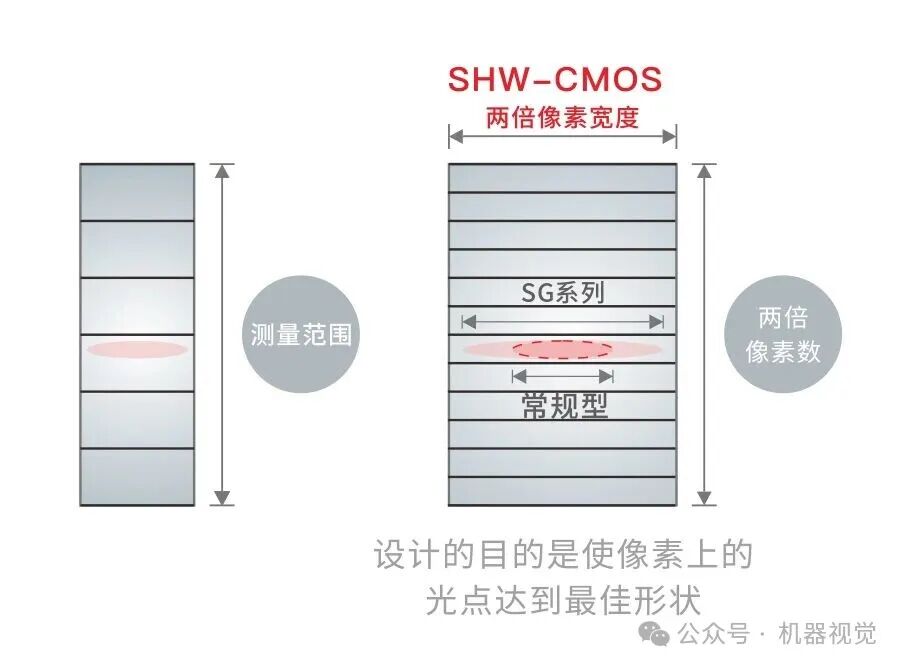
The Deep Vision Technology SD-C series laser displacement sensors achieve precise measurement across the entire stroke range by optimizing optical design and increasing the number of CMOS pixels and pixel width. It is recommended to prioritize products that clearly indicate full stroke error and provide actual measurement data during selection.
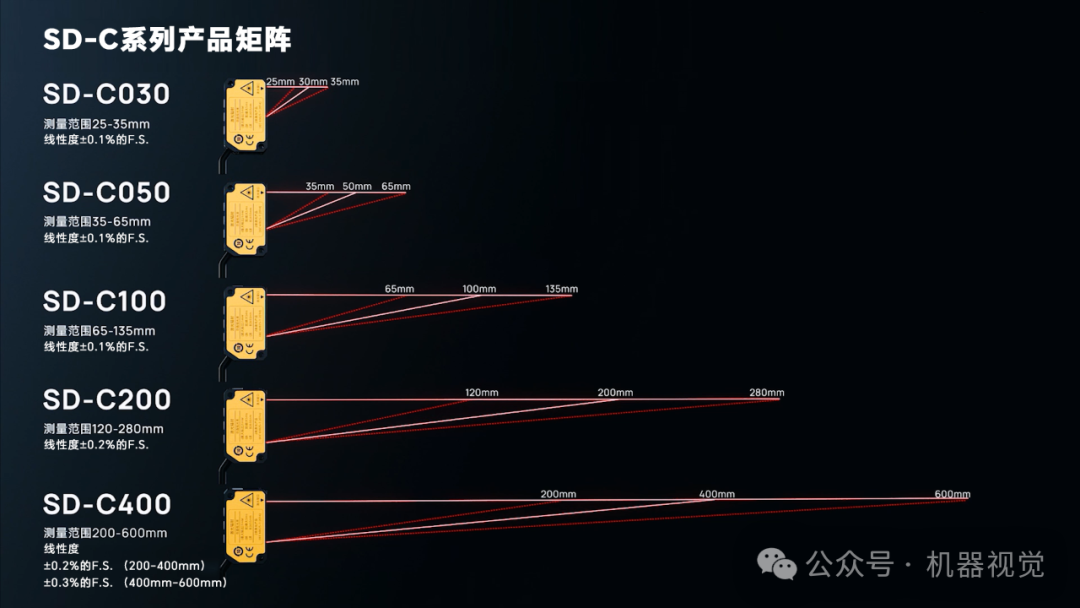
Sometimes, the high precision of a product is a systemic issue, established from the design stage.
2. Electromagnetic interference (EMC) resistance
Those engaged in industrial testing know well the challenges posed by electromagnetic interference.
To determine whether a sensor has electromagnetic interference resistance, a reliable criterion is whether the product has undergone EMC-A testing before shipment and whether it supports CE and RoHS certifications.
Generally, exported electronic devices will support these certifications, which are crucial for ensuring that sensors can operate stably for extended periods in complex industrial environments with high temperatures, strong magnetic interference, and dust, while ensuring the accuracy and consistency of detection results.
The Deep Vision Technology SD-C series laser displacement sensors have EMC, CE, and RoHS certifications and can operate stably near motors and inverters, with accompanying high-flex shielding cables further enhancing anti-interference performance.
3. Strong material compatibility
The material compatibility of sensors mainly reflects in optical performance, especially for some extreme materials, such as highly reflective glossy surfaces, weakly reflective rough surfaces, and dark light-absorbing materials.
The most severe situation of incompatibility is when the sensor cannot read values normally; a more common issue is that under the same conditions, there are differences in measurements for different materials (this difference is inevitable and will decrease as the sensor’s material adaptability improves).
The Deep Vision Technology SD-C series displacement sensors have shown stable performance when testing various bottle cap materials, eliminating the need for repeated calibration due to material changes.
4. Temperature drift
Temperature drift is a key parameter affecting the long-term stability of sensors.
The fundamental reason for its occurrence is that at different temperatures, different structural components within the sensor undergo relative deformation, and the electrical performance of various electronic components may also vary, which collectively leads to performance shifts in the sensor during temperature changes, commonly manifested as increased non-linearity after temperature rises or different values when measuring the same position at different temperatures.
To address this issue, the Deep Vision Technology SD-C series displacement sensors utilize internal algorithms for temperature compensation, providing reliable output even in high-temperature environments of 80°C.
5. Communication interaction
Whether the sensor supports multiple output methods is also important, including RS-485 communication, IO switch output, and analog current/voltage output.This allows the sensor to quickly match and connect with various control systems and logic circuits, adapting to different industrial environments and meeting diverse measurement needs.
The Deep Vision Technology SD-C series sensors provide RS-485, IO switch, and analog output methods, allowing flexible integration with PLCs, industrial computers, and other systems, which is a crucial prerequisite for the successful integration of our project.
That concludes today’s sharing.
03
When we were selecting products, we noticed that the laser displacement sensor market was previously dominated by imported brands.
However, in recent years, domestic technology has advanced rapidly, with companies like Deep Vision Technology not only matching international brands in performance but also demonstrating significant advantages in localization services and supply chains:
- Diverse product lines covering various scenarios: from high-speed and high-precision (SG series sampling frequency over 590kHz) to compact large range (such as SD-C series) to meet various needs;
- Core components are domestically sourced, ensuring a more stable supply chain, shorter delivery cycles, and no tariff costs;
- Local service with timely responses: technical issues are generally resolved on the same day, making it particularly suitable for continuous production manufacturing environments.
In summary, Deep Vision Technology not only has robust technology and stable products but also provides a more reliable and efficient domestic alternative due to its deep understanding of domestic industrial scenarios.
When selecting sensors, it is essential to consider not only the parameters but also their performance in real scenarios and the manufacturer’s service support capabilities. Deep Vision Technology, as an excellent domestic brand, has indeed surprised us this time.
Having been in this industry for a long time, when I encounter useful products and reliable solutions, I always want to share them to provide everyone with more references.
Copyright Statement
Material sourced from Deep Vision Technology’s official website/product catalog and other public materials. If there is any infringement, please contact the author.
Deep Vision Technology Official Website: www.cnsszn.com