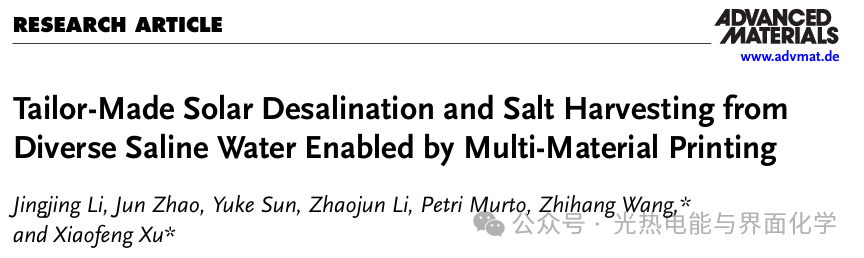
 【Results Overview & Research Background】 The shortage of freshwater resources is a global challenge, and traditional seawater desalination technologies generally face issues such as high energy consumption and complex maintenance. Although solar interfacial evaporation technology has low carbon advantages, existing materials like aerogels and hydrogels are limited by their isotropic structures, making it difficult to optimize performance and multifunctional integration. The team led by Xu Xiaofeng and Wang Zhihang from Ocean University of China proposed amulti-material 3D printing strategy, achieving the controllable preparation of gradient aerogel matrices (AM) for the first time by precisely depositing photothermal inks in space. This technology achievedan evaporation rate of 17.9 kg·m⁻²·h⁻¹ in seawater with 3.5% salinity (at a wind speed of 2 m/s), which is 10.5% higher than in freshwater environments, and maintained an evaporation rate of 6.6 kg·m⁻²·h⁻¹ even in 25% ultra-high salinity brine. The key breakthrough lies in: regulating the anti-polyelectrolyte effect and gradient pore structure (porosity 73.4%-81.6%) through zwitterionic polymers, simultaneously solving the problem of salt crystallization blockage and achieving stable outdoor operation for 30 days.【Innovations & Visual Summary】Innovations:
- First multi-material gradient printing process with three nozzles synchronously depositing inks with different zwitterionic content (0/2/5/8 wt.%), achieving the integration of component-structure-function heterogeneity
- Bidirectional water transport synergistic mechanism where capillarity (AM-2 unit with 127μm large pores) and swelling diffusion (AM-8 unit with 11μm small pores) synergistically enhance water flux in high salinity environments
- Ion crosslinking enhances evaporation Co²⁺/Cu²⁺ crosslinked aerogels reduce evaporation enthalpy, allowing seawater evaporation rates to surpass those of freshwater (an increase of 11.5%)
- Salt crystallization spatial regulation technology with gradient arrangements of AM-0/AM-2/AM-5 achieving directional crystallization, with a salt recovery rate of 269.3 g·m⁻²·h⁻¹ in 20% brine
- Verification of applicability in all scenarios covering a salinity range of 3.5-25%, with an average daily water production of 52.1 kg/m² in outdoor tests over 30 days on the coast of Qingdao
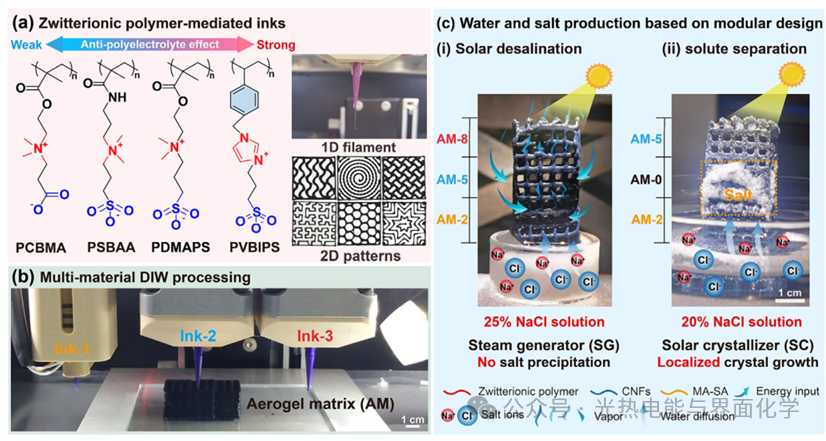
Figure 1: a) Principle of multi-material direct writing; b) Schematic design of gradient photothermal matrix; c) Application scenarios for solar desalination and crystallization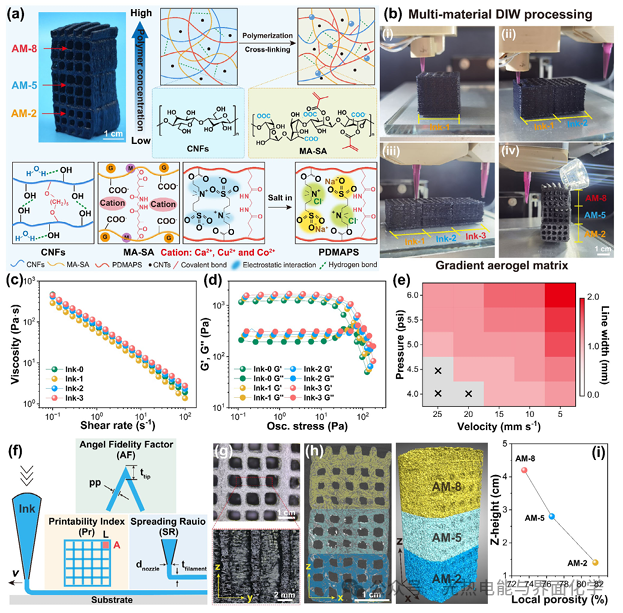
Figure 2: a) Material composition and crosslinking reactions; b) Multi-material printing process; c-f) Characterization of ink rheological properties and printing accuracy; g-i) Macroscopic morphology of aerogel units and micro-CT three-dimensional reconstruction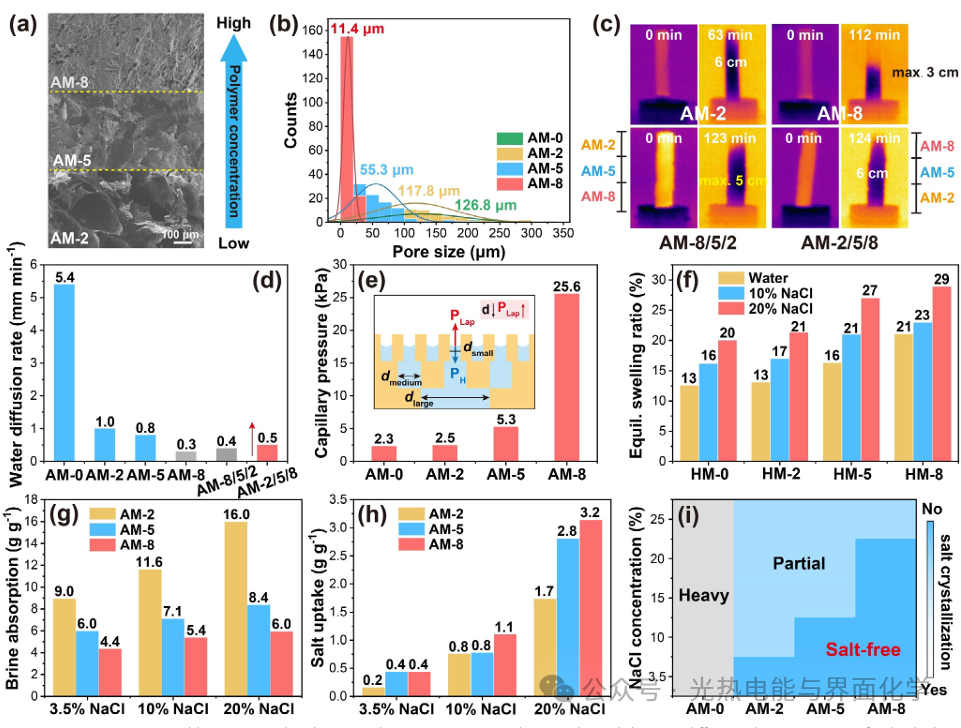
Figure 3: a) SEM images of aerogel units; b) Pore size distribution; c-d) Water diffusion infrared tracing; e) Capillary pressure simulation; f-h) Swelling behavior and salt adsorption performance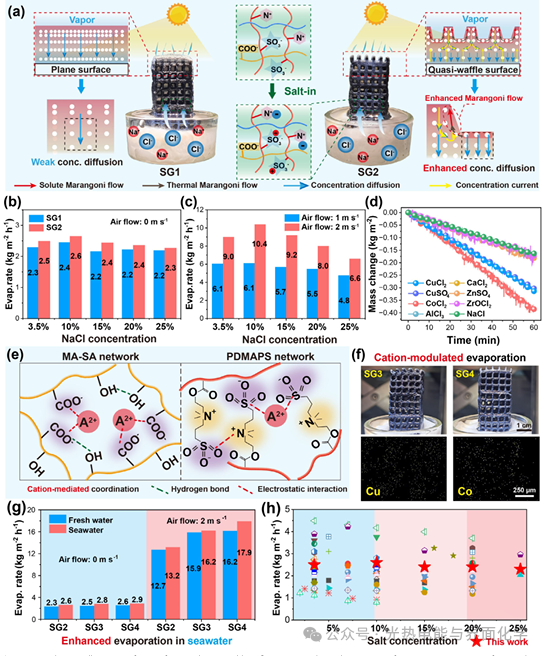
Figure 4: a) Evaporator surface design; b-c) Evaporation performance at different salinities; d) Comparison of evaporation in cationic solutions; e-g) Cationic crosslinking mechanism and elemental distribution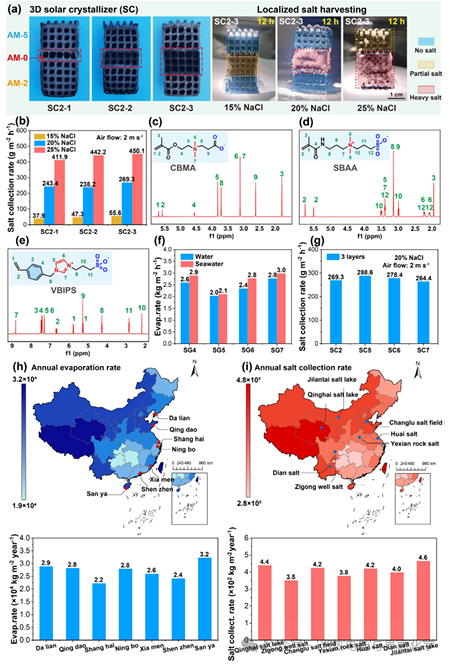
Figure 5:Figure 5: a) Design of solar crystallizer; b) Salt recovery performance; c-e) NMR spectra of zwitterionic monomers; f-g) Evaporation/crystallization performance of multifunctional materials; h-i) Assessment of application potential in coastal areas of China (annual water production of 2.2-3.2×10⁴kg/m²)
【Conclusion & Original Link】
This study achieved, for the first time, the simultaneous high-efficiency solar seawater desalination and salt crystallization recovery using a single gradient aerogel matrix through innovative multi-material 3D printing technology. The key breakthroughs include: the anti-polyelectrolyte effect of zwitterionic polymers (DMAPS/CBMA/SBAA/VBIPS) suppressing salt crystallization, while cationic crosslinking (Co²⁺/Cu²⁺) reduces evaporation enthalpy, allowing seawater evaporation rates to exceed those of freshwater by 10.5%; the unique gradient design of AM-2/AM-0/AM-5 achieving spatial directional crystallization recovery of salts. This technology covers a salinity range of 3.5-25%, maintaining an evaporation rate of 6.6 kg/m²·h in 25% ultra-high salinity brine, and achieving a salt recovery efficiency of 269.3 g/m²·h, providing a new solution for the coordinated development of water-energy-resources in coastal and inland salt lake areas.
Original Link: https://doi.org/10.1002/adma.202517244
Disclaimer: The above content reflects only the author’s personal views. Given the author’s limited knowledge, if there are any inaccuracies, please leave a message for correction!
We warmly welcome colleagues in academia to share or submit information, research results, and articles related to the utilization of light-thermal-electric energy and interfacial chemistry, working together to promote the prosperity of the field: [email protected] (same number for promotional cooperation)