In today’s rapidly developing industrial Internet of Things (IoT), fire monitoring systems in factories are facing dual challenges of network performance and intelligent demands. Traditional monitoring systems often experience high latency, insufficient signal coverage, and poor scalability in high-concurrency scenarios, making it difficult to meet the complex requirements of modern industrial environments. This article will share an optimization plan for an all-scenario IoT fire monitoring system, detailing how to achieve comprehensive improvements in network performance and security through intelligent networking technology.
1. Project Background and Requirements
The fire monitoring system in industrial settings needs to collect and analyze environmental parameters such as temperature, smoke, and combustible gases in real-time, while ensuring rapid linkage of firefighting equipment in emergencies. However, the system often faces the following pain points in practical applications:
High network latency: Large delays in multi-point data transmission affect real-time monitoring and emergency response.
Insufficient signal coverage: Complex workshop layouts lead to wireless signal blind spots, affecting the stability of device linkage.
Limited scalability: As the number of devices increases, traditional network architectures are prone to bottlenecks.
To address these issues, the project adopted intelligent networking technology to construct a fire monitoring network that covers all scenarios.
2. System Optimization Plan
1. System Architecture
The optimized system architecture consists of a perception layer, network layer, platform layer, and application layer, with each layer achieving efficient data transmission and processing through a new intelligent network:
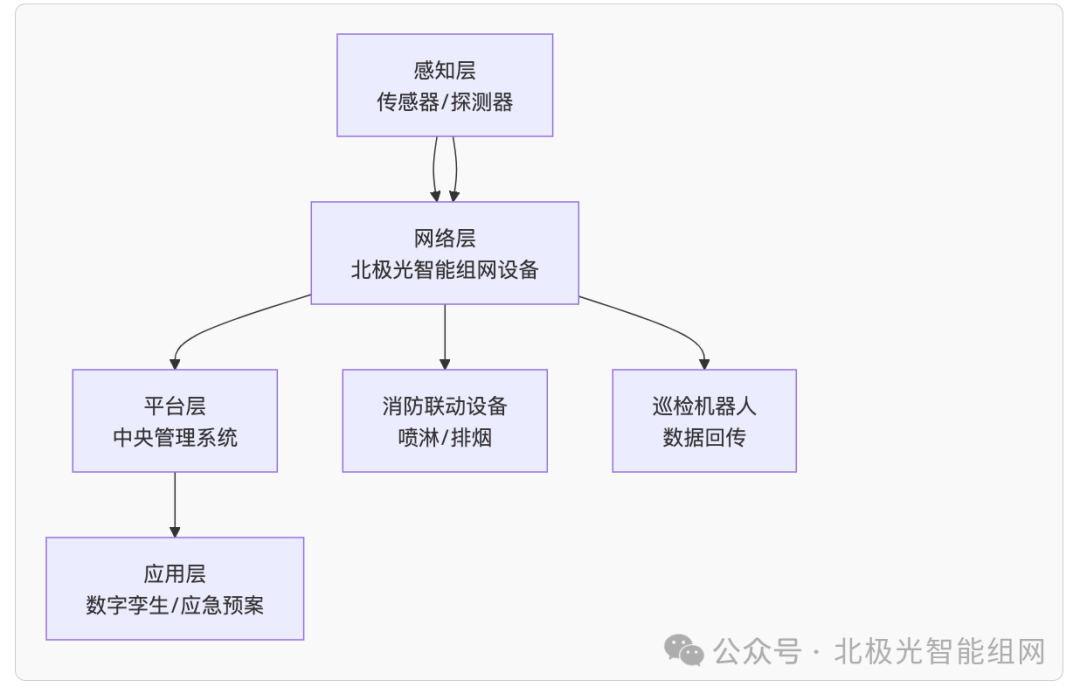
Perception Layer: Deploy temperature sensors, smoke detectors, and other devices to collect environmental parameters in real-time.
Network Layer: Utilize low-latency, high-bandwidth intelligent networking devices to achieve rapid data transmission and efficient interconnection of multiple devices.
Platform Layer: Use a central management platform for data storage and analysis, linking with the firefighting system.
Application Layer: Provide functions such as digital twin and emergency plan simulation to enhance fire incident handling efficiency.
2. Core Technical Highlights
Low latency and high bandwidth: Supports high-speed WiFi6 and 5G networks, ensuring real-time uploading of sensor data.
Distributed networking: Flexibly configure network nodes based on workshop layout to eliminate signal blind spots.
Network redundancy design: Dual-mode modules support automatic network switching, ensuring stable system operation.
3. Application Scenarios of Intelligent Networking Technology
This project introduced intelligent networking devices at the network layer, supporting dual-band communication of 5G and WiFi6, minimizing data transmission latency. In complex industrial workshops, this device achieved full-area signal coverage through a distributed networking model, meeting the needs for multi-point data collection and real-time linkage. Additionally, its high access capacity supports stable connections for up to 128 devices, providing strong support for system expansion.
4. Implementation Results
The optimized fire monitoring system has performed excellently in practical applications:
Improved monitoring efficiency: Data transmission latency reduced to under 8ms, with a 30% increase in early warning speed.
Optimized network coverage: Workshop signal blind spots completely eliminated, ensuring the stability of device linkage.
Enhanced scalability: No significant decline in network performance during system expansion, supporting future device access needs.
5. Conclusion
By introducing intelligent networking technology, the fire monitoring system has achieved comprehensive improvements in performance, scalability, and stability. In the future, combined with AI analysis and digital twin technology, this solution will further enhance the safety and prevention capabilities in industrial scenarios, providing a solid foundation for the construction of smart factories. Industrial intelligence starts with a stable and efficient network!