In mining operations, after each blasting operation, there lurks an invisible killer—blast fumes (primarily composed of nitrogen dioxide). The mining nitrogen dioxide sensor is a key device that protects miners’ breathing safety.
During the mining process, blasting operations generate a large amount of nitrogen oxides, among which nitrogen dioxide (NO₂) is one of the most toxic gases. Research shows that when the concentration of nitrogen dioxide in the air reaches 0.12%, inhaling it for several hours can lead to pulmonary edema; when the concentration rises to 0.25%, it can cause death in a short time. The mining nitrogen dioxide sensor, as a specialized “electronic sentinel” for monitoring this harmful gas, is always guarding the first line of defense for safe mining operations.
Core Technical Principles of Nitrogen Dioxide Sensors
The mining nitrogen dioxide sensor mainly adopts the electrochemical detection principle, converting gas concentration into electrical signals through high-precision sensor components. When nitrogen dioxide gas diffuses through the sensor membrane, oxidation or reduction reactions occur on the sensing electrode, generating a current signal proportional to the gas concentration. This signal is processed by an analog-to-digital converter and a microcontroller, driving a digital display to show the corresponding values, achieving real-time monitoring and over-limit alarm functions.
Technological Innovation: Breakthrough from Fixed Monitoring to Mobile Deployment
Traditional nitrogen dioxide sensors often use fixed installation methods, leading to monitoring blind spots. The latest technological breakthrough is an innovative solution of digitalization and mobile deployment. An innovative digital toxic and harmful gas sensor for metal mines creatively combines the nitrogen dioxide detection module with a flying module, allowing remote control of the aircraft’s movement to achieve mobile monitoring of the sensor in the mine.
This design overcomes the limitations of traditional fixed sensors, achieving a comprehensive coverage monitoring network. A single mobile sensor can replace multiple fixed monitoring points, cycling through different areas of the mine as needed, significantly reducing equipment investment costs. At the same time, this design avoids the risk of personnel directly entering toxic environments to deploy sensors, greatly enhancing safety and work efficiency.
Key Performance Characteristics of Mining Nitrogen Dioxide Sensors
High Precision Monitoring Capability
Modern nitrogen dioxide sensors utilize advanced electrochemical sensing technology, with extremely high sensitivity, capable of detecting changes in nitrogen dioxide concentration at the parts per million (ppm) level. For example, the NO2-B1 sensor from Alphasense can accurately capture NO2 changes at very low concentrations, providing reliable data support for early warning.
Strong Environmental Adaptability
The mining nitrogen dioxide sensor is designed for harsh underground environments, typically featuring an IP54 or higher protection rating, capable of resisting corrosive environments with high humidity and dust. The casing is designed to be waterproof and dustproof, ensuring stable operation under complex conditions. Some high-end products also adopt intrinsically safe explosion-proof design (explosion-proof mark ExibI), allowing safe use in environments with risks of gas and coal dust explosions.
Multiple Alarm Functions
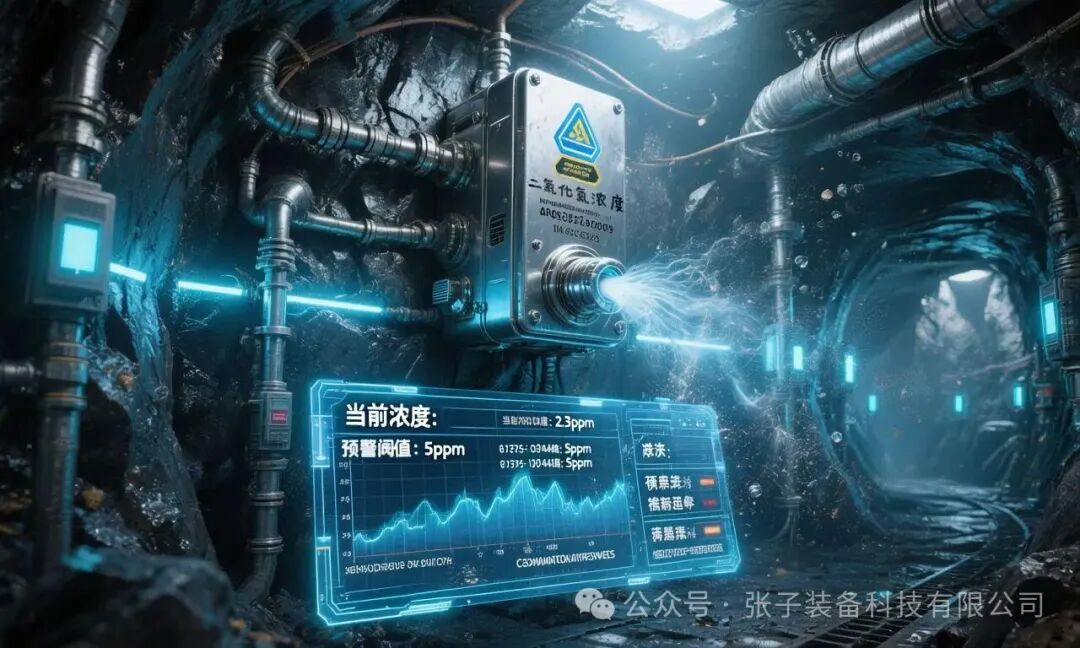
When the nitrogen dioxide concentration exceeds the preset safety threshold (usually 3-5ppm), the sensor immediately triggers a sound and light alarm system. The alarm sound level intensity is no less than 75dB at a distance of 1 meter, and the light signal is clearly visible at a distance of 20 meters in dark environments, ensuring that underground workers can timely perceive danger.
Intelligent Self-Diagnosis and Remote Transmission
The new type of sensor has a self-diagnosis function, capable of real-time monitoring its working status and indicating maintenance needs. It supports various output methods such as RS485 communication, frequency signals, and current signals, with a maximum transmission distance of up to 2 kilometers, seamlessly integrating into the mine safety monitoring system.
Key Applications in Mining Safety Production
In ventilation monitoring after blasting operations, nitrogen dioxide sensors play a crucial role. After blasting, the sensors can monitor the concentration of nitrogen dioxide in the blast fumes in real-time, providing scientific basis for determining the safe entry timing, avoiding poisoning accidents from blast fumes.
In goaf and enclosed areas, nitrogen dioxide sensors can monitor the accumulation of harmful gases. Through real-time data transmission, surface personnel can remotely grasp the underground environmental conditions and timely adjust the ventilation system to ensure operational safety.
In emergency rescue scenarios, portable nitrogen dioxide detectors become a “lifesaving device” for rescuers. Rescuers can use the detection results to assess the gas environment in disaster areas and choose appropriate respiratory protective equipment, ensuring the safety of rescue operations.
It is worth mentioning that some advanced sensors also integrate a camera module, which can visualize the surrounding environment, further enhancing the comprehensiveness and reliability of safety monitoring.
Usage and Maintenance: Ensuring Sensor Reliability
To ensure the accuracy of nitrogen dioxide sensors, it is necessary to calibrate them once a week, using standard gas samples to adjust the zero point and sensitivity. Additionally, the sensor gas chamber should be regularly cleaned to prevent dust blockage from affecting detection accuracy.
The installation position is also crucial. The sensor should be installed at a position no more than 300mm from the tunnel ceiling and at least 200mm from the side walls, avoiding areas with excessive wind speed, ensuring smooth airflow through the sensor gas chamber.
Future Outlook: Intelligent and Multifunctional Integration
With the advancement of intelligent construction in mines, nitrogen dioxide sensors are developing towards multifunctional integration and intelligence. Future sensors will not only detect nitrogen dioxide but also monitor multiple harmful gases such as carbon monoxide and hydrogen sulfide, building a comprehensive gas monitoring system.
The application of wireless transmission technology makes sensor deployment more flexible. Smart sensors based on IoT platforms can achieve real-time cloud synchronization of data, allowing managers to monitor underground gas environments anytime through mobile apps, realizing true remote monitoring and intelligent early warning.
Deep in the mine, nitrogen dioxide sensors act as faithful “electronic sentinels”, vigilantly guarding the safety of miners’ lives. With technological advancements, these sensors will become more precise and intelligent, ensuring safe production in mines.