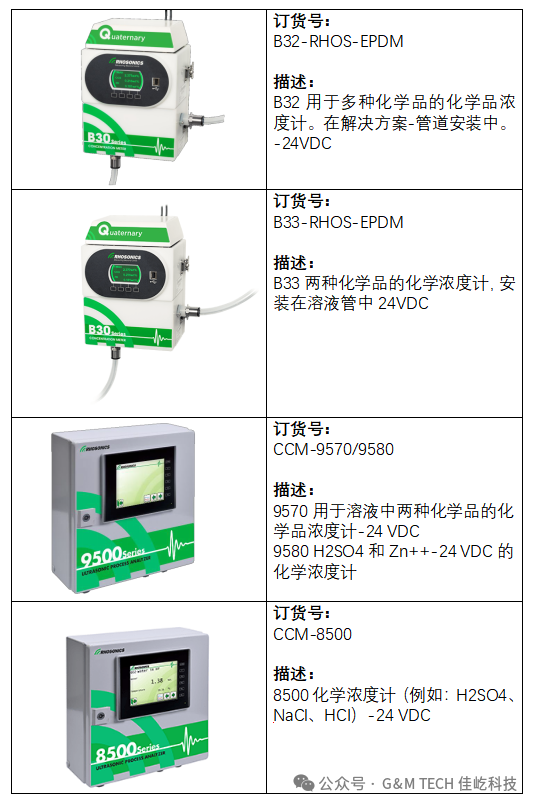
Ultrasonic sensors offer multiple advantages in industrial concentration measurement, making them an important analytical tool, especially in scenarios requiring non-invasive and real-time monitoring. These advantages are primarily reflected in measurement principles, applicability, and contributions to process control.
1
Non-Invasive Measurement
Ultrasonic sensors measure by the propagation of sound waves without direct contact with the liquid being measured (Puttmer et al., 2017)[1] (Henning et al., 2000)[2]. This non-contact measurement method avoids damage to the sensor from corrosive or hazardous liquids, extending the sensor’s lifespan and reducing maintenance costs. This characteristic is particularly important in industries such as chemicals and food, where it is often necessary to measure the concentration of corrosive or contaminating liquids (Huang & Tao, 2011)[3]. The use of ultrasonic sensors for level control does not require contact with the liquid surface or volume, leading to increasing applications in industry (Reyna et al., 2025)[4].
2
High Precision Measurement
The speed of sound and attenuation characteristics in different media are closely related to the physical parameters such as density, viscosity, and compressibility of the medium, which in turn are related to the concentration of the liquid (Bowler & Watson, 2021)[5] (Palmero et al., 2021)[6] (Kobayashi et al., 2006)[7]. By accurately measuring acoustic parameters such as sound speed, acoustic impedance, and attenuation coefficient, high-precision measurement of liquid concentration can be achieved. For example, by measuring the time of flight (TOF) of ultrasonic waves, the concentration of target gases in a gas mixture can be determined, enabling high-resolution gas analysis (Minglei et al., 2010)[8] (Fukuoka et al., 2023)[9]. In the quantitative analysis of serum albumin, the concentration of serum albumin can be determined by measuring the acoustic impedance of the solution (Sun et al., 2025)[10].
3
Real-Time Monitoring
Ultrasonic sensors can provide rapid tracking of concentration changes, aiding in real-time control and optimization of production processes (Bucur et al., 2019)[11] (Palmero et al., 2021)[6]. By continuously monitoring key parameters, deviations in the production process can be detected and corrected in a timely manner, ensuring the stability of product quality. In micro-molding processes, integrated ultrasonic sensors can monitor temperature changes, melt flow conditions, and the solidification, shrinkage, and demolding processes of polymers in real-time, thus achieving precise control of the micro-molding process (Xu et al., 2024)[12].
4
Wide Applicability
Ultrasonic sensors have strong adaptability to the measured medium and can be applied in various shapes, types of containers, and measurement scenarios (Unknown, 2020)[13] (Cacciuttolo et al., 2024)[14]. Whether for gases, liquids, or slurries, and regardless of static or flowing states, ultrasonic sensors can provide reliable measurement results. By using ultrasonic attenuation measurement technology, the concentration of solid suspensions in large tanks can be measured in real-time (Hauptmann et al., 1998)[15]. Additionally, ultrasonic sensors can be used to monitor the physicochemical changes during malolactic fermentation in the wine industry (Bamberger & Greenwood, 2004)[16].
5
High-Temperature Resistance
Some industrial applications require concentration measurement in high-temperature environments, and ultrasonic sensors typically have good high-temperature resistance, meeting these stringent requirements (Hauptmann et al., 2002)[17] (Cao et al., 2024)[18]. By using appropriate sensor materials and structural designs, the stability and reliability of ultrasonic sensors in high-temperature environments can be further enhanced. High-temperature ultrasonic transducers often use buffer rods (Hauptmann et al., 2002)[17].
6
Enhanced Process Safety
By monitoring key parameters in the production process in real-time, ultrasonic sensors can help operators detect potential safety hazards promptly and take appropriate measures, thereby improving process safety (Jayalaxmi et al., 2023)[19] (Cacciuttolo et al., 2024)[14]. For example, using sensor technology for safety monitoring in mining tailings storage facilities can effectively prevent leaks, accidents, and collapses (Cacciuttolo et al., 2024)[14].
7
Improved Energy Efficiency
The application of ultrasonic sensors in process monitoring helps optimize production processes, reduce energy consumption, and improve energy efficiency (Palmero et al., 2021)[6] (Zhao et al., 2008)[20]. By precisely controlling various parameters in the production process, waste rates can be reduced, energy consumption lowered, and green production achieved. In the ultrafiltration process of milk protein concentrates, monitoring physicochemical properties with acoustic sensors can optimize the ultrafiltration process and improve energy efficiency (Rosenberger et al., 1997)[21].
8
Cost Reduction
Although the initial investment may be high, in the long run, ultrasonic sensors can bring considerable economic benefits to enterprises by improving production efficiency, reducing maintenance costs, and lowering energy consumption (Henning et al., 2000)[2] (Huang & Tao, 2011)[3].
9
Integration with Other Technologies
Ultrasonic sensors can be integrated with other sensors and technologies to form complex measurement systems, enabling comprehensive monitoring and optimization of production processes (Rymarczyk & Sikora, 2018)[22] (Ostroukhov et al., 2023)[23]. For example, combining ultrasonic sensors with electrical resistance tomography (ERT) and electrical capacitance tomography (ECT) technologies can achieve monitoring and control of multiphase flows (Rymarczyk & Sikora, 2018)[22]. In metallurgical processes, combining ultrasonic sensors with multi-wavelength pyrometers and online analyzers can enable continuous monitoring of cast iron temperature and rapid adjustment of charge composition (Ostroukhov et al., 2023)[23].
Industrial Monitoring and Control Systems
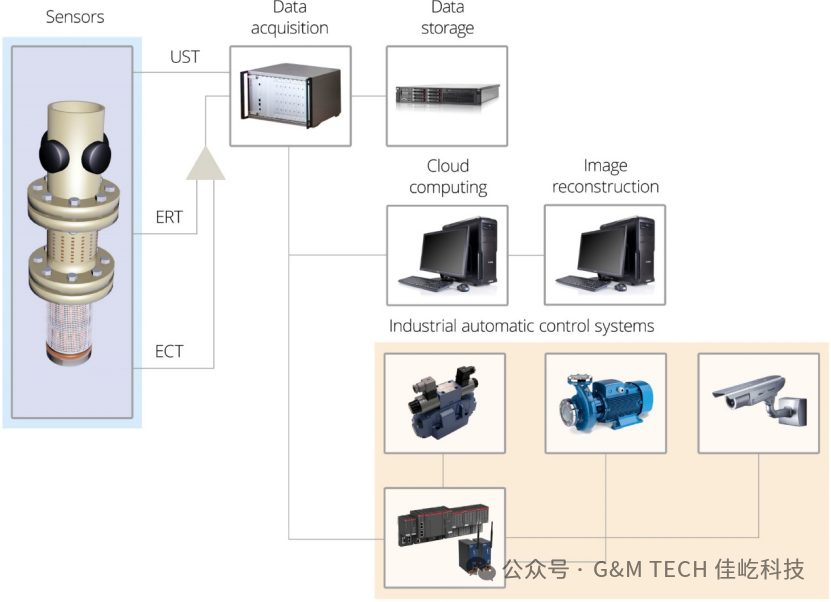
Source: (Rymarczyk & Sikora, 2018)[22]
This figure illustrates a process control and optimization system based on industrial tomography. The system collects data through various sensors, including ultrasonic sensors (UST), electrical resistance tomography (ERT), and electrical capacitance tomography (ECT), and ultimately achieves precise control of the industrial automation control system through data acquisition, storage, cloud computing, and image reconstruction.
IoT System Architecture
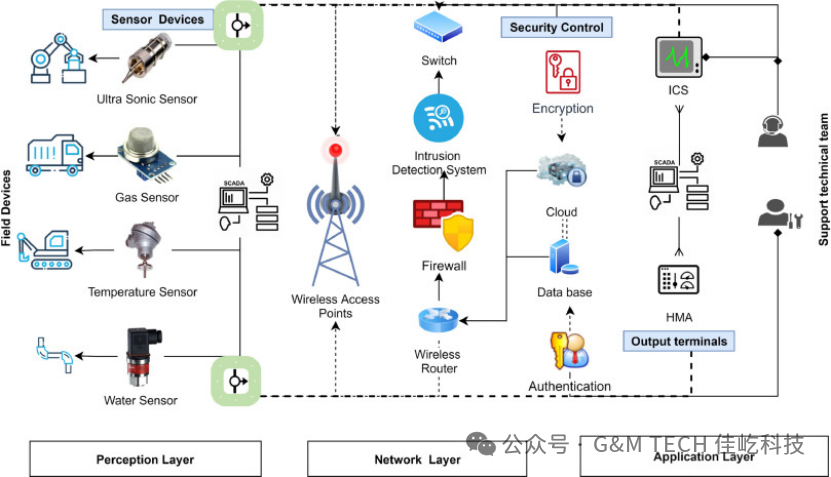
Source: (Jayalaxmi et al., 2023)[19]
This figure illustrates a comprehensive system architecture for an Internet of Things (IoT) or industrial control system, divided into perception, network, and application layers. The perception layer devices, such as ultrasonic sensors, are responsible for collecting data from the real world, the network layer is responsible for data transmission, and the application layer is responsible for data processing and application.
Conclusion
Ultrasonic sensors play an increasingly important role in industrial concentration measurement due to their advantages of non-invasive measurement, high precision, real-time monitoring, wide applicability, high-temperature resistance, and integration capabilities with other technologies (Unknown, 2020)[13]. With continuous technological advancements, ultrasonic sensors will find applications in more fields, bringing greater benefits to industrial production.

Jia Yi Technology
Official Website|gmtechcn.com
Sales Department Email|sale@gmtechcn