To further broaden students’ academic horizons and stimulate interest in cutting-edge technology, on September 17, 2025, our faculty member Du Liyong successfully held an academic lecture titled “Perceiving Everything: ‘Smelling’ the Future of Gas-Sensitive Sensor Technology,” attracting numerous students from the New Energy major to attend.
At the beginning of the lecture, Professor Du used common examples from daily life, such as smoke detectors and alcohol testers, to vividly reveal the close connection between gas-sensitive sensor technology and our lives, quickly igniting the curiosity of the students present. He pointed out that gas-sensitive sensors, as key sensing devices in fields such as the Internet of Things, smart homes, environmental monitoring, and medical diagnostics, are playing an increasingly important role, earning the title of the “electronic nose” of modern technology.
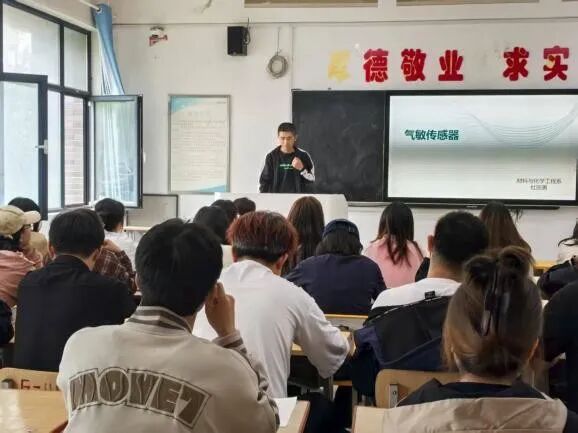
Subsequently, the lecture entered its core segment. Professor Du systematically and deeply analyzed gas-sensitive sensor technology from four aspects: basic principles, core materials, typical applications, and future trends. He first explained how gas-sensitive sensors achieve gas recognition and concentration measurement by detecting changes in electrical parameters (such as resistance and capacitance) caused by gas molecules. He then focused on various sensitive materials that are currently research hotspots, including metal oxide semiconductors, conductive polymers, and carbon nanomaterials, showcasing the characteristics and challenges of different materials in terms of sensitivity, selectivity, and stability through rich charts and case studies.
In the application outlook section, Professor Du painted a broad picture of the future empowered by gas-sensitive technology: from real-time monitoring of air quality and warning of industrial harmful gases, to non-invasive disease screening through exhaled human breath, and even enabling precision control of growth environments in smart agriculture, as well as applying it to bionic robots to give them “olfactory” capabilities. These cutting-edge application cases deeply impressed the students with the tremendous transformative potential that a fundamental technology can bring.
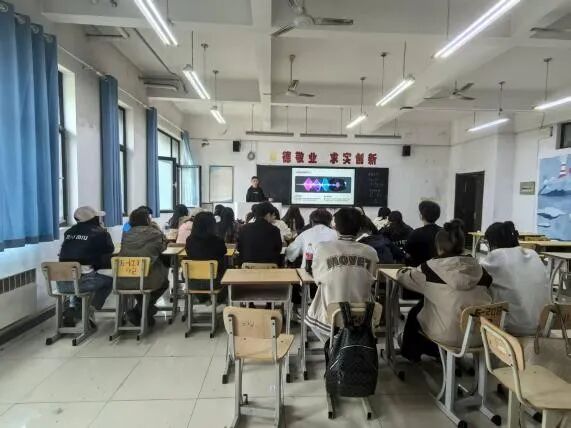
Finally, Professor Du discussed the challenges faced by gas-sensitive sensor technology (such as improving selectivity, reducing power consumption, and miniaturization integration) and the future development directions, encouraging the students present, especially those in related majors, to bravely engage in this research field full of opportunities and challenges.
This lecture not only provided students with an opportunity for in-depth dialogue with cutting-edge technology but also ignited their enthusiasm for exploring the unknown and engaging in scientific research. Students expressed that through this learning experience, they gained a new understanding of gas-sensitive sensors, a technology that seems unfamiliar yet is ubiquitous, and found it immensely beneficial. Our institute will continue to hold such high-level academic activities to create a good academic atmosphere and support students’ growth and success.

 ENDEditor | Li Xuyah Rong JiaxuanInitial Review | Li RuobingFinal Review | Zhao Zirui
Final Approval | Cao Xiangyu
Material Chemistry Department QQ Email | [email protected]