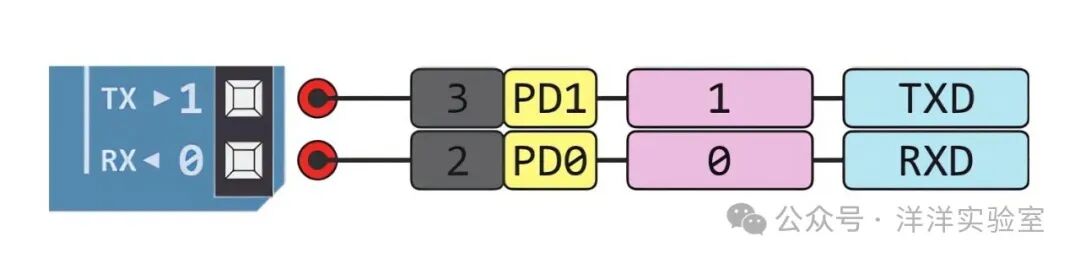
Communication protocols serve as a “common language” between two devices. Data exchange can only proceed smoothly if both parties use the same rules and settings.
UART is a point-to-point (P2P) hardware communication method, where the connected ends can be a microcontroller and anothermicrocontroller, a sensor, or a computer (with conversion).
Before data transmission begins, both the transmitting and receiving ends of UART remain in a high state (which can be understood as a “standby” state). When data is to be sent, UART first emits a “start bit” (low state), indicating the beginning of data transmission; this is followed by the actual data content, known as the “data bits”.
After the data bits have been transmitted, a “stop bit” (high state) is sent, indicating the completion of this data transmission. Typically, the stop bit is 1 bit, but in some low-speed devices, it may use 2 bits.
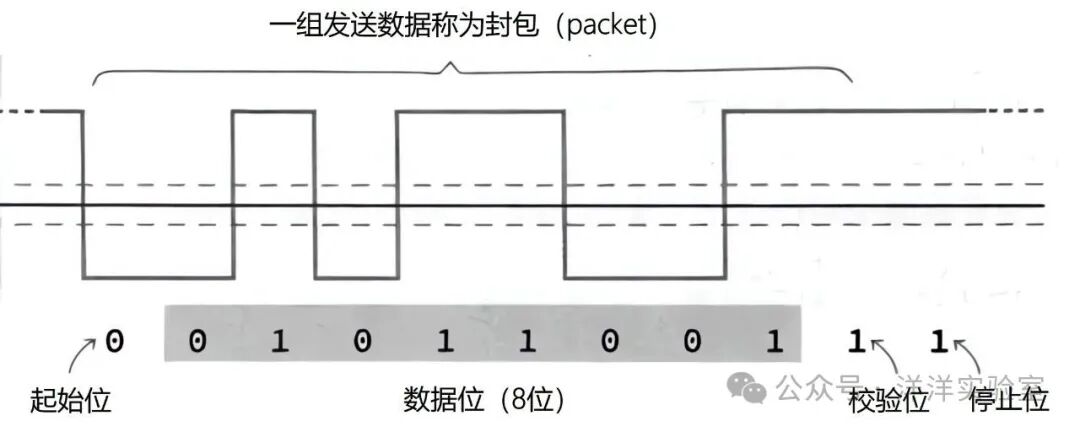
During data transmission, noise interference or other factors may cause data errors. To address this, the transmission protocol includes a parity bit, allowing the receiving end to verify whether the data is correct. The options for the parity bit are as follows:
None
No parity, meaning no parity bit is added; this is the most commonly used option.
Odd
Odd parity, where the parity bit is set to 1 if there are an even number of 1s in the data bits; if there are an odd number of 1s, it is set to 0, making the total count odd.
Even
Even parity, where the parity bit is set to 0 if there are an even number of 1s in the data bits; if there are an odd number of 1s, it is set to 1, making the total count even.
Mark
Mark parity, where the parity bit is always set to 1.
Space
Space parity, where the parity bit is always set to 0.
The communication standards we previously mentioned, such as RS-232 and RS-422, fall under “asynchronous communication” because they do not require an additional clock signal line for synchronization during communication, and are often collectively referred to as UART (Universal Asynchronous Receiver-Transmitter).