
The persistence of plastics in the environment, especially after disposal, poses a significant threat to ecosystems. Among them, microplastics (MPs) are particularly concerning due to their small size and difficulty in detection. Once they enter aquatic systems, microplastics can threaten marine life and human health through the food chain.
Current methods for assessing plastic pollution, such as microscopic counting or Fourier-transform infrared spectroscopy, face challenges of being cumbersome or costly. Biobased detection technologies offer higher sensitivity for low-concentration pollutants, providing a theoretical basis for developing cost-effective microplastic biosensors.
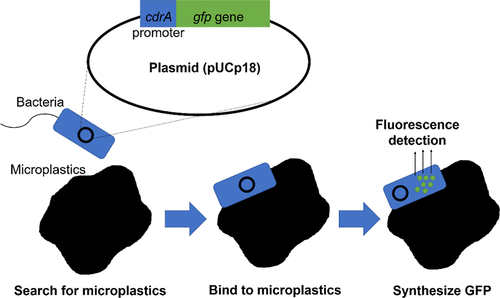
Image Source/Detection of Microplastics Pollution Using a Green Fluorescent Protein-Based Microbial Biosensor Coupled with Raman Spectroscopy
As a proof of concept, the research team utilized the environmental bacterium Pseudomonas aeruginosa as a green fluorescent protein biosensor, capable of producing detectable fluorescent signals within 3 hours, with a detection limit of 1 nanogram/milliliter, demonstrating sensitivity superior to existing microplastic analysis methods. The fluorescent signal expressed by this biosensor is positively correlated with microplastic concentration, allowing for convenient determination of microplastic levels through the establishment of a standard curve. The research team further established a microbial biosensor-Raman microscopy coupling technology, successfully detecting microplastics at a concentration of 100 micrograms/milliliter, primarily composed of biodegradable plastics, in pilot tests of pre-treated urban coastal water samples.
This study is the first to demonstrate the innovative application of microbial biosensors as an economical, rapid, and accurate tool for assessing the presence and concentration of microplastics, providing a convenient means for monitoring the extent of microplastic pollution in the environment.

This research showcases the tremendous potential of synthetic biology in addressing environmental challenges. By ingeniously leveraging the natural characteristics of microorganisms and engineering them, unprecedented environmental monitoring tools can be developed.
As the study author Chua stated, “This is the perfect combination of nature and technology—utilizing the bacteria’s innate ability to form biofilms to endow them with new environmental sensing capabilities.”
With further refinement and promotion of the technology, this living sensor could become a core technology in the global microplastic monitoring network, helping us better understand and address the plastic pollution crisis, ultimately achieving a cleaner and healthier water environment.
References
Choi E., Ma Y., et al. (2025). Detection of microplastics pollution using a green fluorescent protein-based microbial biosensor coupled with Raman spectroscopy. ACS Sensors. DOI: 10.1021/acssensors.5c01120, https://pubs.acs.org/doi/10.1021/acssensors.5c01120


The Intelligent Sensor Professional Committee of the China Metrology Association (hereinafter referred to as the “Intelligent Sensor Committee”) is an industry organization approved and registered by the China Metrology Association, belonging to its branch. The Intelligent Sensor Committee is composed of enterprises and institutions engaged in intelligent sensor technology research, product design, production processing, packaging testing with a certain production scale and quality reputation; units promoting the application of new intelligent sensor technologies; and universities and research institutes with relevant intelligent sensor specialties.
The responsibilities of the Intelligent Sensor Committee are as follows:
(1) Implement national strategic deployments and government policies and regulations; collect and analyze domestic and international market and technology information to provide consulting opinions and suggestions for government decision-making and industrial policy formulation.
(2) Establish expert working groups to carry out industry-related work in intelligent sensor technology research, product design, production processing, packaging testing, etc. Promote the establishment of relevant standards for intelligent sensors, establish relevant group standards, and gradually form industry and national standards, advancing the application of intelligent sensors in fields such as intelligent manufacturing, energy conservation and environmental protection, intelligent robotics, smart cities, consumer electronics, automotive electronics, biomedical, and smart agriculture.
(3) Explore innovative models and mechanisms for the intelligent sensor industry by establishing a data cloud platform for intelligent sensors, promoting the enhancement of capabilities in design, process, production, packaging, and testing.
(4) Establish an information release platform, public account platform, and publications for the Intelligent Sensor Committee, organize industry seminars involving production, learning, research, and application institutions in the intelligent sensor industry chain, inform member units of information, share experiences, promote new technologies, and connect various demands and capabilities to facilitate communication and cooperation.
(5) Promote academic exchanges, regularly organize industry academic conferences, solicit papers and conduct reviews of outstanding papers, publish proceedings, and recommend award-winning papers for publication in public journals.
(6) Conduct training for industry talents in technology, business management, and vocational skills.
(7) Organize evaluations of advanced units, advanced workers, advanced products, and excellent cases in related professions and fields, summarizing and promoting advanced experiences.
(8) Conduct intellectual property operations to accelerate the transformation of corporate scientific research achievements. Organize the publication of popular science books to disseminate relevant scientific knowledge and advanced technology and management experiences.
(9) Organize various types of international and domestic exhibitions or showcases related to intelligent sensors and related fields according to industry development needs.
Member rights of the Intelligent Sensor Committee:
(1) The right to vote, be elected, and appeal within the Intelligent Sensor Committee;
(2) The right to be informed, participate, criticize, suggest, and supervise the work, projects, and activities conducted by the Intelligent Sensor Committee;
(3) Priority for member personnel to enter the academic, technical, and industrial expert committee organizations of the Intelligent Sensor Committee;
(4) Priority and discounts for participating in related activities organized by the Intelligent Sensor Committee;
(5) Access to relevant industry materials, literature, analysis reports, and proceedings published by the committee;
(6) Priority for enterprise promotion and display on the official media of the Intelligent Sensor Committee;
(7) Priority for other services provided by the Intelligent Sensor Committee.
We welcome relevant enterprises to join the Intelligent Sensor Committee, let us work together for a grand vision.
Contact number: 010-62453984
Email: [email protected]


Editor丨Wang Luowen
Reviewer丨Zhang Yunxia