Abstract
Authors:
He Zheng1, Xie Mowen1✉, Wu Zhixiang1, Zhao Chen1, Sun Guangcun2, Xu Le2
Affiliations:
1) School of Civil and Resource Engineering, University of Science and Technology Beijing, Beijing 100083;
2) Beijing Zhongguancun Smart Safety Science Research Institute Co., Ltd., Beijing 102199
Abstract:
The monitoring and forecasting of landslides in dangerous rock masses have always been a key focus and a weak link in geological disaster prevention research. A “collection-calculation-transmission” mechanism was established based on micro-electro-mechanical system (MEMS) technology to monitor the slight inclination angles and strong vibration accelerations of dangerous rock masses, leading to the development of micro-pile sensors for low-power long-term monitoring. Through field measurements and analyses of cracking-type dangerous rock mass collapses, it was found that these rock masses exhibit accelerated inclination deformation accompanied by increased frequency and amplitude of strong vibrations as precursors to collapse. A significant exponential relationship was established between the cumulative inclination deformation and the inclination deformation rate during the accelerated inclination phase before collapse, and a linear correlation was found between the inverse of the inclination rate and the time until collapse. Consequently, a “inverse inclination rate method” collapse time prediction model was developed, forming a real-time application algorithm based on MEMS inclination angle sensor data characteristics. The research results can positively promote the monitoring and early warning of collapse disasters.
Keywords:
Cracking-type dangerous rock mass; inclination deformation; collapse prediction model; collapse precursor; MEMS technology; micro-pile
Main Text
1. Research Background
The collapse of dangerous rock masses on slopes is a significant issue in geological disasters, especially in mountainous and sloped areas. Cracking-type dangerous rock masses, due to their unique geological structure, often undergo rapid inclination deformation processes, making them prone to collapse. Timely warnings are crucial for reducing disaster losses. Existing collapse monitoring methods mostly rely on traditional displacement monitoring and rainfall data, but these methods often perform poorly in certain special environments, particularly when slope deformations are minimal. Therefore, this paper introduces a novel monitoring technology based on micro-pile sensors, combining MEMS inclination sensors with strong vibration acceleration sensors to deeply study the inclination deformation characteristics of cracking-type dangerous rock masses, providing new insights for collapse prediction.
2. Focus on Results
Innovative Application of Micro-Pile Sensors:
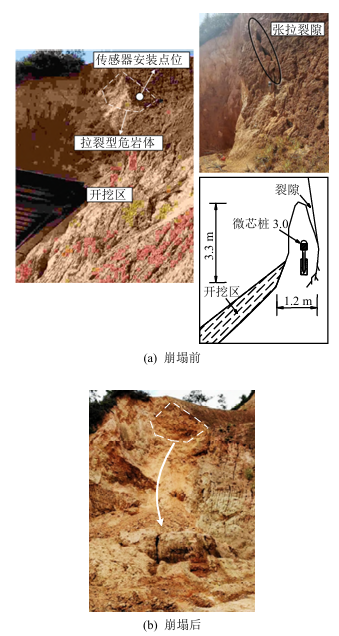
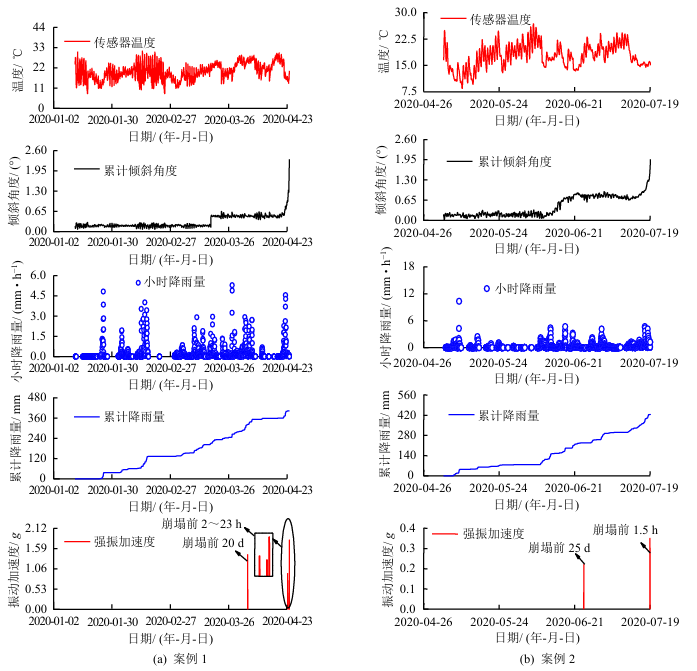
This paper successfully achieved precise monitoring of the inclination deformation of slopes nearing collapse by applying micro-pile sensors to cracking-type dangerous rock masses. The micro-pile sensors combine MEMS inclination sensors with strong vibration acceleration sensors, providing high-precision real-time data capable of effectively capturing slight deformation changes in dangerous rock masses. Using this technology, the research team conducted field tests in two different geological environments, specifically in Guangdong and Hubei, obtaining high-quality monitoring data to support early warnings of collapse. In the two field monitoring experiments in Guangdong and Hubei, the micro-pile sensors successfully recorded the inclination deformation characteristics of cracking-type dangerous rock masses before collapse. Notably, during the critical phase before collapse, monitoring data showed a significant increase in inclination rate, with the changes in inclination angle exhibiting a continuously accelerating upward trend. This trend indicates that the deformation of cracking-type dangerous rock masses during the critical phase has clear regularity, and the ongoing intensification of inclination changes signals the occurrence of collapse. Analyzing this data allows for accurate assessment of potential collapse risks.
Identification of Collapse Critical Points and Prediction Model:
The study further proposed the “inverse inclination rate method” collapse prediction model and its field application algorithm process, which utilizes the reverse changes in monitored inclination rates to determine the arrival of collapse critical points. By combining comparative experiments with field monitoring data, this method can effectively identify the inclination changes of cracking-type dangerous rock masses during the critical phase and provide predictions for the timing of collapse. The research indicates that the inverse changes in inclination rate are highly correlated with the critical moment of collapse, making it a key indicator for collapse prediction.
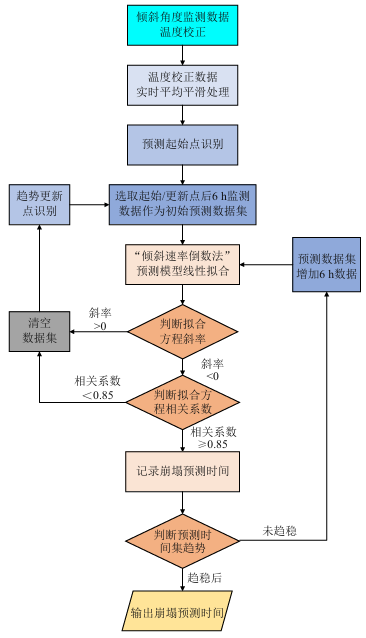
Case analysis shows that during the real-time prediction of collapse, when the prediction results stabilize, collapse forecasts can be made using the average values during the stable phase. In two cases, collapses were predicted to occur 9 hours 54 minutes and 14 hours 30 minutes after the forecasts, which were 9 hours 17 minutes and 11 hours 10 minutes before the actual collapses, respectively. The prediction results meet emergency evacuation needs, validating the feasibility of the algorithm process.
3.Conclusion
This paper successfully achieved real-time early warning of collapse in cracking-type dangerous rock masses through the combination of micro-pile sensors and the “inverse inclination rate method” model. Experiments show that micro-pile sensors can effectively monitor slight inclination deformations in dangerous rock masses and, combined with strong vibration acceleration signals, provide reliable evidence for collapse warnings. However, monitoring of slight deformations still faces certain challenges, and future work will continue to optimize hardware and algorithms to improve monitoring accuracy and better address slope collapse disasters.
References
He Zheng, Xie Mowen, Wu Zhixiang, et al. Field Measurement Study on the Inclination Deformation Characteristics of Cracking-Type Dangerous Rock Masses Using Micro-Pile Sensors. Journal of Rock Mechanics and Geotechnical Engineering, 2024, 45(11): 3399-3415. DOI:10.16285/j.rsm.2024.0146.
GREA
Produced by: Institute of Spatial Remote Sensing and GIS Applications
Editor: Lu Weikang
Reviewed by: Du Yan