The medical community welcomes a new “weapon” against cancer, as a domestic innovative drug demonstrates outstanding performance in the treatment of lung cancer and breast cancer, bringing new hope to advanced patients.At the 2025 European Society for Medical Oncology (ESMO) annual meeting, a domestically developed innovative antibody-drug conjugate—Lukangsatuzumab (Sac-TMT, Jiatai Lai®)—announced multiple Phase III clinical study results, attracting widespread attention in the field of cancer treatment.Developed by Kelun-Biotech, Lukangsatuzumab is a TROP2 ADC that shows remarkable efficacy in EGFR-mutant non-small cell lung cancer (NSCLC) and HR+/HER2- breast cancer, marking a milestone in domestic cancer drug development.
01
Innovative Mechanism of Action—Precision Striking Cancer Cells with a “Biological Missile”Lukangsatuzumab is a targeted TROP2 antibody-drug conjugate (ADC), designed like a “biological missile” that precisely strikes cancer cells.TROP2 is a transmembrane glycoprotein that is overexpressed in various solid tumors, including lung cancer and breast cancer, while being almost absent or low in normal tissues, ensuring that the drug can accurately identify and attack cancer cells.The drug’s structure consists of three parts: a humanized anti-TROP2 monoclonal antibody with high affinity and targeting; a CL2A linker optimized for stability; and a self-developed toxin small molecule topoisomerase I inhibitor (T030) irreversibly conjugated to the antibody.This design achieves a drug-antibody ratio (DAR) of up to 7.4, enhancing the drug’s stability and anti-tumor activity while reducing non-tumor toxicity.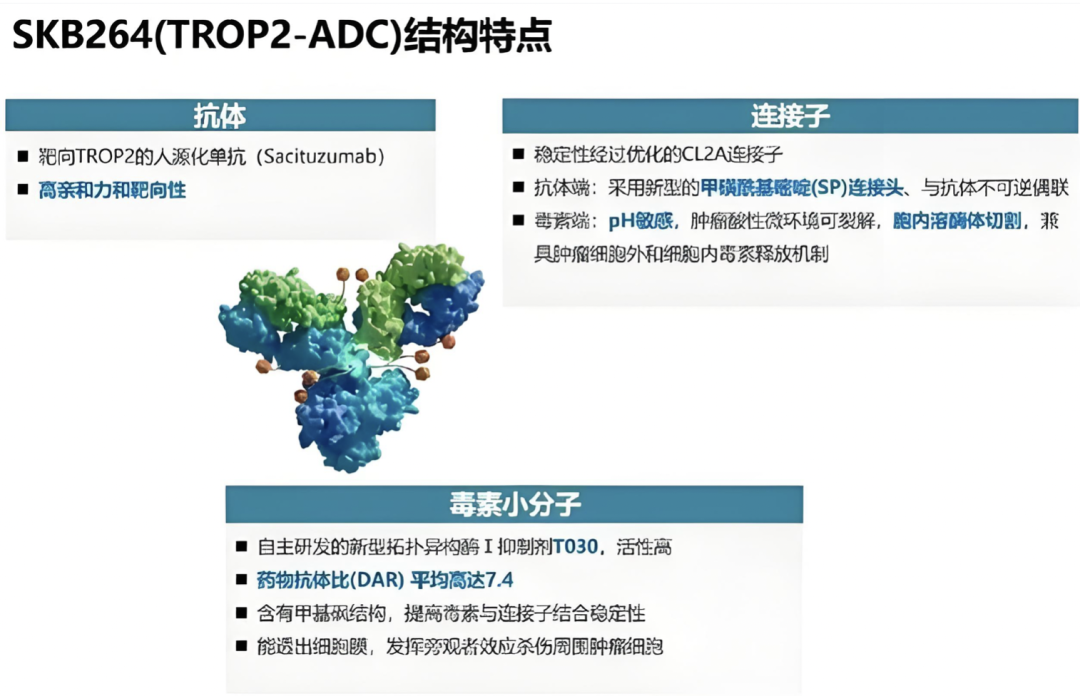
02
Breakthrough in Lung Cancer Treatment—Overcoming the Challenge of EGFR-TKI ResistanceThe treatment of EGFR-mutant non-small cell lung cancer has always been a clinical challenge. Although the emergence of EGFR-TKIs has changed the treatment landscape, acquired resistance remains an unavoidable problem.The Phase III OptiTROP-Lung04 study results show that Lukangsatuzumab significantly improved the median progression-free survival (PFS) to 8.3 months in patients with advanced NSCLC who had previously failed EGFR-TKI and platinum-based chemotherapy, compared to 4.3 months in the chemotherapy group, reducing the risk of disease progression or death by 51% (HR 0.49).Even more exciting, Lukangsatuzumab also achieved an advantage in overall survival (OS), reducing the risk of death by 40% (HR 0.60), becoming the world’s first TROP2 ADC drug to achieve significant benefits in both PFS and OS in second-line treatment of EGFR-mutant NSCLC.These data were not only selected for a Late Breaking Abstract oral presentation at the 2025 ESMO conference but were also published in the prestigious international medical journal, The New England Journal of Medicine.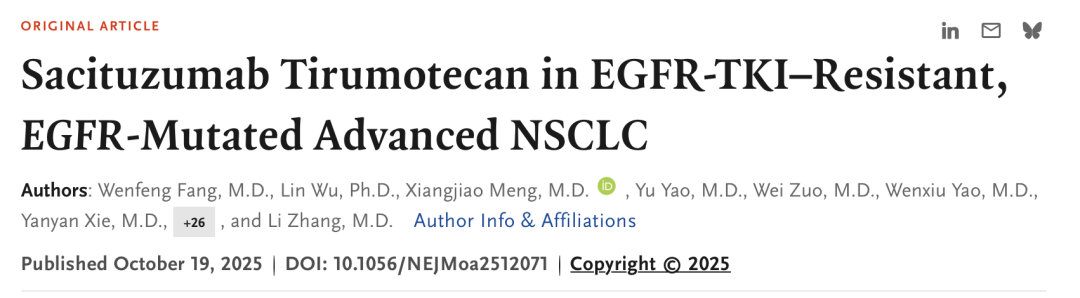 Early studies have also shown the drug’s potential in lung cancer. The results of the KL264-01 study published in Nature Medicine showed an overall objective response rate (ORR) of 40% and a disease control rate (DCR) of 81% in patients with advanced NSCLC, with a median overall survival of 21.8 months.In patients with EGFR mutations, the efficacy was even more pronounced, with an objective response rate of 55% and a median progression-free survival of 11.1 months.
03
Advancements in Breast Cancer—A New Option for HR+/HER2- Breast CancerIn addition to lung cancer, Lukangsatuzumab has also shown strong potential in the treatment of breast cancer.The results of the Phase III OptiTROP-Breast02 study presented at the 2025 ESMO conference showed that in patients with locally advanced or metastatic HR+/HER2- breast cancer who had previously received CDK4/6 inhibitor treatment and failed at least one chemotherapy, the median progression-free survival in the Lukangsatuzumab group was significantly longer than that in the chemotherapy group (8.3 months vs. 4.1 months; HR 0.35).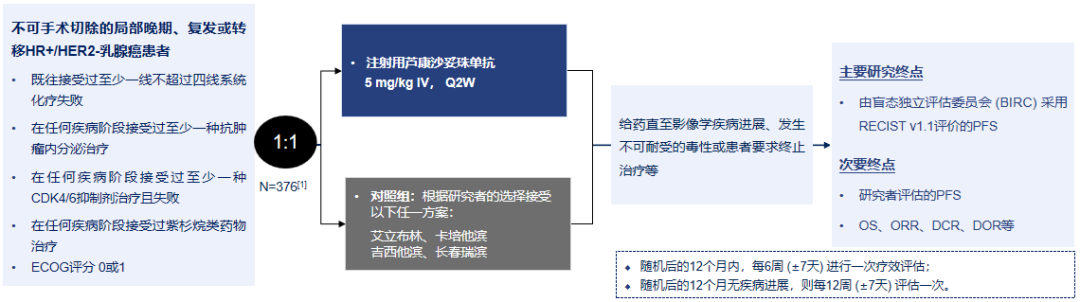 In patients with different HER2 expression levels, the Lukangsatuzumab group showed clinically significant benefits, with an objective response rate increasing to 41.5%. Overall survival (OS) also showed a favorable trend (HR 0.33).Based on these positive data, the new indication application for Lukangsatuzumab in the treatment of HR+/HER2- breast cancer has been accepted by the National Medical Products Administration (NMPA) of China and included in the priority review and approval process, becoming the fourth indication application for this drug to be accepted.Lukangsatuzumab has been approved in China for the treatment of adult patients with unresectable locally advanced or metastatic triple-negative breast cancer (TNBC) who have received at least two systemic treatments.Research data show that in first-line TNBC treatment (N=41), the objective response rate of Lukangsatuzumab monotherapy reached 70.7%, with a median progression-free survival of 13.4 months, demonstrating its potential in first-line treatment.
04
Safety Profile—Overall Manageable with Adverse ReactionsThe clinical application of any cancer drug requires a balance between efficacy and safety. Lukangsatuzumab shows good characteristics in this regard.A meta-analysis of ADC drug treatment for non-small cell lung cancer showed that the incidence of all-grade treatment-related adverse events (TRAEs) was high with ADC monotherapy, but most were grade 1-2, indicating overall manageable safety.The safety profile of Lukangsatuzumab is consistent with this. The most common adverse reactions are hematological toxicities, including thrombocytopenia, anemia, and neutropenia, but most patients can recover quickly after symptomatic treatment.In the pivotal Phase III OptiTROP-Lung04 study, no cases of interstitial lung disease/pneumonitis were reported for Lukangsatuzumab, nor were there any TRAEs leading to discontinuation or death. The incidence of ocular surface toxicity was 9.6%, all of which were grade 1-2.Clinical use still requires close monitoring of neutropenia, oral mucositis, ocular surface adverse reactions, and infusion-related reactions/hypersensitivity reactions, with appropriate preventive and management measures taken.The achievement of Lukangsatuzumab as the world’s first TROP2 ADC drug to achieve significant benefits in both progression-free survival and overall survival in second-line treatment of EGFR-mutant non-small cell lung cancer is not just a title, but a testament to China’s innovative drug development strength.With more research results being published and indications expanding, this drug is expected to bring new hope for life to more cancer patients.