
Author|YY
01
Focus on the ADC signals
The discussion at the 2025 European Society for Medical Oncology (ESMO) annual meeting once again centered on antibody-drug conjugates (ADCs).
After over a decade of clinical accumulation, ADCs are gradually moving from treatment for metastatic and advanced tumors into earlier stages of disease. At this year’s conference, AstraZeneca and Daiichi Sankyo’s jointly developed Enhertu (trastuzumab deruxtecan) achieved its primary endpoint for the first time in early HER2 positive breast cancer populations in two Phase 3 studies, demonstrating that this class of drugs has the potential to drive a shift towards “ADC dominance + Taxanes/anti-HER2” strategies. Meanwhile, BMS and China’s SystImmune collaborated to develop izalontamab brengitecan (iza-bren), which showed activity in a Phase 1 study involving multiple tumors and heavily pre-treated populations, with related registration studies covering first-line and second-line specific tumor scenarios; AstraZeneca’s self-developed FRα (folate receptor α) targeted ADC asset AZD5335’s early results support AZ’s platform strategy in the FRα-ADC space.
These three pathways reveal the same trend from different angles: ADCs are transforming from tools for late-stage treatment into important components of early and even first-line therapy. The results from ESMO 2025 not only validate the clinical potential of the next-generation molecules but also mark a comprehensive advancement of ADC technology in drug chemistry, mechanism design, and industrial layout.
02
Enhertu
Establishing the treatment standard for early HER2 positive breast cancer

Enhertu (trastuzumab deruxtecan, T-DXd) is an ADC jointly developed by AstraZeneca and Daiichi Sankyo, linked by a cleavable peptide linker to a trastuzumab backbone, loaded with a topoisomerase I inhibitor derivative (DXd). Its design is based on the “bystander effect”: the drug can diffuse and kill adjacent low-expressing or heterogeneous cells after being cleaved inside the targeted cells, allowing its efficacy to surpass traditional single-cell targeted toxicity. This mechanism is the foundation for its breakthroughs in low-HER2 breast cancer and establishes its theoretical advantage in early disease stages.
DESTINY-Breast05 is a pivotal Phase 3 study that included patients with residual invasive disease after neoadjuvant therapy for early HER2-positive breast cancer, directly comparing it with Roche’s Kadcyla (trastuzumab emtansine, T-DM1). The results showed that Enhertu reduced the risk of invasive disease recurrence or death by 53%, with invasive disease-free survival (IDFS) and disease-free survival (DFS) both achieving HR 0.47 (95% CI 0.34–0.66; p < 0.0001). Analysis revealed that 12.5% of patients in the Kadcyla group experienced recurrence or death, while the Enhertu group had only 6.2%. Additionally, Enhertu showed significant improvement in brain metastasis-free survival (HR 0.64; 95% CI 0.35–1.17), indicating its strong central penetration.
Dr. Evandro de Azambuja commented at the conference: “With manageable safety and superior efficacy, Enhertu should replace Kadcyla as the new standard for patients with residual disease after surgery.”
In another Phase 3 study, DESTINY-Breast11, Enhertu was used earlier in neoadjuvant therapy. This study enrolled 927 high-risk HER2-positive early breast cancer patients, comparing the “Enhertu + THP” (taxane, trastuzumab, and pertuzumab) regimen with the traditional anthracycline-THP regimen. The results showed that the Enhertu group had a pathological complete response (pCR) rate of 67.3%, significantly higher than the control group’s 56.3% (p = 0.003), while the incidence of left ventricular dysfunction was only 1.3%, compared to 6.1% in the control group. This not only indicates that the non-anthracycline regimen can outperform traditional chemotherapy combinations but also suggests a significant improvement in cardiac toxicity.
The main safety issue with Enhertu remains interstitial lung disease (ILD). In Breast05, the incidence of ILD in the Enhertu group was 9.6%, compared to 1.6% in the Kadcyla group. Although this risk is statistically manageable, its potential lethality (approximately 0.24% mortality) continues to attract regulatory attention. Furthermore, as Enhertu simultaneously enters both preoperative and postoperative settings, a practical issue arises: if a patient has already received Enhertu preoperatively and still has residual disease postoperatively, can the same drug be reused? How regulatory bodies define labeling in the future will impact Enhertu’s treatment cycles and market size in the real world.
In most centers in the U.S., the second-line HER2+ mBC (metastatic breast cancer) scenario has seen Enhertu become the mainstream alternative to Kadcyla; Daiichi Sankyo disclosed that the patient share in key centers has exceeded 70%. If approved in adjuvant therapy, its market conversion speed can be anticipated. According to Daiichi Sankyo’s data, Kadcyla’s sales in the U.S. are projected to reach 765 million Swiss francs in 2024, with 40% coming from adjuvant therapy scenarios. Enhertu’s success means this portion of the market will be rapidly replaced. With Enhertu’s rapid progress, HER2-positive breast cancer, once considered the most aggressive subtype, is now likely to achieve higher cure rates.
03
Izalontamab brengitecan
BMS’s dual-target differentiated approach
Izalontamab brengitecan (iza-bren) is a dual-target ADC developed by BMS in collaboration with China’s SystImmune, targeting both EGFR and HER3, with a payload of topoisomerase I inhibitor brengitecan. By dual binding to EGFR and HER3, it enhances tumor cell selectivity, particularly suitable for epithelial-derived tumors (such as non-small cell lung cancer, breast cancer, bladder cancer, etc.).
In the global Phase 1 study presented at ESMO 2025, a total of 113 patients with solid tumors were enrolled. The confirmed objective response rate (ORR) in the 2.5 mg/kg dose group (n=20) was 55%. Among them, non-small cell lung cancer patients (n=14) had an ORR of 42.9%, with EGFR mutation types at 36.4% and wild types at 66.7%; breast cancer patients (n=3) achieved 100%. These results are consistent with earlier data observed in the Chinese population. The main adverse events were hematologic toxicities: ≥3 grade neutropenia 55%, anemia 28%, thrombocytopenia 12%.
The study has since included mandatory preventive measures for neutropenia in subsequent cohorts.
BMS acquired global rights to the drug outside of China in 2024 for an upfront payment of $800 million and a total potential of $8.4 billion. The company has initiated Phase 2/3 studies to explore the first-line treatment potential of iza-bren in triple-negative breast cancer, bladder cancer, and lung cancer. BMS’s oncology development head noted that iza-bren shows response rates consistent with Chinese data among global patients and emphasized the company’s goal to stay ahead in competition. In the EGFR×HER3 field, there are currently early projects from companies like Duality Biotherapeutics, Avenzo, Biocytogen, and CStone, but BMS holds an advantage with its global data first-mover advantage.
Similar to Enhertu, which also uses topoisomerase I as a payload, iza-bren’s innovation lies in its dual-targeting. HER3 is often co-expressed with EGFR or HER2 in various tumors, forming bypass signaling pathways that lead to resistance to single-target antibody therapies. The emergence of EGFR×HER3 ADC provides a new drug delivery model for highly heterogeneous tumors. This “dual-target + consistent payload” strategy reflects BMS’s differentiated competitive path following the success of Enhertu.
04
AZD5335
AstraZeneca’s proprietary ADC
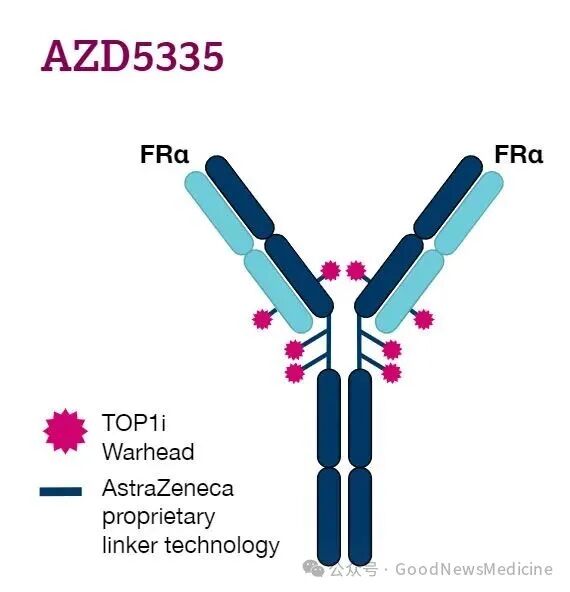
AZD5335 is an independently developed FRα (folate receptor α) targeted ADC by AstraZeneca, utilizing the company’s proprietary topoisomerase I payload and high-stability linker technology. FRα is highly expressed in platinum-resistant ovarian cancer and is a validated drug delivery target. Through its self-developed platform, AstraZeneca aims to achieve full-chain control from target selection to payload optimization to support the development of multiple cancer indications.
In the Phase 1/2a study presented at ESMO 2025, a total of 189 platinum-resistant ovarian cancer patients were enrolled. According to dose grouping, the ORR in the 1.6 mg/kg group was 56%, in the 2.0 mg/kg group was 56.1%, and in the 2.4 mg/kg group was 49.2%, with 56.2% of patients remaining disease-free at a median follow-up of 7.8 months. The main adverse event was neutropenia, with a ≥3 grade incidence of 45.9% in the 2.4 mg/kg group, while the low-dose group tolerated well. No unexpected off-target toxicities or irreversible organ damage were observed.
AstraZeneca’s early oncology development head stated that these results validate platform stability and emphasize that the company is building the next generation of chemotherapy alternatives based on the successes of Enhertu and Datroway.
Unlike Enhertu and Datroway, AZD5335 represents AstraZeneca’s formal entry into the autonomous innovation stage of ADCs. They have accumulated seven self-developed ADC projects covering solid tumors and hematologic malignancies. Its head stated that AZ is one of the few companies that have truly established linker-payload libraries and target resource libraries, allowing for free combinations in multiple directions. This platform strategy sharply contrasts with the paths of BMS, Pfizer, and others that rely on external licensing or acquisitions.
05
Global ADC landscape rebalancing
ESMO 2025 not only belongs to Enhertu and iza-bren but also to those companies redefining their destinies through different paths. Merck, Roche, and AbbVie’s multi-line layouts have led to a new shift in the global ADC industry landscape.
Merck: Dual-engine layout after Keytruda
While Keytruda remains solid, Merck is positioning ADCs as the core of its next growth phase. Its Trop-2 targeted drug sacituzumab tirucan (sac-TMT) completed Phase 3 OptiTROP-Lung04 study in China, reducing the mortality risk for EGFR mutant non-small cell lung cancer patients by 40%, with median progression-free survival (PFS) increasing from 4.3 months in the chemotherapy group to 8.3 months. Another study in HR-positive/HER2-negative breast cancer, OptiTROP-Breast02, similarly reduced the risk of disease progression or death by 65%, with PFS doubling from 4.1 months to 8.3 months. These data demonstrate that ADCs can directly replace traditional chemotherapy rather than merely supplement it. The Chinese drug regulatory authority approved sac-TMT for marketing in October 2025, making it the first Trop-2 ADC developed by a Chinese company and led by a global pharmaceutical company, marking substantial results in Merck’s global strategic succession.
Merck’s second pillar, raludotatug deruxtecan (R-DXd), targets gynecological tumors. In platinum-resistant ovarian cancer patients, this drug achieved a confirmed objective response rate (cORR) of 50.5% in a sample of 107 cases, with complete responses in 3 cases and partial responses in 51 cases, far exceeding the existing chemotherapy baseline of 10-15%. The incidence of ILD with R-DXd was only 4 cases, all low-grade, indicating further maturation of safety control for the DXd payload. With sac-TMT and R-DXd, Merck is no longer just a participant in the “diversified ADC” landscape but has become a core member of the second-generation ADC camp supported by real survival benefits.
Roche: External collaboration model leveraging Chinese innovation
Roche’s strategy at this conference was not to showcase self-developed products but to demonstrate how to reshape its pipeline using a global innovation network. The company announced a collaboration with China’s Hansoh Pharmaceutical for $1.45 billion, acquiring global development and commercialization rights outside Greater China for its CDH17-targeted ADC HS-20110, aimed at colorectal cancer. Previously, Roche had also entered licensing collaborations with MediLink (c-Met ADC) and Innovent Biologics (DLL3 ADC). This means that Roche, as it is about to lose momentum in developing ADCs in solid tumors, is beginning to re-enter the ADC main track through licensing/collaboration. By concurrently advancing multiple mature projects from China, Roche can compress clinical cycles and translate them into global competitiveness, representing a pragmatic strategy that replaces source originality with data maturity.
AbbVie: Verifier of second-generation linker chemistry
AbbVie’s c-Met-targeted ADC telisotuzumab adizutecan (Temab-A) represents another evolutionary route. The drug demonstrated multiple study results at ESMO 2025, with an ORR of 46% in MET-amplified tumors, 26.7% in treated colorectal cancer (combined with bevacizumab), and still reaching 24% in pancreatic ductal adenocarcinoma. Although these data do not reach the high levels of Enhertu, they highlight its cross-tumor applicability and the balanced results of linker-payload optimization. AbbVie’s R&D head pointed out that this moderate response rate reflects the characteristics of the next generation of ADCs, which are “lower toxicity and broader spectrum.”
Technical consensus and future challenges
From these results, it is evident that the ADC field is forming a clear evolutionary mainline:
Technically, moving from single-target to dual-target or multi-target structures; chemically, transitioning from high DAR to controllable DAR, balancing exposure and toxicity; industrially, shifting from isolated molecules to platforms and modular combinations; geographically, transitioning from a Europe-U.S. dominance to a new pattern of “China-U.S. co-axis”.
However, challenges still exist. ADCs using topoisomerase I as a payload still face ILD risks, while insufficient biomarker screening makes precise drug delivery difficult to fully realize. The core question for the future is no longer “how much can efficacy be improved” but rather who can identify truly benefiting patients and extend the cure window under controllable safety.
06
From mechanisms to patterns
Scientific and industrial stratification of ADCs
ESMO 2025’s clinical results clearly demonstrate a trend: ADCs are no longer merely fulfilling a salvaging or transitional treatment role but are extending into earlier stages of treatment pathways. Enhertu has established a confirmatory position in early HER2-positive breast cancer, indicating that ADCs possess the efficacy and safety conditions to compete directly with chemotherapy; BMS’s iza-bren shows that dual-target mechanisms can achieve high response rates across various tumor types, suggesting this category has the potential to transition to broad-spectrum first-line treatment; AstraZeneca’s AZD5335 further indicates that mainstream pharmaceutical companies view ADCs as strategic platforms rather than single-molecule projects.
This trend is not coincidental but is the result of long-term accumulation of pharmacological properties and clinical experience. The introduction of topoisomerase I inhibitor payloads has enhanced cellular penetration, allowing ADCs to achieve sufficient killing in early diseases; optimization of linkers and antibody structures has improved drug exposure and tolerability, creating a pharmacokinetic basis for first-line use. From a technical perspective, ADCs are no longer “modified cytotoxic drugs” but have become a molecular therapeutic framework with programmable precision.
Clinically, this forward-moving trend is also reshaping treatment logic. The emergence of ADCs has shifted tumor treatment away from strict distinctions between “chemotherapy” and “targeted therapy” towards treatment designs based on disease molecular characteristics. For early patients, preoperative and postoperative use of ADCs has become a viable strategy choice; for late-stage patients, new-generation molecules with dual-targeting and optimized DAR (drug-antibody ratio) are exploring higher response rates and longer exposure times.
ESMO 2025 provides a clear signal: ADCs have transitioned from proof of concept to mainstream treatment stage. Future competition will no longer be about efficacy comparisons between single drugs but will revolve around who can first structure ADC platforms into first-line standard regimens. This not only signifies technological evolution but also a reordering of the tumor treatment system.
Ref.
Waldron, J. ESMO: BMS looks to ‘stay ahead of the competition’ with ADC’s 55% response rate in early-stage trial. Fierce Pharma. 17. 10. 2025.
New Generation of Antibody-Drug Conjugates (ADCs) Shows Unprecedented Promise in Early-Stage Disease. ESMO. 18. 10. 2025.
Waldron, J. ESMO: AstraZeneca believes latest data ‘validate’ going it alone on next-gen ADCs. Fierce Biotech. 18. 10. 2025.
Liu, A. ESMO: AZ, Daiichi unleash Enhertu’s 2-fisted power, aiming to reshape early breast cancer landscape. Fierce Pharma. 18. 10. 2025.
Enhertu reduced the risk of disease recurrence or death by 53% vs. T-DM1 in patients with high-risk HER2-positive early breast cancer following neoadjuvant therapy in DESTINY-Breast05 Phase III trial. AstraZeneca Press Release. 18. 10. 2025.
Oncology Business Briefing FY2024. Daiichi Sankyo Press Release. 26. 02. 2025.