Recently, Intel released a white paper that systematically outlines the core vision of the next-generation wireless technologyWi-Fi 8 (based on theIEEE P802.11bn standard). UnlikeWi-Fi 7, which primarily pursued peak rate improvements,Wi-Fi 8 shifts its strategic focus to“deterministic experience“, aiming to build an ultra-reliable, intelligent wireless environment. According to the plan, the first batch of commercial devices compliant with the standard is expected to be available from the end of2027 to the beginning of2028.
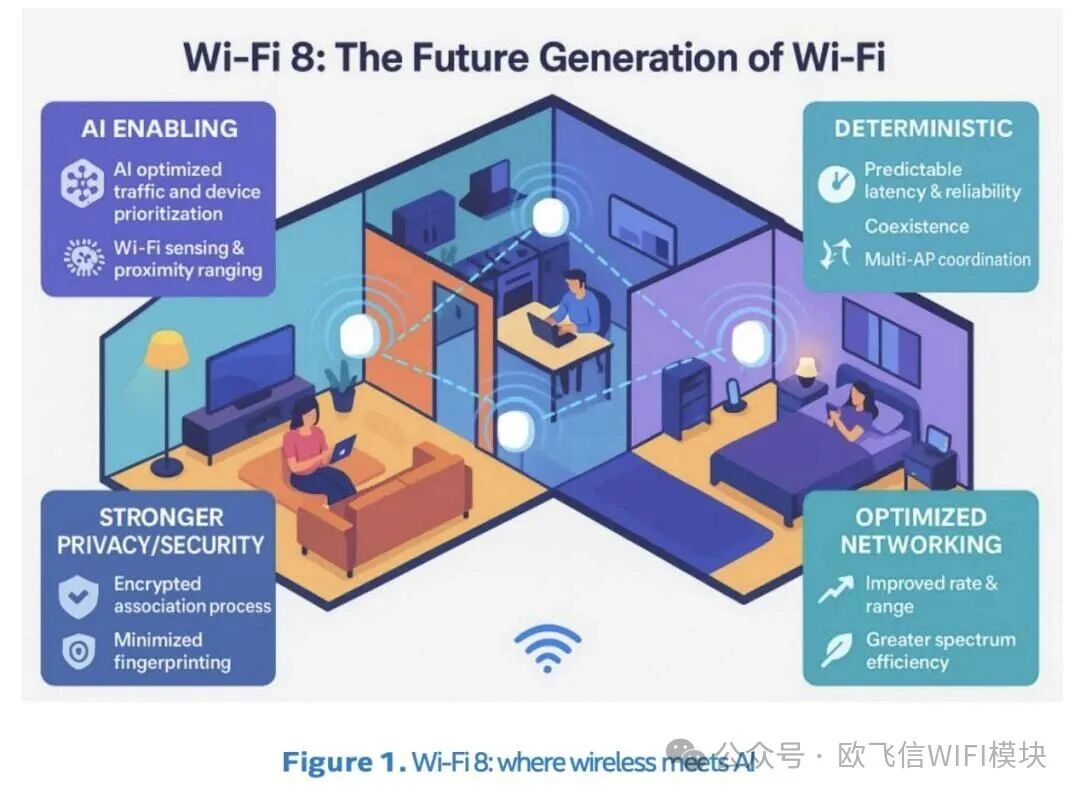
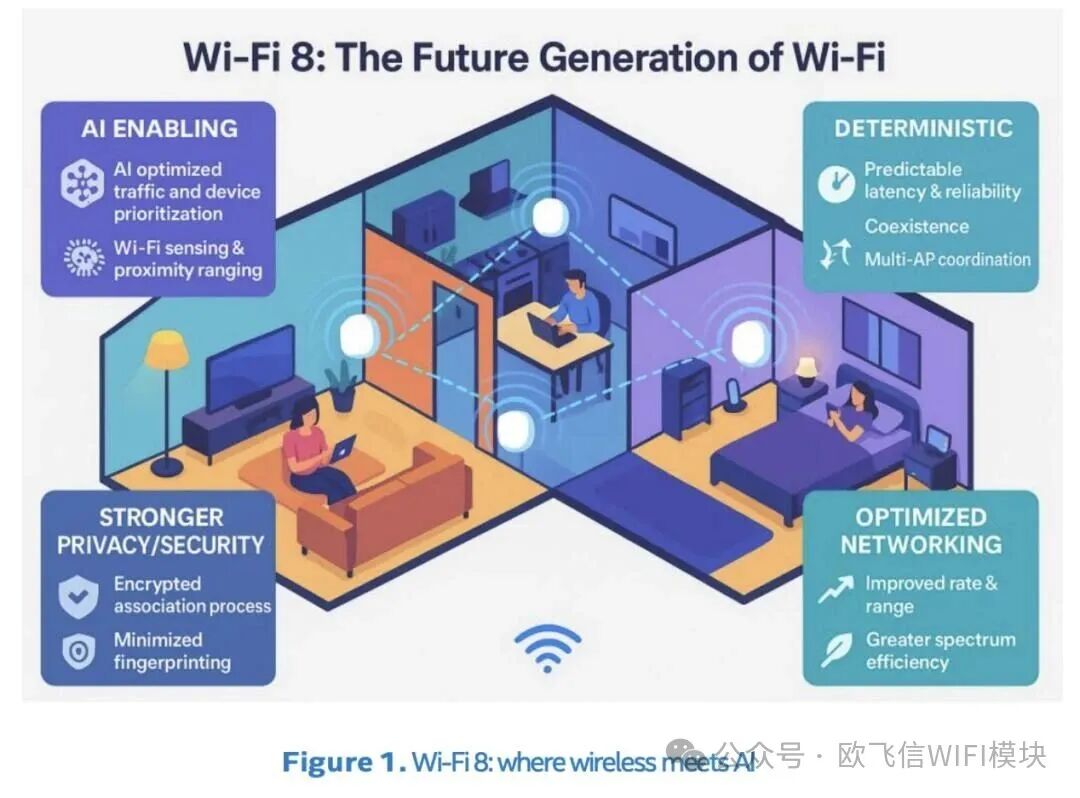
From“High Speed“ to“Reliability“: The Four Value Pillars of Wi-Fi 8
The technological evolution of Wi-Fi 8 revolves around four core dimensions:Network performance optimization remains fundamental. The new generation standard will enhance throughput by at least25% in complex environments through more refined channel access control and extended coverage technology, significantly reducing latency.Deterministic connectivity becomes a key breakthrough. Wi-Fi 8 introduces an enhanced priority scheduling mechanism that can provide dedicated channels for critical traffic such as gaming and industrial control, ensuring that packets are reliably delivered within specified timeframes.Security and privacy protection will be comprehensively upgraded. The standard is expected to support enhanced protocols such asIEEE 802.11bi, achieving encryption protection throughout the connection process, significantly improving security in public network environments.AI empowerment is the biggest highlight. Devices will natively support perception and ranging capabilities based onWi-Fi signals, laying the foundation for intelligent applications such as gesture recognition and personnel detection.
Specific Scenarios Changing the Experience
Smart homes will be the first to benefit. As the number of connected devices in households approaches30, Wi-Fi 8‘s multi-AP collaboration technology will allow router networks to work together like a“symphony orchestra“, completely eliminating signal dead zones and ensuring that critical applications such as gaming and meetings are not affected by download tasks.Enterprise applications will undergo a revolution. In high-density scenarios such as airports and stadiums, access points can coordinate transmission timing and power in real-time, avoiding mutual interference, allowing thousands of people to be online simultaneously while still enjoying a smooth experience.XR collaboration will enter a new stage. When colleagues collaborate remotely usingAR glasses, Wi-Fi 8‘s deterministic latency ensures that virtual operations and real feedback are almost synchronized, truly achieving“immersive“ work efficiency.
Technological Innovations Behind It
Multi-AP collaboration is the core technological breakthrough. Multiple access points can share scheduling information, intelligently allocate transmission resources, and even collaboratively adjust antenna beam shapes, effectively reducing interference from adjacent networks.Intelligent spectrum management makes connections more stable. The new non-primary channel access feature allows devices to quickly switch to idle frequency bands, as if planning multiple“emergency lanes“ for data streams, significantly enhancing anti-interference capabilities.Seamless roaming experience upgrade. Devices can maintain a“connect first, disconnect later“ approach when switching between access points, combined with a pre-established security key mechanism, making video calls during the transition almost seamless.
Industry Preparedness and Ecological Outlook
Although there is still time before the standard is finalized, chip manufacturers such as Intel and Broadcom have already begun early technical layouts. It is worth noting that Wi-Fi 8 will be fully backward compatible with existing devices, ensuring a smooth transition for user investments. Industry analysts point out that the true value of Wi-Fi 8 lies in providing a wireless foundation for applications in the AI era. From perceptual interaction in smart homes to precise control in industrial IoT, its guarantee of“deterministic performance“ will open a new cycle of innovation.
Wi-Fi 7 modules provide hardware foundation for industry upgrades
While the industry focuses on the development of Wi-Fi 8, QOGRISYS‘s O2072PM wireless module has entered the stage of large-scale commercial use. This module adopts a tri-band concurrent architecture (2.4/5/6GHz), supports320MHz channel bandwidth and5.8Gbps theoretical rates, significantly enhancing spectral efficiency through2×2 MIMO and4K QAM technologies. Its enhanced multi-link operation (eMLSR) supports intelligent switching across multiple frequency bands, effectively ensuring connection reliability. Integrated Bluetooth6.0 technology can simultaneously supportLE Audio andBLE long-distance transmission, meeting the composite connection needs of multimedia and IoT devices. In industrial applications, it features high-precision ranging (HADM) and auxiliary RF functions, suitable for low-latency scenarios such as industrial control and smart warehousing. The compactM.2 2230 package facilitates terminal integration, providing hardware support for upgrading smart devices and laying the foundation for the evolution towards Wi-Fi 8.