The intermittent 5G signal on mobile phones, lagging Wi-Fi 6E transmissions, and severe interference from millimeter-wave devices — behind these issues lies a critical component’s “design bottleneck”:acoustic wave filters.
As the “spectrum gatekeeper” of the RF front end, acoustic wave filters are responsible for selecting effective signals and shielding interference, making them core hardware for high-speed communications like 5G and Wi-Fi 6E. However, as bandwidth demands shift from “narrowband” to “ultra-wideband” (for instance, the 5G n77 frequency band has a bandwidth of 0.9GHz), traditional design methods either lead to significant errors or numerical collapse, severely limiting the enhancement of communication speeds.
In October 2025, a groundbreaking paper was published in the IEEE Transactions on Microwave Theory and Techniques (a top journal in the microwave field), proposing auniversal direct bandpass (DB) synthesis method, which completely resolves the design challenges of wideband/high-order acoustic wave trapezoidal filters, providing efficient solutions for scenarios such as 5G millimeter waves, Wi-Fi 6E, and the Internet of Things.

1. The “Two Major Pitfalls” of Traditional Filter Design: Difficulties in the Wideband Era
The difficulty in designing AW filters stems from the inability of traditional methods to adapt to the dual demands of “wideband + high-order”; two major pain points are particularly prominent:
1. Low-pass prototype (LP) method: “Translation distortion” in wideband scenarios
Traditional design is like “writing in English and then translating to Chinese” — first designing an ideal filter in the “low-pass domain” and then “translating” it to the actual “bandpass domain” through frequency transformation. This method is barely usable in narrowband scenarios (like early 4G), but it completely “fails” in the wideband era:
- In wideband, the characteristics of capacitors and inductors change significantly with frequency, and the assumption of “fixed characteristics” in traditional methods no longer holds, leading to a dramatic increase in “translation errors”, larger passband ripple, and signal distortion;
- It ignores the signal characteristics at “extreme frequencies” (such as ultra-high frequency bands), which cannot be overlooked in wideband, further deteriorating filtering effects.
In simple terms: designing a 5G wideband filter using the LP method is like navigating a new highway with an old map; it is fundamentally inaccurate.
2. Existing direct bandpass (DB) methods: High-order/narrowband “numerical collapse”
To address the wideband issue, academia proposed the DB method of “designing directly in the bandpass domain”, but new problems arose:
- Inability to control “phase matching”: The phase of the filter needs to be precisely adapted to the front-end circuit, which existing DB methods cannot achieve, leading to poor signal matching and increased interference;
- Numerical instability: When designing filters of order 5 or higher or narrowband filters, the computational data can become excessively large, exceeding computer calculation precision, resulting in design failures or error accumulation.
These two major pain points have extended the design cycle of wideband high-order AW filters to several weeks, keeping production costs high.
2. Core Innovation: Two Breakthroughs Allow Filter Design to “Pass Directly”
The universal DB synthesis method proposed in the paper acts like a “dual-core accelerator” for filter design, fundamentally solving the aforementioned problems:
1. Breakthrough 1: Universal bandpass design, adaptable to both wideband and narrowband
Instead of “translating first and then designing”, it directly customizes in the bandpass domain, relying on two key operations:
- Logarithmic mapping: Accurately restoring signal characteristics: Using logarithmic functions to “stretch” ideal filter characteristics to the actual bandpass domain while fully retaining the signal characteristics at “extreme frequencies”, completely eliminating wideband translation errors;
- Complex reflection zeros (CRZs): Dual control of phase + anti-interference: Equivalent to equipping the filter with a “phase regulator” and an “anti-interference switch” — by adjusting the parameters of CRZs, it can precisely match the phase of the front-end circuit while suppressing the “rebound” of out-of-band interference (professionally known as “out-of-band return”), resulting in purer filtering effects.
In simple terms: this design is like writing an article directly in Chinese without translation, while also being able to adjust the tone according to the context, precisely adapting to the requirements.
2. Breakthrough 2: Root extraction method, preventing high-order design collapse
Traditional methods rely on “polynomial coefficients” to calculate parameters, which can easily lead to “overflow” at high orders; the paper adopts a “direct root finding” approach:
- Not getting bogged down in complex coefficient calculations, but directly solving for the “roots” (core parameters) of the signal equations, avoiding excessive data growth;
- After extracting one component parameter each time, iteratively updating calculations ensures numerical stability without relying on high-precision computing tools.
The results are immediate: designing an 18th-order narrowband filter reduced computation time from 1.2 seconds to 0.06 seconds, achieving a 20-fold increase in efficiency without numerical collapse.
3. Simplified Design Process: 4 Steps to Achieve High-Performance Filters
The design method in the paper may seem complex, but it is actually clear when broken down, allowing engineers to implement it directly:
- Set objectives: Clearly define the filter’s operating frequency band (e.g., 5G n78 at 3.3-3.8GHz), bandwidth, and out-of-band suppression requirements;
- Build a model: Use “logarithmic mapping + CRZs” to construct the bandpass filter function, ensuring equal ripple characteristics (minimal signal fluctuation);
- Extract parameters: Use the “root extraction method” for iterative solving to obtain the core parameters of the filter (such as the capacitance and inductance values of the resonator);
- Transition to manufacturing: Convert the parameters into a producible AW resonator model (BVD model) for direct use in factory mass production.
The entire process has been compressed from “weeks” to “hours”, significantly enhancing design efficiency.
4. Experimental Validation: Data Speaks, Performance Crushes Traditional Methods
The paper demonstrates the effectiveness of the method through two key experiments, with astonishing data:
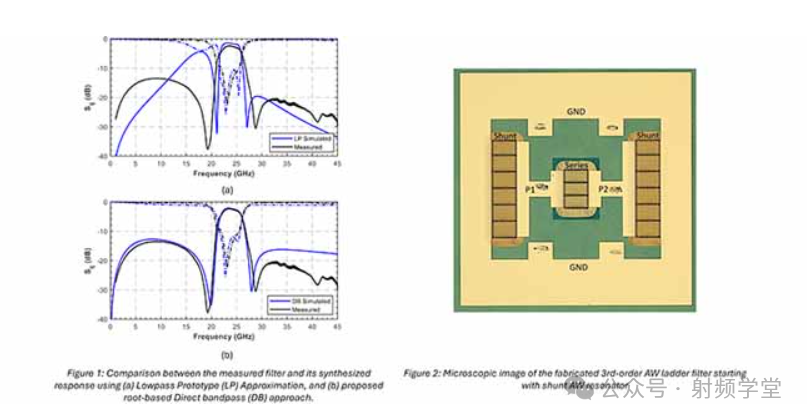
Experiment 1: 18% Ultra-wideband Filter (5G Millimeter Wave Scenario)
- Design specifications: Operating frequency band 21.35-25.65GHz (ultra-wideband), manufactured based on LiNbO3 thin film technology;
- Measured results: Passband signal fluctuation <0.5dB (traditional LP method > 3dB), out-of-band suppression > 40dB, with parameter error of the actual manufactured filter < 5%, fully meeting 5G millimeter wave requirements.
Experiment 2: 18th-Order Narrowband Filter (IoT Scenario)
- Design specifications: Operating frequency band 1805-1880MHz (narrowband), 18th order (traditional methods prone to collapse);
- Measured results: Successfully completed design, passband fluctuation <0.3dB, out-of-band suppression > 60dB, computation time only 0.06 seconds, with numerical stability and no collapse.
Comparison with Traditional Methods: Comprehensive Superiority
| Comparison Dimension | Traditional LP Method | Existing DB Method | New Method from Paper |
|---|---|---|---|
| Wideband Error | >3dB | 1.5-2dB | <0.5dB |
| Maximum Design Order | 5th Order | 4th Order | 18th Order |
| Computation Time (18th Order) | – (failed) | >1.2 seconds | 0.06 seconds |
| Phase Matching | Poor | Average | Excellent |
Whether for wideband, narrowband, or high-order designs, the new method achieves comprehensive superiority.
5. Application Prospects: Benefits for 5G, Wi-Fi 6E, and IoT
The implementation of this technology will directly promote communication upgrades across multiple scenarios:
- 5G Millimeter Wave Terminals: Rapidly designing wideband filters to stabilize 5G signals and increase speeds, facilitating the popularization of ultra-high-definition video, VR/AR, and other scenarios;
- Wi-Fi 6E Devices: The wideband filter demand for the 6GHz band can be quickly met, allowing Wi-Fi transmission rates to exceed 10Gbps, making lag a thing of the past;
- IoT Terminals: More efficient design of narrowband high-order filters reduces power consumption and costs for IoT devices, aiding in the interconnectivity of all things;
- Satellite Communication: Adapting to the high-frequency demands of satellite communication enhances signal anti-interference capabilities, making satellite terminals smaller and more stable.
6. Conclusion: The “Efficiency Revolution” in Filtering Technology
The core value of this paper lies not only in proposing a new method but also in initiating an “efficiency revolution” in AW filter design — transforming the design of wideband high-order filters from “time-consuming and labor-intensive” to “efficient and precise”, clearing critical obstacles for the popularization of high-speed communications like 5G and Wi-Fi 6E.
As communication technology progresses towards 6G, the demands for bandwidth and precision in filters will increase, and the application scenarios for this technology will continue to expand. It may not be long before the 5G mobile phones, Wi-Fi routers, and smart devices around us are equipped with filters based on this technology, ensuring more stable signals and faster speeds.
What other scenarios do you think this technology could be applied to? Feel free to leave your thoughts in the comments below!
Appendix
Paper Source: IEEE Transactions on Microwave Theory and Techniques (October 2025) Paper DOI: 10.1109/TMTT.2025.3565809
Full Paper:


Recommended Articles

[RF Basics][Chip Filters]

Copyright Statement: The copyright of the content originally created or reproduced by RF Academy belongs to the original author, and the views only represent the author's personal opinions. RF Academy is used solely for knowledge sharing. For reprints or citations, please contact the original author. RF Academy cites online articles, all of which are credited to their sources and authors, except for untraceable articles. If there are any objections, please contact us.
For article reprints, business cooperation, advertising promotion, RF community, etc., please add WeChat: RF_Centered and specify the cooperation matters.
Please click the bottom right corner to give me a thumbs up!