The “Strongest Brain” of Smart Cars: Explosion of In-Vehicle SoC Chips
Edited By: ForceInstitute
【Introduction】2025 is set to be a pivotal year for the smart car industry. With the penetration rate of new energy vehicles exceeding 50%, the acceleration of autonomous driving, and AI large models entering the cabin, the importance of in-vehicle SoC chips has reached unprecedented heights. They are not only the “brain” of smart cars but also the core of reshaping the automotive industry chain. This article will systematically review the evolution path, core value, market landscape, and domestic substitution trends of SoC chips in vehicles based on the latest industry research, providing a comprehensive analysis of the “chip war” in the era of smart cars.
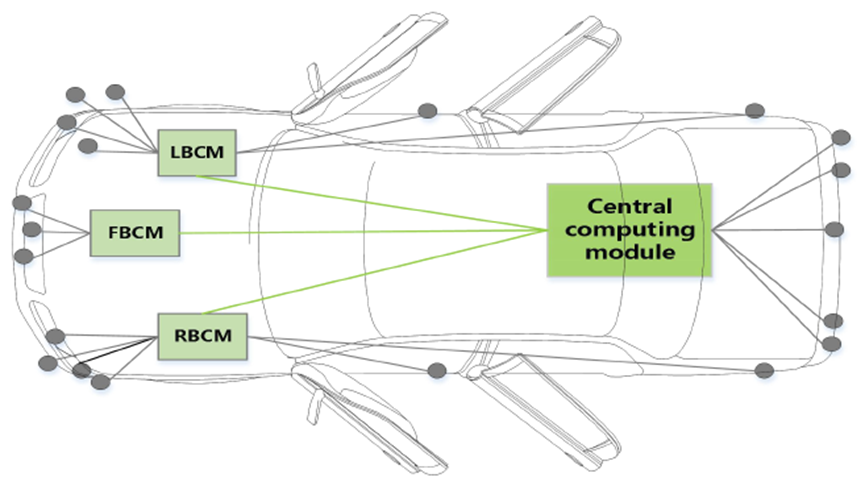
Tesla Model 3 Electronic and Electrical Architecture Diagram
1. From ECU to SoC: The Evolution of the “Brain” of Smart Cars
For decades, automotive electronic control primarily relied on ECUs (Electronic Control Units), distributed across different functional modules such as power, chassis, and body. However, with the surge of intelligence, the traditional ECU architecture has gradually become inadequate:
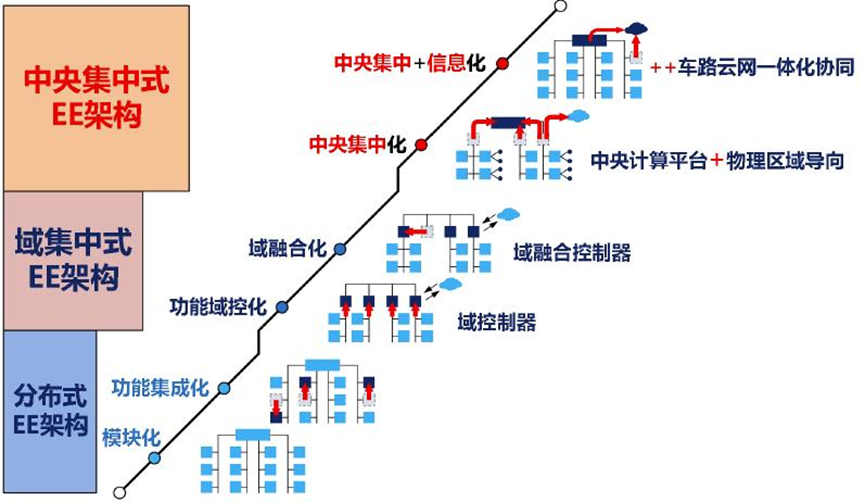
- •EE Architecture Evolution: From distributed control to domain control, and then to central computing + cloud control, a single ECU cannot meet the complex computing power requirements.
- •Emerging Functions Driving: Smart cabins and autonomous driving have become the most computing-intensive “disaster areas,” requiring SoC chips to support more complex algorithms and data interactions.
SoC (System on Chip) has become the “strongest brain” of smart cars due to its multi-core heterogeneous computing, massive storage, and powerful AI computing power. If traditional cars are defined by their engines, then smart cars are defined by their SoCs.
From Distributed to Centralized + Informationized Automotive EEA Development Path
2. Smart Cabin + Smart Driving Dual Engines, SoC Chip Demand Explodes
1. Smart Cabin: The Battlefield of User Perception
- •Market Explosion: From 2021 to 2024, the global smart cabin market is expected to have a compound annual growth rate of 28.7%, with an estimated scale of 148.4 billion USD by 2030; the Chinese market is even higher at 31.6%.
- •Core Trends:
- One Chip Multiple Screens: A single SoC drives multiple screens including the central control, instrument panel, co-driver, and rear entertainment, leading to a surge in GPU computing power demand.
- Multimodal Interaction: Voice + Gesture + Visual (DMS/OMS) integration, requiring the SoC to have stronger multitasking capabilities.
- Cabin-Driving Integration: From “cabin and parking integration” to “cabin and driving integration,” and even moving towards “cabin, parking, and driving integration,” the SoC plays a core role in integration.
- Large Model Edge Deployment: Large models like ChatGPT and DeepSeek entering vehicles, pushing the computing power of SoCs into the era of hundreds of TOPS.
2. Smart Driving: End-to-End and “Smart Driving Equality”
- •Technological Evolution: CNN → Transformer + BEV → End-to-End large models, with computing power requirements soaring from 30 TOPS to over 200+ TOPS, even reaching thousands of TOPS.
- •Smart Driving Equality: BYD is leading the push for “high-level smart driving as standard across all models,” moving from luxury cars to models priced at 100,000 yuan, directly driving the demand for mid-to-low computing power SoCs.
- •Market Data: BYD alone is expected to have 2.5 to 3 million smart driving models by 2025, creating strong demand for the SoC market.
3. High-Level Autonomous Driving: Robotaxi and Unmanned Mining Trucks
- •Unmanned Delivery: By 2025, sales in China may exceed 47,000 units, with a market scale of 18.5 billion yuan.
- •Unmanned Mining Trucks: By 2025, the penetration number may exceed 5,000 units, with a doubling growth rate.
- •Robotaxi: Baidu’s Apollo Go is expected to complete 1.4 million services in Q1 2025, while Tesla’s Robotaxi is piloting in Texas, with computing power demands reaching over 1000+ TOPS.
3. Market Landscape: Highly Concentrated + Domestic Substitution
1. Smart Cabin SoC: Qualcomm Dominates, but Domestic Breakthroughs
- 2024 Market Landscape: Qualcomm’s market share is 70%, followed by AMD and Renesas.
- Domestic Breakthroughs: Core Technology’s market share has reached 4.8%, with Core Chip Technology and Huawei accelerating their catch-up. The new generation of SoCs can now support the operation of 7B-level large models on the edge.
2. Smart Driving SoC: NVIDIA vs. Domestic New Stars
- •High-End Market: NVIDIA’s Orin and Thor have computing power exceeding 2000 TOPS, dominating L3/L4 level smart driving.
- •Domestic Representatives:
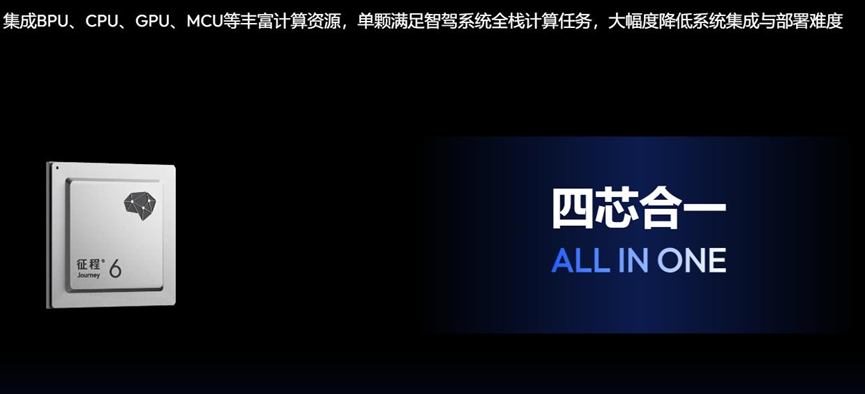
- Horizon: J5 (128 TOPS), J6 (560 TOPS), already entering the supply chains of BYD, Li Auto, and others.
- Black Sesame: A1000Pro exceeds 100 TOPS, focusing on mid-to-high-end smart driving.
- Aixin Yuanzhi: Transitioning from security to smart driving, accelerating breakthroughs in mid-level computing power markets.
- Core Technology and Core Chip: Balancing cabin and smart driving, promoting integrated SoC solutions.
Horizon Journey 6 SoC Chip “All in One” Design Concept
3. In-House Chip Development by Automakers: The “Chip Dream” of New Forces
- •Tesla: Self-developed FSD chip has evolved to HW4.0, with AI 5 expected to be mass-produced by 2025, enhancing computing power by 10 times.
- •NIO: Self-developed Shenqi NX9031, 5nm process, comparable to NVIDIA’s Thor.
- XPeng: Self-developed “Turing Chip,” aimed at L4 level autonomous driving.
- •Li Auto: Accelerating NPU self-development to create differentiated computing power advantages.
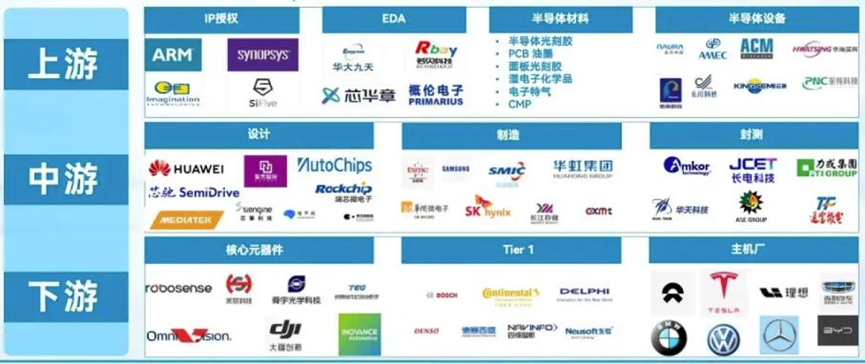
4. Industry Chain
1. Industry Chain Structure
- •Upstream: IP cores, EDA tools, semiconductor equipment materials.
- •Midstream: Chip design (Fabless), manufacturing (Foundry), packaging and testing.
- •Downstream: Tier 1 suppliers and automakers are accelerating direct connections with chip manufacturers to promote customized cooperation.
2. Highlights
- •Smart CabinSoC: Benefiting from large models and cabin-driving integration, demand is expected to expand long-term, with significant room for domestic substitution.
- •Smart DrivingSoC: Parallel demand for high, medium, and low computing power to meet different vehicle needs, with market structure trending towards diversification.
- •Domestic Manufacturers: Horizon, Core Technology, Core Chip, Black Sesame, Aixin Yuanzhi are expected to achieve production breakthroughs through “smart driving equality.”
Main Companies in the SoC Chip Industry Chain
5. Conclusion: The Chip War in the Era of Smart Cars
In the era of traditional fuel vehicles, the engine determined the performance of the car; in the era of smart cars, SoC chips determine the intelligence level of the vehicle. As new energy vehicles enter the second half, cabin intelligence and autonomous driving have become the core of differentiated competition. Whether it is BYD’s push for “smart driving equality” or the self-developed chip race among Tesla, NIO, and XPeng, the automotive industry is being propelled into a new “chip war.”
In the next decade, the market for in-vehicle SoC chips is expected to reach a trillion scale, and whether domestic manufacturers can rise in this war will directly determine China’s global discourse power in the smart car industry.


[Disclaimer] Excerpts and images are sourced from the internet, aimed at discussing industry dynamics. If there are any copyright issues or concerns, please contact us promptly, and we will change or delete the relevant content as soon as possible!