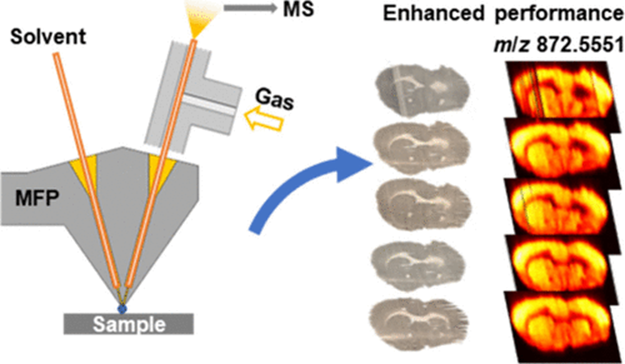
Hello everyone, today I would like to introduce an article published in 2025 in the Journal of the American Society for Mass Spectrometry titled “Pneumatically Assisted Microfluidic Probe for Enhanced Mass Spectrometry Imaging Performance.“ This article develops a pneumatically assisted microfluidic probe (MFP) with two microfluidic channels for nano-DESI mass spectrometry imaging of biological samples.
 01Background Introduction
Nano-DESI (nano-DESI) is an environmental mass spectrometry imaging (MSI) technology that enables spatial mapping of biological samples with minimal sample preparation. With high spatial resolution, sensitivity, and throughput, it has developed into a robust quantitative imaging method. The principle involves forming a dynamic liquid bridge through the probe to extract analytes from the sample surface, which are then ionized through the electrospray process for mass spectrometric analysis. Traditional nano-DESI probes consist of two glass capillaries at a 90-degree angle, while the emergence of microfluidic probes (MFP) simplifies the setup by integrating two microfluidic channels, achieving a high spatial resolution of better than 10 μm and increasing experimental throughput by 5-10 times. However, in MSI experiments, a stable solvent flow rate is crucial for the consistency of the liquid bridge, and high-throughput experiments require higher flow rates to prevent sample residue. For mass spectrometers with insufficient vacuum suction, achieving high flow rates poses challenges. Although pneumatically assisted electrospray has been used in capillary probes, it has not yet been fully applied in MFPs.
02Design Concept
This study addresses the issue of achieving and maintaining high flow rates (>0.4 μL/min) when the channel size of the V-shaped MFP is reduced to 30 μm by integrating pneumatically assisted electrospray into the V-shaped MFP. The V-shaped MFP is manufactured using selective laser-assisted etching, containing two fluid channels at a 30-degree angle, with two glass capillaries for fixed solvent delivery and spray emitters, combining the advantages of capillaries and MFP probes. This design overcomes the limitations of insufficient vacuum suction in mass spectrometers, ensuring stable high flow rates for smaller channel MFPs, supporting robust imaging of biological samples with high spatial resolution based on MFP for nano-DESI MSI.
 03Data Introduction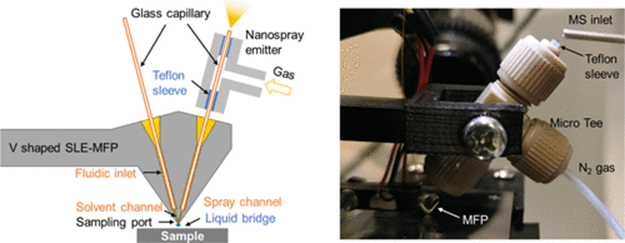
Figure 1. Schematic diagram (left) and photo (right) of the pneumatically assisted multifunctional integrated device..
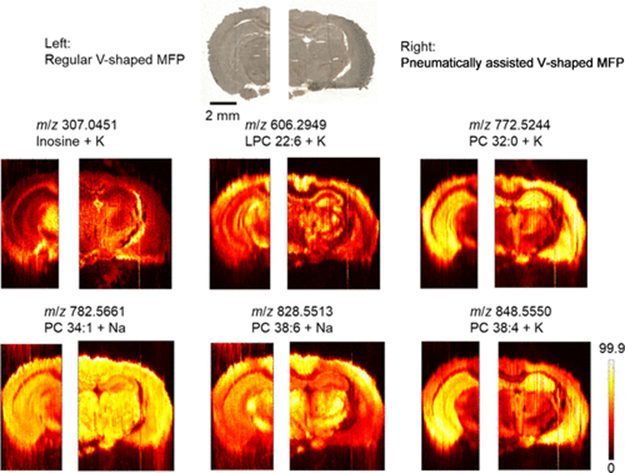
Figure 2. Optical images of molecules and representative positive ion images obtained from mouse brain tissue using a conventional V-shaped MFP with a 65 μm channel (left) and a pneumatically assisted V-shaped MFP (right). Both experiments were conducted at a scanning speed of 400 μm/s, a line spacing of 50 μm, and an MS acquisition rate of 20 Hz. The flow rate of the conventional V-shaped MFP was 0.5 μL/min, while the flow rate of the pneumatically assisted probe at a nebulizer gas pressure of 1.7 bar was 1.8 μL/min. The ion images were normalized to the total ion count (TIC). Scale bar, 2 mm; intensity scale, black (low) and yellow (high).
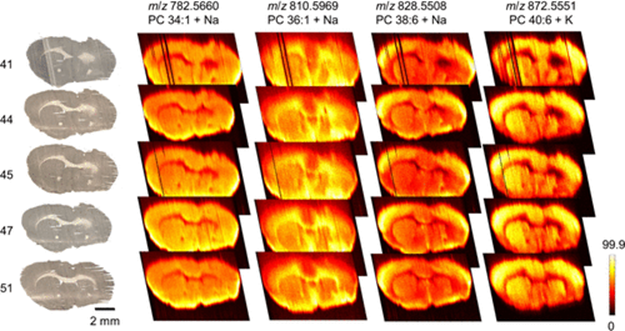
Figure 3. Optical images of molecules and representative positive ion images obtained from five 18 μm thick mouse brain tissue slices using the same pneumatically assisted V-shaped MFP with a 30 μm channel. The number next to each optical image indicates the order of the brain tissue slices. The experiments were conducted using a nebulizer gas pressure of 2.0–2.2 bar, a flow rate of 1.0 μL/min, a scanning speed of 400 μm/s, a line spacing of 50 μm, and an MS acquisition rate of 20 Hz. The ion images were normalized to TIC. Scale bar, 2 mm; intensity scale, black (low) and yellow (high).
04Conclusion
This study successfully incorporated nebulizer gas into the V-shaped MFP and evaluated its performance by imaging multiple mouse brain tissue slices using the same probe. Unlike the conventional V-shaped multifunctional integrated device, the pneumatically assisted version operates independently of the vacuum suction at the mass spectrometer inlet, achieving high and stable solvent flow rates. This enhanced functionality is crucial for multifunctional integrated devices with small microfluidic channels (≤30 μm), which would otherwise be unsuitable for high-throughput MSI experiments. Additionally, the stable flow rate extends the lifespan of the MFP, allowing for continuous imaging of five mouse brain slices using the same pneumatically assisted MFP without the need for cleaning.

Author: Huang Yiting
Original link: https://pubs.acs.org/doi/10.1021/jasms.5c00011