First Author: Seung-Hyeon Kim (UNIST)Corresponding Authors: Runnan Guan, Qunxiang Li, Hankwon Lim, Jong-Beom Baek (UNIST & USTC)
Research BackgroundAmmonia (NH₃) is a highly promising hydrogen carrier (containing 17.6 wt% hydrogen), but traditional thermal catalytic cracking requires 400–600 °C, resulting in a mixture of H₂/N₂/NH₃, with subsequent PSA purification accounting for 47.6% of the total equipment cost, becoming the biggest bottleneck for the hydrogen economy. The NH₃-Si reaction theoretically can generate H₂ + Si₃N₄ in one step, but it is difficult to initiate under mild conditions due to the high activation energy of the Si surface (2.56 eV).
Research ObjectiveTo overcome the activation energy barrier of the NH₃-Si reaction using “dynamic” mechanochemistry (ball milling), achieving 100% NH₃ conversion and 100% H₂ purity at room temperature and pressure without separation steps, while recycling photovoltaic waste silicon into high-value Si₃N₄, balancing environmental protection and economic viability.
Experimental MethodUsing a planetary ball mill (ZrO₂ balls) to in situ grind Si powder or waste silicon wafers with NH₃; DFT calculations to analyze strain-energy barrier relationships; tracking the dynamic process of Si defects → NH₃ adsorption → Si₃N₄ generation using XRD, XPS, EPR, TPD-MS, FT-IR, TOF-SIMS, and TEM-EDS; verifying scalability with a continuous ball mill; conducting a techno-economic analysis comparing traditional cracking.
Main Findings
-
Significant Energy Barrier Reduction: Dynamic ball milling introduces a reaction energy barrier of 0.90 eV (vs static 2.56 eV), achieving 100% NH₃ conversion within 24 minutes and a H₂ production rate of 102.5 mmol h⁻¹.
-
No Separation Required: The products are only H₂ + solid Si₃N₄, with no need for PSA; stable production rate of 13.4 mmol h⁻¹ over 5 hours of continuous operation.
-
Waste Silicon Utilization: The hydrogen production performance of waste silicon wafers is comparable to commercial silicon; each kg of waste silicon can produce 32.9 mmol H₂ and co-produce high-value Si₃N₄, with a unit H₂ cost of −7.14 USD kg⁻¹ (including co-product revenue).
-
Mechanism: The compressive strain and nano-defects generated by ball milling (EPR Si• signal) increase the NH₃ adsorption energy from −1.94 eV to −4.27 eV, forming Si-NHₓ → Si-N → Si₃N₄, all at temperatures <50 °C.
Figure Interpretation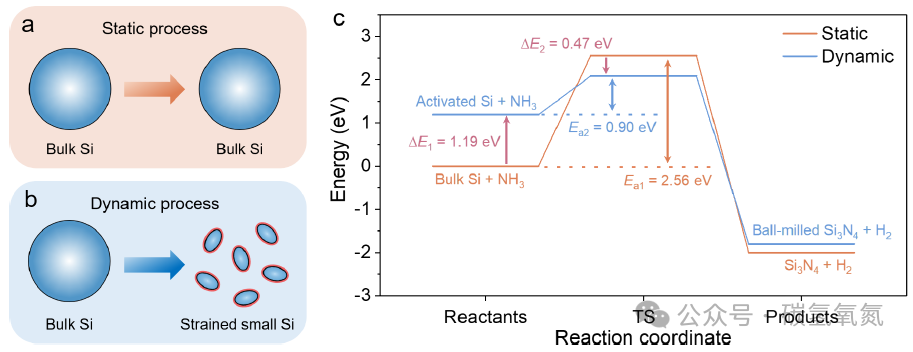
Figure 1 Static vs Dynamic NH₃-Si Reactiona Static: Energy barrier 2.56 eV, conversion rate <0.04%.b Dynamic: Ball milling induces strain, energy barrier 0.90 eV.c Energy profile: Dynamic pathway significantly reduces Ea.
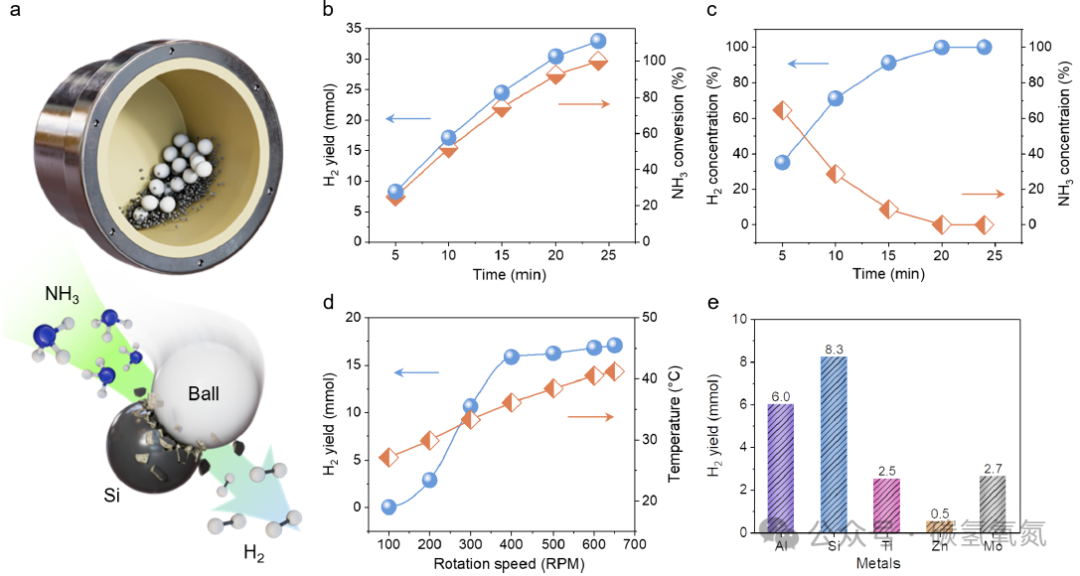
Figure 2 Mechanochemical NH₃-Si Reaction Performancea Schematic: Ball milling – hydrogen production – Si₃N₄ production.b Grinding time – H₂ production rate: plateau reached at 24 min.c GC: Only H₂, no N₂.d Speed – production rate: 300 rpm is sufficient, temperature <50 °C.e Metal comparison: Si has the highest activity.
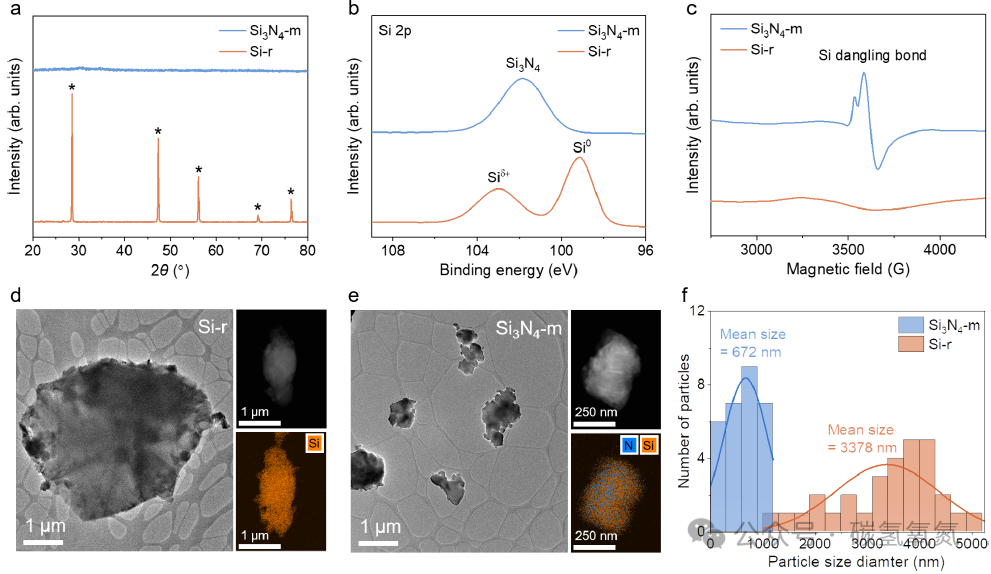
Figure 3 Si → Si₃N₄ Structural Evolutiona XRD: Si peak disappears, amorphous Si₃N₄ forms.b XPS: Si⁰ → Si-N bond.c EPR: Si defect signal confirmed.d,e TEM: Particle size decreases from 3380 nm to 670 nm, EDS shows uniform N distribution.f Particle size distribution statistics.
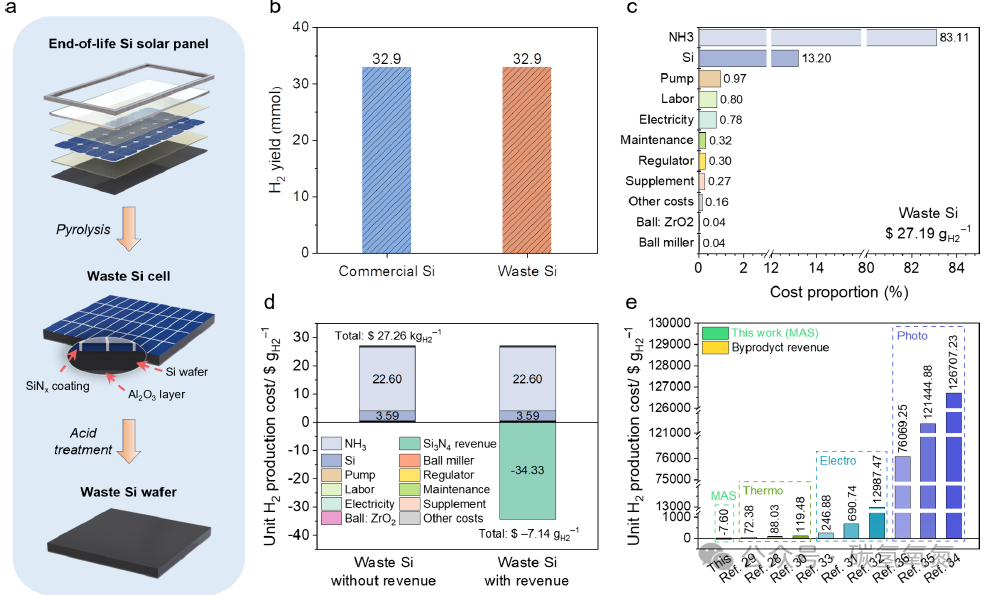
Figure 4 Waste Silicon Recycling and Economic Assessmenta Process: Waste silicon wafers → ball milling → H₂ + Si₃N₄.b Comparison of hydrogen production from waste silicon and commercial silicon.c Cost composition: NH₃ 83%, Si 13%.d Unit H₂ cost of −7.14 USD kg⁻¹ after including co-product revenue.e Comparison of costs with thermal/photo/electrolysis cracking: MAS is the only negative cost.
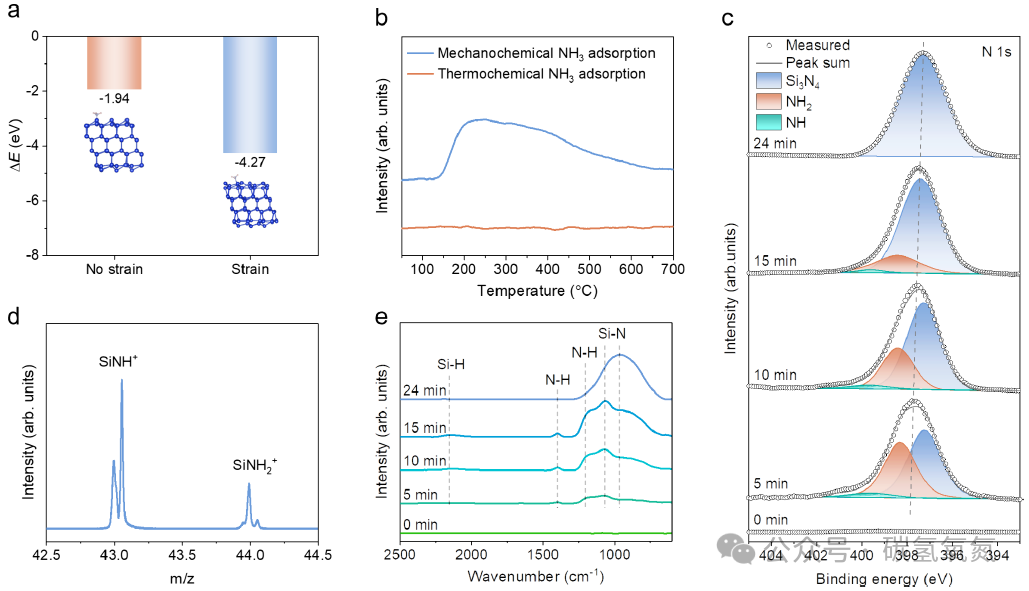
Figure 5 Mechanism Experiment – Theory Combineda DFT: Strain enhances NH₃ adsorption.b TPD-MS: Strong adsorption sites generated under dynamic conditions.c Time-resolved XPS: NH₃ → Si-NHₓ → Si-N → Si₃N₄.d TOF-SIMS: SiNH⁺/SiNH₂⁺ intermediates.e FT-IR: Si-N peak enhanced, N-H peak disappeared.
Conclusion and OutlookThe mechanochemical NH₃-Si (MAS) reaction achieves separation-free high-purity hydrogen production at room temperature while simultaneously recycling photovoltaic waste silicon into high-value Si₃N₄, with an energy consumption of only 5.8 kWh mol⁻¹ H₂ and a cost of −7.14 USD kg⁻¹, providing a new circular, low-carbon, commercially viable route for the hydrogen economy. The next step will be to optimize continuous equipment, scale up to ton-level waste processing, and explore mechanochemistry for other hydrogen carrier cracking.
Reference Information: Kim, S.-H., Guan, R., Gu, J., Shao, Y., Zhao, Q., Sheng, L., Lee, J. S., Lee, S. J., Baek, J.-H., Li, C., Li, J., Li, Q., Lim, H., & Baek, J.-B. (2025). Separation-Free High-Purity Hydrogen Production via the Mechanochemical Ammonia–Silicon Reaction under Mild Conditions. Journal of the American Chemical Society. https://doi.org/10.1021/jacs.5c10245
Literature Transfer: Nat. Nanotechnol. Mechanochemistry Aids CO2 Capture and Conversion Sci. Adv.: Mechanochemistry Accelerates the Decomposition of Recyclable Plastics
Please open in the WeChat client