Hello everyone, this week I am sharing an article published in JACS titled “Late-Stage Aromatic C–H Bond Functionalization for Cysteine/Selenocysteine Bioconjugation.” The corresponding authors are Professor Wang Binju from Xiamen University, Dr. Daphna Shimon from Hebrew University, and Professor Norman Metanis. Professor Wang’s research focuses on multiscale theoretical simulations of chemical reactions in aqueous solutions and protein environments, Dr. Shimon’s research focuses on magnetic resonance techniques, and the Metanis group specializes in the total chemical synthesis of proteins, particularly selenoproteins.
Peptide and protein bioconjugation has greatly enhanced our understanding of biological processes. Cysteine (Cys) and selenocysteine (Sec) are often chosen as target amino acids by chemists due to their high reactivity and low protein abundance. Representative strategies for Sec/Cys-specific bioconjugation previously reported include the creation of reactive sites in target proteins (e.g., TNP), pre-installation of reactive groups on Sec/Cys, or electrochemical/photochemical catalysis of diselenides. In contrast to these strategies, the direct coupling of aromatic C–H bonds with Cys/Sec in complex molecules represents a simple and ideal method for protein bioconjugation.
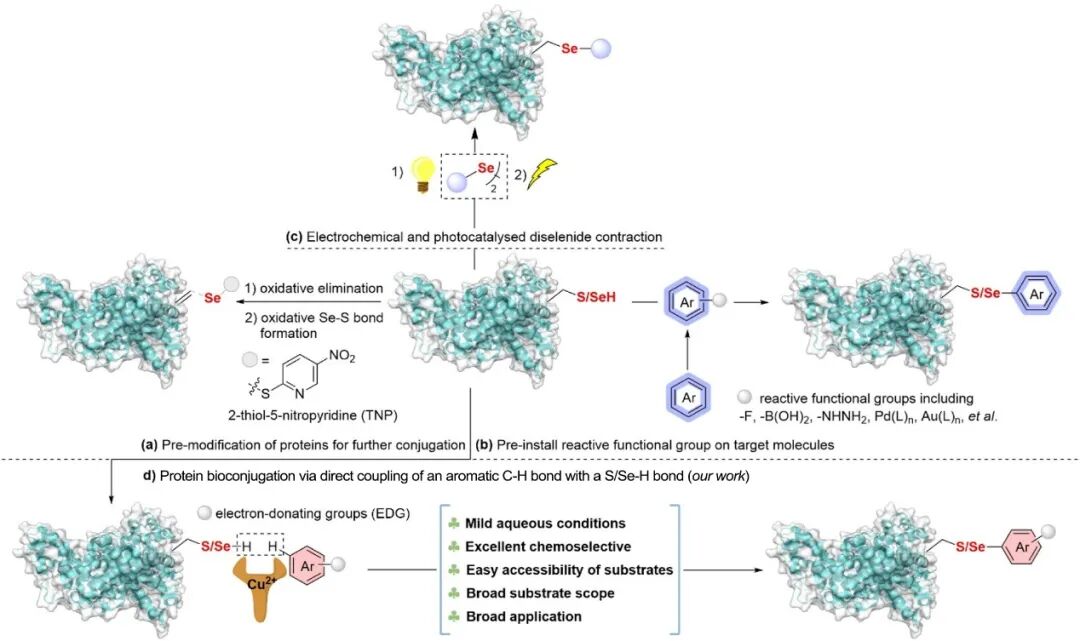
This article reports a copper-mediated coupling reaction between aromatic C–H bonds and S/Se-H bonds under biocompatible conditions. Specifically, inspired by previous research results, the authors discovered that under the catalysis of Cu2+, electron-rich catechols can couple with Sec/Cys. They conducted a substrate scope study and found that the reaction has a broad substrate range (from electron-rich aromatics, heteroaromatic compounds to even natural products), while achieving specificity for Sec by varying the substrates.
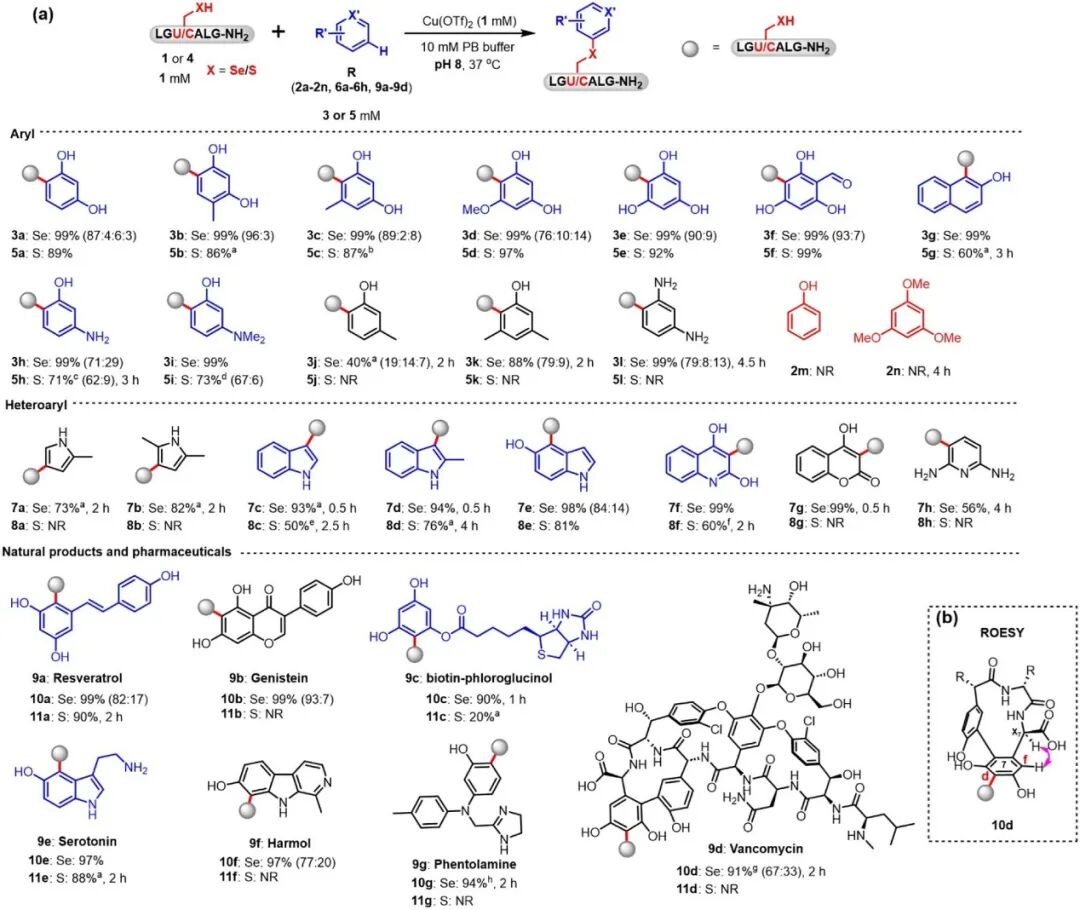
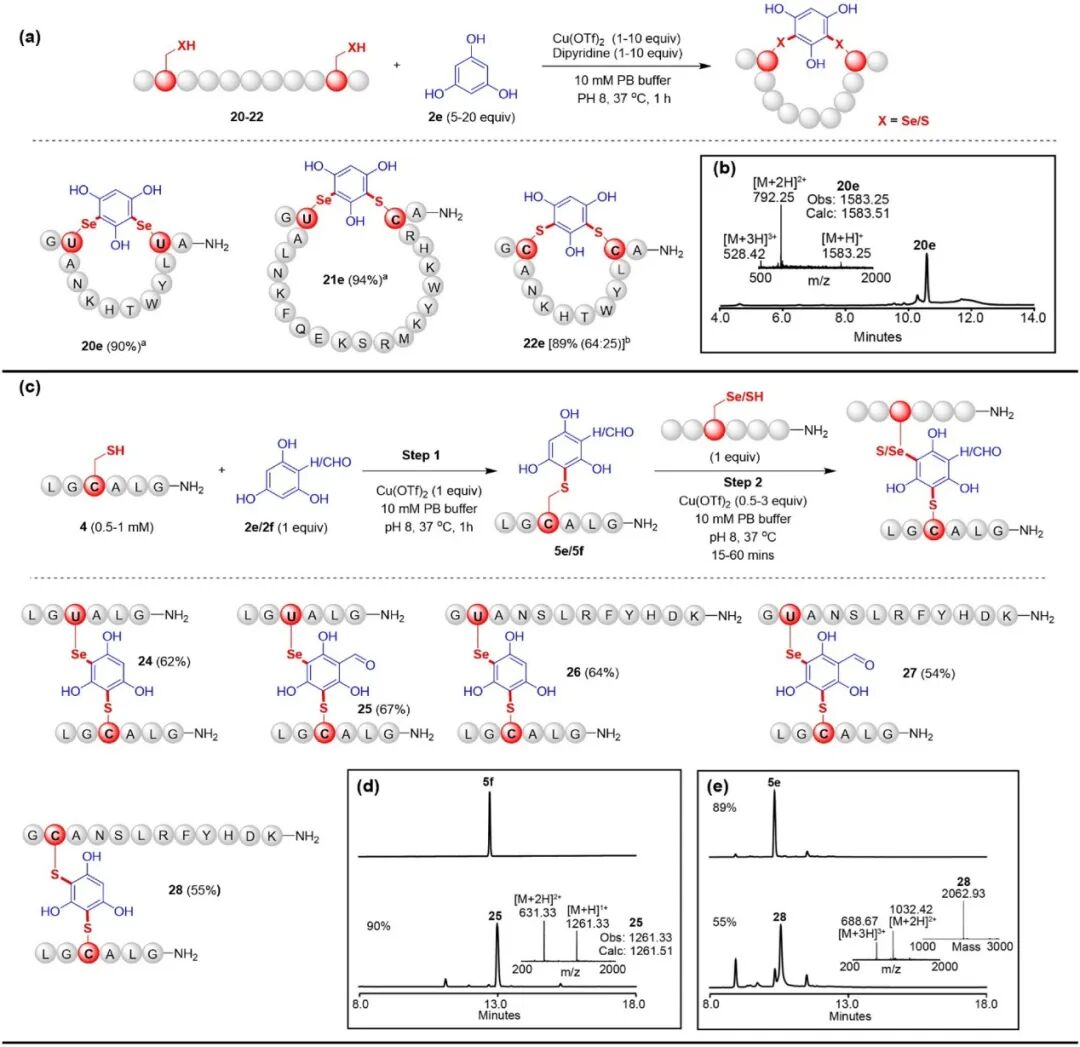
Subsequently, to evaluate the applicability of this coupling method to complex target molecules, the authors demonstrated that peptides containing Sec/Cys have good conversion rates, while peptides lacking Sec/Cys remain inert, indicating that the reaction has high selectivity for Sec/Cys. The authors then identified several potential application scenarios, starting with cyclic peptides and cross-linked peptides. They successfully synthesized cyclic peptides with high yields using catechol analogs and synthesized cross-linked peptides using this method. Furthermore, they validated the functional modification of proteins, successfully modifying serotonin and vancomycin on proteins containing Sec/Cys. Finally, the authors conducted DFT calculations to study the reaction mechanism.
In summary, this article develops an efficient and broadly applicable method for the chemical selective modification of peptides and proteins containing Sec and/or Cys under mild conditions.
Author: YDP
Editor: LYC
DOI: 10.1021/jacs.5c08936
Original link: https://doi.org/10.1021/jacs.5c08936