Recently, during interviews, I found that many hardware test engineers are completely unaware of the concept of oscilloscope bandwidth, and some with over three years of experience do not understand the concept of bandwidth. Some candidates can roughly state the conclusion: the recommended bandwidth for an oscilloscope should be 3-5 times the signal frequency. However, they are at a loss when it comes to actual calculations. Based on my understanding, I will introduce relevant concepts, and corrections are welcome if there are any inaccuracies.1. What is oscilloscope bandwidth?
According to Tektronix training documentation, the bandwidth of an oscilloscope is defined by applying a fixed voltage sinusoidal signal to the input, gradually increasing the frequency of this sinusoidal signal until the voltage displayed on the oscilloscope is 0.707 times the original value or -3dB. The frequency at this point is the specified bandwidth of the oscilloscope.
2. Why is a sinusoidal wave chosen for the above definition instead of the square wave we often encounter?
Based on Fourier transform knowledge, the frequency components of a sinusoidal wave are singular, whereas a square wave contains many frequency components. (It can be understood that a square wave is composed of countless superimposed sinusoidal waves.) Therefore, it is more appropriate to define using the singular frequency of a sinusoidal wave.
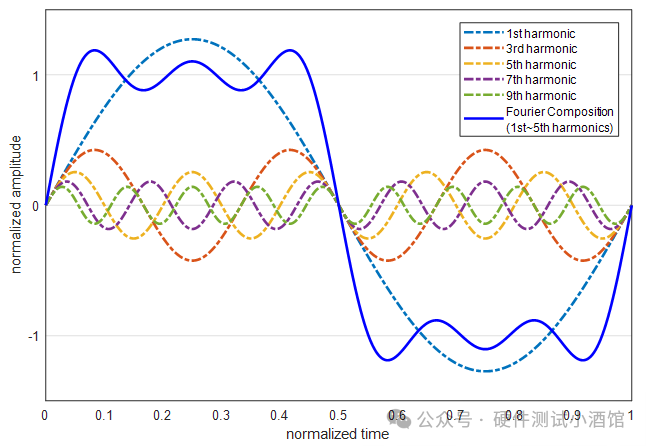
3. What is the biggest impact when using a 1GHz bandwidth oscilloscope to test a 1GHz sinusoidal wave? The definition of oscilloscope bandwidth is based on the -3dB point, which corresponds to the amplitude decreasing to 0.707 times the original signal. Therefore, the biggest impact is that the actual measured amplitude of the signal will become 0.707 times the true value.4. For sinusoidal wave testing, the situation when selecting different oscilloscope bandwidths is as follows: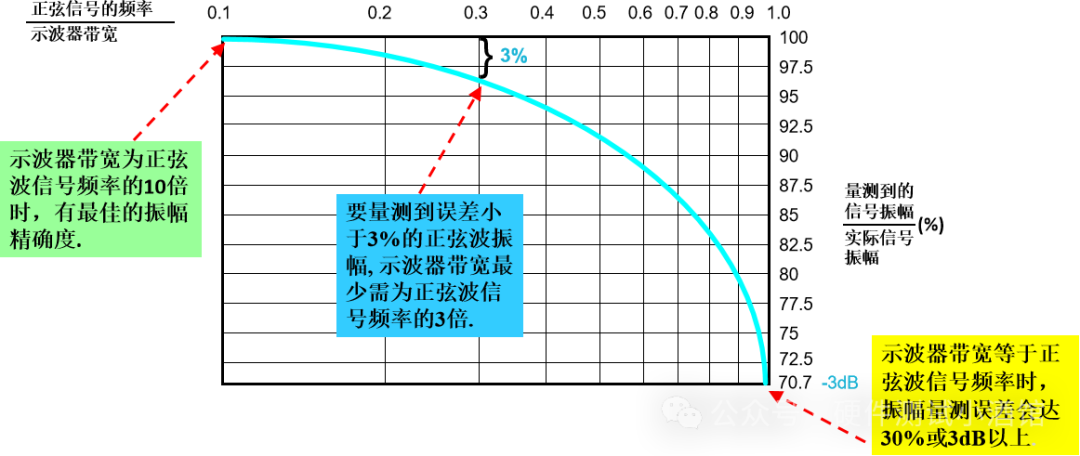 This leads to the earlier mention of “3”. For the simplest sinusoidal signal, to achieve an amplitude error ratio of less than 3%, at least 3 times the signal frequency is needed to select the oscilloscope bandwidth.5. How to calculate signal frequency? What is the frequency of PCIe 3.0 signals? (Given 8GT/s)Let’s think about what 8GT/s represents? For a specific signal line, it means that 8 billion bits are transmitted in 1 second. What is the highest frequency corresponding to transmitting 8 billion bits in 1 second? Many people might think it is 8GHz. The reason 8GHz is incorrect is that to form one cycle, at least one “1” and one “0” are required, i.e., 2 bits. If all 8 billion bits are “1” or all “0”, it would be a straight line and wouldn’t constitute a cycle. Therefore, the correct answer is that the maximum frequency of PCIe 3.0 signals is 4GHz.6. How does the steepness of the edge of a square wave (fast edge signal) affect oscilloscope bandwidth selection? The steeper the edge, the more high-frequency components it corresponds to, and the greater the required oscilloscope bandwidth.
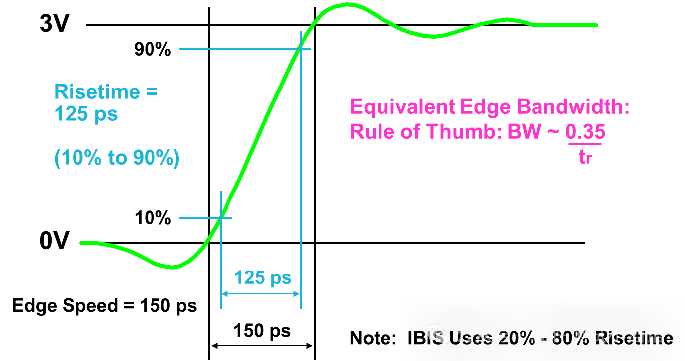 How is the aforementioned “0.35” derived? The derivation process is as follows:
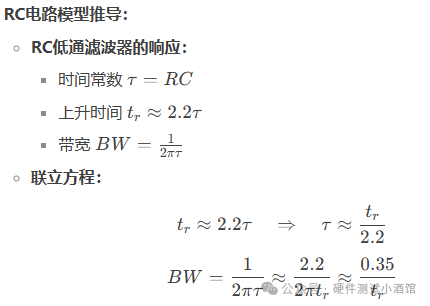 In fact, oscilloscopes cannot be ideal RC low-pass filters. Currently, Tektronix uses maximally flat filters, which have a coefficient of 0.39-0.4. Those using brick-wall filters have a coefficient of 0.45-0.5. The higher the coefficient, the higher the oscilloscope bandwidth required for precise measurement.Note:
- The images in the text are sourced from Tektronix training materials.
- The response derivation of the RC low-pass filter is sourced from Deepseek.
- The cover illustration is sourced from Doubao.