Hello everyone, today I would like to share a recent article published in the Journal of the American Chemical Society, titled:Red Light-Driven, Oxygen-Tolerant RAFT Polymerization Enabled by Methylene Blue.The corresponding author of this article is Professor Krzysztof Matyjaszewski from Carnegie Mellon University.
Controlled radical polymerization (RDRP) techniques (such as RAFT, ATRP) have become core tools for synthesizing advanced polymer materials by precisely controlling polymer molecular weight and structure. Photo-induced RDRP (photoRDRP) further utilizes the controllability of light to construct complex polymer architectures under mild conditions. However, oxygen quenches radical intermediates, which has long restricted its practical application, forcing the reaction system to be strictly deoxygenated (e.g., freeze-thaw cycles or inert gas protection). To overcome this bottleneck, researchers have developed various oxygen-tolerant strategies: enzyme-mediated RAFT, photocatalysis PET-RAFT and organic photocatalysts, but all have significant limitations.
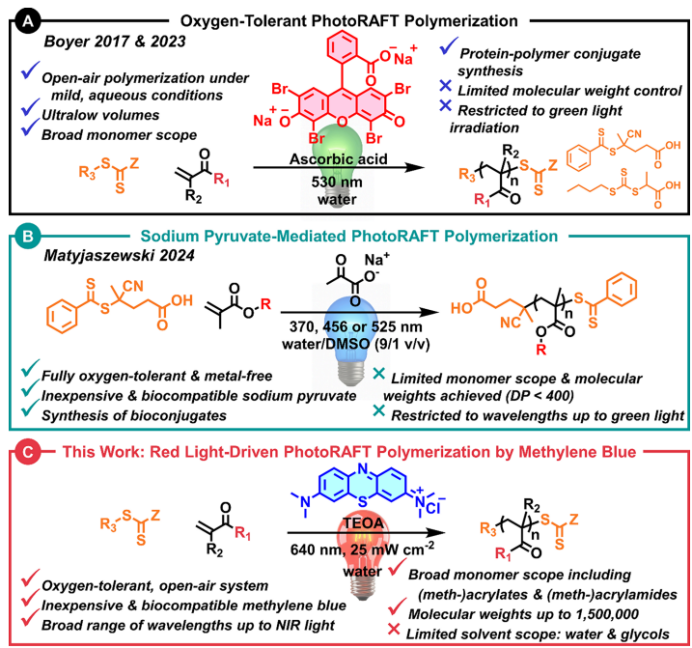
Figure 1. Overview of representative oxygen-tolerant light-induced RAFT(photoRAFT) strategies. (A) The system developed by Boyer et al. using Rose Bengal Y/ascorbic acid achieves green light-driven open aqueous phase polymerization, with broad monomer applicability, but is limited by short wavelengths and ultra-low reaction volumes (42,43); (B) The sodium pyruvate-mediated light RAFT system reported by Matyjaszewski’s team exhibits complete oxygen tolerance and bioconjugation compatibility in the UV-green light range, but has a narrow monomer range and limited molecular weight (44); (C) This work: We propose a red light-driven methylene blue (MB+)/triethanolamine (TEOA) RAFT polymerization platform, which has complete oxygen tolerance, can operate under ambient conditions or even sunlight, is compatible with various monomers, and can synthesize ultra-high molecular weight polymers (Mn > 1,000,000).
As shown in Figure 1, the system developed by Boyer et al. using Rose Bengal Y/ascorbic acid (Figure 1A) achieves open aqueous phase polymerization but is limited to green light and microliter scales; Matyjaszewski’s team’s sodium pyruvate strategy (Figure 1B) enhances biocompatibility but sacrifices molecular weight limits and monomer universality. Red light (600–750 nm) is considered an ideal excitation light source due to its deep tissue penetration and biological safety, but no metal-free red light catalytic system has yet solved the oxygen inhibition problem.
In this context, the research team proposed a methylene blue (MB⁺)/triethanolamine (TEOA dual-component photocatalytic system: utilizing the red light absorption characteristics of the low-cost, biocompatible dye MB⁺, combined with the electron-donating ability of TEOA, we achieved for the first time red light/sunlight-driven RAFT polymerization in a fully open system, and successfully synthesized ultra-high molecular weight (UHMW > 10⁶ g/mol) polymers, providing a new solution for oxygen-tolerant RDRP.
In the experiments, N,N-dimethylacrylamide (DMA) was used as the model monomer. Optimization indicated that:MB⁺ and TEOA concentrations need to be controlled synergistically (Table 1). When [MB⁺]=150 μM, [TEOA]=20 mM, the open system conversion rate reached 95%, and the molecular weight distribution (Ð) was only 1.13.
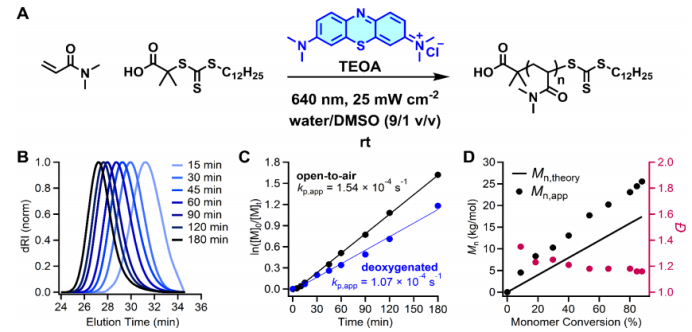
Figure 2. (A) Schematic diagram of the mechanism of the DMA RAFT polymerization reaction mediated by methylene blue (MB+). (B) Evolution of SEC spectra during the DMA polymerization mediated by MB+, showing a monomodal distribution shifting towards shorter elution times, indicating continuous molecular weight growth.(C) Quasi-first-order kinetic curves show linear kinetic characteristics and stable radical concentrations under both open and deoxygenated conditions.(D) The relationship between apparent molecular weight (Mn,app) and monomer conversion rate, showing linear growth of molecular weight with low dispersity(Đ ≤ 1.20) until conversion rates exceed 90%.
Kinetic studies revealed the oxygen tolerance mechanism (Figure 2). In the open system, the SEC curve shows a single peak shift (Figure 2B), and molecular weight increases linearly with conversion rate (Figure 2D). Interestingly, the polymerization rate in the open system (kₚₐₚₚ=1.54×10⁻⁴ s⁻¹) is 30% faster than that in the deoxygenated system (Figure 2C), which is attributed to oxygen promoting the regeneration of MB⁺—the excited state MB⁺* is reduced by TEOA to form MB•, and oxygen can reoxidize it to MB⁺, forming a catalytic cycle.
The most groundbreaking achievement of this system is the synthesis of UHMW polymers in an open system. When the target degree of polymerization (DPₜ) reaches 20,000, by reducing [MB⁺] to 26 μM (to avoid excessive radicals), we successfully obtained Mₙ,abs=1,290,000 g/mol of PDMA (Ð=1.52), which highly matches the theoretical value (Figure 3A). This is the first breakthrough of over one million molecular weight in the field of oxygen-tolerant RDRP.
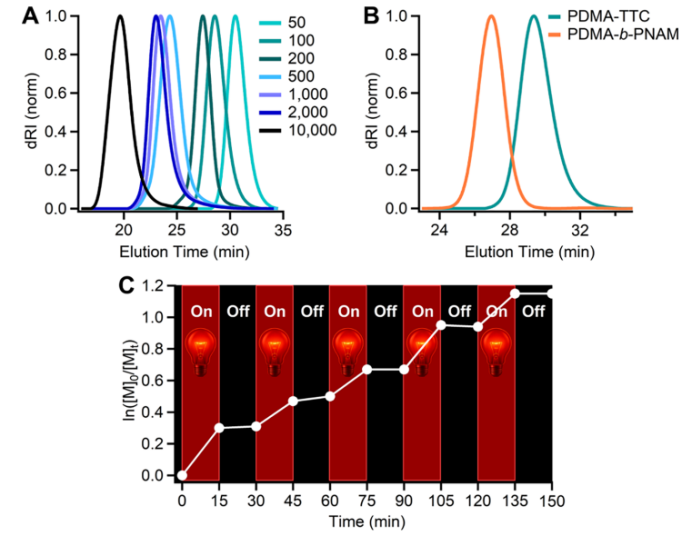
Figure 3. (A) Changes in SEC spectra of PDMA at different target degrees of polymerization. (B) Chain extension reaction of PDMA macroinitiator with NAM monomer to generate PDMA-b-PNAM block copolymer.(C) Time-controlled experiments during the RAFT polymerization mediated by MB+.
The active characteristics were confirmed through triple experiments: first, chain extension experiments showed that the PDMA macroinitiator can efficiently synthesize PDMA-b-PNAM block copolymers, with SEC curves showing no shoulder peaks (Figure 3B); secondly, light-switch experiments demonstrated that polymerization can be paused and restarted five times (Figure 3C), with zero conversion during dark periods; finally, 13C-NMR confirmed the integrity of the ω-thiocarbonate end groups. These results collectively validate the excellent chain end fidelity.
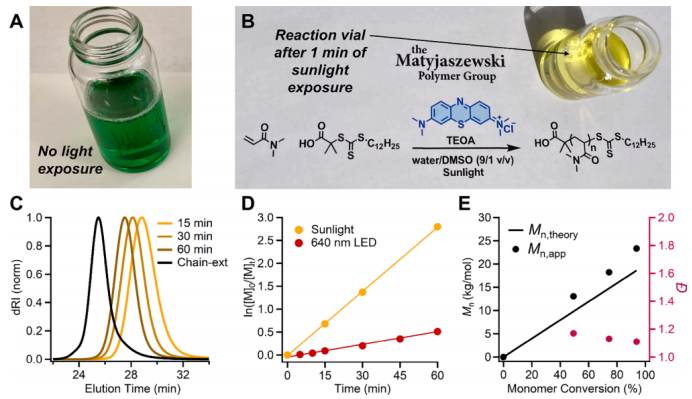
Figure 4. Methylene blue (MB⁺)/triethanolamine (TEOA) mediated sunlight-driven RAFT polymerization (A) Reaction mixture before sunlight irradiation, showing green color formed by the combination of blue MB⁺ and yellow TTC chain transfer agent. (B) Schematic diagram of the reaction mechanism and physical photo after 1 minute of sunlight irradiation: the green color quickly fades (producing colorless reduced methylene blue, LMB), confirming efficient light activation.(C) Time evolution of SEC spectra during sunlight-driven polymerization.(D) Quasi-first-order kinetic curves.(E) The relationship between apparent molecular weight (Mn,app) and conversion rate.
The broad spectral absorption characteristics of MB⁺ allow the system to adapt to various light sources. Except for 370 nm UV light causing end group decomposition, blue/green/red/near-infrared light all achieve >90% conversion (Ð<1.14). More notably, the sunlight-driven effect (Figure 4): in an open bottle, a 13 mL reaction system reached a conversion rate of 94% after 1 hour of sunlight irradiation, with a rate 5 times higher than that of red light (kₚₐₚₚ=7.78×10⁻⁴ s⁻¹), and successfully achieved in situ block copolymerization (Figure 4C), confirming that chain end stability is maintained even under sunlight.
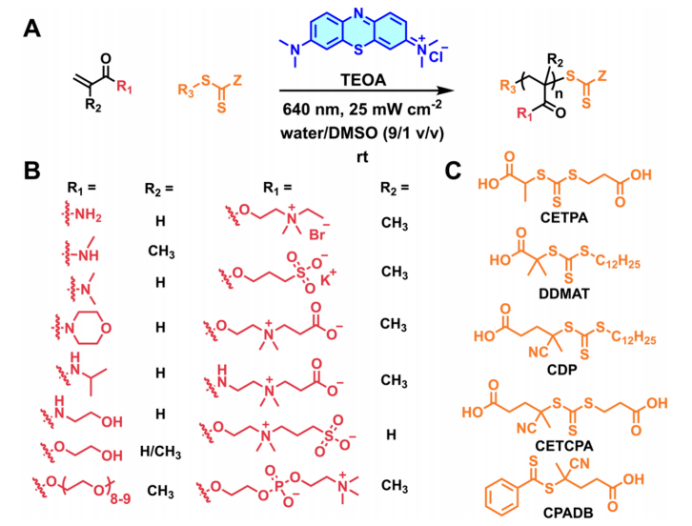
Figure 5. (A) General formula of the red light-driven RAFT polymerization reaction mediated by the MB⁺/TEOA photoinitiating system (covering various (meth)acrylate and (meth)acrylamide monomers). (B) Demonstration of the monomer applicability of the MB⁺ system: compatible with (meth)acrylate and (meth)acrylamide monomers containing polar/charged/zwitterionic functional groups. (C) Study of the applicability of chain transfer agents (CTA).
The monomer universality study (Figure 5) covers hydrophilic acrylates/acrylamides and functional monomers. In addition to conventional monomers (such as DMA, NAM), the system is also compatible with charged sulfonium betaine acrylate (SBMA), carboxybetaine acrylate (CBMA), and difficult-to-polymerize acrylamides (NMMA, HPMA). Particularly in ethylene glycol solvent, NMMA polymerization achieved Ð as low as 1.15, breaking the bottleneck of acrylamide RDRP.
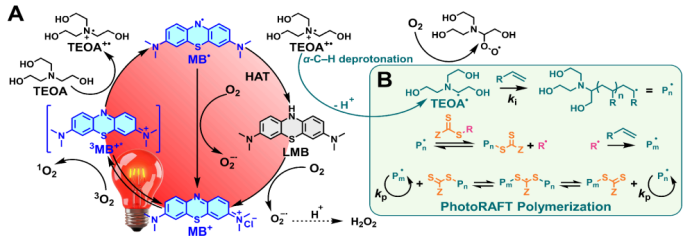
Figure 6. (A) Proposed mechanism of the MB⁺/TEOA mediated light RAFT polymerization. Under visible light excitation, MB⁺ transitions to a triplet excited state (³MB⁺*), which is reduced by tertiary amines (such as TEOA) to generate the semi-reduced state MB radical (MB•) and amine cation radical (R₃N⁺•). Subsequently, α-C-H deprotonation forms a highly active α-aminoalkyl radical, which can initiate polymerization.MB• has competitive pathways including: reoxidation by O₂ to regenerate MB⁺, or generating photoinactive reduced methylene blue (LMB). (B) RAFT polymerization process: α-aminoalkyl radicals add to electron-deficient vinyl monomers, forming growing chain radicals (Pₙ•). This radical adds to the chain transfer agent (CTA) to generate thioester intermediate radicals, which release R radicals (R•) as secondary initiators, forming new growing chain radicals (Pₘ•). Pₙ• and Pₘ• dynamically exchange active and dormant species through the RAFT equilibrium process, achieving controlled polymerization.
Unlike PET-RAFT, this system indirectly initiates polymerization through α-aminoalkyl radicals (Figure 6). The excited state ³MB⁺ (E=+1.60 V vs SCE) is reduced by TEOA (E=+0.76 V) to generate amine cation radicals, which deprotonate to form highly active α-aminoalkyl radicals. This radical has dual functions: rapidly consuming dissolved oxygen to achieve self-deoxygenation while initiating monomer polymerization. Meanwhile, MB• can be reoxidized by O₂ to maintain the cycle, or generate superoxide radicals (O₂•⁻) to accelerate deoxygenation.
In summary, the MB⁺/TEOA system achieves red light/sunlight-driven RAFT polymerization in an open environment for the first time through a unique α-aminoalkyl radical-mediated mechanism, solving the oxygen inhibition problem. Its core advantages of being metal-free, enabling ultra-high molecular weight synthesis, and broad monomer compatibility can be expanded to applications such as 3D bioprinting and in situ tissue repair coatings, bringing breakthroughs to the field of biomaterials.
Author:ZY
DOI: 10.1021/jacs.5c10541
Link: https://doi.org/10.1021/jacs.5c10541
Previous article