Hello everyone, today I would like to share a recent article published in the Journal of the American Chemical Society, titled:Recyclable Inorganic Subnanowire Plastics.The corresponding authors of this article are Professor Zhang Simin from Beijing Institute of Technology and Professor Wang Xun from Tsinghua University.
Plastic waste has become a major environmental issue globally, leading to white pollution. Traditional mechanical recycling is limited by the number of cycles and processing costs, while chemical recycling faces problems such as secondary pollution and inefficiency. In this context, subnanowire (SNWs) materials stand out due to their unique structural characteristics—combining the functionality of inorganic materials (polarization, photothermal, fluorescence, catalysis, etc.) with the processing performance of polymer materials (flexibility, rheology, etc.). This innovative material, which simulates the polymer backbone with an inorganic framework and achieves functional regulation through surface ligands, has shown great application potential in functional materials such as fluorescent polarizing films and lithium-sulfur battery separators, providing breakthrough solutions for the development of new environmentally friendly materials.
In this article, the authors developed a novel dynamic cross-linked inorganic subnanowire plastic (SNW plastic). Using GdOOH as a model, a dynamic network was constructed through the DAD/OM-THDI cross-linking system (Figure 1A), achieving high-performance materials with a tensile strength of 30.55 MPa and a Young’s modulus of 1.46 GPa, outperforming existing dynamically cross-linked recyclable plastics. This material can be recycled through simple thermal pressing without the need for catalysts or acid-base treatment. This method is universal and has been successfully applied to multi-systems such as rare earth oxides, achieving the integration of “inorganic functionality–polymer processing characteristics, providing an innovative solution for the development of new recyclable materials.
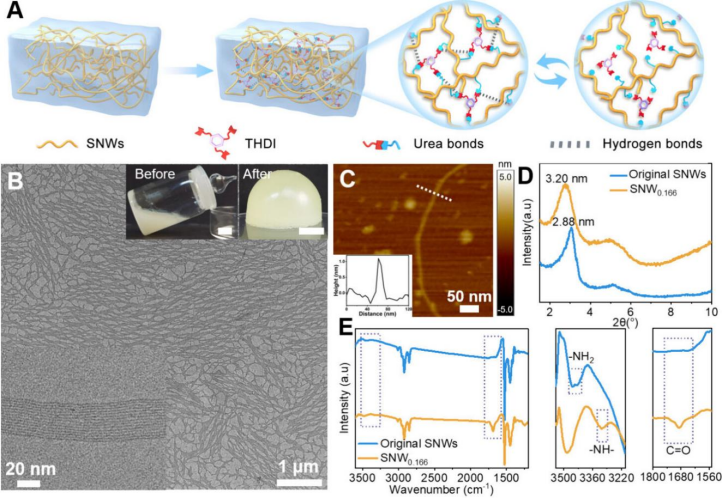
Figure1. Characterization results of subnanowires:(A)Illustration of the cross-linking reaction of SNWs. (B)Transmission electron microscopy image of SNW0.166, with the upper right inset showing the physical photo of the sample before and after cross-linking (scale bar is 1 cm). (C)Atomic force microscopy morphology image of SNW0.166, with the inset showing the line scan profile corresponding to the dashed line. (D)X-ray diffraction patterns of original SNWs and SNW0.166. (E)Infrared spectra of original SNWs and SNW0.166.
The preparation of GdOOH SNW was carried out using a previously reported solvothermal method: GdCl3 was reacted with oleic acid/oil amine in an ethanol-water system, and purified by centrifugation to obtain one-dimensional nanowires with a diameter of 1nm and a length of several micrometers. The original SNWs were physically cross-linked through molecular entanglement and van der Waals forces. Transmission electron microscopy (TEM) and atomic force microscopy (AFM) characterization showed that they have a one-dimensional structure approximately several micrometers long and about 1 nm in diameter. After introducing the THDI cross-linking agent, a three-dimensional network of SNW0.166 was constructed through urea bonds and hydrogen bonds (Figure 1B), and the cross-linked SNW0.166 can form independent gels (Figure 1B inset). The cross-linked material still maintains a one-dimensional nanowire structure, with a diameter of about 1 nm (Figure 1C), and the spacing between adjacent SNWs increased from 2.88 nm to 3.20 nm (Figure 1D).
Fourier transform infrared spectroscopy (FTIR) further confirmed the structural characteristics of SNW0.166 (Figure 1E). In the spectrum of the original SNWs, characteristic peaks of primary amine groups (-NH2) were observed at 3460 and 3434 cm-1, corresponding to the terminal groups of the surface DAD ligands. After reacting with THDI, a new characteristic peak appeared at 1685 cm-1, corresponding to the stretching vibration of the carbonyl group in the urea moiety. Additionally, the isocyanate groups of THDI (−NCO) showed a characteristic peak disappearing at 2200 ~2280 cm–1, proving that the isocyanate has completely reacted with the primary amine to form urea bonds, thus a new secondary amine peak (3313 cm–1) appeared. The above characterization results confirm the successful construction of urea-bonded SNWs and the presence of hydrogen bonding interactions between urea bonds in the system.
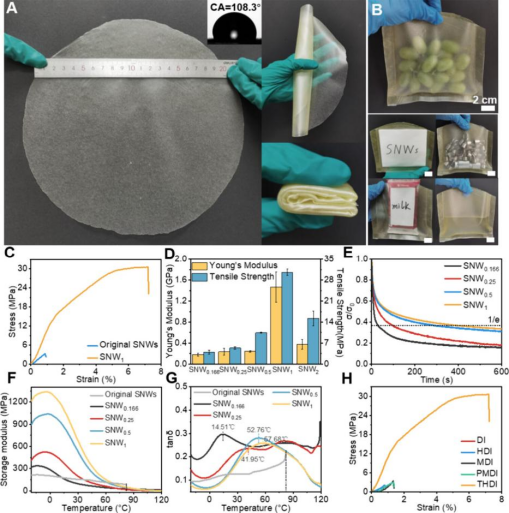
Figure2. Characterization results of SNW plastic::(A) Photo of SNW0.5 plastic film, with the inset showing the water contact angle test results of the film. (B) Physical image of SNW0.5 plastic bag carrying different items. (C) Comparison of stress-strain curves of original SNWs film and SNW1 film. (D) Young’s modulus and tensile strength of SNW plastic films prepared with different amounts of THDI. (E) Stress relaxation curves of films with different amounts of THDI. (F,G) DMA curves of films with different amounts of THDI. (H) Stress-strain curves of SNW plastic films prepared with different isocyanate cross-linking agents.
Cross-linked SNWs exhibited excellent plastic-like properties after complete drying and could be processed into flexible plastic films through thermal pressing. The resulting materials have outstanding mechanical properties, with the mechanical strength of SNW1 plastic film being nearly 10 times higher than that of the original SNWs (Figure 2C).
This material not only withstands repeated bending without damage (Figure 2A), but can also be processed into plastic bags that can carry various items (Figure 2B), while the original SNWs could only form powdery aggregates under the same conditions. The degree of cross-linking (x value) is a key factor affecting material performance: as the x value increases from 0.166 to 1, the tensile strength significantly increases (Figure 2D); however, when x=2, the material performance decreases due to the formation of white precipitates leading to an unstable network structure. Furthermore, the thermal-mechanical properties of the material are closely related to the degree of cross-linking; the higher the cross-linking degree, the weaker the stress relaxation (Figure 2E), and a significant glass transition temperature can be detected through DMA (up to 57.7℃), while both the storage modulus and rubber modulus increase with the degree of cross-linking (Figure 2F-G).
The structure of the isocyanate has a decisive impact on the material properties: single isocyanate groups (DI) cannot achieve cross-linking, while double isocyanate groups (HDI and MDI) can cross-link but with poor effectiveness (Figure 2H), indicating that both rigid segments (to stabilize the network) and flexible segments (to provide toughness) are needed to achieve optimal performance.
SNW plastic is cross-linked through dynamic urea bonds and reversible hydrogen bonds, combined with the rigid six-membered ring structure of THDI to prevent irreversible aggregation, achieving efficient thermal pressing and re-dispersible recycling. The specific recycling process involves: after thermal pressing the dried SNW1 block into a film, it is cut into pieces, stirred in toluene to re-disperse into a gel, and can be recycled after drying (Figure 3A). Among them, low cross-linking materials can be re-dispersed at room temperature due to fewer covalent bonds, while high cross-linked SNW1 requires heating to dissociate dynamic bonds. The material exhibits excellent recycling stability: after three chemical recycling processes, the mechanical properties are completely maintained (Figure 3B), and after five thermal pressing physical recycling, the performance only slightly decreases (Figure 3C), while also possessing good water stability, maintaining 80% of tensile strength after soaking for three days.
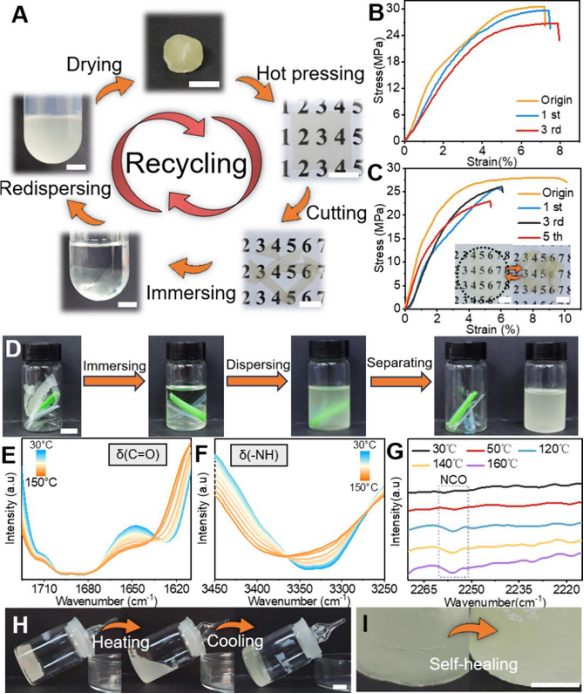
Figure3. Recycling of SNW plastic::(A) Schematic diagram of the closed-loop recycling process of SNW1 plastic. (B) Stability of mechanical properties of SNW plastic during the solvent method and (C) thermal pressing recovery process, with the inset showing a physical photo of the thermal pressing recovery process. (D) Selective recycling process of SNW1 plastic from mixed plastic waste containing PET, PVC, PP, PS, and HDPE. (E-G) Temperature-variable infrared spectra of SNW1. (H) Reversible sol-gel transition and (I) self-healing properties of SNW1 gel (all scale bars are 1cm).
SNW plastic can achieve efficient separation of mixed plastics through the re-dispersion process (Figure 3D). Temperature-variable FTIR analysis indicates that as the temperature increases, the stretching vibration peaks of the urea bond’s N-H and C=O undergo blue shifts and decrease in intensity (Figure 3E-F), while the isocyanate group peak at 2256 cm-1 gradually appears (Figure 3G). The material exhibits excellent dynamic properties: at 120°C, SNW1 gel can reversibly transform into sol, completely recovering after cooling (Figure 3H), and scratches can self-heal after heating (Figure 3I). In contrast, the original SNWs undergo irreversible aggregation after drying, losing their thermal pressing and re-dispersion capabilities.
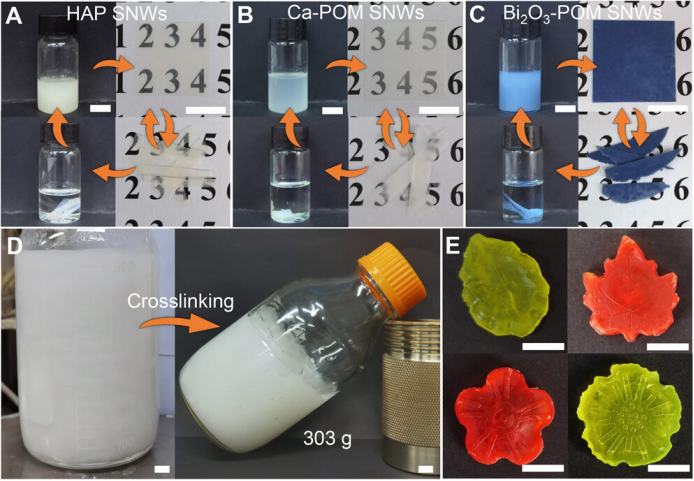
Figure4. Other SNW plastics and their extrusion molding:(A) HAP, (B) Ca-POM, and (C) Bi2O3-POM SNW plastic closed-loop recycling process schematic. (D) Enlarged synthesis of Ca-POM SNW plastic. (E) 3D model of SNW plastic (all scale bars are 1cm).
The SNW plastic developed based on dynamic cross-linking strategies exhibits excellent versatility and scalability. This strategy has been successfully applied to the preparation of various SNW plastics such as HAP, Ca-POM, and Bi2O3-POM (Figure 4A-C), and after cross-linking with THDI, they can achieve thermal pressing film formation and re-dispersible recycling. Notably, by scaling up the precursor, Ca-POM SNW plastic can be produced in bulk (yielding up to 303g, Figure 4D), and the material can fully retain the functional characteristics of non-cross-linked SNWs. Furthermore, SNW plastics can not only be formed through thermal pressing but can also be processed into various shapes and colors through extrusion (Figure 4E), fully demonstrating the advantages of this strategy in terms of scalability and processing adaptability.
In summary, this study has developed high-performance SNW plastics with tensile strengths comparable to HDPE, which can be recycled through simple thermal pressing. The preparation method is highly versatile and applicable to various SNW materials, and can be produced on a large scale. The materials support multiple processing techniques such as thermal pressing and extrusion. Currently, it is being expanded to low-cost calcium-based materials, functionalized SNWs, and new processes such as 3D printing. This dynamic cross-linking strategy provides a new approach for the development of recyclable high-performance plastics.
Author:XJQ
DOI: 10.1021/jacs.5c11335
Link: https://doi.org/10.1021/jacs.5c11335
Previous article