https://advanced.onlinelibrary.wiley.com/doi/10.1002/adfm.202521585
PART 01
Research Background
-
This research is inspired by the multimodal perception capabilities of the human tactile system—human palms can acquire various modal information through touch to adapt to the perception and grasping of different objects, which has driven the development of multimodal tactile sensors. Such sensors have broad application prospects in various fields such as artificial intelligence, medical diagnosis, agricultural harvesting, and human-computer interaction, with the core need to achieve key perception functions such as pressure, temperature, and material recognition. However, existing technologies have significant limitations: while progress has been made with single-function sensors, the integration of multiple sensors faces challenges such as mechanical structure incompatibility and severe crosstalk between different channels. Some multifunctional sensors that adopt a single sensing architecture or hybrid solutions still face issues such as limited types of perceptual information, difficulty in suppressing capacitive signal interference caused by temperature fluctuations and in-plane stretching, and existing multimodal tactile platforms generally lack the compact co-integration and collaborative working capabilities of sensors, neglecting the synergistic enhancement effect between different sensing functions. Although stacked capacitive sensors are used for pressure measurement due to their fast response and low cost, metal-based PTC thermistors are suitable for flexible temperature sensing, and triboelectric nanogenerators (TENG) have gained attention in material recognition due to their material-specific responses, the effective integration of the three remains a technical challenge.
PART 02
Illustrated Guide
(1) Structure and Manufacturing of the Multifunctional Flexible Tactile Sensor
Using the ethanol-assisted dispersion method, carbon nanofibers are uniformly doped into the PDMS dielectric layer, enhancing the maximum sensitivity of the capacitive pressure sensor in the micro-pressure range to 0.212 kPa-1.
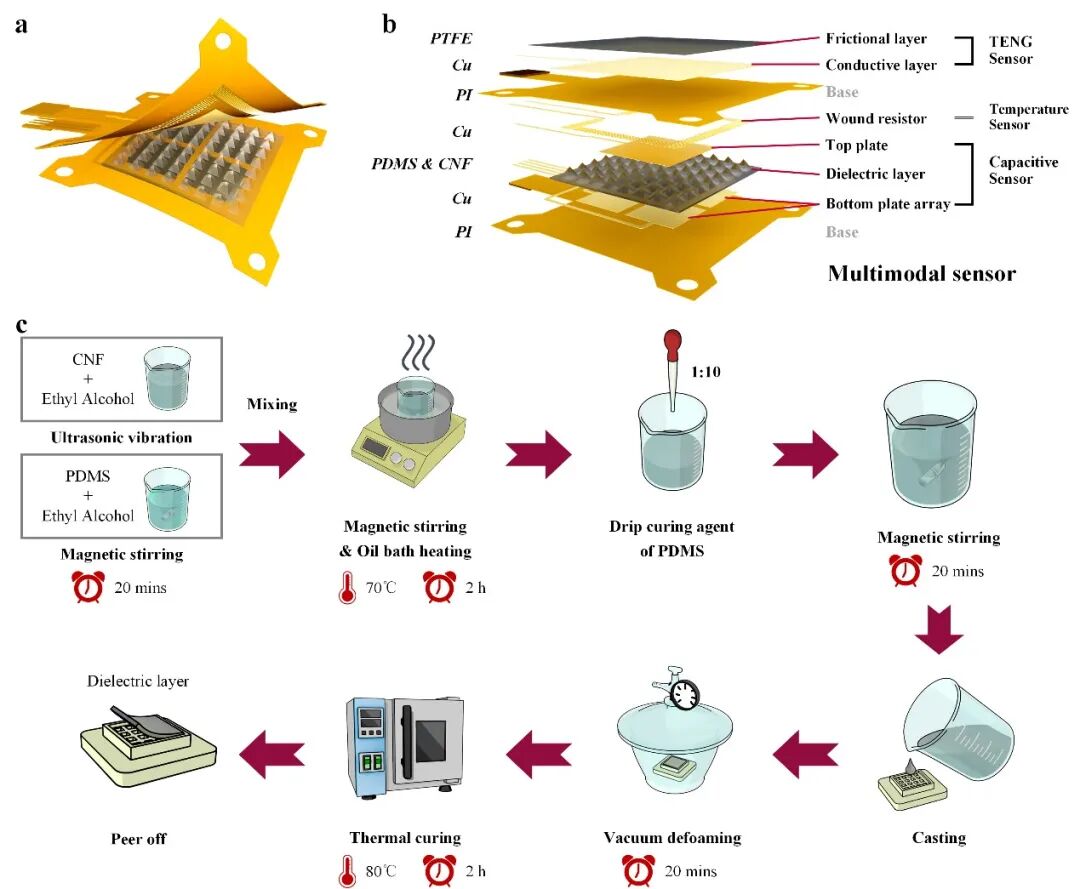
Figure 1. a) 3D rendering of the sensor. b) Exploded view of the sensor and schematic diagram of the three functional layers. c) Manufacturing process flow of the sensor.
(2) Anisotropic Pressure Sensing Based on Capacitive Array Structure
To address the issue of layered capacitive sensors being easily affected by in-plane tensile strain, a 2×2 capacitive array with a shared top electrode was designed. By analyzing the opposite change trends of capacitance on both sides when the top electrode is displaced, in-plane forces can be effectively sensed and their impact on normal pressure detection can be compensated, achieving precise pressure measurement resistant to tensile interference. Meanwhile, the dielectric layer uses PDMS doped with 1.5wt% carbon nanofibers, leveraging the Maxwell–Wagner–Sillars polarization effect, where the spacing between carbon nanofibers decreases under compression, enhancing interfacial polarization and dielectric constant, significantly improving pressure sensitivity, and the pyramid microstructure further increases the deformation of the dielectric layer, strengthening the capacitive response.
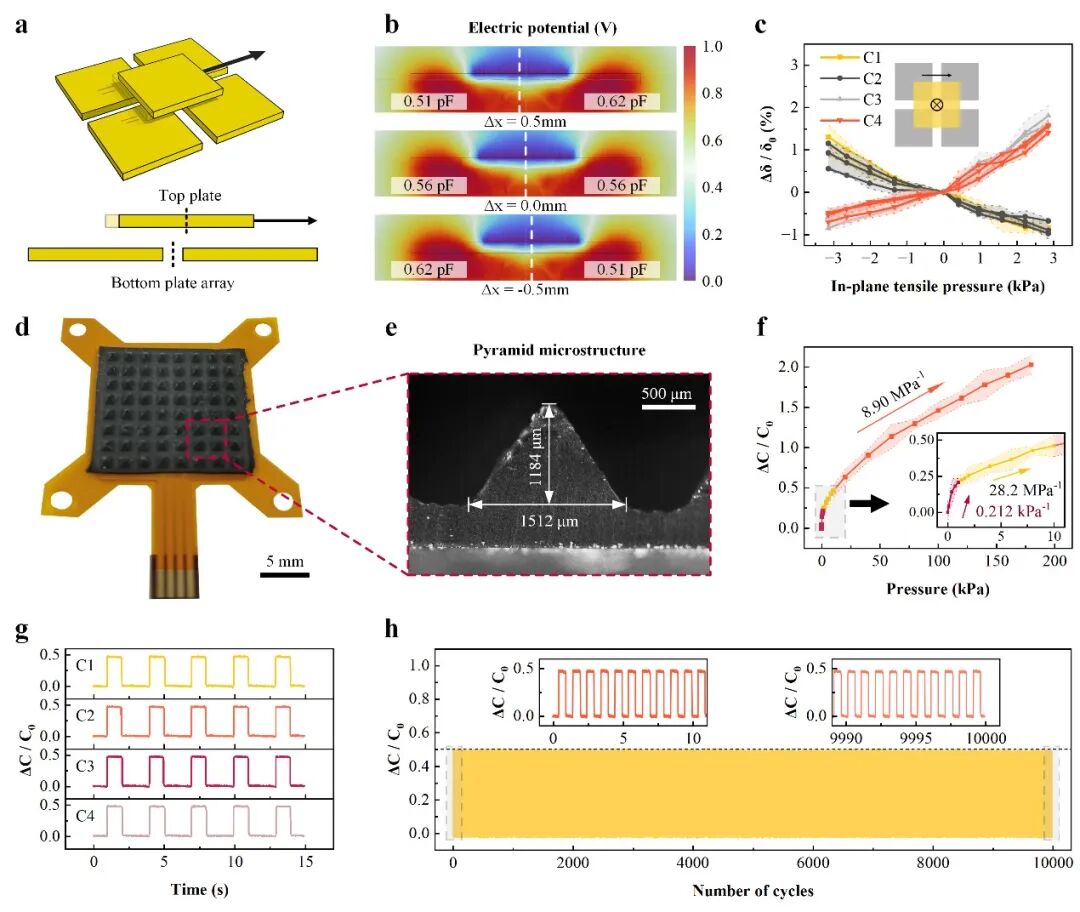
Figure 2. a) Schematic diagram of the capacitive sensor array structure with a shared top electrode, showing the displacement of the shared top electrode under in-plane tensile force using 3D and side views. b) Simulation results of the anisotropic response of the capacitive array when the top electrode is displaced by +0.5, 0, and -0.5 mm. c) Capacitive response of each array unit under different in-plane tensile forces. d) Morphological characterization of the dielectric layer with pyramid microstructure. e) Microscopic image of the cross-section of the dielectric layer characterizing the size of the pyramid microstructure. f) Pressure sensitivity of the capacitive sensor in the range of 0–200 kPa. g) Repeatability of the capacitive sensor under 10 kPa pressure. h) Durability test results of the capacitive sensor after 10,000 cycles of repeated loading and unloading at 10 kPa pressure.
(3) Temperature Sensing Based on Snake-Shaped Thermistors
In terms of temperature sensing, a copper-based snake-shaped thermistor integrated into a flexible circuit board (FPCB) was fabricated, achieving a temperature sensitivity of 3.72×10⁻³℃-1 after line width optimization under a narrow line width design of 50μm, with rapid temperature response (169.4±1.9ms) and excellent linearity (R2=0.9969). The resistive temperature sensor can compensate for the influence of temperature on the capacitive signal in real-time.
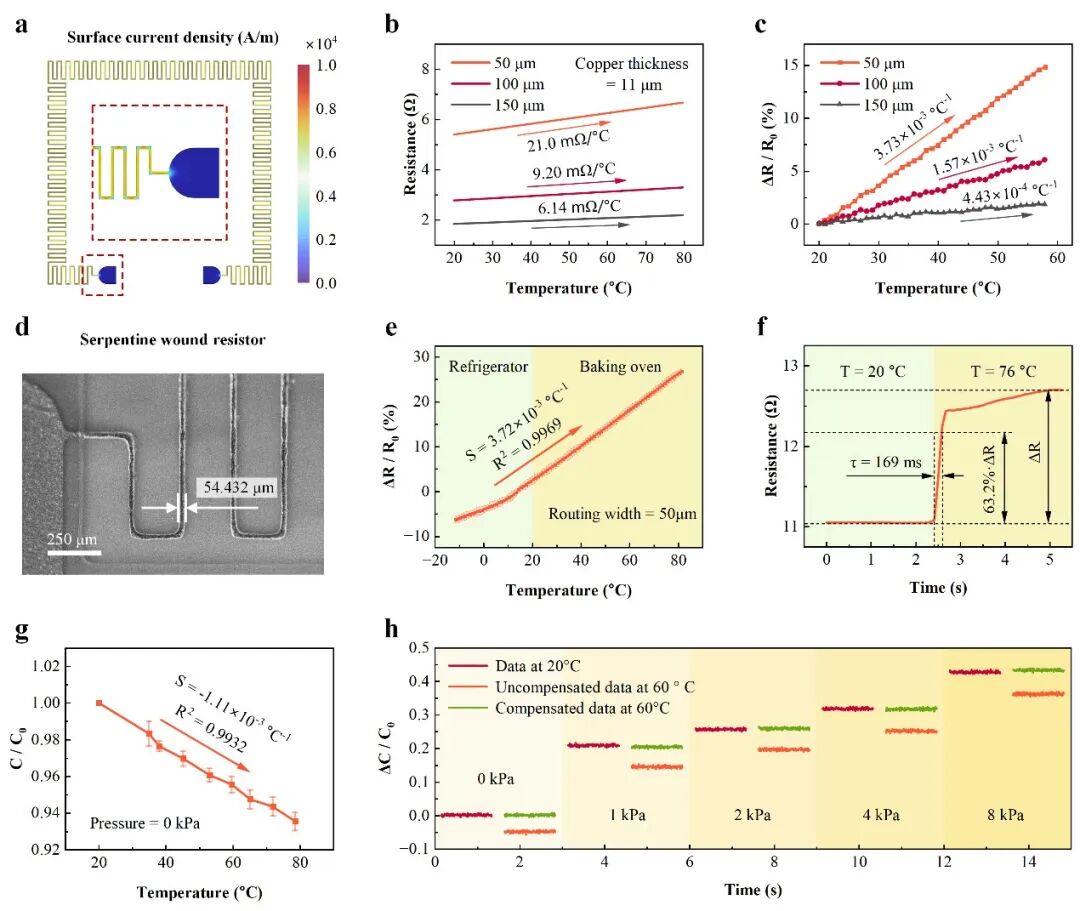
Figure 3. a) Simulation results of current density in the snake-shaped thermistor. b) Simulation results of sensitivity of snake-shaped thermistors with different line widths. c) Experimental results of sensitivity of snake-shaped thermistors with different line widths at 20 – 60 ℃. d) Microscopic image characterization of the snake-shaped thermistor in the FPCB. e) Sensitivity and linearity of the thermistor over a wide temperature range of -20 – 80 ℃. f) Response time of the snake-shaped thermistor. g) Curve of capacitance variation with temperature. h) Comparison of output signals of capacitive pressure sensors at 20 ℃, 60 ℃ without temperature compensation, and 60 ℃ with temperature compensation under 0 – 8 kPa pressure.
(4) Material Recognition Sensor Based on TENG
The triboelectric sensor exhibits strong durability and stable signal output characteristics under contact with different materials, providing a reliable basis for material recognition based on triboelectric signal patterns due to its high contact sensitivity and material specificity.
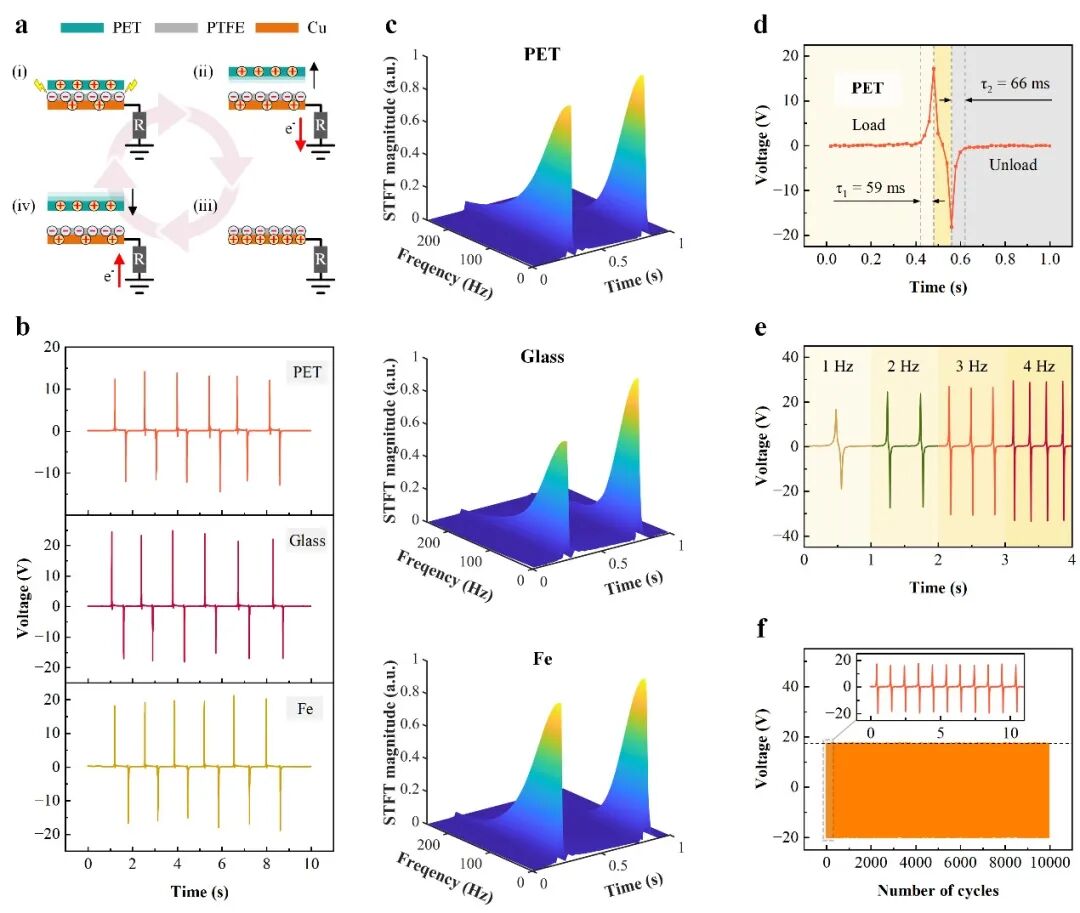
Figure 4. a) Working mechanism of the single-electrode TENG. b) Response of TENG under contact with different materials at 10 kPa pressure. c) STFT time-frequency spectrum of the response of TENG under contact with different materials at 10 kPa pressure. d) Instantaneous response of TENG. e) Response generated by TENG at 10 kPa pressure under contact with PET at different frequencies. f) Durability test of TENG under repeated contact and separation at 10 kPa pressure.
(5) Applications of the Multifunctional Flexible Tactile Sensor
The functional layers are vertically stacked and embedded, resulting in a compact structure with good mechanical compatibility, reducing crosstalk between functions. A complete tactile sensing system was developed based on the PyQt framework, integrating signal acquisition, processing, and display functions, and employing a ResNet18-1D convolutional neural network to classify object features from triboelectric signals, successfully achieving high-precision recognition of different types of cups.
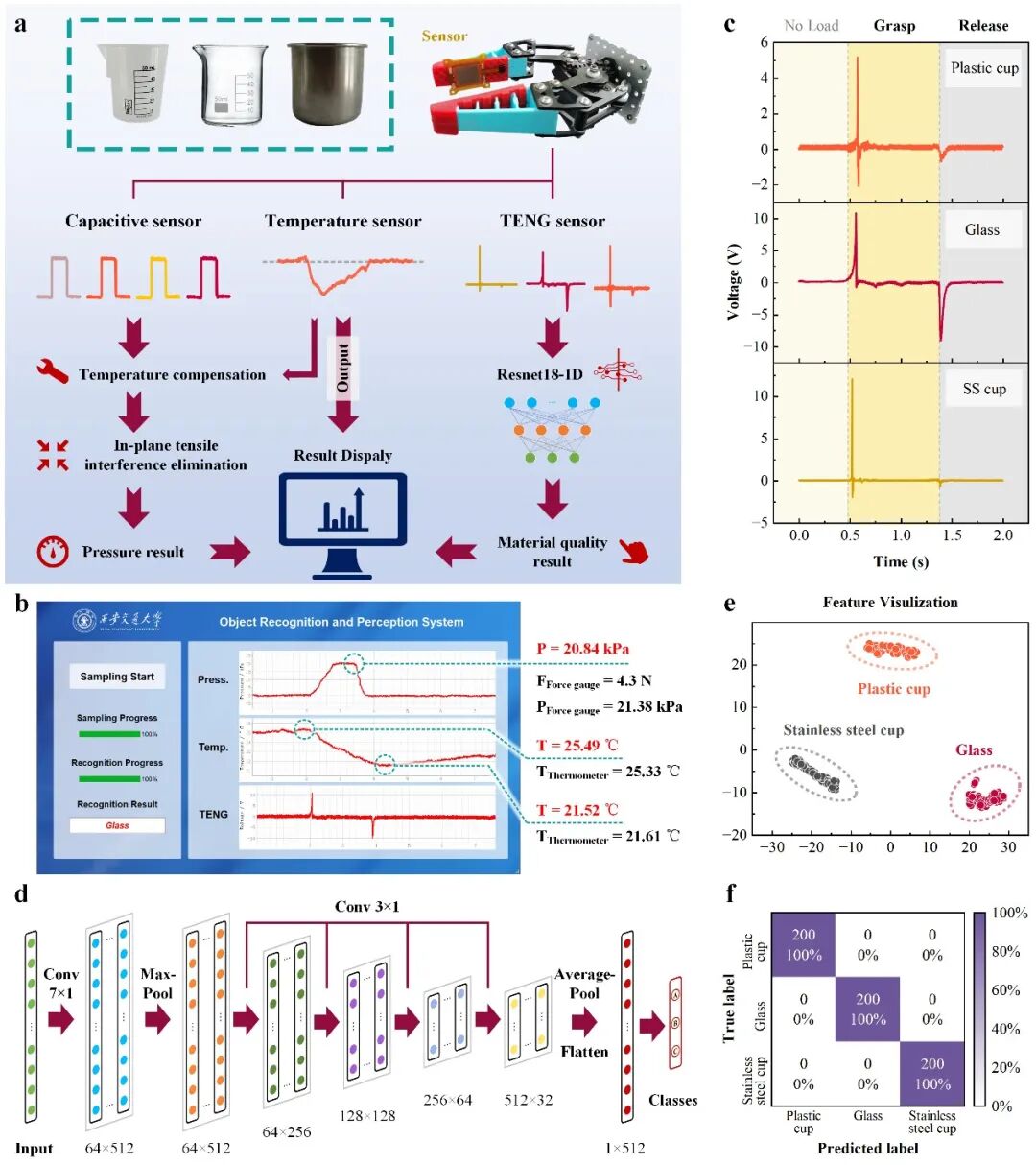
Figure 5. a) Schematic diagram of the integrated system for collaborative acquisition, processing, and real-time display of multimodal sensor signals. b) Real-time monitoring system and material recognition system based on PyQt, comparing measured values with reference values. c) TENG signals generated when a robot grasps objects of different materials.
PART 03
Conclusion and Outlook
The research successfully developed a compact multifunctional flexible tactile sensor that integrates three core functions: pressure sensing, temperature sensing, and material recognition. The pressure sensing can effectively avoid measurement interference caused by external tensile forces, maintaining high sensitivity even under slight pressure, and is stable and responsive in use; the temperature sensing is accurate, with good linearity, rapid response, and can real-time correct the influence of temperature on other measurements; the material recognition, leveraging specific signal features and neural network technology, can accurately distinguish different materials, with strong durability of the sensor. Additionally, the research established a complete tactile perception system that includes sensors, robotic arms, data acquisition control interfaces, and classification models, with small measurement errors in pressure and temperature measurements, significantly enhancing measurement accuracy in complex scenarios through multi-signal collaborative correction. This sensor, with its high sensitivity, strong anti-interference capability, and compact structure, has great application potential in advanced robotics, smart prosthetics, and human-computer interaction scenarios. In the future, it can further expand the perception range and optimize the design to adapt to more complex usage environments, promoting the practical application of related technologies.

Follow Us