Click the blue text to follow us

Today’s Question
- In the last issue, we discussed the implementation of data-driven adaptive fusion using artificial neural networks. However, neural networks typically rely on powerful central computing units, which pose a risk of “single point failure.” Federated filtering inherits the strong learning capabilities of neural networks while ensuring system reliability and interpretability. So, how does federated filtering construct a highly fault-tolerant distributed fusion system?
-
One-Sentence Answer
Federated filtering employs a “divide and conquer, hierarchical fusion” architecture, allowing each sensor to perform preliminary filtering and state estimation locally, and then upload local results (rather than raw data) to the main filter for optimal fusion. This structure not only significantly reduces the central computing load and communication bandwidth requirements but, more importantly, when any local sensor or filter fails, the system can automatically isolate the faulty node, allowing the remaining parts to continue functioning stably, thus creating a highly fault-tolerant distributed fusion system.
-
Detailed Interpretation
The core idea of federated filtering is to decompose a complex global state estimation task into multiple parallel, relatively simple local estimation tasks, and finally optimally synthesize the information at the center.
- Core Architecture: “Local Autonomy” and “Global Coordination”
A typical federated filter consists of the following components: (1) Local Filter: Each sensor or homogeneous sensor group is equipped with an independent local filter (such as KF, EKF, UKF). They only process local sensor data, producing local state estimates (such as position, velocity) and their estimation error covariance. (2) Main Filter: Responsible for fusing the state information from all local filters to generate a global optimal estimate. (3) Information Distribution and Synthesis Principles: This is the core of the federated filtering algorithm. It coordinates the relationship between local and global using a preset “information distribution coefficient” (β) to ensure fusion consistency and avoid “duplicate calculations” of the same information.
- Workflow: Stepwise Fusion to Ensure Fault Tolerance
The workflow is a continuous cycle of information distribution and fusion:Information Distribution: At the beginning of each fusion cycle, the main filter feeds the previous “global state information” back to each local filter according to the preset distribution coefficients (β₁,β₂,…,βₙ, where ∑βᵢ=1). This provides a common prior basis for local estimation in this cycle.Local Estimation: Each local filter independently and in parallel processes its new sensor data and combines it with the prior information allocated by the main filter to complete local state updates, generating local optimal estimates.Information Upload: Each local filter uploads its local state estimate and the corresponding estimation error covariance (i.e., “information matrix”) to the main filter. Note that what is uploaded is the processed “result,” not the massive raw sensor data.Global Fusion: The main filter receives all local information and, according to the “information conservation” principle (i.e., total information = sum of local information – common prior information), combines them into a global optimal state estimate. The commonly used fusion algorithm is minimum variance fusion.Output and Iteration: The main filter outputs the global optimal estimate for this cycle, which is used for vehicle decision-making and control, and prepares for the next cycle’s information distribution.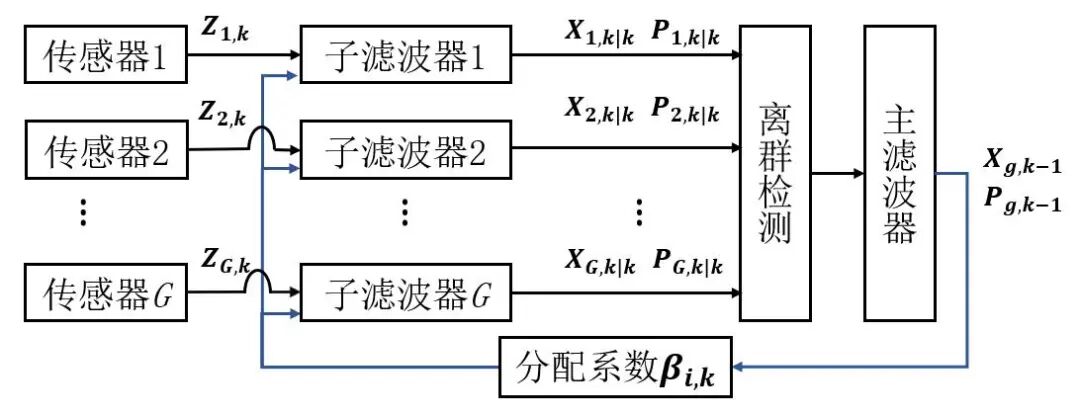 (Figure: Federated Filtering Schematic)
- Core Advantages: Why is it an Ideal Choice for Fault-Tolerant Systems?
(1) Extremely High Fault Tolerance and Reliability: This is the most prominent advantage of federated filtering. Since local filters work independently, when a sensor fails or its local filter diverges, the main filter can quickly identify and isolate the faulty node through consistency checks (such as χ² tests). After the system automatically excludes the faulty node’s information, it can still perform fusion output relying solely on the remaining normal local filters, achieving “graceful degradation” rather than total collapse.(2) Distributed Deployment of Computational Load: The massive computational load is distributed across various local processors, significantly reducing the pressure on the central computing unit, lowering the extreme requirements on a single chip’s computing power, and making system expansion easier.(3) Low Communication Bandwidth Requirements: Local filters only need to transmit dimensionally reduced “state estimate values” and “covariance matrices” between each other and between local and main filters, rather than massive raw data such as images or point clouds, significantly saving the system bus bandwidth.(4) Modular and Easy to Maintain: The system structure is clear and highly modular. Adding, replacing, or upgrading a sensor and its local filter is very convenient and has minimal impact on other parts.
- Challenges and Limitations: Trade-offs of Distributed Architecture
(1) Suboptimality: Due to the distribution and approximation of process noise and other information, federated filtering is theoretically a suboptimal estimate, with its accuracy slightly lower than that of centralized optimal filtering that can access all raw data. However, in most engineering practices, this loss of accuracy is acceptable.(2) Design of Information Distribution Strategy: The choice of distribution coefficient β will affect the performance and convergence speed of the filter, requiring design and optimization based on specific applications.(3) Communication Delays: There is a slight delay (usually 10-20 milliseconds) in the information exchange between local nodes and global nodes, necessitating optimization of communication speed in high-speed scenarios.(4) System Complexity: Deploying multiple filters and designing complex communication synchronization protocols increases the overall software and hardware complexity of the system.
Next Issue Preview
In the next issue, we will discuss: “Lightweight Algorithms for Multi-Sensor Fusion: Complementary Filtering, How to Achieve Fusion in Low Computing Power Scenarios with Minimal Logic?”, stay tuned!
Feel free to leave a message in the comments:
- In which key subsystems of autonomous driving (such as chassis control, powertrain) do you think the fault tolerance of federated filtering is indispensable? Why?
- If you were to design a federated filtering system for drone formations, how would you allocate information coefficients (β) for GPS, visual odometry, and inertial navigation unit sensors?
- In what scenarios might the “suboptimality” of federated filtering become an unacceptable drawback? How can we compensate for it?
If you find this article helpful, please like, bookmark, and share to help build a stable and reliable “perception immune system” for autonomous driving!
END
Editor | Li Meifang
Reviewer | Liu Guochen