|
Title |
J Eur Ceram Soc: In Situ Light-Mediated Dielectric Constant Enhancement in Multifunctional BNT-Based Ceramics |
|
Research Background |
The non-contact modulation of dielectric properties is of significant importance in device applications. Light-controlled non-contact devices offer advantages such as fast response times and low energy consumption. Currently, the study of unconventional photo-induced dielectric effects in ferroelectric materials has garnered considerable attention, but the relative change in dielectric constant before and after illumination remains limited to 2%–10%. Rare earth elements exhibit excellent optoelectronic properties due to their unique electronic shell structure. This study synthesizes Er³⁺ doped BNT-based piezoelectric ceramics and systematically investigates their optical properties and photo-induced dielectric effects, aiming to achieve decoupled control of dielectric performance and insulation characteristics through defect engineering, laying the foundation for light-controlled capacitors and adaptive microwave devices. |
|
Research Content |
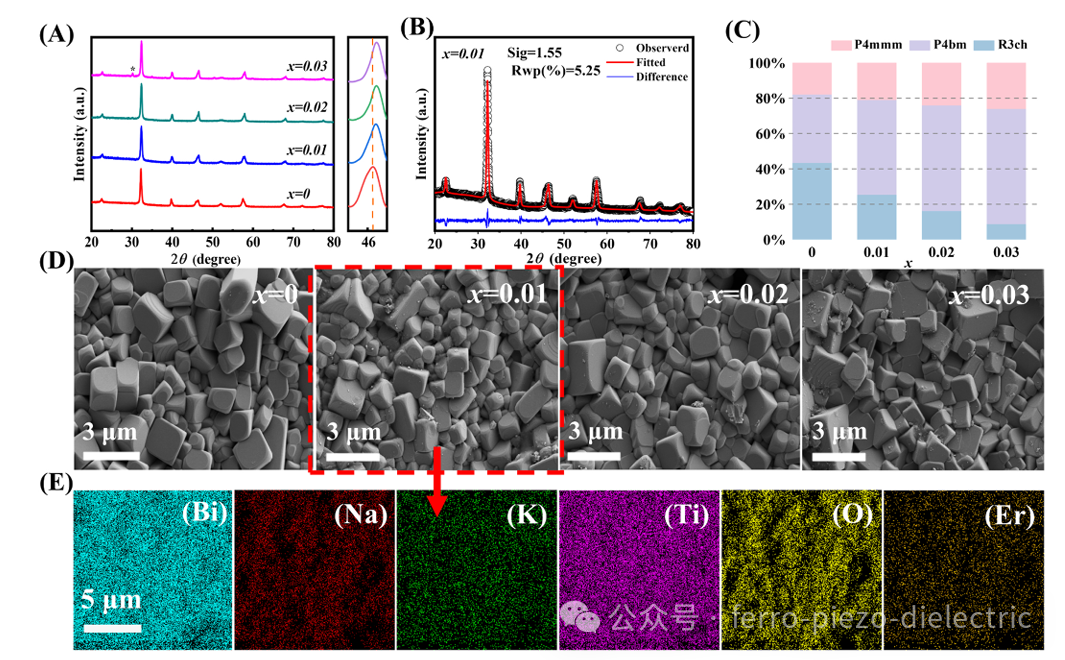
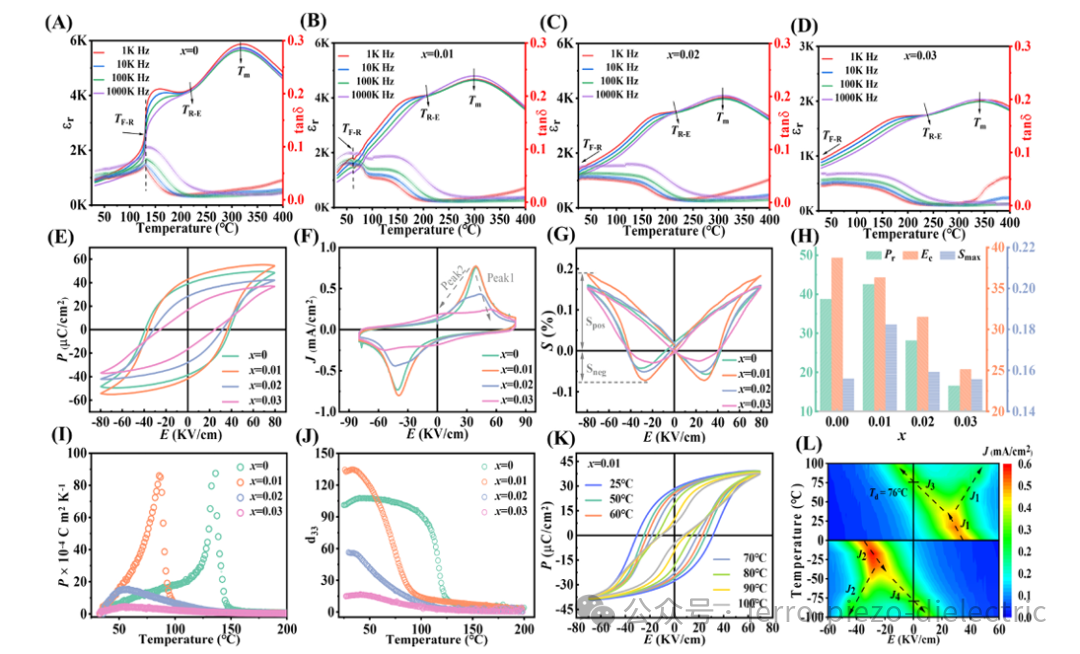
① Synthesis of (Bi₀.₅Na₀.₄₁K₀.₀₉)₁₋ₓErₓTiO₃ (x=0–0.03) ceramics using solid-state reaction method, with systematic analysis of their phase structure, microstructure, and electrical properties (P-E, S-E, dielectric temperature spectrum).
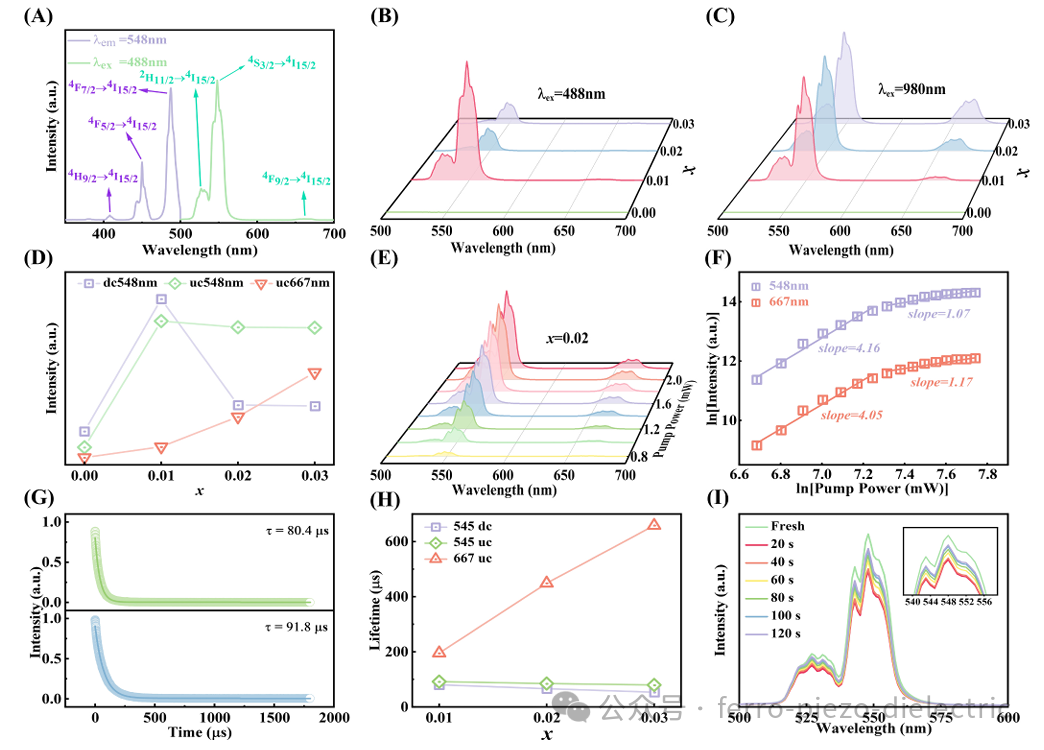
② Investigating the effect of Er³⁺ doping on the luminescent properties of the ceramics, including down-conversion (DC) and up-conversion (UC) luminescence intensity, lifetime, and photochromic behavior, clarifying the dominance of 548 nm green light emission.
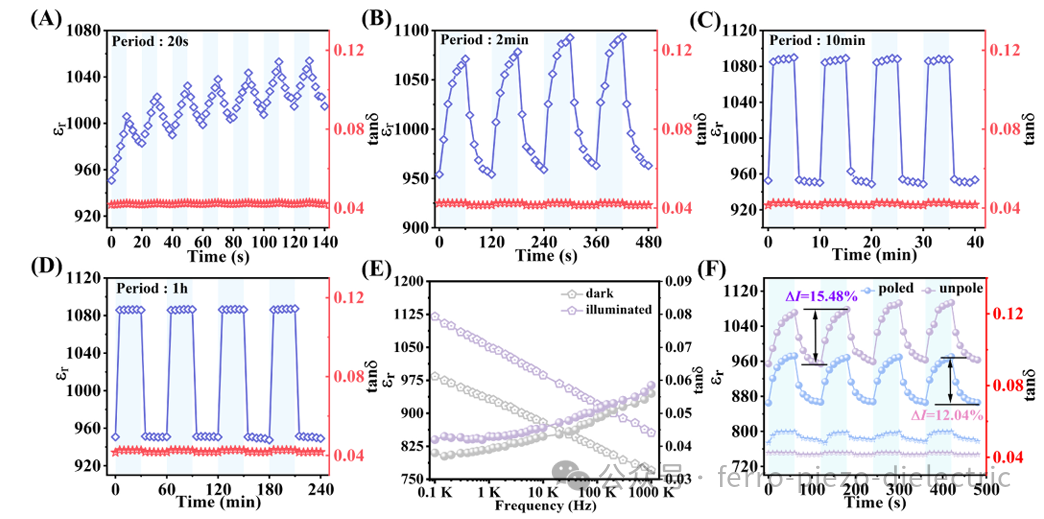
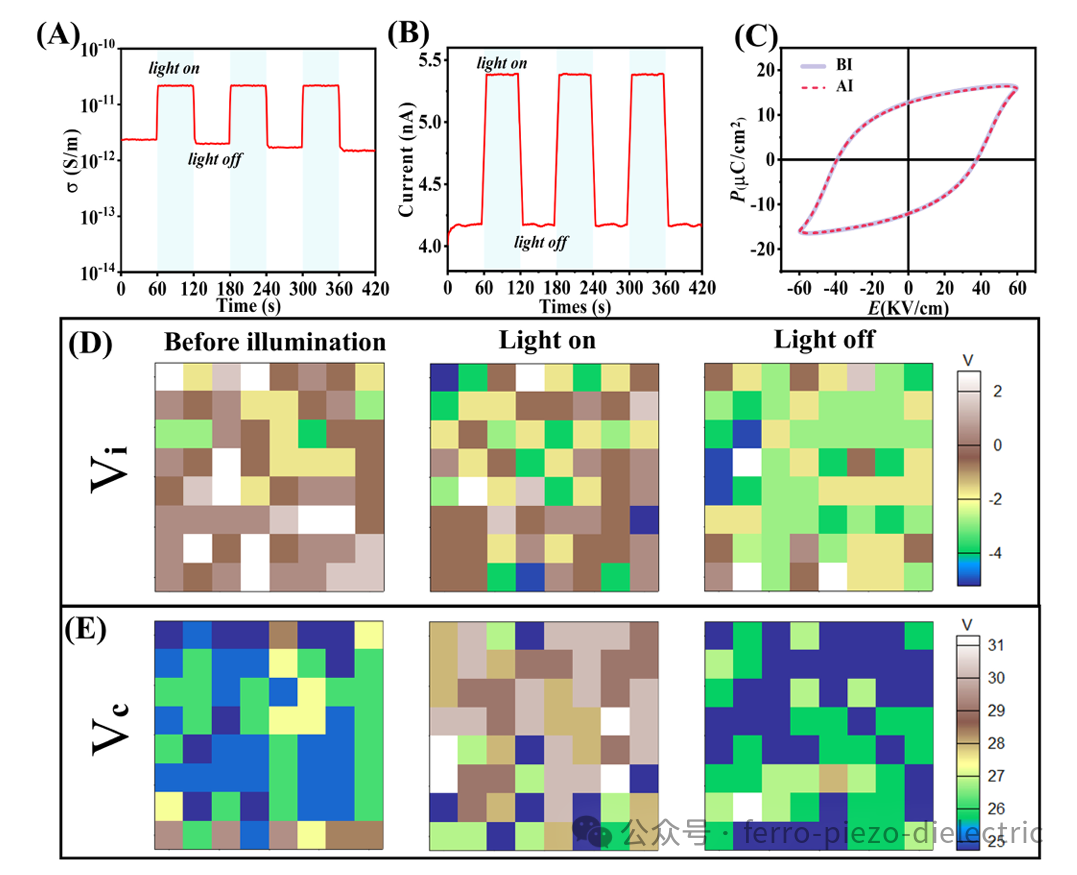
③ Under 405 nm laser irradiation, measuring the dielectric constant (εᵣ) and dielectric loss (tanδ) of the ceramics as a function of time, frequency, and polarization state, with a maximum dielectric constant change rate of 15.48%.
④ By comparing the photo-induced dielectric response of polarized and non-polarized samples, combined with PFM analysis, elucidating the regulatory mechanism of defect energy levels (oxygen vacancies, A-site vacancies, Er³⁺ related vacancies) on the separation and recombination of photogenerated electrons/holes. |
|
Innovations |
① Achieving a photo-induced dielectric constant enhancement of up to 15.48% in Er³⁺ doped BNKT ceramics for the first time, with negligible change in dielectric loss, outperforming previously reported BNT-based ceramics.
② Validating the critical role of defect energy levels in the photo-induced dielectric effect through polarization treatment, proposing a new mechanism where photogenerated carriers are localized by defect states to form dipoles, enhancing the dielectric constant under an external electric field.
③ Realizing light-controlled dielectric switch functionality (response time ≤ 1 min, recovery time ≤ 1 min), and demonstrating multi-cycle (20 s–30 min) stability, providing a material basis for light-controlled adaptive devices. |
|
Paper Summary |
This study successfully prepared Er³⁺ doped BNKT ceramics, achieving optimal comprehensive performance at x=0.01 (Pmax=55 μC/cm², Pr=42 μC/cm², Ec=36 kV/cm). Under 405 nm laser irradiation, the dielectric constant of the ceramics increased by 15.48% at a frequency of 1 kHz, with negligible change in dielectric loss (Δtanδ<0.001), exhibiting unconventional photo-induced dielectric effects. The light response is rapid (saturation time ≤ 1 min) and shows good reversibility. Through defect energy level regulation, effective formation and orientation of photogenerated dipoles were achieved, providing new material and mechanism support for light-controlled dielectric devices. Final performance values: Δεᵣ=15.48% (1 kHz), tanδ≈0.02, and photo-induced current change of only 1.3 nA. |
|
Original Article |
10.1016/j.jeurceramsoc.2025.117999 |
Disclaimer: This article summarizes information based on publicly available data from relevant academic journals and is not original content. It is intended for academic exchange and does not represent the views of this public account.