
Source: Scientific Reports | Translated by: Additive Manufacturing Dog | Date: 2025-11-23
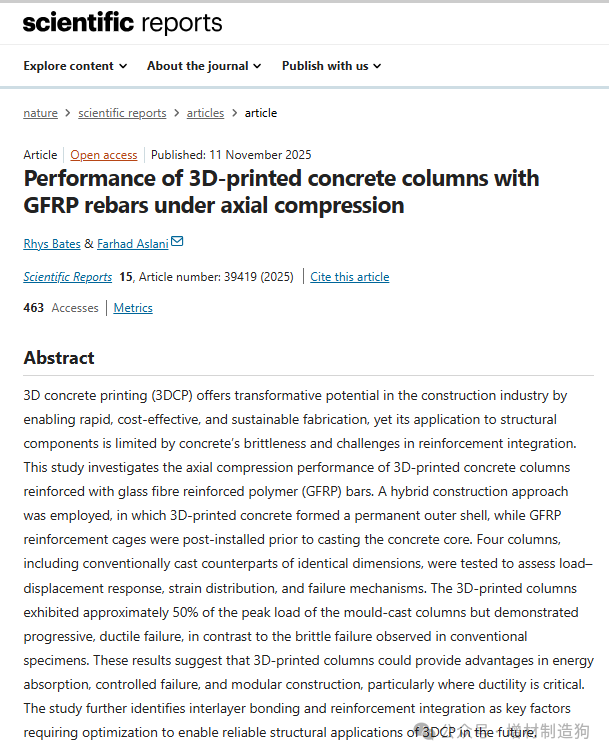
A research team from the University of Western Australia published a paper in Scientific Reports, comparing the axial compression performance of 3D printed permanent formwork combined with cast concrete core columns (GFRP reinforced) to traditional cast columns through experimental tests. The study tested square columns with different slenderness ratios, and the results showed that although the ultimate load capacity of the 3D printed columns was only about 50% of that of traditional cast columns, they exhibited distinctly different failure modes. Traditional columns experienced brittle failure under peak loads, while the 3D printed columns demonstrated progressive ductile failure through the delamination of the outer shell.
The study employed a hybrid construction method: first, a hollow concrete shell was 3D printed to serve as a permanent formwork, followed by the installation of a glass fiber reinforced polymer (GFRP) rebar cage and the pouring of the core concrete. The experiments found that the main reason for the reduced load capacity of the 3D printed columns was insufficient interlayer bonding strength and delamination at the interface between the printed shell and the core concrete. This delamination phenomenon, while reducing overall strength, unexpectedly provided an energy dissipation mechanism that prevented catastrophic sudden collapse.
This research releases a dialectical industry “signal”: in the pursuit of fully automated construction, interlayer bonding strength remains the “Achilles’ heel” of structural safety. It clearly indicates that although 3D printed concrete cannot yet fully replace traditional cast structures in terms of load capacity, its unique “progressive failure” characteristics provide new ideas for the design of non-primary load-bearing structures or seismic energy-dissipating components. Future technological breakthroughs must focus on enhancing interfacial chemical or physical bonding rather than merely pursuing printing speed.
Original source link:https://www.nature.com/articles/s41598-025-22990-4