The full text contains 2085 words, expected reading time is 10 minutes.
In the wave of digitalization, Security Operations Centers (SOC) are no longer just “behind-the-scenes support”; they have become the “frontline battlefield” for enterprises against cyber threats. However, a report by Cybersecurity Insiders titled “Pulse of the AI SOC Report” reveals that global SOCs are mired in multiple dilemmas, and artificial intelligence (AI) has shifted from being an “optional innovation” to a “survival necessity.” Today, let’s explore how AI is reshaping the present and future of SOCs..
1. Current State of SOC: Four Major Pain Points Overwhelming Security Teams, Crisis is Here
The report, based on survey data from 739 global cybersecurity leaders, reveals the current “survival dilemma” of SOCs—not due to a lack of effort, but because traditional models cannot keep pace with the evolution of threats.
1. Threats Targeting “Identity”, but Visibility is Severely Lacking
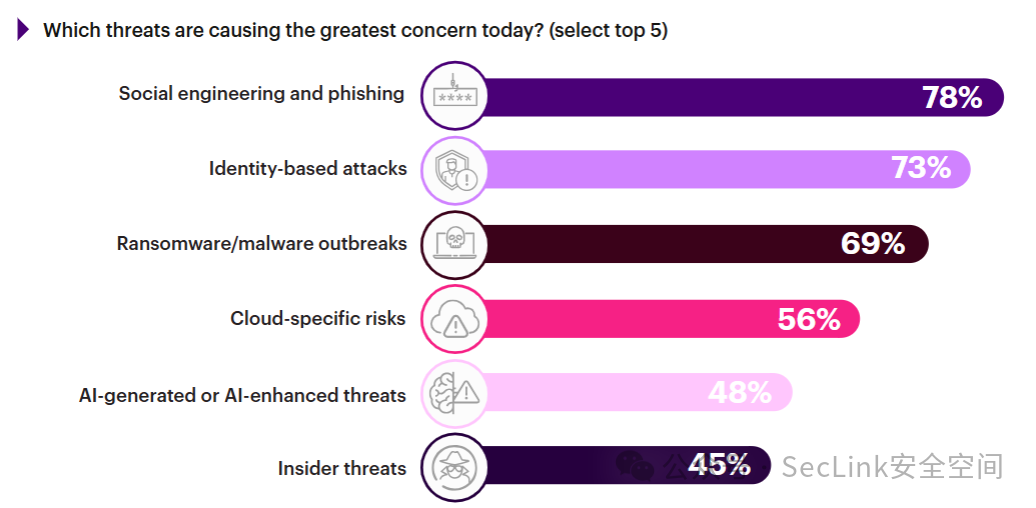
Attackers have long regarded “identity authentication” as their preferred breakthrough: 78% of security leaders list phishing/social engineering attacks as top threats, and 73% focus on authentication-related attacks (such as account hijacking and privilege abuse). Ironically, 67% of organizations still cannot monitor access behaviors and lateral movements, making the most critical areas invisible.
Even more severe is the fact that these threats are highly covert—attackers operate with legitimate credentials, and traditional detection tools simply cannot “catch” them. By the time they are detected, significant data breaches may have already occurred.
2. Surge in Alert Volume Becomes a “Disaster”, 76% of Teams Suffer from “Alert Fatigue”
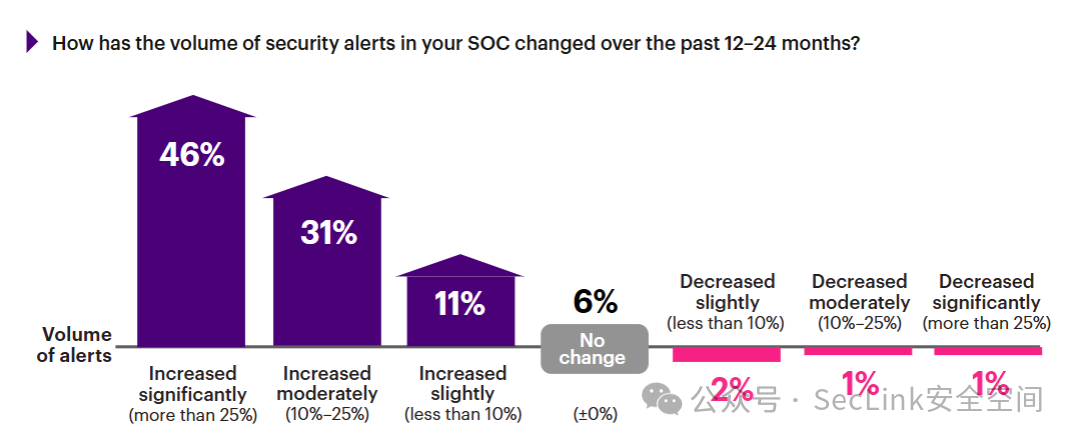
88% of companies report that the volume of security alerts is “continuously rising,” with 46% experiencing an increase of over 25%, meaning security analysts face a “flood of alerts” daily. Worse still, 76% of teams list “alert fatigue” as a top challenge, as a large number of ineffective alerts consume their energy, drowning out real threats.
3. Personnel Burnout Becomes the Norm, Manual Processes Drag Down Efficiency
73% of organizations face issues of “analyst burnout + personnel shortages,” while 64% of detection, triage, and investigation processes still rely on manual efforts—small teams must switch between fragmented tools, manually sift through logs, and verify alerts, with workloads far exceeding their limits, making “working around the clock” a daily routine.
4. Tool Fragmentation + Data Lag, SOC Becomes an “Information Island”
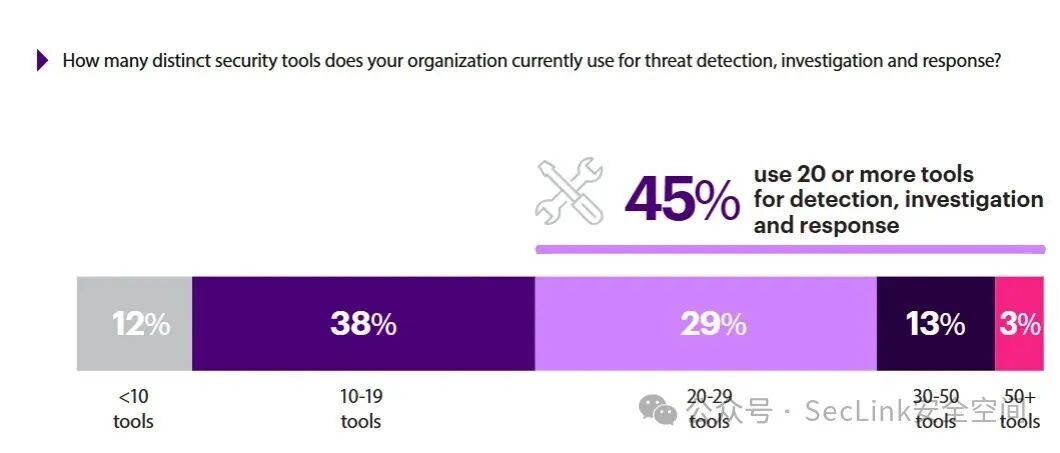
- Too Many Tools Create Chaos: 45% of organizations use more than 20 security tools, each managing a different aspect, leading to data silos where the same threat is described differently across systems, forcing analysts to manually piece together clues, resulting in extremely low efficiency.
- Data Access is Ridiculously Slow: Only 4% of organizations can complete SIEM integration for new data sources within one day, 41% need 1-4 weeks, and 32% even take 1-6 months—by the time the data is usable, hackers may have already “struck”.
2. AI Breakthrough: From “Pilot” to “Necessity”, 87% of Organizations Have Taken Action
In the face of the above dilemmas, AI is no longer a “future concept” but the most realistic solution at present. The report data shows that AI is completing the transition from “trial” to “necessity” in the SOC field.
1. 87% of Organizations Promote AI Implementation, but the “Execution Gap” Remains Obvious
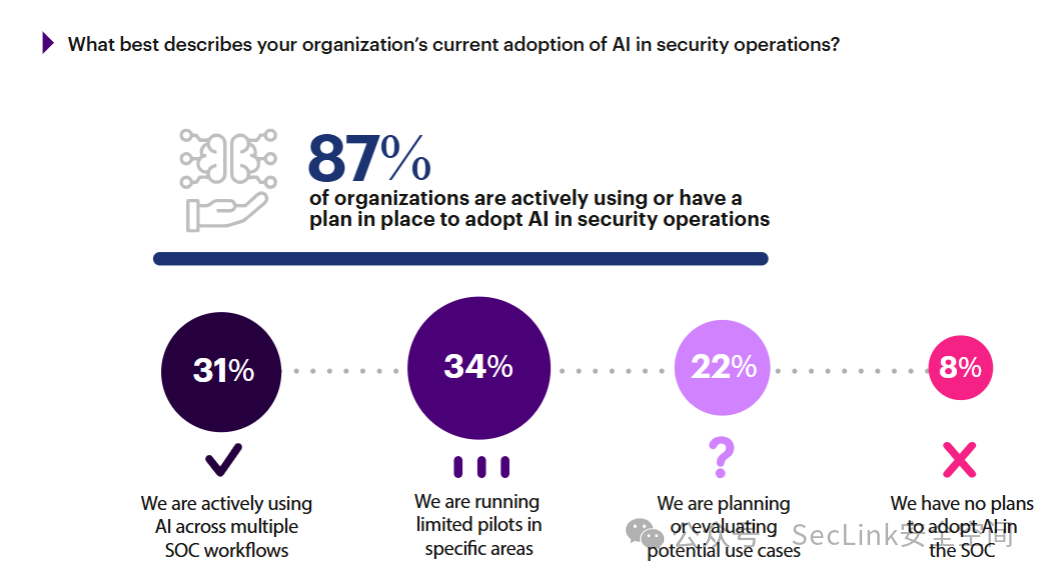
87% of organizations have entered the “deployment, pilot, or evaluation” stage of AI SOC tools, but only 31% can fully apply it in core detection and response processes—many teams remain at a superficial level of “using AI to generate reports” without truly integrating it into daily work.
2. AI Automation Becomes a “Lifeline”, 79% of Organizations View It as Core
79% of respondents believe that within the next 24 months, AI automation will be the “mission-critical” or “core strategy” for SOCs, with 45% stating “we can’t do without it.” The core demand is clear: to free analysts from low-value tasks such as “manually checking logs” and “repetitive triage,” allowing them to focus on complex threats that truly require human judgment.
3. Key to AI Implementation: Focus on “Practicality” Rather than “Perfection”
The report emphasizes that the success of AI in SOCs is not about “the more advanced the technology, the better,” but about focusing on pain points, building trust, and aligning goals. The implementation experiences of leading organizations can be summarized into three key principles:
1. Start with the “Most Burdensome Links”, Avoiding Overreaching
73% of organizations have tasted success through AI automation in “alert triage and prioritization”—first addressing the most troublesome issue of “alert filtering” for analysts, then gradually advancing to threat intelligence enrichment and automated response playbooks, building confidence step by step, which is more reliable than “attempting full process automation from the start.”
2. Make AI “Transparent and Explainable” to Regain Analysts’ Trust
Only 9% of analysts are “very confident” in AI outputs, and 41% need frequent manual verification—the core reason is that AI is often treated as a “black box.” Excellent AI tools will “show their thought process”: for example, why a certain behavior is deemed a threat? What data was used? What intelligence was associated? This allows analysts to understand and trust the results rather than “passively accepting outcomes.”
3. Align Business Goals, Avoid Blindly Pursuing “New Technologies”
72% of CISOs list “accelerating investigation response” as the primary goal for AI, 65% hope to “reduce alert noise,” and 61% focus on “automating cost reduction”—AI solutions must connect with these quantifiable metrics, such as “how much MTTR (Mean Time to Respond) is shortened” and “how much the average analyst’s alert handling capacity is increased,” rather than empty discussions about “how intelligent AI is.”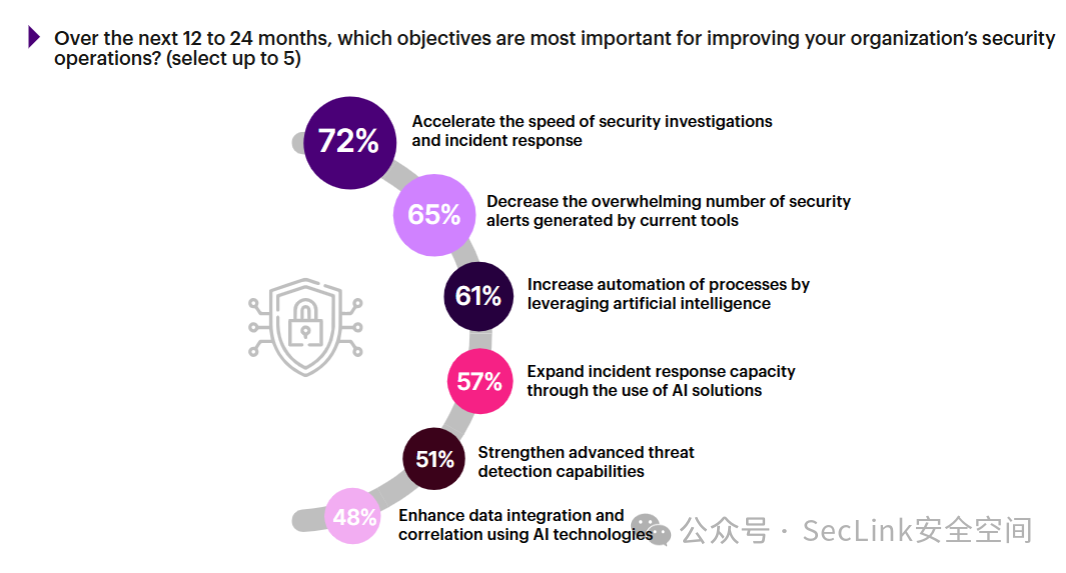
4. Future Trends: Budget Shifts Towards AI, Three Key Directions Become Focus Areas
The report predicts that in the next 1-2 years, the AI SOC field will exhibit two clear trends:
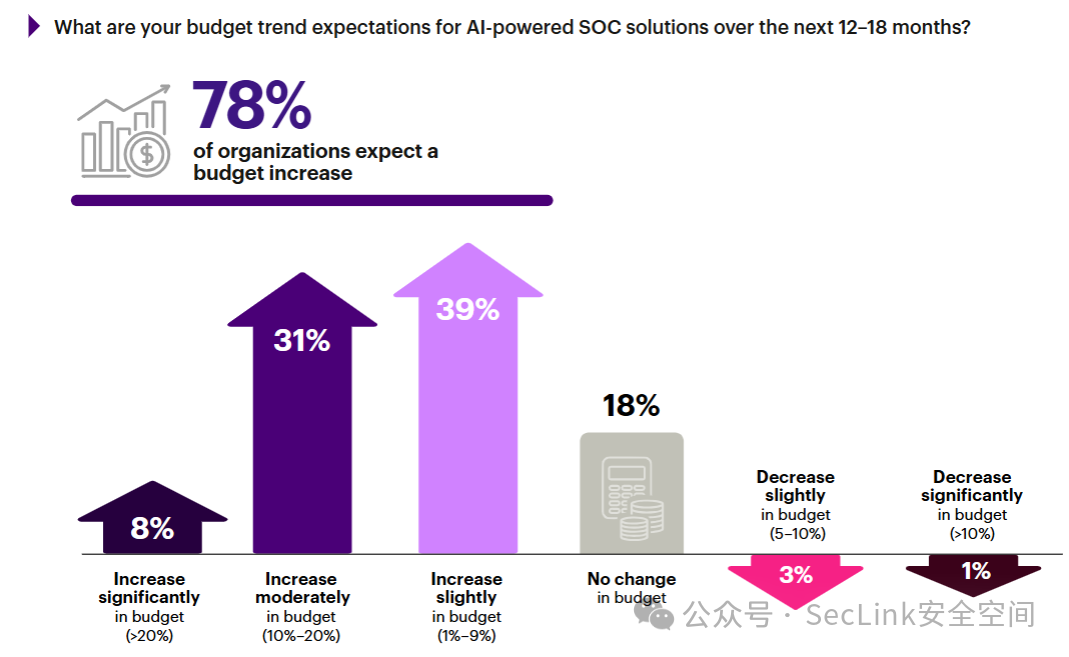
1. Budget Increases: 78% of Organizations Plan to Boost AI Investment
78% of organizations will increase their AI SOC budgets, with 8% increasing by over 20% and 31% increasing by 10%-20%—funding is shifting from “pilot projects” to “scaled implementation,” and AI tools that deliver tangible results will receive more resources.
2. Three Key Technology Directions Receive Most Attention
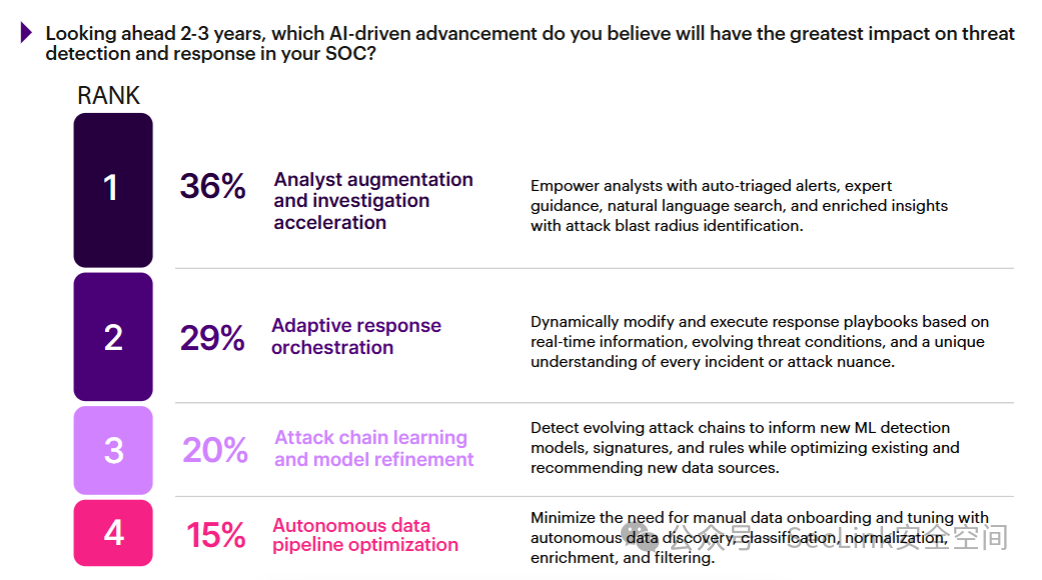
In the next 2-3 years, SOC teams are most optimistic about AI advancements focusing on:
- Analyst Empowerment and Investigation Acceleration (36%): Using AI to automatically generate alert summaries and annotate the impact of attacks, helping analysts “see through” threats;
- Adaptive Response Orchestration (29%): AI can adjust response strategies based on real-time threat changes, such as automatically freezing permissions and pushing alerts when account anomalies are detected, without waiting for human intervention;
- Attack Chain Learning (20%): AI can optimize detection models by analyzing historical attack data, identifying new attack patterns in advance.
Final Thoughts
For security teams: the pain points of SOC can no longer be solved by simply “adding personnel or tools”; AI is an inevitable choice, but the key to success lies not in “whether to use AI” but in “how to use AI correctly”—starting from pain points, making AI a “partner” for analysts rather than a “replacement,” is essential for truly achieving the transition from “passive response” to “proactive defense.” After all, in the face of threats, efficiency equals security.
Please follow SecLink Security Space for our latest updates.
Welcome to join the SecLink Security Space WeChat group to discuss security issues!