|
Title |
Impact of SrTiO3 Addition on the Microstructure and Dielectric Properties of Mg2SiO4 Ceramics for 5G/6G Applications |
|
Research Background |
With the rapid deployment of 5G and the arrival of 6G, there is an increasing demand for microwave dielectric ceramics that are stable at high frequencies and exhibit low loss. Such materials need to have a low dielectric constant (εr ≤ 12) to reduce signal delay, a high quality factor (Q×f ≥ 50,000 GHz) to minimize energy loss, and a near-zero temperature coefficient of resonant frequency (τf) to ensure thermal stability. Magnesium silicate (Mg2SiO4, MSO) has attracted attention due to its low εr (≈6-7) and extremely high Q×f value (≈240,000 GHz), but its strong negative τf (approximately -67 ppm/°C) and high sintering temperature limit its practical applications. Previous attempts to adjust τf through doping or adding TiO2 often resulted in performance degradation due to the formation of secondary phases from chemical reactions, thus necessitating the search for new effective compensating agents. |
|
Research Content |
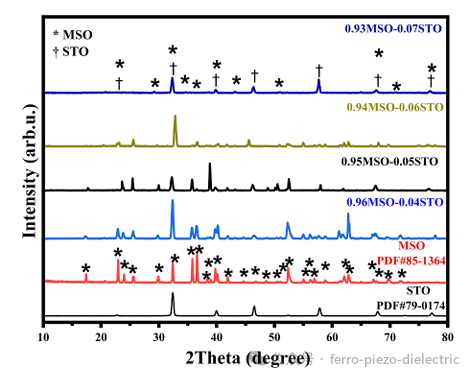
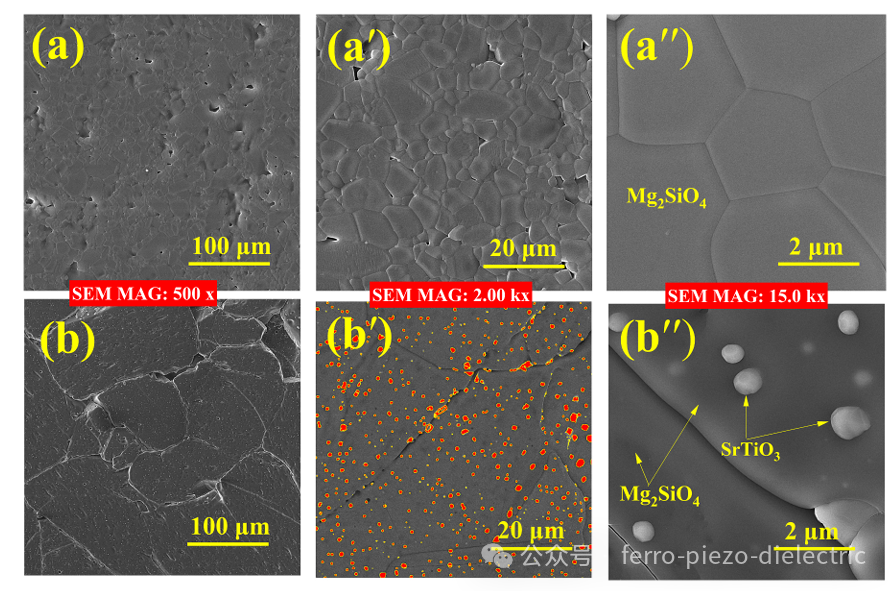
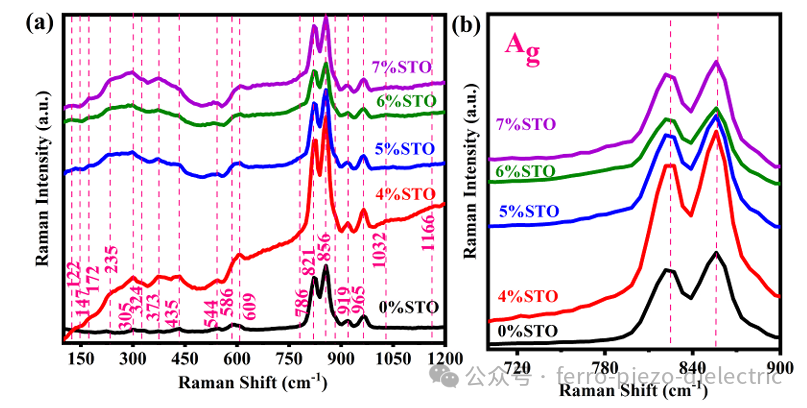
① A solid-state reaction method was successfully used to prepare (1-x)Mg2SiO4-x wt% SrTiO3 (x = 0-0.07) composite ceramics, and the effect of STO addition on the phase composition and microstructure of the materials was systematically studied. ② Characterization techniques such as XRD, FESEM, and Raman spectroscopy confirmed the coexistence of MSO and STO phases in the composite material without the formation of secondary phases, and the addition of STO promoted abnormal grain growth and densification.
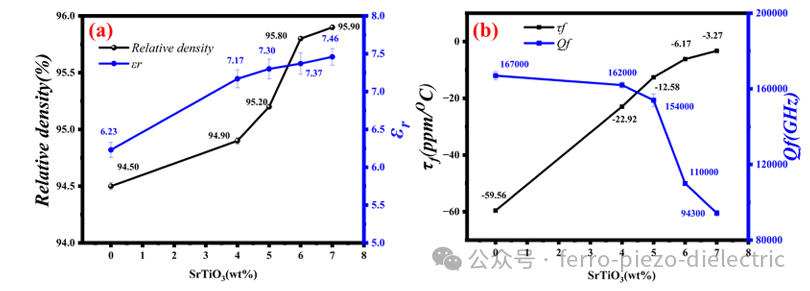
③ The microwave dielectric properties (εr, Q×f, τf) of ceramics with different STO contents were measured in detail, revealing that as STO increased, εr and τf increased while Q×f decreased, and τf was precisely controlled through linear mixing rules.
|
|
Innovations |
① For the first time, SrTiO3 with a large positive τf (≈+1640 ppm/°C) was introduced into the Mg2SiO4 system, effectively compensating for the negative τf of MSO through a simple physical blending method rather than chemical doping, avoiding lattice distortion and performance degradation caused by ionic substitution. ② Utilizing the significant differences in crystal structure and ionic radius mismatch between MSO and STO, the mutual reactions and secondary phase formation during the sintering process were successfully suppressed, resulting in a stable two-phase composite structure that ensures predictability and stability of performance.
③ While achieving a near-zero τf, a low dielectric constant (εr < 8) was maintained, meeting the requirements for low signal delay in 5G/6G applications, providing a new approach for developing high-frequency thermally stable microwave dielectric materials.
|
|
Paper Summary |
This study successfully developed a low-loss, temperature-stable microwave dielectric ceramic suitable for 5G/6G communication base station resonators by adding SrTiO3 to Mg2SiO4. The results indicate that the addition of STO not only effectively adjusts the negative τf value of MSO but also promotes the densification of the ceramics during sintering. When the STO addition is 7 wt%, the optimal ceramic performance is achieved after sintering at 1450°C for 5 hours: relative density reaches 95.9%, dielectric constant (εr) is 7.46, quality factor (Q×f) is 94,300 GHz, and the temperature coefficient of resonant frequency (τf) is close to zero at -3.27 ppm/°C. This composite material achieves a balance of performance through phase separation mechanisms, avoiding the complexity of chemical reactions, and shows great potential in high-frequency wireless communication applications. Although the Q×f value decreases due to the intrinsic low Q and interfacial losses of STO, its overall performance surpasses many reported magnesium silicate systems doped or aided by low-melting-point glass, providing promising material candidates for next-generation wireless communication technologies. |
|
Original Article |
https://doi.org/10.1016/j.jeurceramsoc.2025.117986 |
Disclaimer: This article summarizes information based on publicly available data from relevant academic journals and is not original. It is intended for academic exchange and does not represent the views of this public account.