
The 3D printing technology reference has noted that a research team from the University of Toronto’s Faculty of Engineering has designed a new type of material that is both extremely lightweight and incredibly strong—it can maintain its strength even at temperatures of 500℃. These characteristics make it highly valuable in aerospace and other high-performance industries. This new composite material consists of metal alloys and nanoscale precipitates, with a structure that mimics reinforced concrete, but at a microscopic scale.

This research, titled “Achieving Higher Mechanical Performance in Aluminum Matrix Composites Inspired by Reinforced Concrete Structures,” was published in Nature Communications. It proposes an aluminum matrix composite inspired by reinforced concrete structures, achieving composites that maintain excellent mechanical properties at high temperatures through the combination of 3D printing and micro-casting technology.
Traditional aluminum alloys and aluminum matrix composites experience a significant drop in strength at high temperatures (>300°C), limiting their applications in high-temperature environments. In reinforced concrete structures, steel bars provide tensile strength while concrete provides compressive strength. Inspired by this, the researchers designed a multiscale reinforced structure that introduces aluminum matrix composites into metal 3D printed lattice structures.
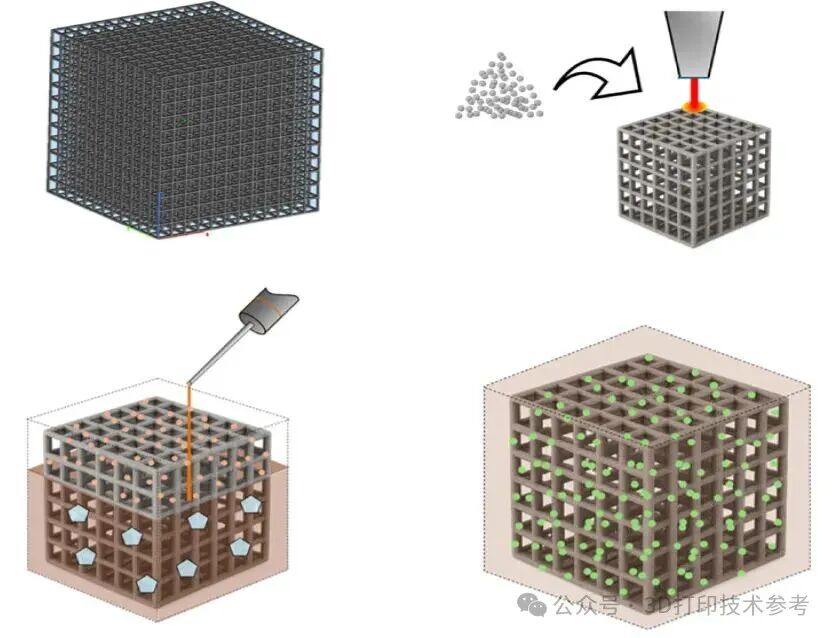
Process Principle: Combining Metal 3D Printing Technology with Precision Micro-Casting
The core manufacturing strategy of this research is the innovative integration of metal 3D printing technology with precision micro-casting processes. The researchers first designed a 3D lattice model of Ti6Al4V (titanium alloy) with cubic lattice units using Unigraphics NX software, with unit sizes of 0.5 mm and pillar diameters of only 0.1 mm. This complex, predefined titanium alloy scaffold was then accurately manufactured using the SLM process.
After successfully printing the Ti6Al4V lattice, a critical micro-casting step was performed to achieve the composite of the metal “skeleton” and aluminum-based “concrete.” The printed titanium alloy lattice was placed in an alumina mold and pre-treated in a vacuum environment at 800 degrees Celsius, where molten AlSi7Mg aluminum alloy droplets wetted the surface of the lattice for 15 minutes. This step is crucial to ensure that the aluminum can flow and fill the micron-scale lattice structure during subsequent pouring. Afterward, the molten AlSi7Mg alloy was injected into the mold, completely submerging the titanium alloy lattice in aluminum liquid, and held at 800 degrees Celsius for 2 hours. During this process, not only was the aluminum matrix cast, but more importantly, an in-situ reaction occurred between the molten aluminum and titanium alloy, generating a large number of micron-sized Al₃Ti reinforcement particles at the interface, thus forming a second level of reinforcement phase within the matrix.
The entire process chain concluded with heat treatment, including solution treatment at 545℃ for 12 hours, water quenching, and then aging treatment at 170℃ for 8 hours to precipitate nanoscale intermetallic compounds, such as AlSi₂Ti₆ and silicides, thus constituting the third level, i.e., the nanoscale reinforcement effect.
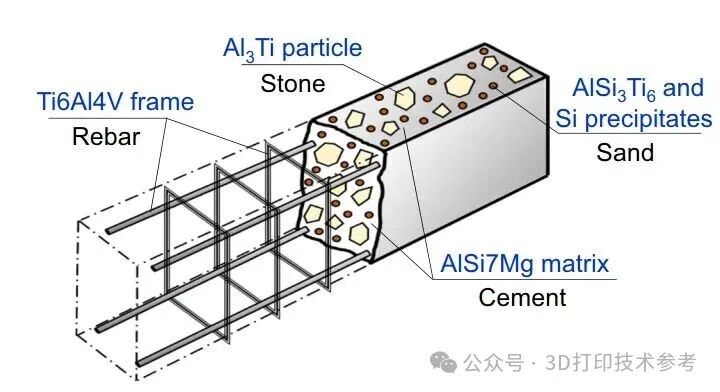
Illustration of Multiscale Reinforced Composite Material Inspired by Reinforced Concrete Structure Concept
Through this integrated approach of “design-print-cast-treat,” the researchers successfully prepared a multiscale synergistic reinforced composite material with a millimeter-scale Ti6Al4V skeleton, micron-scale Al₃Ti particles, and nanoscale precipitate phases, with an internal porosity controlled to below 0.5%, laying a solid structural foundation for achieving excellent mechanical properties at room temperature and even at 500℃.
Subsequently, the research team conducted various tests on this new material to determine its strength. The researchers stated that at room temperature, the highest yield strength obtained was about 700 MPa, while the typical yield strength of aluminum matrices is about 100 to 150MPa..
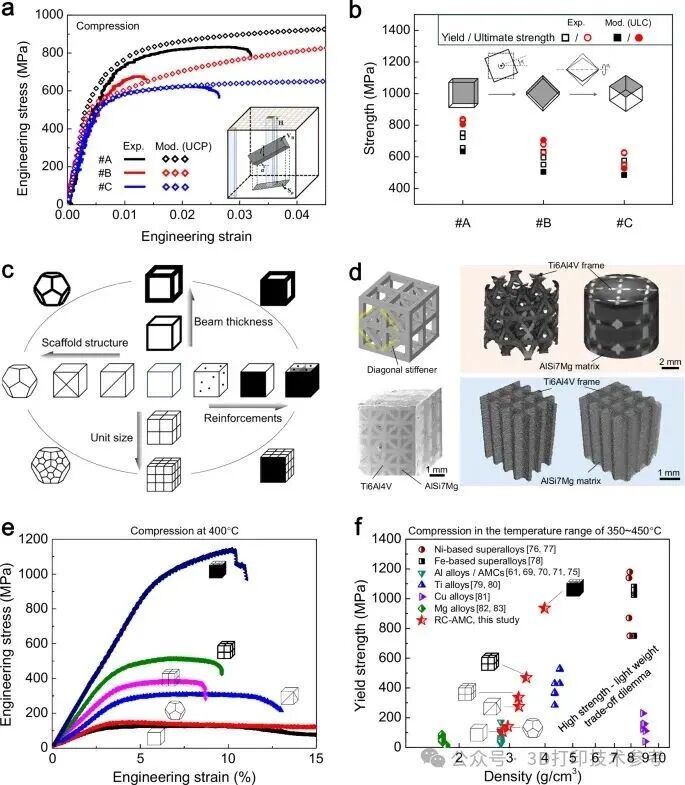
Avoiding the High Strength-Lightweight Trade-off Dilemma in RC-AMC Prediction, Optimization, and Development
Its true advantage lies in its high-temperature performance. At 500℃, the yield strength is between 300 and 400MPa, while the yield strength of traditional aluminum matrix composites is about 5MPa. In fact, the performance of this new metal composite is comparable to that of medium-strength steel, but its weight is only about one-third of the latter.
It is surprising that this material still possesses high strength at such high temperatures, prompting the research team to establish detailed computer models to understand the underlying principles. Another co-author of the paper, Chen Huicong, led these computer simulations. He stated, “At high temperatures, the deformation mechanism of this composite material is different from that of most metals. We refer to this new mechanism as enhanced twinning, which allows the material to maintain most of its strength even at very high temperatures.”
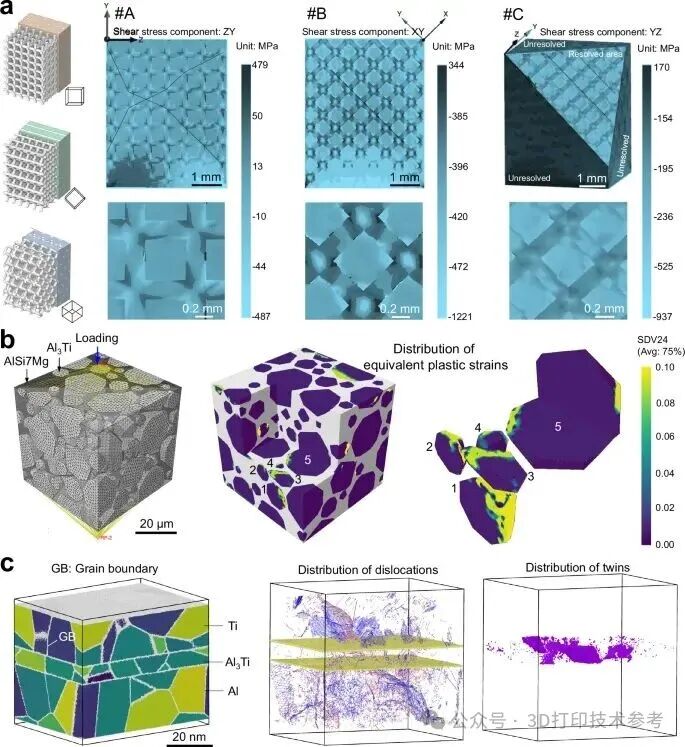
Multiscale Deformation Mechanism Analysis
However, the researchers also indicated that this new material may take some time before it can be applied in industry, but its discovery reflects the advantages of combining additive manufacturing with other traditional manufacturing techniques. The cost of mass-producing such materials is still high, but in certain application areas, its high performance is worth it. #AdditiveManufacturing #3DPrinting
Note: This article was created by the 3D Printing Technology Reference and is not authorized for reproduction without contact..Feel free to share
Further Reading:
1. Xikong Intelligent Manufacturing’s 3D Printing Technology Innovation Ranks Among Xi’an’s Gazelle Enterprises
2. Artificial Intelligence Deeply Integrated with 3D Printing, Its Importance Will Only Increase!
3. Beifeng Intelligent Metal 3D Printing Breakthrough in Difficult-to-Melt Alloy Powder Development! Potential Expansion in Extreme Environment Applications!
4. Plitel Launches AI-Driven Metal 3D Printing Quality and Risk Assessment System