Introduction
In the journey of human exploration of the universe, breaking free from the constraints of Earth’s resources has always been a core challenge. The emergence of space 3D printing technology is reshaping the underlying logic of space manufacturing. This technology not only enables on-demand production of components in microgravity environments but may also become the cornerstone for future lunar bases and Martian city construction.
01
1. Paradigm Shift from Ground to Space
The core breakthrough of space 3D printing lies in its adaptive reconstruction for extreme environments. Traditional FDM (Fused Deposition Modeling) technology has successfully addressed the issue of uneven material deposition in microgravity during experiments on the International Space Station by adjusting the print head height and material cooling parameters. For example, the first plastic panel printed by NASA on the ISS in 2014 had a circular irregularity of 17%, but structural light scanning and CT detection revealed that its internal density differed from ground products by less than 3%. Furthermore, the China Aerospace Science and Technology Corporation achieved continuous space printing of carbon fiber reinforced composites in 2020, with mechanical properties comparable to aluminum alloys while reducing weight by 50%.
Innovations in material science further expand application boundaries. A team from Tsinghua University developed temperature-sensitive bio-ink that maintains cell viability at -196°C, successfully printing a three-dimensional tumor model with drug response on a satellite platform. A Korean team developed carbon-doped high-entropy alloys, which, through the reinforcement of nano-carbide particles, increased the tensile strength of printed components at extremely low temperatures by 140%, providing possibilities for extreme environment equipment such as liquid hydrogen fuel tanks.
02
2. Application Scenarios: From On-Orbit Maintenance to Deep Space Infrastructure
In low Earth orbit, 3D printing has transitioned from experimentation to practical use. The Redwire printer on the International Space Station has produced over 150 components, including wrenches, sensor brackets, and other tools, allowing astronauts to operate without relying on ground supplies. The Chinese Tiangong space station plans to conduct on-orbit experiments with a cold cathode electron gun through the Tianzhou-8 mission in 2026, achieving a printing accuracy of 0.1 millimeters with equipment that is only one-fourth the size of similar products on the ground.
In the field of deep space exploration, 3D printing is driving breakthroughs in in-situ resource utilization (ISRU). The cold cathode electron gun technology from the China Aviation Manufacturing Technology Research Institute addresses the issue of metal droplet drift in microgravity through a pulsed electromagnetic deposition device, laying the foundation for the production of metal components for lunar bases. The “Moon Pot” concept proposed by Huazhong University of Science and Technology combines traditional mortise and tenon techniques with 3D printing, utilizing sintered bricks made from lunar soil to construct modular bases that can withstand temperature differences of 300°C and lunar seismic impacts.
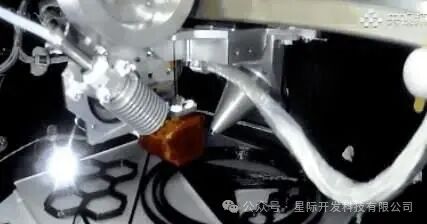
Chinese experimental 3D printing
03
3. Challenges and Innovations: Manufacturing Philosophy in Extreme Environments
The harshness of the space environment has given rise to unique technological pathways. To address the challenges of material forming in microgravity, Harbin Institute of Technology developed a high-temperature 3D printer that synchronously extrudes metal wires and plastics at a temperature of 500°C, reducing the porosity of composite materials to 1.5% while achieving integrated functions of conductivity, thermal conductivity, and radiation protection. Meanwhile, Tsinghua University’s tumor model printing system, based on a YOLOv5 deep learning algorithm, improved the focusing success rate of space microscopic imaging from 44% to 86%, with a processing speed increase of seven times.
Miniaturization of energy and equipment is another significant challenge. The Deep Space Exploration Laboratory’s lunar soil brick-making machine uses parabolic mirrors to focus solar energy to generate temperatures of 1500°C, directly melting lunar soil into building materials without the need for water or adhesives. This “sunlight factory” model reduces the construction cost to 90% per cubic meter, providing an economically viable solution for lunar base construction.
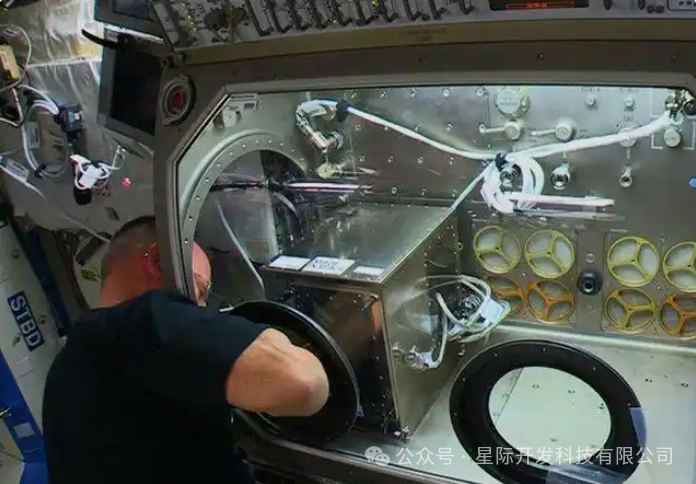
The world’s first space 3D printer
04
4. From Component Manufacturing to Civilizational Infrastructure
In the lunar south pole, China plans to establish an international lunar research station by 2030. Based on 3D printing lunar soil sintering technology, it can transform the lunar regolith into radiation shielding materials and structural components, reducing base construction costs by 80%. Mars colonization faces even more complex challenges — in NASA’s “Mars Manufacturing Challenge,” participating teams used simulated Martian soil to print habitats capable of withstanding meteorite impact pressures of 10 tons per square meter.
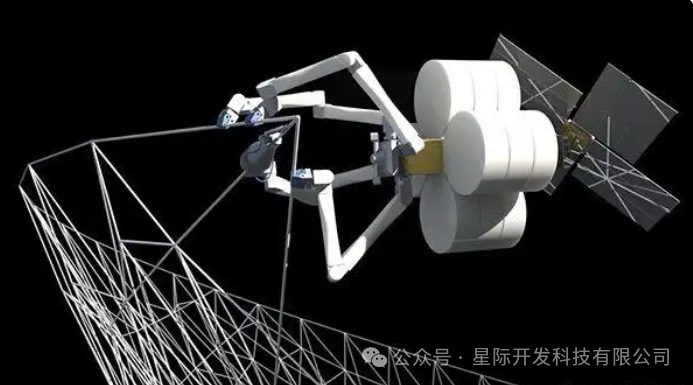
The SpiderFab project supported by NASA
Even more revolutionary is the “self-replicating” technology. NASA’s concept of a “space manufacturing factory” envisions the first landing modules carrying 3D printers to produce equipment needed for subsequent missions on the lunar surface, forming a closed-loop manufacturing system. This “seed factory” model could reduce the resource dependency of deep space exploration from 100% on Earth’s supply chain to less than 20%.
05
Chinese Strength: A Leap from Following to Leading
In this space manufacturing revolution, China is demonstrating a unique path of innovation. In April 2025, the China Aviation Manufacturing Technology Research Institute broke through cold cathode electron gun technology, with its titanium-aluminum composite material strength improved by 25% compared to equipment on the International Space Station, saving 23 million yuan in launch costs per mission. Meanwhile, Tsinghua University’s space bio-printing system not only achieved on-orbit cultivation of tumor models but also discovered that microgravity enhances cancer cell sensitivity to chemotherapy drugs, opening new directions for space medicine research.
In the field of lunar base construction, the “Lunar Xuanwu Base” plan proposed by the China Aerospace Science and Technology Corporation combines 3D printed mortise and tenon structure bricks with modular prefabrication technology, allowing for the completion of a 500 square meter habitat within 180 days. This path that integrates traditional wisdom with modern technology provides a new paradigm for deep space architecture.
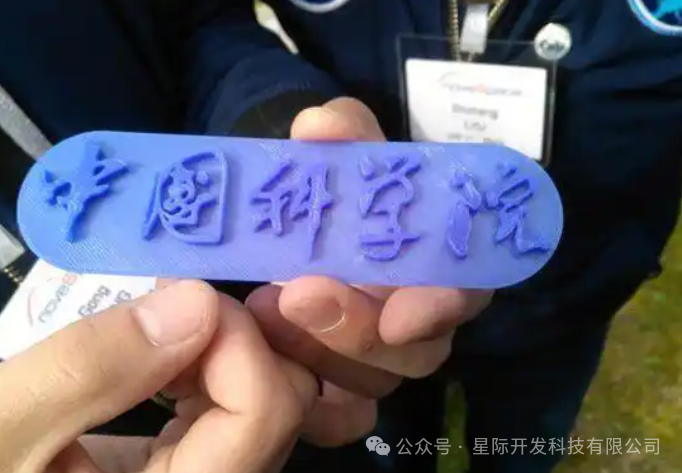
A nameplate printed by a domestic 3D printer under microgravity conditions
Space 3D printing is not only an upgrade in manufacturing technology but also a revolutionary infrastructure for human civilization’s expansion into the universe. When the first lunar soil brick-making machine sprays molten lunar dust on the lunar surface, and the first Martian habitat rises on the red plains, this technology is redefining the relationship between humanity and the universe. From the experimental cabin of the International Space Station to future deep space cities, the trajectory of 3D printing outlines a clear path of human evolution from Earth-bound beings to interstellar species. With China’s continuous breakthroughs in cold cathode electron guns, in-situ resource utilization, and other fields, the Chinese chapter of this manufacturing revolution is destined to leave a profound mark in the universe.
Editor | Li Shicong
Chief Editor | Li Shicong
Review Editor | He Yushuo