Compiled by: Wang Tiyao
According to data from the National Spinal Cord Injury Statistical Center in the United States, over 300,000 people suffer from spinal cord injuries, and currently, paralysis caused by these injuries cannot be reversed. A major challenge lies in the death of nerve cells and the inability of nerve fibers to regenerate at the injury site. However, a recent study published in Advanced Healthcare Materials has brought new hope.
The research team has demonstrated for the first time a groundbreaking technology that combines 3D printing, stem cell biology, and laboratory tissue engineering, successfully applied to spinal cord injury rehabilitation.
The researchers constructed a special organ scaffold with microchannels using 3D printing, designed to support lab-cultured organ tissues. They filled the microchannels with region-specific spinal cord neural progenitor cells, derived from human adult stem cells, which can divide and differentiate into specific types of mature cells.
“We guide the growth of stem cells through the channels of the 3D-printed scaffold, ensuring that the newly formed nerve fibers grow in the predetermined direction,” said Guebum Han, the first author of the paper from the University of Minnesota Twin Cities. “The relay system constructed using this method can bypass the damaged area after being implanted into the spinal cord.”
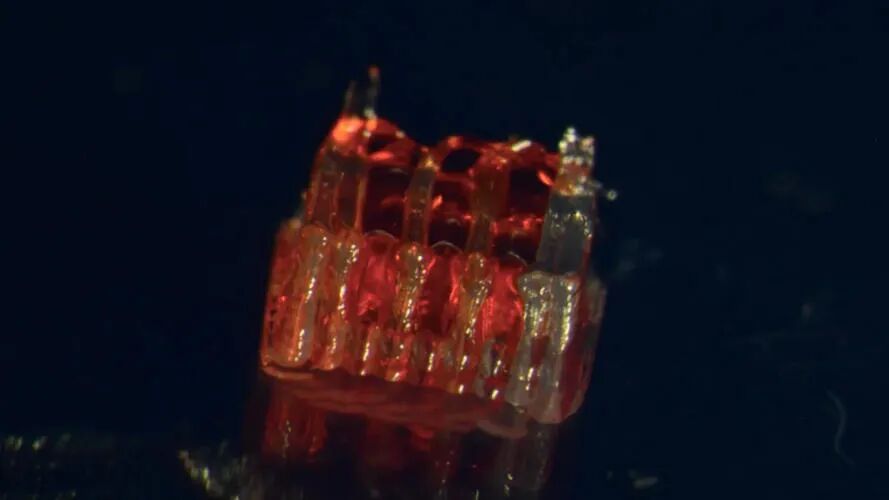
The researchers created a unique 3D-printed framework for the lab-cultured organs.Image Source: University of Minnesota
The researchers transplanted the scaffold into rats with completely severed spinal cords. They found that these cells successfully differentiated into neurons and extended nerve fibers in both the rostral and caudal directions, ultimately establishing new connections with the host’s existing neural circuits. Over time, the newly formed nerve cells were able to seamlessly integrate with the host spinal cord tissue, significantly restoring the rats’ functions.
“Regenerative medicine has opened a new era for spinal cord injury research,” said Ann Parr, the corresponding author from the University of Minnesota. “We will explore the clinical translation potential of this ‘mini spinal cord.’”
Although this research is still in its early stages, it brings new hope to patients with spinal cord injuries. The team plans to scale up production to develop this technology combination for future clinical applications.
Related Paper Information:
https://doi.org/10.1002/adhm.202404817
China Science Daily (2025-08-28, Page 2, International)Editor: Li HuiyuTypesetting: Jiang Zhihai

Please scan the QR code below for recognition in 3 seconds