Click the blue text to follow us immediately Research paper published by Grayson Minnick and his team from the University of Nebraska-Lincoln in the journal Small Science systematically explores the standardization issues of tensile testing in Two-Photon Polymerization (2PP) 3D printing technology at the microscale, providing important experimental evidence and methodological guidance for the precise characterization of material mechanical properties in this field.
As a high-precision additive manufacturing method, Two-Photon Polymerization (2PP) can construct three-dimensional structures with sub-micrometer resolution, demonstrating enormous application potential in fields such as micro-electromechanical systems (MEMS), biomedical engineering, and micro-optics. The core principle of this technology lies in focusing a high-intensity femtosecond laser beam within a photoresist, triggering a polymerization reaction only within the focal volume (Voxel) through nonlinear two-photon absorption effects, thus achieving high-precision processing point by point and layer by layer. However, as 2PP technology matures and its application fields continue to expand, accurately and reliably characterizing the mechanical properties of the microscale structures it produces has become a critical bottleneck hindering further development of this technology. Due to the extremely small sample size and complex geometries, traditional macroscopic mechanical testing methods are often not directly applicable, leading to significant discrepancies in mechanical property data obtained by different research teams, lacking comparability.
To address these challenges, the core of Minnick and his team’s research is to systematically evaluate the impact of different geometric designs of microscale tensile test samples on experimental results, aiming to establish a more standardized mechanical property evaluation system for materials manufactured by 2PP. The research team designed three different geometries for microscale tensile samples (Figure 2), including a proportionally scaled design based on ASTM D638 standards and two designs optimized for the specificities of microscale samples.
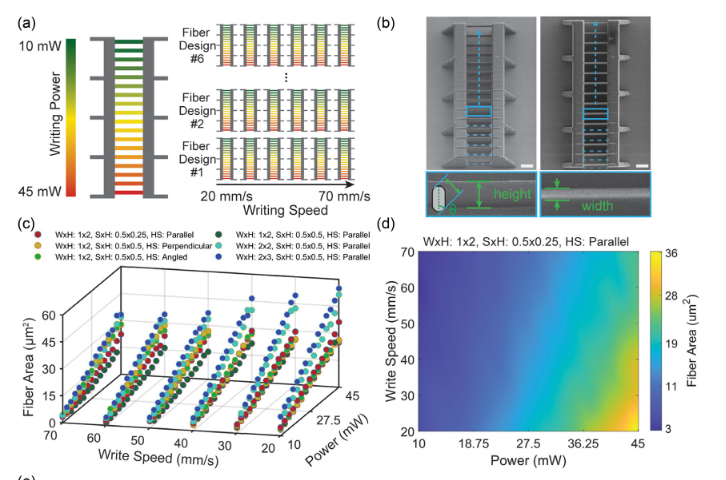
All samples were manufactured using Nanoscribe’s photonics professional GT system through the Two-Photon Polymerization technology, utilizing photoresist exposure. The researchers precisely controlled parameters such as laser power, scanning speed, and slice distance to ensure consistency and high quality in sample preparation. Using a nano-indenter integrated with a force sensor, the research team conducted in-situ tensile tests on these microscale samples, accurately recording their stress-strain responses during deformation until fracture.
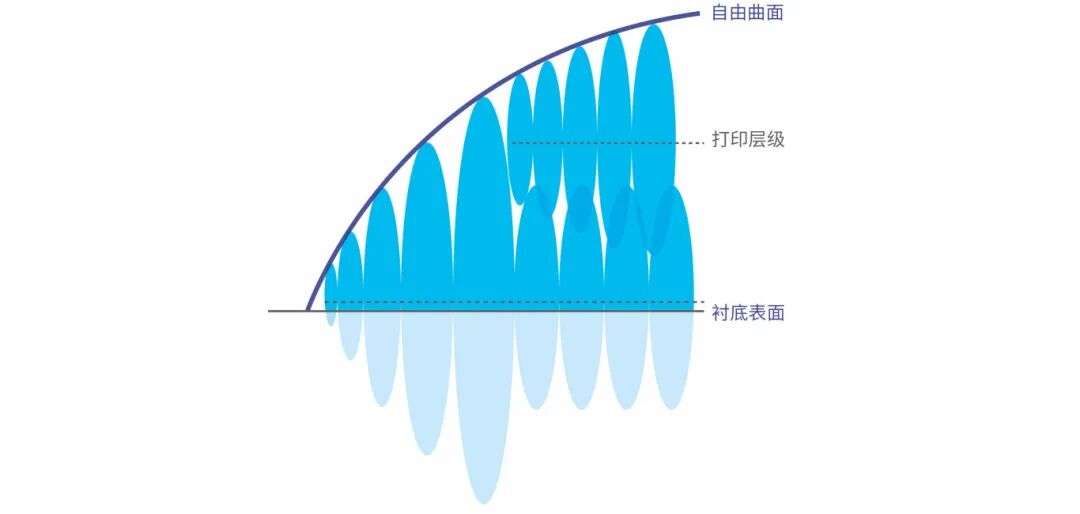
Nanoscribe’s Two-Photon Grayscale Lithography technology (2GL®) is a revolutionary breakthrough in the field of micro-nano 3D manufacturing. This technology combines the advantages of grayscale lithography and two-photon polymerization, achieving precise control over microstructures and their surfaces, providing unprecedented design freedom. 2GL® can manufacture ultra-smooth spherical/aspherical micro-lenses, sharp planar structures, and high aspect ratio freeform micro-optical devices, and even create hybrid optical elements for diffraction/refraction. Nanoscribe’s 2GL® technology is protected by Chinese national patent (Patent No.: CN110573291B).
The key findings of this research reveal the significant impact of sample geometry on microscale tensile testing. The study shows that traditional dog-bone sample designs tend to experience stress concentration in the transition area between the gripping ends and the testing section, leading to premature failure in the gripping part, thus underestimating the true strength and ductility of the material. In contrast, an optimized design with a smoother transition area and larger gripping heads (as shown in Figure 3 with the “dumbbell-shaped” design) can more effectively concentrate stress in the central testing area of the sample, resulting in measurements that are closer to the intrinsic mechanical properties of the material.
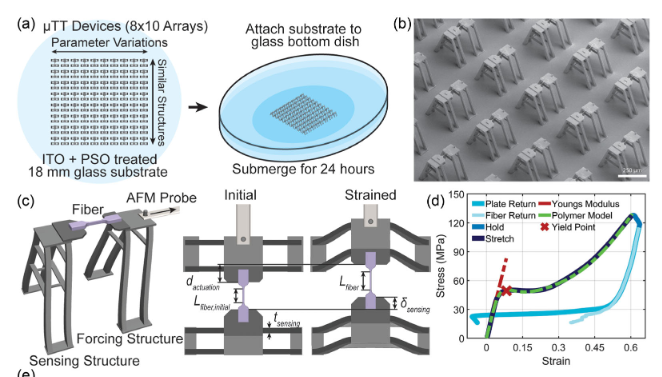
Experimental data show that the key mechanical parameters such as Young’s modulus, ultimate tensile strength, and elongation at break measured from the optimized sample design are significantly improved compared to traditional designs, with smaller data dispersion. This finding highlights the necessity of re-evaluating and optimizing mechanical testing sample designs at the microscale. The proposed solution in the paper, which involves improving sample geometric design to reduce non-ideal stress distribution, provides a clear and effective path to address technical bottlenecks such as the “gripping problem” and “stress concentration” in microscale mechanical testing.
Based on the results of this research, the characterization of mechanical properties in future 2PP technology will develop towards a more standardized and refined direction. The optimization design principles proposed in the study are expected to be adopted as universal testing standards for material screening and structural design in this field, thereby enhancing the comparability and credibility of different research outcomes. Furthermore, this work lays a methodological foundation for studying the mechanical behavior of more complex microscale structures, such as multi-material and gradient materials. With the establishment of standardized testing methods, researchers will be able to more accurately explore the structure-performance relationship between process parameters (such as laser power and scanning strategy) and the final mechanical properties of materials, thus accelerating the development of new high-performance photosensitive resins. At the application level, precise mechanical property data will greatly promote the application of 2PP technology in fields with higher load-bearing requirements, such as the design and manufacture of micro-robots with specific mechanical responses, implantable medical devices, and highly reliable micro-sensors (Figure 4).
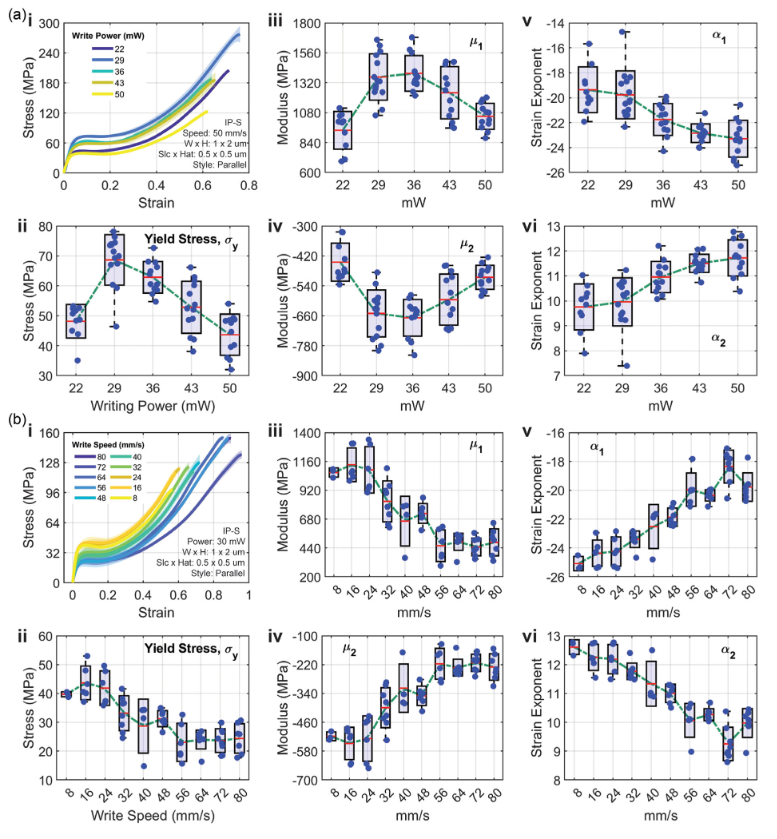
In summary, this research provides solid experimental evidence and standardized solutions to address key common issues in the field of 2PP micro-nano manufacturing, holding significant guiding significance for both academic research and industrial applications.
Related literature and image sources
https://doi.org/10.1002/smsc.202500228
 MNTech Micro-Nano NavigationScan the QR code to follow usPrevious Recommendations:
Engineering Surface Control of Stem Cell Behavior and Its Prospects in Regenerative Medicine
Technical Interpretation and Outlook of Silicone Additive Manufacturing in Biomedical Applications
Click here to “read the full text” to view the original paper