Global Analysis of ADC Drugs: Popular, Emerging Targets and Star Drugs
The human epidermal growth factor receptor2 (HER2) is one of the most extensively studied and fruitful targets in ADC drugs.HER2 belongs to the ERBB receptor tyrosine kinase family and is overexpressed or amplified in various epithelial-derived tumors, including breast cancer, gastric cancer, and non-small cell lung cancer.HER2 positive tumors typically exhibithigh invasiveness,poor prognosis, making it an important target for tumor-targeted therapy.
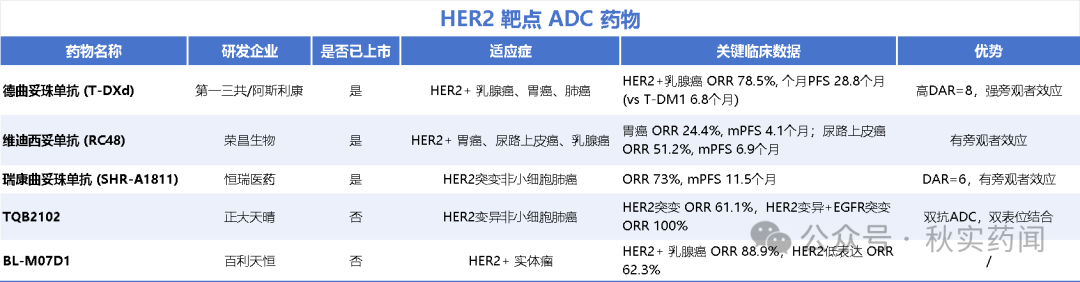
Summary of HER2 Target and Popular ADC Drugs:
Note:
1. Approved HER2 ADC Drugs
Currently, there are4 approved HER2-targeted ADC drugs globally:Trastuzumab emtansine (Trastuzumab emtansine/T-DM1),Trastuzumab deruxtecan (Trastuzumab deruxtecan/T-DXd/DS-8201)Disitamab vedotin/RC48) and SHR-A1811 (SHR-A1811). Among them,Trastuzumab deruxtecan has become the benchmark drug for treating HER2-positive tumors due to its outstanding efficacy and innovative design mechanism.
1. Trastuzumab deruxtecan (T-DXd), developed by Daiichi Sankyo/AstraZeneca
Trastuzumab deruxtecan (T-DXd) is developed by Daiichi Sankyo/AstraZeneca, utilizing a humanized anti-HER2 monoclonal antibody, a cleavable peptide linker, and a topoisomerase I inhibitor (Dxd). Its uniqueness lies in: high drug-antibody ratio (DAR≈8), membrane-permeable payload (with strong bystander effect) and stable plasma circulation (reducing off-target toxicity). It has been approved by the FDA for all HER2-positive solid tumors and by the NMPA for breast cancer, gastric cancer, and lung cancer. For breast cancer, the key clinical trial DESTINY-Breast03 showed that in HER2-positive breast cancer patients,T-DXd significantly prolonged progression-free survival (mPFS:28.8 vs 6.8 months; HR=0.33), with an objective response rate of78.5%. Additionally, in patients with low HER2 expression breast cancer (IHC 1+ or IHC 2+/ISH-), the DESTINY-Breast04 study showed that T-DXd significantly improved mPFS (9.9 vs 5.1 months) and overall survival (mOS: 23.4 vs 16.8 months), with an ORR of 56.2%, breaking the traditional limitations of HER2 binary classification and expanding the population benefiting from HER2-targeted therapy from 15% to 50% of breast cancer patients. For HER2-positive gastric cancer, the DESTINY-Gastric01 study showed that T-DXd also significantly improved mPFS (5.6 vs 3.5 months) and overall survival (mOS: 12.5 vs 8.4 months), with an ORR of 40.5% (vs chemotherapy 11.3%). For HER2-mutant lung cancer, the DESTINY-Lung02 study showed that T-DXd had an ORR of 49%, mPFS of 9.9 months, and mOS of 19.5 months.
2. Disitamab vedotin (RC48), developed by Rongchang Biotech
Disitamab vedotin (RC48) is independently developed by Rongchang Biotech in China, utilizing a novel humanized anti-HER2 antibody and a payload of monomethyl auristatin E (MMAE), and has been approved by the NMPA for the treatment of HER2-overexpressing gastric cancer, urothelial carcinoma, and breast cancer. For HER2-overexpressing gastric cancer patients, the C008 study showed that the ORR reached 24.4%, mPFS was 4.1 months, and mOS was 7.9 months. For HER2-overexpressing urothelial carcinoma patients, the C005 study showed that the ORR reached 51.2%, mPFS was 6.9 months, and mOS was 13.9 months. For HER2-overexpressing breast cancer patients, the C006 study showed that Disitamab vedotin significantly benefited compared to lapatinib combined with capecitabine, with mPFS of 9.86 vs 4.9 months, and mOS of not reached and 25.9 months.
3. SHR-A1811, developed by Hengrui Medicine
SHR-A1811 (SHR-A1811) is independently developed by Hengrui Medicine in China, utilizing an anti-HER2 monoclonal antibody and a topoisomerase I inhibitor (SHR169265, a novel camptothecin) payload, with a drug-antibody ratio (DAR) of 6, and has been approved by the NMPA for HER2 (ERBB2) mutated non-small cell lung cancer. The HORIZON-Lung study showed that for patients with HER2-mutated non-small cell lung cancer, the ORR reached 73%, mPFS was 11.5 months, and for patients with brain metastases, mPFS was 9.9 months.
II. Clinical Stage HER2 ADC Drugs
Currently, several novel HER2 ADCs are in clinical development, among which the most representative are Zheijang Chia Tai Tianqing’s TQB2102 (HER2 bispecific ADC) and Bai Li’s BL-M07D1.
4. TQB2102 (Bispecific ADC), developed by Zheijang Chia Tai Tianqing
TQB2102 is developed by Zheijang Chia Tai Tianqing, targeting HER2 protein ECD2 and ECD4 dual non-overlapping epitopes, and is a bispecific ADC drug. Its antibody part enhances affinity and internalization efficiency towards tumor cells through dual epitope binding, while the topoisomerase I inhibitor is released through lysosomal cleavage, precisely inducing DNA damage and cell death. The data from the II phase study announced at the 2025 WCLC conference showed that in 59 cases of HER2-mutant non-small cell lung cancer patients, TQB2102 demonstrated considerable clinical benefits: in the HER2 mutant cohort (36 cases): ORR reached 61.1%; in the HER2 gene amplification or protein overexpression cohort (9 cases): ORR was 44.4%; in the cohort with both HER2 and EGFR mutations (6 cases): ORR was 100%. Notably, TQB2102 also showed good activity in patients with both HER2 and EGFR mutations, providing new ideas for overcoming EGFR-TKI resistance.
5. BL-M07D1 ( developed by Bai Li Tianheng
BL-M07D1 is developed by Bai Li Tianheng, coupling HER2 antibodies with small molecule toxins of topoisomerase inhibitors (Ed-04) through Ac linkers. In the 2023 ESMO conference, phase I study data reported that patients with HER2-expressing solid tumors receiving M07D1 treatment showed an overall ORR of 55% and DCR of 95%. As of July 2024, the 4.4mpk Q3W dose group for HER2+BC showed an ORR of 88.9% and DCR of 100%; for patients who had received HER2 ADC treatment, ORR was 93.8% and DCR was 100%. For HER2 low-expressing BC, ORR reached 62.3% and DCR was 94.3%, with all cohorts not reaching mPFS.
Currently, multiple clinical trials have been conducted both domestically and internationally, including 3 phase III clinical studies, exploring indications covering HER2 low-expressing breast cancer, HER2-positive breast cancer postoperative adjuvant therapy, and various other solid tumors.

References
[1]Tarantino P, Carmagnani Pestana R, Corti C, et al. Antibody-drug conjugates: Smart chemotherapy delivery across tumor histologies. CA Cancer J Clin. 2022;72(2):165-182. doi:10.3322/caac.21705
[2]Trastuzumab deruxtecan (Enhertu) prescribing information
[3]Disitamab vedotin prescribing information
[4]Ziming Li, Yan Wang, et al, OTrastuzumab rezetecan, a HER2-directed antibody–drug conjugate, in patients with advanced HER2-mutant non-small-cell lung cancer (HORIZON-Lung): phase 2 results from a multicentre, single-arm study, Lancet Oncol. 2025.
[5]2025WCLC
“Medication should be taken as prescribed by a physician; this article does not provide medical advice.”