Research Updates
Professor Xu Haichao’s research group, in collaboration with Professor Lang Kai’s team from Heilongjiang University, has made significant progress in the field of organic electrosynthesis. Their research, titled “Carbene Reactivity Directly from Aldehydes via Low-Valent Iron Electrocatalysis,” has been published online in the Journal of the American Chemical Society (DOI: 10.1021/jacs.5c17027).
Carbenes are a class of highly reactive and functionally diverse key intermediates that can achieve various efficient and selective bond transformations, holding an important position in organic synthesis. However, generating reactive metal carbenes directly from abundant and stable precursors has been a core scientific issue in this field. Particularly for aldehyde compounds, the activation of their carbonyl C=O bonds is significantly hindered by both kinetic and thermodynamic limitations, making the catalytic conversion of “aldehydes directly as carbene precursors” rarely reported.
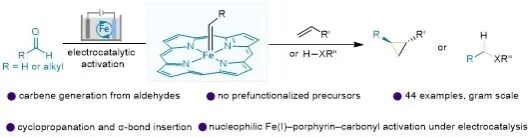
Inspired by the nucleophilic activation mechanism of low-cost iron species on CO2, Professor Xu Haichao’s research group proposed that the carbonyl of aldehydes could potentially be activated similarly by a nucleophilic low-valent metal center. Based on this idea, the research team constructed a low-valent iron(I) porphyrin electrocatalyst in situ using electrochemical methods. Through nucleophilic addition of iron(I) to the aldehyde carbonyl and inducing α-elimination at cathodic potentials, they successfully generated a highly reactive iron carbene intermediate, thereby establishing a direct electrocatalytic conversion strategy from aldehydes to metal carbenes. This pathway effectively circumvents the energy barrier limitations faced by traditional carbonyl reduction systems. The resulting iron carbenes can efficiently participate in olefin cyclopropanation and X–H (X = Si, S, N) bond insertion reactions, demonstrating broad substrate applicability, excellent functional group tolerance, and good electrochemical operability, providing a green and efficient new route for carbene transformations to construct diverse organic molecules.
This work was completed under the joint guidance of Professor Xu Haichao, Professor Xiong Peng, and Professor Lang Kai from Heilongjiang University. Xiamen University PhD students Zheng Yuntao, Wu Yuanxin, and Yang Ning are co-first authors of the paper, with contributions from Xiamen University master’s student Ma Zhihang and Heilongjiang University master’s student Wang Guang. This research was supported by the National Natural Science Foundation (22225101, 22361142752), the National Key Research and Development Program (2023YFA1507202), and others.
[Click at the end of the article to read the original paper]



People from the Department of Chemistry, Xiamen University
Official WeChat Account
Click “View” to let more people from the Department of Chemistry see this