Click the blue text

Follow us
Infrared scattering, 0.5 mg/m³, affordable solution for graduation project “Air PM2.5”
1
Module Introduction
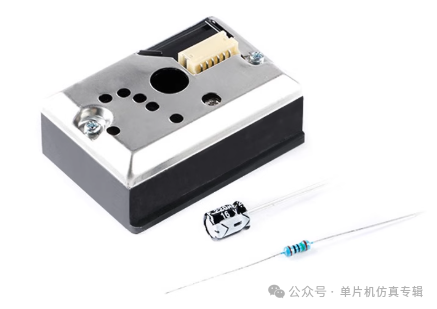
GP2Y1014AU is a Sharp infrared scattering dust sensor, with a range of 0.5-2.5 mg/m³, analog output of 0-3.5 V, 5 V power supply, designed for the graduation project “PM2.5 affordable detection”—just plug it in.
2
Principle
Built-in IRED + photodiode, particle scattering light → current → voltage; PWM pulse sampling at 0.32 ms, output voltage is positively correlated with dust concentration, no calibration needed for mg/m³ estimation.
3
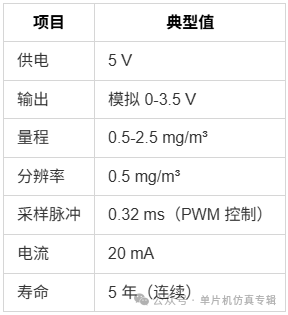
Core Parameter Table
4
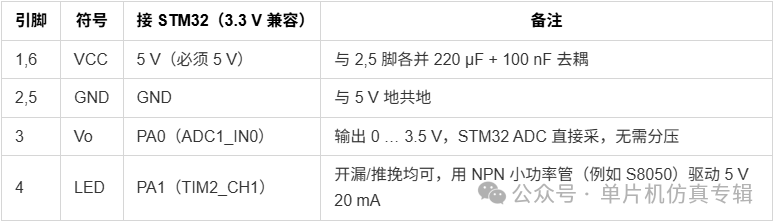
Pin Table
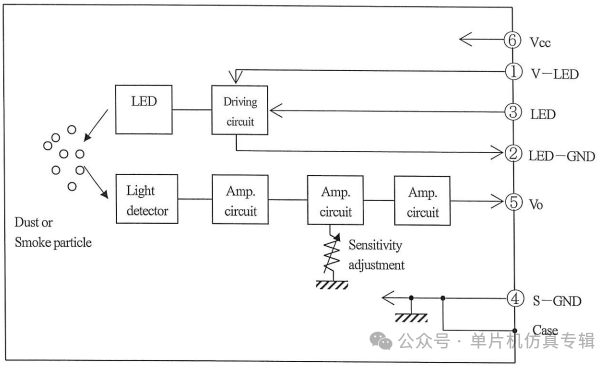
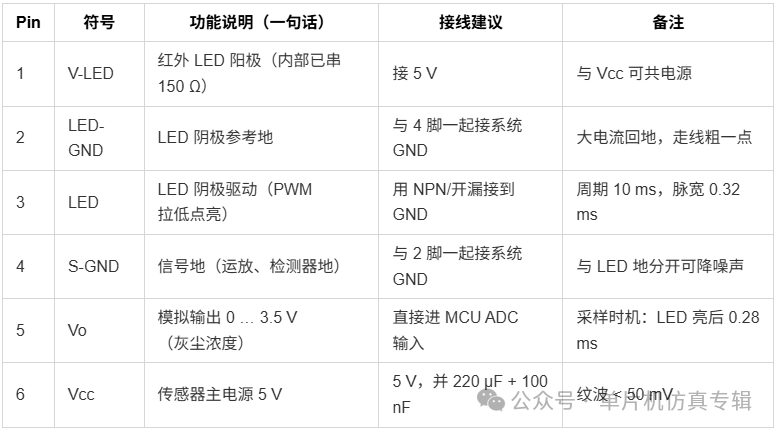
Note: The LED pin requires a 0.32 ms pulse, with a period of 10 ms; Vo 0-3.5 V directly to ADC.
5
Usage Steps
5.1 Timing Sequence (must be strictly followed)
1. LED period: T = 10 ms (±1 ms)
2. LED pulse width: Pw = 0.32 ms (±0.02 ms)
3. Sampling point: After the LED is turned on 0.28 ms
4. Do not read within 1 s after powering on the sensor; the internal circuit is stabilizing.
5.2 Hardware Connection (taking the 6-pin GP2Y1014AU0F as an example)
LED Driver Circuit
PA1 → 1 kΩ → NPN base
NPN emitter → GND
NPN collector → Module pin 4 (LED)
Module pin 4 should also pull a 150 Ω to 5 V (Sharp recommended value, R=150 Ω in the documentation)
5.3 Writing Code
6
Graduation Project Scenario
– Real-time display of PM2.5, LCD curve drawing;
– Dust exceeding standard SMS alarm, SIM900A linkage;
– Air purifier linkage, fan starts when dust >1 mg/m³;
– Comparison of laser vs infrared, chapter “Sensor Comparison” in the thesis.
7
Precautions
① Infrared scattering, sensitive to PM2.5, not a laser particle counter;
② Output 0-3.5 V, 3.3 V MCU directly to ADC;
③ Requires 0.32 ms precise pulse, generated by timer;
④ Accuracy 0.5 mg/m³, for μg/m³ requirements please switch to laser sensor.