
Shake flasks are one of the most widely used cultivation vessels in biotechnological process development. In recent years, several new technologies have been reported for online monitoring of various parameters such as oxygen, pH values, or biomass. However, most reports only involve monitoring a single parameter per shake flask. This study evaluates the capability of a novel multiparameter sensor (MPS) to simultaneously measure dissolved oxygen (DO), biomass, and fluorescence. Therefore, non-biological tests were conducted to assess its reproducibility, sensitivity, and accuracy. In biological tests, we used different microbial systems to evaluate its broad application potential. This study demonstrates that three different parameters—dissolved oxygen, biomass, and fluorescence—can be monitored online in parallel for various biological systems. The obtained online data provides critical process knowledge, such as the onset time of intracellular product formation. Both non-biological and biological tests showed good reproducibility, resolution, and sensitivity to changes in environmental conditions. Compared to other existing DO or oxygen transfer rate measurement systems, more data points can be recorded, allowing for a detailed overview and better understanding of the process.
In academia and industry, shake flask cultivation is an important component of biological research and process development, for example, for early strain characterization or finding optimal medium compositions. Despite the widespread application of shake flask cultivation, online monitoring tools are scarce. This leads to a significant amount of manual sampling or makes shake flask cultivation a black box operation, limiting the value of experiments and increasing costs and time investment.
Over the past 20 years, new technologies have developed to allow online measurement of parameters, thus bridging this gap. To monitor the physiological state of aerobic cultures online, oxygen transfer rates (OTR) and carbon dioxide transfer rates (CTR) can be measured using commercially available RAMOS devices (HiTec Zang GmbH) or TOM devices (Adolf Kühnner AG). Another approach is to measure dissolved oxygen (DO) in the liquid phase. Several studies have been conducted to determine this parameter online. Online measurements can be performed using different types of chemical sensors, such as points, patches, or nanoparticles coated with oxygen-sensitive luminescent dyes. Chemical sensors are based on the quenching principle. Sensor points are attached to the inside of the shake flask, while nanoparticles are suspended in the liquid. Data is read from outside the shake flask via fiber optics or mats.PyroScience or PreSens provide commercial systems for measuring dissolved oxygen (DO) or dissolved oxygen tension (DOT). However, sensor points are fixed at a certain position inside the shake flask, meaning they do not maintain continuous contact with the bulk liquid. As described by Hansen et al. and Flitsch et al., this configuration has been shown to cause issues. When using nanoparticles, the optical sensors are also located at a fixed position. However, as the particles move within the bulk liquid, the position of the liquid can be tracked, so measurements are only triggered when the liquid is in front of the optical sensor measurement window. To avoid mixed signal issues, a higher filling volume and lower shaking frequency can be employed to ensure that the sensor points are always covered by the bulk liquid. Online biomass quantification can be achieved by utilizing non-invasive optical techniques, such as measuring the scattered light or backscattering in the shake flask.sbi (Scientific Bioprocessing) produces the CGQ system and PreSens (Precision Sensing GmbH) produces the SFR vario system, both of which can be used for online monitoring of biomass.
So far, online fluorescence measurements have only been established on a microtiter plate scale. While it is common to monitor multiple parameters in parallel at the bioreactor scale, it is still rare for shake flasks. Compared to bioreactors, the options for shake flasks are usually limited to one parameter per device. To fully exploit the potential of easily set up shake flask cultivations, online monitoring is crucial.Schneider et al. demonstrated in their work the combination of pH and DOT measurements using commercially available SFR vario, where oxygen sensor points were used (PreSens Precision Sensing GmbH). Dinter et al. demonstrated the ability to monitor DOT, pH, biomass, and viscosity in parallel online using PyroScience GmbH ‘s Oxnano nanoparticles and a novel ShakeVisc module. Unlike the equipment used in this work, this module is not yet commercially available. In this study, the potential of using a multiparameter sensor (MPS) and a DO Sensor Pill (Aquila Biolabs GmbH, Scientific Bioprocessing INC) to measure biomass, dissolved oxygen (DO) , and fluorescence in parallel was evaluated.MPS is a sensor board located in an adapter beneath the shake flask, capable of measuring biomass, DO , and fluorescence through various integrated measurement modules. Using a chemical sensor-coated DO Sensor Pill, dissolved oxygen is measured utilizing the quenching effect. The Pill rotates with the bulk liquid in the shake flask. Non-biological tests were conducted to verify the accurate and sensitive results of the DO Sensor Pill to changes in oxygen concentration in the liquid. Biomass and fluorescence can be measured at different wavelengths and emission lengths. To demonstrate broad applicability, the following microorganisms were cultivated: Escherichia coli, Corynebacterium glutamicum, Pichia pastoris, and Ustilago maydis.
Escherichia coli and Corynebacterium glutamicum are widely used in industrial production, such as for pharmaceuticals or food and cosmetic ingredients. They share the common characteristics of rapid growth and high oxygen consumption. Here, they were used to study the sensitivity of the MPS to DO measurements. To demonstrate the broad applicability of the system, the growth of Pichia pastoris and the dimorphic fungus Ustilago maydis was also analyzed. Additionally, the Pichia pastoris strain used produces GFP protein, which should be tracked using the MPS. Since the selected Ustilago maydis strain produces triglycerides intracellularly, this study investigated whether this product affects DO and biomass measurements.
For detailed experimental procedures and results, please refer to the original text.
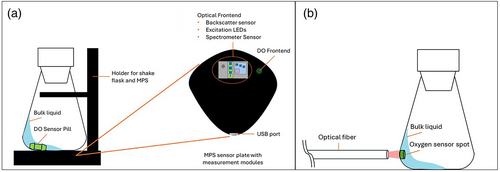
Figure 1. Schematic diagram and setup of the DO Sensor Pill measurement, including the multiparameter sensor (MPS) module (a) and DO sensor points (b). The setup of the RAMOS device can be found elsewhere.
For detailed experimental procedures and results, please refer to the original text.
Results and Discussion
Sensitivity and Reproducibility of Non-Biological Tests
The aim was to investigate the sensitivity and reproducibility of the dissolved oxygen sensor (DO Sensor Pill). For this purpose, gas mixing batteries were used to set different oxygen concentrations in a Wilms-MOPS medium (non-biological medium) without microbial cells. At the same time, data was continuously recorded to document changes (Figure 2).
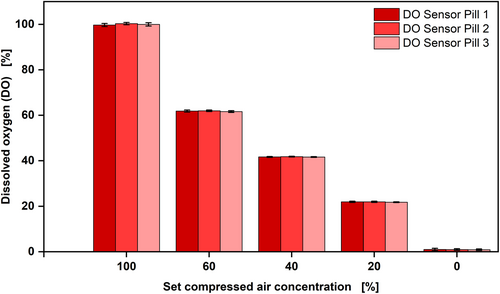
Figure 2. Sensitivity testing of the DO Sensor Pill in the non-biological Wilms-MOPS medium, using a mixture of compressed air and nitrogen gas, and employing a mixing battery. Using the RAMOS system for aeration, n = 250 rpm, d 0 = 50 mm, t = 30°C, V L = 25 mL, rep. = 3. The concentrations of compressed air were set to 100%, 60%, 40%, 20%, and 0%.
The setup was as follows:N2 and compressed air mixture, where the content of compressed air was set to 100%, 60%, 40%, 20% and 0%. Under 100% compressed air, the DO Sensor displayed 100% dissolved oxygen. This is due to the calibration of the DO Sensor using compressed air with an oxygen content of 21.95%. For the DO Sensor, this value is set to 100% DO. All three sensors accurately measured all set oxygen concentrations, with deviations in the range of 0.15–1.3%. Since different gas compositions were set successively, a certain balancing time is required to ensure that the set oxygen concentration is reached in both the liquid and the top space of the shake flask. The balancing time depends on the volume of the shake flask, the volume of the top space, and the air flow rate, which in this case was 1.5 hours. The same applies to other oxygen concentrations. However, slight deviations may also be due to the limited accuracy of the gas mixing battery. For this purpose, we conducted further tests using a gas collector with precisely defined gas compositions. The corresponding value deviation displayed by the DO Sensor Pill was0.33%, and this value remained stable over120 hours (Figure S3). This indicates that the DO Sensor Pill can provide reproducible results and has sensitivity and accuracy at different dissolved oxygen concentrations. Furthermore, the measurements remained stable over120 hours, making it suitable for longer cultivation periods.
Comparison with Other Existing Online OTR and Online DO Measurement Systems
The DO Sensor Pill measurements were tested against two established measurement systems for measuring dissolved oxygen content in liquids or oxygen transfer rates (OTR). The selected systems were the optical oxygen sensor method using PyroScience equipment (oxygen sensor points) and the RAMOS measurement system. The selected biological system was Escherichia coli, cultivated under two different conditions, with varying filling volumes, shaking frequencies, and shaking diameters, which are commonly found in the literature (Figure 3).
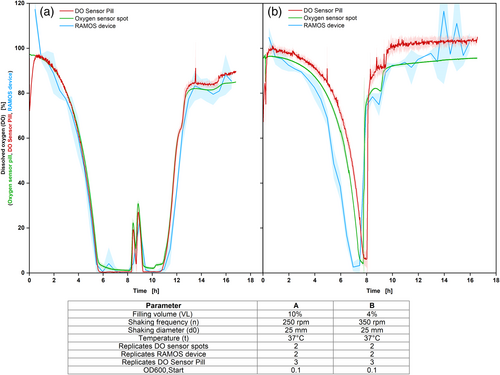
Figure 3. Comparison of dissolved oxygen (DO) measurement values in the measurement systems: DO Sensor Pill, oxygen sensor points, and the RAMOS device with Escherichia coli BL 21 DE 3. Wilms-MOPS medium; shaded areas indicate standard deviation.
Using the t test validated the significance of these results. The p-value of the cultivation results shown in Figure 3a is 4.6 × 10⁻⁵. The p-value recorded in Figure 3b is significantly higher, at 2.25 × 10 −17. These results indicate that the data from the DO Sensor Pill and the DO sensor points are highly comparable.
The DO Sensor Pill exhibited higher noise levels in the high DO range. This has already been pointed out in studies by Tolosa et al. This may be due to the inherent properties of the dye in the DO Sensor Pill leading to a nonlinear calibration curve between oxygen concentration and emission intensity. Compared to the calculated DO values displayed by the RAMOS device, the oxygen sensor points and the DO Sensor Pill provide shorter sampling intervals, resulting in higher resolution for DO measurements compared to RAMOS measurements (Figure S4). Reducing the measurement interval of the RAMOS device can alleviate this issue to some extent.
Using the DO Sensor Pill, small peaks were detected in both tests (e.g., at 5 hours in Figure 3b or 13.5 hours in Figure 3a). One reason may be that the DO Sensor Pill was not fully covered by the medium for a short time. More peaks at lower filling volumes can confirm this hypothesis (Figure 3b). The time offset of the online measurement data (Figure 3b) is due to the different times the calibration and pressure tests placed the shake flask in the shaker. To ensure biological comparability, time offsets during inoculation were avoided. However, repeated tests conducted using only the RAMOS device and the DO Sensor Pill did not show delays, indicating that handling issues are the main reason (Figure S5). Dissolved oxygen (DO) levels exhibited offsets, with the DO Sensor Pill showing higher DO content, especially after 9 hours of cultivation. The differences between the RAMOS data and the DO values may be due to variations in the conversion from OTR to DO. The deviations of the sensor points are likely due to calibration, as indicated by the initial 96% DO. Additionally, the low filling volume of the DO Sensor Pill (4%) may lead to measurements of oxygen content in the top space. It is recommended to use 5% as the minimum filling volume to yield more comparable results regarding DO levels (Figure S6). Therefore, ensuring an adequate filling volume is crucial. According to the manufacturer’s information, a filling volume of 10% for a 250 mL shake flask should be used. This condition is primarily used for industrial applications and was therefore chosen for subsequent experiments. Notably, the DO Sensor Pill measured DO levels of approximately 0% within the time range of 5.5-10.5 hours, while the oxygen sensor points measured approximately 3% (Figure 3a). Since the RAMOS also measures oxygen limitation, it is expected that the DO values from the oxygen sensor points are also very close to zero.Flitch et al. have observed this phenomenon. Hansen et al.’s findings indicate that this is due to the fixed position of the sensor points causing mixed signals between the DO in the bulk liquid and the oxygen in the top space of the shake flask. When the DO Sensor Pill began measuring, both experiments started with DO levels of approximately 80%. This may be attributed to the temperature equilibrium of the medium after starting the shaker (Figure S7 andS8). Another hypothesis is that the Pill containing the dye must adapt to the liquid and environmental conditions. In contrast, the oxygen sensor points were soaked in sterile water for 24 hours for preparation.
At the end of each cultivation, offline samples were collected for each online measurement system, and the results showed no statistically significant differences. Furthermore, experiments demonstrated that both the MPS and the DO Sensor Pill did not exhibit any toxic effects on the cells (Figure S9).
The Combination of MPS and DO Sensor Pill for Online DO and Online Biomass Measurements
In addition to using the DO Sensor Pill to measure dissolved oxygen (DO), the MPS can also be used to measure changes in biomass during fermentation online. To ensure synchronized measurements of biomass and dissolved oxygen, we measured Escherichia coli at two different shaking frequencies (as shown in Figures 4 and 5, shaking diameters of 50 mm, 350 rpm and 250 rpm).
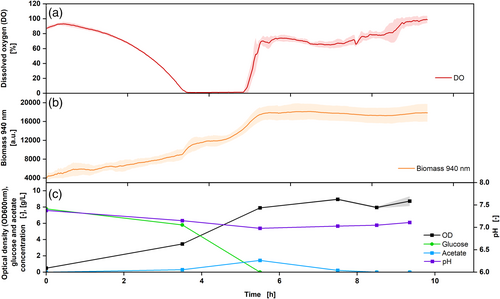
Figure 4. Escherichia coli BL 21 DE 3 cultivation, Wilms MOPS medium, DO Sensor Pill (a, red), and offline sampled biomass measurements (b, orange), OD 600 (c, black), glucose (c, green), acetate (c, blue), and pH values (c, purple), V L = 10%, n = 350 rpm, d 0 = 50 mm, t = 37°C, rep. = 3, OD 600, Start = 0.5. Shaded areas indicate standard deviation.
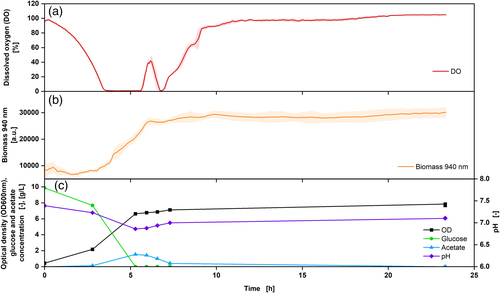
Figure 5. Escherichia coli BL 21 DE 3 cultivation, Wilms-MOPS medium, DO Sensor Pill, offline sampled dissolved oxygen at 940 nm wavelength (a, red) and biomass measurements (b, orange): OD 600nm (c, black), glucose (c, green), acetate (c, blue), and pH values (c, purple), V L = 10%, n = 250 rpm, d 0 = 50 mm, t = 37°C, rep. = 3, OD 600, Start = 0.5. Shaded areas indicate standard deviation.
The experimental method at a shaking frequency of 350 rpm showed that DO decreased within the first 3.5 hours, followed by a plateau of approximately 1% for over an hour (Figure 4), indicating oxygen limitation. This can also be seen in the RAMOS data, which ran in parallel with the shake flask containing the DO Sensor Pill (Figure S10). Subsequently, after glucose was consumed (5 hours), DO increased again. The increase in biomass was measured by the intensity of scattered light at a wavelength of 940 nm. From the time of oxygen limitation (3.5 to 5 hours), a plateau was observed in the measurements, which may indicate a slower increase in biomass under oxygen-limited conditions. Due to the limited number of samples collected, this could not be identified in the offline OD 600 data. However, the different growth phases of the culture (e.g., exponential phase or stationary phase) corresponded between the online and offline data. Based on HPLC data, glucose was observed to be consumed at approximately 5.5 hours. Under oxygen-limited conditions, the production of acetate increased significantly, and the decrease in pH values also confirmed this. After glucose was consumed, acetate was also metabolized, leading to an increase in pH values. When glucose was also nearly exhausted, dissolved oxygen (DO) increased again to 100% (Figure 5).
The experimental method at a shaking frequency of 250 rpm indicated that the three repetitions of the DO Sensor Pill exhibited the same DO process during fermentation, thus demonstrating reproducibility (Figure 5). These results also aligned with the measurements from the RAMOS (Figure S11), where oxygen limitation could be identified for over 2 hours. Compared to the previously described experiment (Figure 4), the duration of oxygen limitation was extended, which can be explained by the lower shaking frequency. An increased shaking frequency creates a larger exchange surface between the medium and the surrounding air, facilitating oxygen transfer into the medium. Prolonged oxygen limitation can lead to reduced cellular respiration, thereby extending the fermentation process. In this experiment, the online biomass signal matched the offline OD 600 values. Differences between online and offline measurements were only observed when reaching the biomass concentration plateau. While the online measured biomass concentration increased in the first 6 hours of cultivation, the offline data reached a plateau after 5 hours. DO values indicated that from 3.6 hours to 6 hours, the oxygen concentration was approximately0%, indicating that the cells maintained respiratory activity. The appearance of respiratory activity indicates that, among other factors, biomass concentration also increased. Therefore, the DO measurement results validated the biomass concentration measurements obtained online. In offline samples, no significant differences were observed between the OD samples at 5 hours and 6 hours. This difference may be due to inaccuracies in the manual sampling procedure. This finding emphasizes the importance of continuous online data measurement, as it can avoid such influencing factors. Furthermore, the correlation graph (Figure S12) demonstrates the correlation between offline and online biomass measurements. Ultimately, both online and offline measurement results showed a slight increase in biomass concentration before the end of the cultivation. Offline samples also indicated that glucose was exhausted after approximately 5.5 hours, leading to a brief increase in DO again. However, during the oxygen-limited period, the metabolism of acetate produced a decrease again, and only when both acetate and glucose were fully metabolized did DO increase again.
These two tests indicate that online biomass measurements can be conducted simultaneously with online DO measurements under both shaking conditions without the need for additional equipment.
Additionally, the applicability of using the DO Sensor Pill and MPS for online DO measurements and online biomass measurements in complex media was also investigated (Figure S13). Since metabolic effects can be studied more effectively in defined media, this study focused on the use of defined media.
The Impact of Different Biological Systems on DO Measurements
In subsequent experiments, in addition to measuring Escherichia coli, we also tested whether the DO Sensor Pill is applicable to other biological systems. For this purpose, we cultivated Corynebacterium glutamicum, Pichia pastoris, and Ustilago maydis. Furthermore, we further investigated whether biomass measurements could be integrated and whether fluorescence measurements could be included as a third parameter.
Figure 6 shows the cultivation results of Corynebacterium glutamicum DM 1933. Oxygen limitation also began after approximately 9 hours of fermentation and lasted for about 7 hours. Biomass measurements displayed a typical growth curve for batch cultivation of bacteria. After an initial lag phase of 7 hours, an exponential growth phase followed until 12 hours, at which point glucose was exhausted. HPLC data also indicated that acetate was formed during the oxygen-limited period, which was subsequently metabolized. Only a brief stable growth phase was observed (from 12.5 to 13 hours). In the subsequent death phase, biomass concentration decreased, which may be due to nutrient depletion or morphological changes leading to cell lysis, thus affecting backscattering (Figure 6c). This was also observable in the online biomass measurements as the intensity of backscattering decreased. Overall, it can be summarized that the online measurements conducted using the DO Sensor Pill and biomass measurements using the MPS correlated well with offline data (Figure S14).
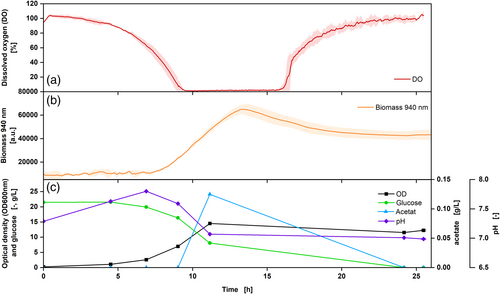
Figure 6. Corynebacterium glutamicum DM 1933 cultivation, CG XII medium, DO Sensor Pill (a, red), biomass measurement at 940 nm (b, orange), offline measurement (c):OD 600 (black), pH values (purple), acetate (blue), and glucose (green) concentrations, V L = 10%, n = 350 rpm, d 0 = 50 mm, t = 30°C, rep. = 2, OD 600, Start = 0.2. Shaded areas indicate standard deviation.
The Impact of Intracellular Product Synthesis on Online DO and Biomass Measurements
Ustilago maydis was cultivated in both inducing media (Figure 7) and media that inhibit triglyceride production (Figure S15). Thus, different concentrations of glucose and nitrogen were used. This study investigated the impact of intracellular products on online biomass and dissolved oxygen (DO) measurements. For better comparison, the results of the OTR from the RAMOS device are also shown in the figure.
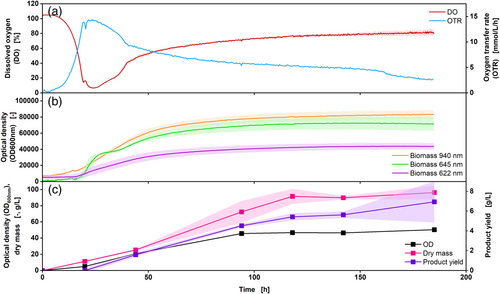
Figure 7. Ustilago maydis MB215Δcyp1Δemt1 cultivation, Verduyn oil-producing medium, DO Sensor Pill (a, red), OTR measurement by RAMOS (a, blue), biomass measurement at 940 nm (b, orange), 645 nm (b, green) and622 nm (b, light purple) online biomass measurements, as well as offline measurements:OD 600 (c, black), dry mass (c, pink), product yield (c, purple). V L = 10%, n = 250 rpm, d 0 = 50 mm, t = 30°C, rep. = 3, OD 600, Start = 0.2. Shaded areas indicate standard deviation.
During the initial 150 hours, both the OTR and DO curves followed the same trend, with OTR decreasing slowly from 40 hours to 150 hours, while DO correspondingly increased. Richter et al. also observed the changes in OTR, where the slow decrease in OTR indicates the triglyceride production phase. After 150 hours, OTR sharply decreased further, while DO did not increase, as not all glucose had been consumed (Figure S16). Looking at the biomass results from the first 25 hours, a sharp increase was measurable at both 645 nm and 940 nm, which was also observable in offline measurements. At approximately 25-34 hours, an “inflection” was observed in the online measurements at 645 nm, which may indicate the onset of triglyceride production, as evidenced by the increase in product yield during the same time frame. Additionally, this inflection was not observed during the U cultivation. Growing in nitrogen-rich media does not trigger triglyceride formation (Figure S15). Furthermore, changes in cell morphology can also be observed in the backscattering graph. As cells store triglycerides intracellularly, the size of triglycerides increases, leading to morphological changes. The continuous storage of triglycerides within the cells will increase their size until the substrate is exhausted, which is also confirmed by the online biomass data. Here, the increase in biomass concentration can be ruled out, as no further growth occurs after nitrogen limitation. However, this effect should be actively assessed, as it can provide conclusions about the process, such as the onset of triglyceride production. The onset of triglyceride production cannot be inferred from offline biomass data (OD and dry biomass) as both analyses are influenced by the storage of intracellular products (Figure 7c). During nitrogen limitation, it is assumed that no further biomass growth occurs. However, this can be inferred from the increase in biomass observed in offline measurements. Studies indicate that this applies to both OD and dry mass measurements. The difference between the increase in biomass and triglyceride concentration can only be determined through product analysis, which is time-consuming and does not provide real-time data.
The Impact of GFP Production on Online DO and Biomass Measurements and Validation of Online Fluorescence Measurements
To test whether the production of GFP protein affects DO and/or biomass measurements, and whether online fluorescence measurements can be integrated, the Pichia pastoris Mut S host strain BSYBG11 was cultivated (Figure 8).
DO signals showed no oxygen limitation, but two consecutive peaks appeared between 11 and 15 hours of cultivation, which can be explained by the Crabtree effect. After approximately 30 hours, another DO peak was measurable, followed by a slight decrease in DO due to methanol consumption (Figure 8d). As methanol was exhausted, DO increased again. For online fluorescence measurements, emission wavelengths of 515, 555, and 590 nm were selected (only 555 nm is shown, more data: Figure S17). The excitation wavelength was set to 465 nm. Simultaneously, samples were collected for offline fluorescence determination. From 20 hours of cultivation, an increase in emission measured in offline samples could be observed. Here, GFP was formed, which is also reflected in the decrease in methanol concentration, caused by the basal expression leading to GFP production as described by Wollborn et al. The second increase in online measured emission coincided well with the main GFP production phase after 30 hours. Differences between online and offline fluorescence measurements could be observed. While online measurements of fluorescence increased from 5 hours to 14 hours, the increase was only measured in offline biomass measurements after 22 hours of cultivation. Since measurements were conducted sequentially, the influence of online biomass measurements via backscattering on fluorescence measurements can be neglected. This was also considered when setting the measurement intervals in the software. In this case, the differences between online and offline fluorescence measurements can be attributed to the measurement bandwidth. Different detection spectra can be set for online and offline measurements, and the desired peak detection wavelength can be selected. However, in addition to this peak, the bandwidth is always measured, the size of which depends on the spectrometer or detector. In this case, it was found that the spectrometer in the MPS had a bandwidth of ±27 nm at a wavelength of 555 nm, while the bandwidth of the plate reader for offline samples was only ±2 nm. This indicates that additional fluorophores may be detected during online measurements, leading to differences. Additionally, biological replicates were conducted during online measurements, while technical replicates were conducted during offline measurements. In particular, the results of offline measurements at sampling points after 31.5 hours were particularly pronounced, which may be attributed to technical replicates. In general, fewer sampling points can show less trend variation. This again emphasizes the importance of continuous online measurements during shake flask bioprocesses. The OD change curves show an increase from cultivation 0 to 15 hours, which can also be observed in the online biomass data at all wavelengths (Figure 8c,d). However, larger deviations between the three replicates can be measured at 940 nm and 622 nm. Additionally, after 75 hours of cultivation, the intensity of backscattering increased significantly, while offline OD values only increased slightly. Glucose was also consumed after 20 hours, indicating that no additional biomass was measured at these wavelengths. The observed changes may be attributed to the presence of metabolites and changes in cell conformation, which occur during this phase of cultivation and affect backscattering in these wavelength ranges. A slight increase in OD was also measured at 645 nm, which may be due to methanol incorporation into peroxisomes and additional growth of cells on methanol. Therefore, the measurements at 645 nm are the most significant. Another hypothesis is that during the first 20 hours of fermentation, there is crosstalk between the excitation peaks, emission peaks, and backscattering due to the increase in biomass. The three dissolved oxygen (DO) measurement replicates showed greater deviations during the main phase of GFP production, which may be due to methanol evaporation. Changes in the sealing of the shake flask may lead to different losses of methanol, thus affecting dissolved oxygen measurements, as methanol is an inducer of GFP and stimulates cellular respiration. The possibility of simultaneously measuring dissolved oxygen, biomass, and fluorescence in a shake flask system provides the potential for further understanding of biological processes. Additionally, different excitation and emission wavelengths as well as biomass measurement wavelengths can be set and recorded in parallel, further expanding the range of applications and avoiding measurement interference. However, for unknown systems, suitable wavelengths for biomass measurement (backscattering) and fluorescence measurement (excitation/emission) should be screened to achieve optimal settings. In complex media, it is also possible to simultaneously measure dissolved oxygen (DO), biomass, and fluorescence (Figure S13). However, as identifying metabolic effects from online data presents challenges, this aspect was not included in this study.
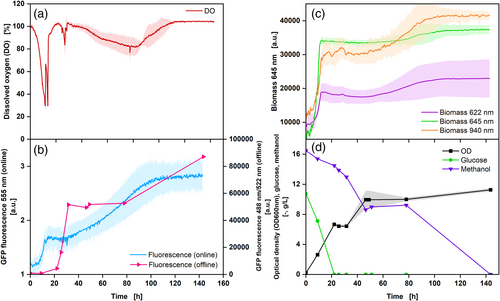
Figure 8. Pichia pastoris Mut S cultivation, Syn6-MES medium, DO Sensor Pill (a, red), online fluorescence measurements at 465 nm excitation and 555 nm emission (b, blue), offline fluorescence measurements at 488 nm excitation and 522 nm emission (b, pink), 622 nm (c, purple), 645 nm (c, green), 940 nm (c, orange) biomass measurements, as well as offline measurements:OD 600 (d, black), glucose (d, green), methanol (d, purple) concentrations.V L = 10%, n = 350 rpm, d 0 = 50 mm, t = 30°C, rep. = 3, OD Start = 0.2. Shaded areas indicate standard deviation.
Conclusion
Shake flasks are the most commonly used vessels in biotechnology research and process development. Therefore, there is an urgent need to better understand the shake flask cultivation process, which can be achieved through online monitoring of parameters such as dissolved oxygen, oxygen transfer rates, and biomass. In recent years, online measurement technologies have continuously developed. However, typically only single parameters such as dissolved oxygen or oxygen transfer rates are recorded. This study aimed to explore whether it is possible to analyze dissolved oxygen, biomass, and fluorescence values online in parallel in a single shake flask using a multiparameter sensor (MPS), thereby gaining deeper insights into biological processes. Non-biological tests indicated that the changes in dissolved oxygen measured using the DO Sensor Pill exhibited good reproducibility, as well as sensitivity and accuracy. This was true for all biological systems. Compared to existing dissolved oxygen and oxygen transfer rate measurement systems, the DO Sensor Pill showed comparable results. All experiments demonstrated the reproducibility of online DO, biomass, and fluorescence measurements. The differences between online and offline fluorescence measurements may be attributed to the differences in bandwidth of the spectrometers integrated in the MPS and the plate reader. Overall, this study indicates that using the user-friendly MPS allows for the parallel online measurement of three different parameters across various biological systems, providing deeper insights into the entire process. Shake flasks have well-known advantages, such as high parallelization, sufficient capacity for offline analysis, ease of operation, and low cost per experiment. Combining these advantages with the advanced insights gained from the MPS has the potential to further solidify the role of shake flasks in critical application areas, such as bioprocess characterization in process development and scale-up processes.
Original text:L.Strehl, A.Kuhn, K.Hoffmann, et al., A novel multiparameter sensor for shake flask cultivations: Online biomass, dissolved oxygen, and fluorescence monitoring for comprehensive bioprocess characterization. Biotechnology Progress, 2025.