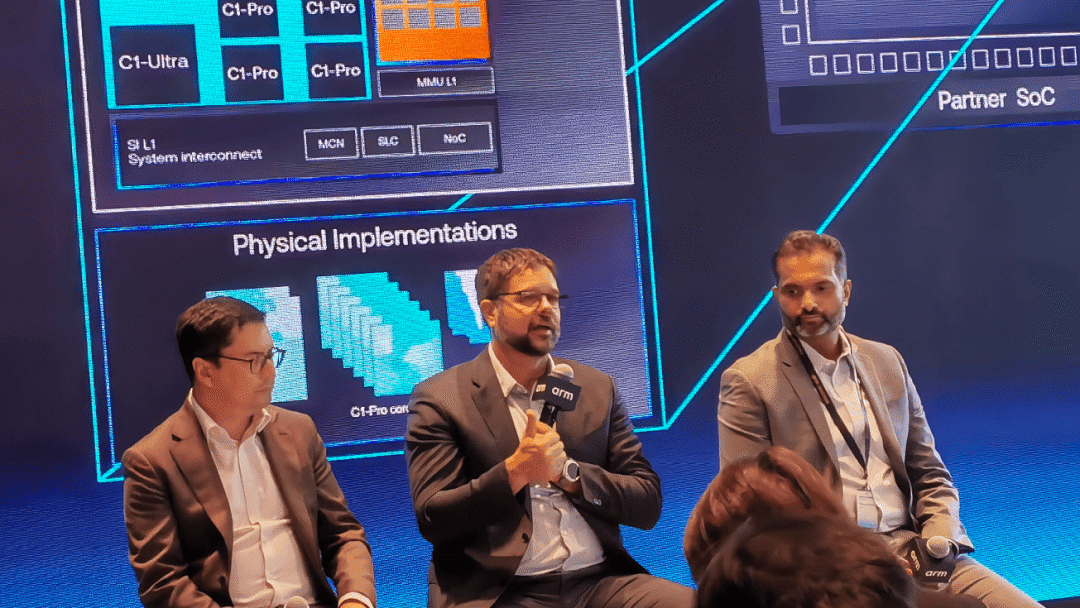
Recently, at the Arm UNLOCKED summit held in Shanghai, Chris Bergey, Senior Vice President and General Manager of Arm’s Client Line of Business, along with James McNiven, Vice President of Product Management, made a clear response regarding the widely discussed Xiaomi 3nm self-developed chip, “Xuanjie O1”.
In May 2025, Xiaomi’s first 3nm flagship SoC, Xuanjie O1, will be released alongside the Xiaomi 15S Pro.
This chip, utilizing TSMC’s 3nm process, features a four-cluster ten-core architecture (2 X925 super-large cores + 4 A725 large cores + 2 A725 low-frequency cores + 2 A520 small cores) and an IMG CXT 48 – 1536 GPU combination, achieving performance close to the Snapdragon 8 Gen 2 series, successfully ranking among the top five in global mobile chip performance.
However, alongside this technological breakthrough, there have been doubts regarding the source of the chip’s technology.
The controversy originated from a press release on Arm’s official website titled “XRING O1 Custom Silicon from Xiaomi is Powered by the Arm Compute Platform.” Some netizens translated “Custom Silicon” directly as “custom chip,” leading to the inference that Xuanjie O1 is a complete solution customized by Arm based on its CSS (Compute Subsystem) platform for Xiaomi.
Despite Xiaomi’s chip head Zhu Dan quickly refuting this, and Arm’s official account urgently deleting and reissuing the press release, the doubts have not subsided.
ARM Executives’ Systematic Response
In a media interview following the Arm UNLOCKED summit, Chris Bergey systematically addressed this controversy for the first time.
He clearly pointed out that the core value of the Arm CSS platform lies in providing customers with validated CPU/GPU cluster solutions and software stacks, helping customers reduce R&D investment in basic computing units, but this does not equate to providing a complete SoC chip.
Chris Bergey emphasized, “After purchasing CSS, customers still need to design or integrate key components such as interface IP, ISP (Image Signal Processor), NPU (Neural Processing Unit), and baseband modules themselves.
Taking Xiaomi as an example, the ISP, image processing pipeline, and the UWB 3.0 seamless interconnection feature with Xiaomi’s SU7 car are all differentiated technologies independently developed by Xiaomi based on its own ecological needs.
These are the core factors determining the chip’s competitiveness.”
James McNiven further added that the Arm CSS platform provides reference designs and physical implementations, rather than a “turnkey project.”
Customers cannot directly hand over CSS solutions to foundries for production, as the complete functionality of an SoC requires customers to overlay a large amount of proprietary IP on top of the CPU/GPU.
“The real technological barrier lies in how to deeply integrate Arm’s computing foundation with the customer’s differentiated needs, which requires the collaborative innovation of hundreds of engineers, rather than simple IP assembly.”
High Degree of Autonomy in Xuanjie O1
From the publicly available technical parameters, the autonomy of Xuanjie O1 far exceeds the scope of a “custom chip,” covering architecture design, functional integration, ecological collaboration, and more.
Industry analysts point out that if Xuanjie O1 were merely a “repackaged product” of Arm CSS, it would not be able to achieve such a high degree of functional customization, nor could it surpass the Snapdragon 8 Gen 3 leading version in performance rankings.
Chris Bergey repeatedly emphasized in his response that self-developed chips have become a consensus in the global technology industry. “Apple, Samsung, and Huawei have been deeply engaged for many years, and Chinese manufacturers like Xiaomi, OPPO, and vivo are also accelerating their catch-up.
This is not only a demand from smartphone manufacturers; data centers and automotive manufacturers are also seeking customized chips to build technological barriers.”
Xiaomi’s founder Lei Jun previously stated that the R&D cycle for self-developed chips lasts three to four years, with the first generation mainly used for technology validation.
Xiaomi is advancing the development of the second generation “Xuanjie O2” chip, expected to be released in September next year, possibly applied to the Xiaomi 16S Pro and expanded into the smart automotive field.
Conclusion
Industry insiders analyze that the ARM executives’ response not only clarifies Xiaomi’s self-developed chip but also reveals the current trend in the chip design industry—chip design companies utilizing ARM’s IP and platform, combined with their own technological advantages, to create differentiated products.
This is not a “repackaging” but a mature industry ecosystem.
With ARM’s official clarification, the doubts regarding Xiaomi’s chip “not being self-developed” have been thoroughly debunked.
This is not only a recognition of Xiaomi’s technological strength but also another testament to the improvement of China’s chip industry’s self-development capabilities.
In the context of increasingly fierce global chip competition, Chinese technology companies like Xiaomi insist on self-developing chips not only for technological breakthroughs but also to master core technologies in future technology fields such as smart terminals and smart vehicles, creating differentiated competitive advantages. The response from ARM executives undoubtedly adds an important note to this trend.
THE END
Follow “Electronic Engineering Magazine” and add the editor’s WeChat
Regional groups are now open; please send messages like 【Shenzhen】【Shanghai】【Beijing】【Chengdu】【Xi’an】 to the public account