 Arduino Sensors: HS-S01A Infrared SensorArduino Sensors: HS-S02P Infrared Sensor (Obstacle Avoidance)Arduino Sensors: HS-S03P Ultraviolet SensorArduino Sensors: HS-S05P Sound SensorArduino Sensors: HS-F07P Active BuzzerArduino Sensors: HS-S08P Flame SensorArduino Sensors: HS-S09LB Raindrop SensorArduino Sensors: HS-S09PC Soil Moisture Sensor
Arduino Sensors: HS-S10P Mist Sensor
Arduino Sensors: HS-S11-L Gas Sensor
Arduino Sensors: HS-S20P Ambient Light Sensor
Arduino Sensors: HS-S21P Tilt SensorArduino Sensors: HS-S22P Grayscale SensorArduino Sensors: HS-S24P Digital Temperature SensorArduino Sensors: HS-S26A Temperature and Humidity SensorArduino Sensors: HS-S28P Potentiometer
Arduino Sensors: HS-S31P Touch Sensor
Arduino Sensors: HS-S37PS Water Level Sensor
Arduino Sensors: HS-S38P Human Body Sensor
Arduino Sensors: HS-S40P Hall Magnetic Sensor
Arduino Sensors: HS-S45P Barometric Pressure Sensor
Arduino Sensors: HS-S46P Weighing Sensor
Arduino Sensors: HS-S59P Slot Type Photoelectric Sensor
Arduino Sensors: HS-S70P Heart Rate and Blood Oxygen Sensor
Arduino Sensors: Infrared Receiver Module
Arduino Sensors: Infrared Transmitter Module
Arduino Sensors: Clock Module
Arduino Sensors: Rotary Encoder Module
Arduino Sensors: Dual-axis Joystick Module
Arduino Sensors: Gyroscope Module
Arduino Sensors: Voice Broadcast Module
Arduino Sensors: Voice Recognition Control Module
Arduino Communication Module: Bluetooth Module
Arduino Power Module: Motor Driver Module
Arduino Control Module: Self-locking Button ModuleArduino Storage Module: SD Card Module
Arduino Control Module: Conductive Switch Module
01Basic Knowledge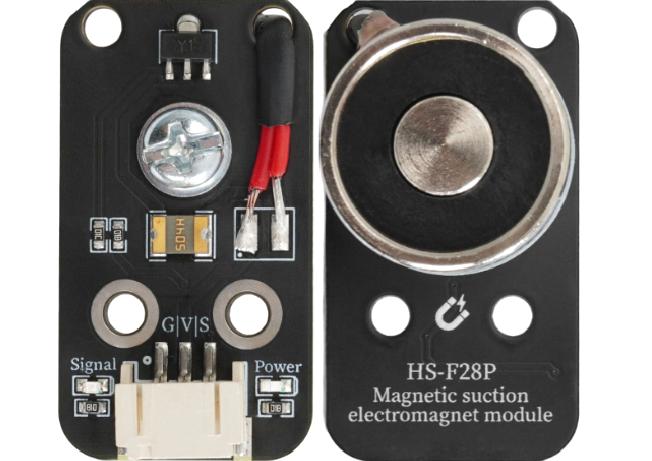 Model:HS-F28PName: Electromagnet ModuleSeries: Electromagnetic Actuator ModuleDescription: This is a magnetic attraction actuator module based on the principle of electromagnetic induction. It generates a magnetic field through current flowing through the coil to achieve the function of attracting/releasing metallic objects. It integrates a drive circuit and protective components, featuring stable suction, rapid response, and simple control, making it a core execution component for automated grabbing, electromagnetic locks, and sorting machinery.Usage Scenarios: Intelligent sorting systems (classifying and storing iron-containing metal parts); electromagnetic door lock devices (using power to attract the latch to close the door, and unlocking when power is cut); teaching experimental devices (demonstrating the relationship between electricity and magnetism, and the relationship between magnetic force and current); DIY robotic arm gripping mechanisms (controlling the electromagnet to attract iron objects); primary and secondary school science experiments (exploring the relationship between the strength of the electromagnet and the number of coil turns and current), in line with the “General Education Guidelines for Artificial Intelligence in Primary and Secondary Schools (2025 Edition)” practical requirements; assistive devices designed for people with disabilities (remotely controlling the attraction of metallic objects).Disciplinary Integration:Physics, Mathematics, EngineeringInformation TechnologyEthical Education: The application of electromagnets must consider safety thresholds (e.g., preventing excessive attraction force from causing injury), reflecting humanistic care; energy consumption from continuous power must be optimized (e.g., short-term power for attraction, cutting power to maintain state), practicing green concepts; recycling of metal coils from electronic waste must focus on resource recycling; electromagnetic locks in public places must be designed with emergency mechanical unlocking devices to avoid being trapped due to failure; understanding the potential impact of electromagnetic radiation in technical applications must be controlled within safe limits.Note: Images are sourced from the internet, and products are based on actual purchases.
02Technical Parameters
Working Principle:
The core of the module is the electromagnet coil and drive circuit. When the control signal is high, the driving transistor conducts, and current flows through the electromagnet coil to generate a magnetic field, magnetizing the core to create suction to attract ferromagnetic objects; when the control signal is low, the coil is powered off, the magnetic field disappears, and the object is released under the influence of gravity or spring force. The module has a built-in flyback diode to absorb the reverse electromotive force generated when the coil is powered off, protecting the control circuit from high voltage spikes.
Parameter Analysis:
G(GND): Power input negative/groundV(VCC): Power input positive/voltage levelS(Signal): Signal output interfaceElectromagnet type: DC suction cup type (diameter 28mm)Rated voltage: 12V (typical value)Working current: ≤300mA (at 12V)Maximum suction force: ≥1.5kg (at a distance of 0.5mm)Response time: ≤50ms (from power on to maximum suction)Insulation resistance: ≥10MΩ (between coil and core)03Code Example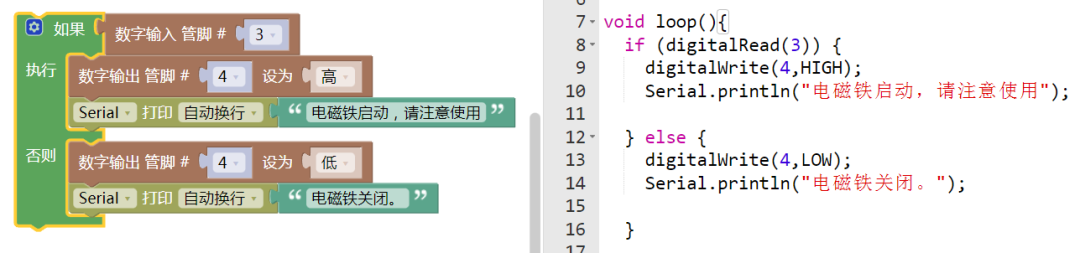
Connection Pins: Switch: D2\ Electromagnet: D3.
04Safety Measures
1. Power must be turned off before wiring, strictly distinguish between control terminals (IN/GND) and drive power (VCC) to prevent damage to the control circuit from incorrect connections;
2. The drive power voltage must not exceed 12V, otherwise, it may cause the coil to overheat and burn out (adjust within the range of 6V-12V);
3. Do not forcibly pull the attracted object while in the attracted state, as it may damage the mechanical structure or cause the object to fly off;
4. Avoid attracting metal objects with sharp edges to prevent injury when releasing;
5. The coil will generate a magnetic field when powered, keep away from magnetic-sensitive devices (such as credit cards, hard drives, pacemakers);
6. Monitor the coil temperature during prolonged use, and suspend use if it exceeds 60°C;
7. Children must be supervised by adults when operating to prevent fingers from being pinched by attracted objects;
8. If the module is used for load-bearing devices, mechanical auxiliary fixing must be designed to avoid sudden power loss causing objects to fall.
05Extensions
Students can try the following methods:
1. Create an “Automatic Sorting Machine”: In conjunction with the HS-S42A color sensor, when an iron-containing object of a specified color is detected, the electromagnet attracts and grabs it, allowing other objects to pass;2. Build an “Electromagnetic Password Lock”: Combine with the HS-KEY1B-P button switch module, after entering the correct password, the electromagnet attracts to unlock, and automatically locks after timeout without operation;3. Design a “Material Counter”: In conjunction with the HS-S50P ultrasonic sensor, when metal materials pass by, the electromagnet briefly attracts and counts, recording the number of passes;4. Develop an “Interactive Mechanical Device”: Use the HS-F12PA RGB-LED ring light to indicate the status of the electromagnet (red when attracted, green when released), achieving visual feedback.

 — Previous Recommendations —