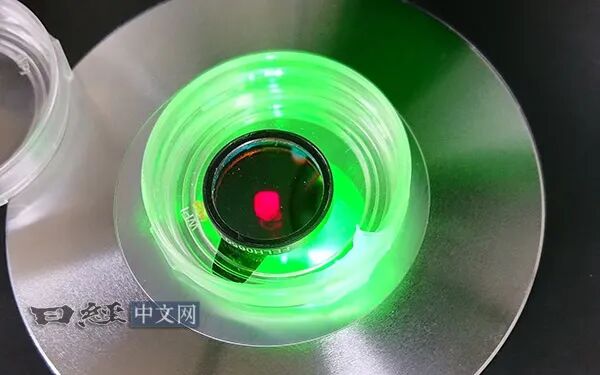
 The quantum sensors developed by QST utilize laser irradiation (provided by QST) and will be mass-produced by the Japan Quantum Science and Technology Agency. The team at this agency successfully used quantum sensors made from diamonds to precisely measure temperature changes in cells. If changes in temperature and other factors within cells can be observed in detail, it may be possible to detect diseases at a very early stage. They plan to establish a mass production system capable of producing 60,000 to 100,000 sensors annually by 2028… The Japan Quantum Science and Technology Agency (QST) will begin mass production of highly sensitive quantum sensors that aid in the rapid detection of diseases. These sensors can measure the temperature within human cells with high precision. They plan to establish a mass production system capable of producing 60,000 to 100,000 sensors annually by 2028. The goal is to commercialize through enterprises by 2030.
 Quantum sensors are a type of quantum technology that can apply physical phenomena occurring in the extremely small quantum world, below the atomic level, to industry. Quantum computers are widely known as a representative of quantum technology, and if practical, they are expected to significantly surpass the computing speed of current supercomputers. On the other hand, quantum sensors are characterized by their ability to measure parameters such as temperature with ultra-high sensitivity, completely different from traditional methods. QST is committed to applying this technology in the medical field. Various phenomena occurring within cells are accompanied by heat generation or changes in acidity. If changes within cells can be observed in detail, it may be possible to detect diseases at a very early stage.
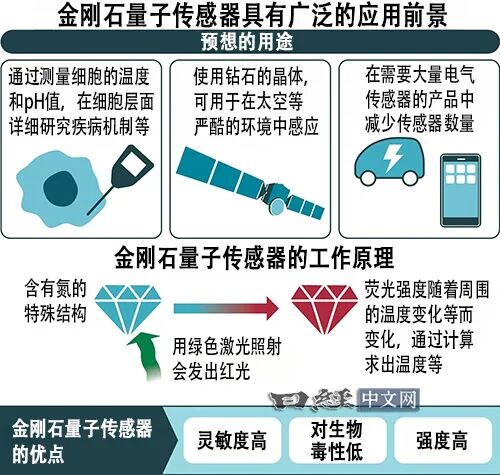 Traditional sensor technology cannot measure temperature changes within individual cells, but quantum sensors can achieve this. The team led by Ryuji Igarashi at QST successfully utilized quantum sensors made from diamonds containing trace amounts of nitrogen to precisely measure temperature changes in cells. A special structure exists near the nitrogen atoms, and the quantum state of electrons changes with the surrounding environment. This structure emits red light when illuminated with green laser light. When the quantum sensor is placed inside a cell, the state of the electrons in the diamond crystal also changes with factors such as temperature changes within the cell. By irradiating with a certain intensity of laser light, when the electron state changes, the change in the intensity of the red light can be captured. By calculating the change in fluorescence intensity, temperature and other data can be obtained. Igarashi stated, “It has been confirmed that a single cell can experience temperature changes of about 0.1 degrees Celsius.” Theoretically, it is also possible to measure minute changes at the level of 0.01 degrees Celsius. The chemical properties of diamonds, which are composed of carbon, are stable and have low toxicity to biological systems. Previous studies have already shown that there are temperature differences between diseased cells and normal cells. If more detailed studies can be conducted on the temperature of each cell in diseased cells, it is expected to be beneficial for analyzing the malignancy of diseases and predicting drug efficacy. Currently, there is ongoing research to use quantum sensors to detect substances that serve as disease markers for examinations, and to apply this in diagnostics. For example, in the case of Alzheimer’s disease, the levels of related substances in the blood are extremely low and difficult to detect with existing technologies. Therefore, it is necessary to collect cerebrospinal fluid from the patient’s spinal cord, which places a significant burden on the patient. If high-sensitivity quantum sensors are used, it may be possible to conduct tests through blood, thereby reducing the burden on patients during examinations. QST plans to mass-produce sensors with different functions and sizes, including those as small as 5 nanometers (1 nanometer is one billionth of a meter). The manufacturing method has been developed, and research aimed at improving sensitivity is currently underway. QST is currently promoting measures to increase the production of quantum sensors through a research and development project by the Cabinet Office of Japan. Currently, about 10 grams can be supplied annually, with plans to increase this to 520 grams by 2028. Due to the extremely small and lightweight nature of quantum sensors, simple calculations show that this quantity can provide examinations for at least 60,000 and up to 100,000 people. The future goal is to conduct examinations with fewer quantum sensors. They will collaborate with enterprises to advance technology development in mass production and quality management. QST will sell measurement devices that utilize quantum sensors through a newly established startup. They will introduce measurement devices and establish a supply system for quantum sensors, aiming to promote the adoption of quantum technology in the industry. A report released by the research company Global Information indicates that the market size for quantum sensors is expected to reach approximately 1 to 2 billion dollars by around 2030. The Quantum Future Industry Creation Strategy established by the Cabinet Office of Japan in 2023 sets a goal of enabling 10 million people in Japan to use quantum technology by 2030. Quantum sensors are also expected to be applied in fields beyond life sciences. If extremely durable diamonds are used as raw materials, sensors that can be used in harsh environments such as space can be manufactured. Additionally, if the numerous sensors equipped in electric vehicles or smartphones are replaced with highly sensitive quantum sensors, it is expected to reduce the number of sensors required. The Nikkei (Chinese version: Nikkei Chinese Network) by Aza Miya
Copyright Notice: All rights reserved by Nikkei Inc. Unauthorized reproduction or partial copying is prohibited and will be pursued legally.
Nikkei Chinese Network https://cn.nikkei.com