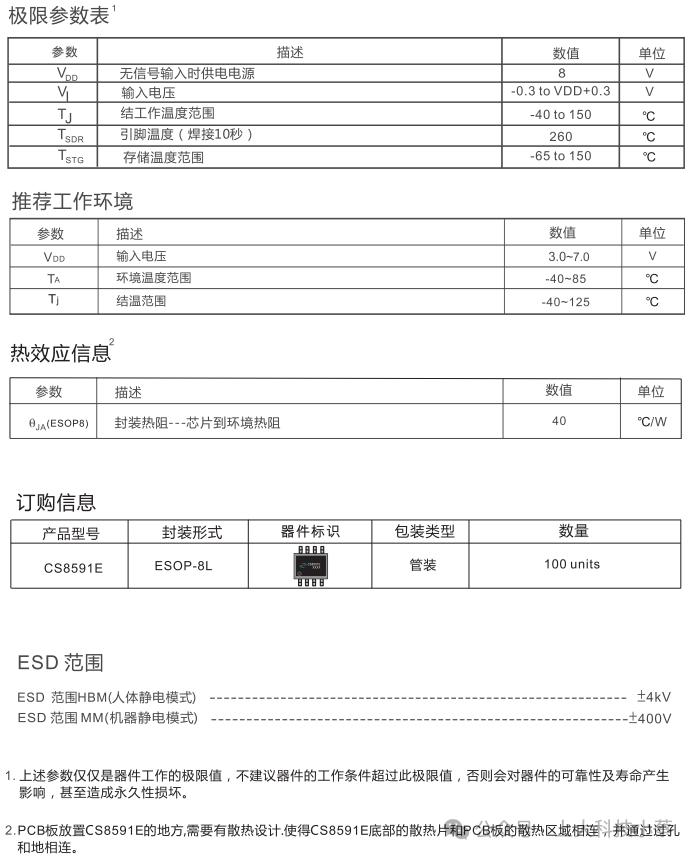
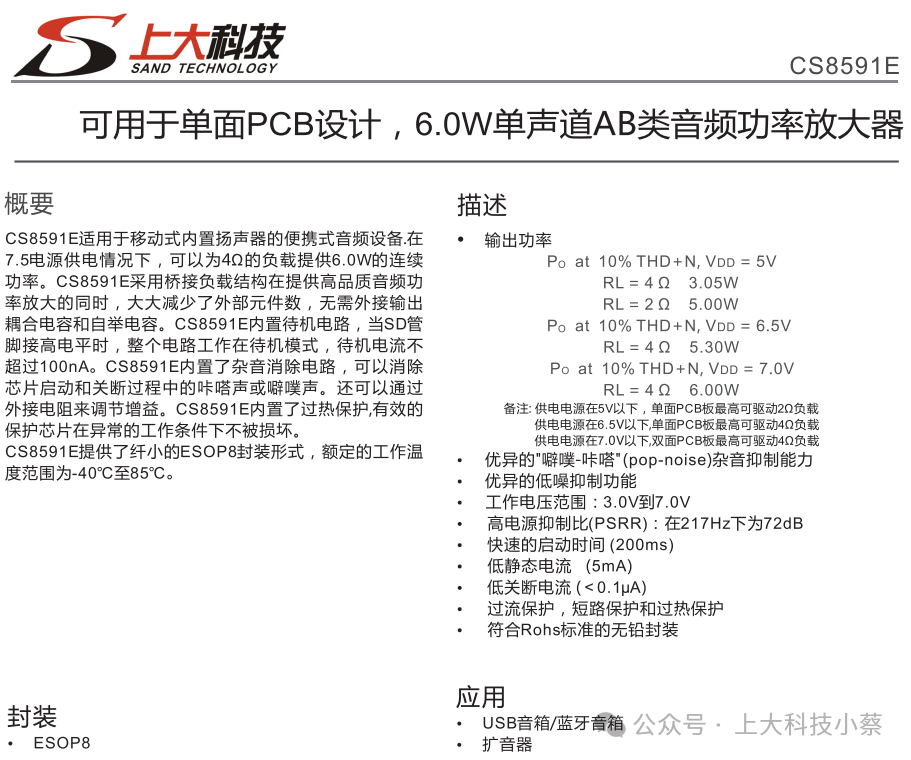
The CS8591E is a monophonic Class AB audio power amplifier designed for single-sided PCB layouts, suitable for portable audio devices such as USB speakers, Bluetooth speakers, and amplifiers. It comes in an ESOP8 package, operates at a voltage range of 3.0 to 7.0V, and has an operating temperature range of -40 to 85°C. It does not require external output coupling capacitors or bootstrap capacitors, resulting in a simplified peripheral design.
Core performance is impressive: the output power varies with supply voltage and load. At 5V supply, it outputs 3W with a 4Ω load (10% THD+N) and 5W with a 2Ω load. At 7V on a double-sided board, it can reach 6.1W with a 4Ω load (10% THD+N). The gain can be adjusted using external resistors (Av=2×Rf/Ri), with a power supply ripple rejection ratio (PSRR) of 72dB, total harmonic distortion plus noise (THD+N) as low as 0.04%, and a signal-to-noise ratio of 85dB, ensuring pure audio output with excellent noise suppression capabilities.
Features and protections are comprehensive: it includes a noise cancellation circuit to eliminate clicks and pops during startup and shutdown; the SD pin controls shutdown (active high), with a shutdown current of <0.1μA and a static current as low as 4-5mA, allowing for controlled power consumption. It is equipped with overcurrent, short-circuit, and over-temperature protection (junction temperature limit of 125°C), effectively preventing device damage under abnormal conditions.
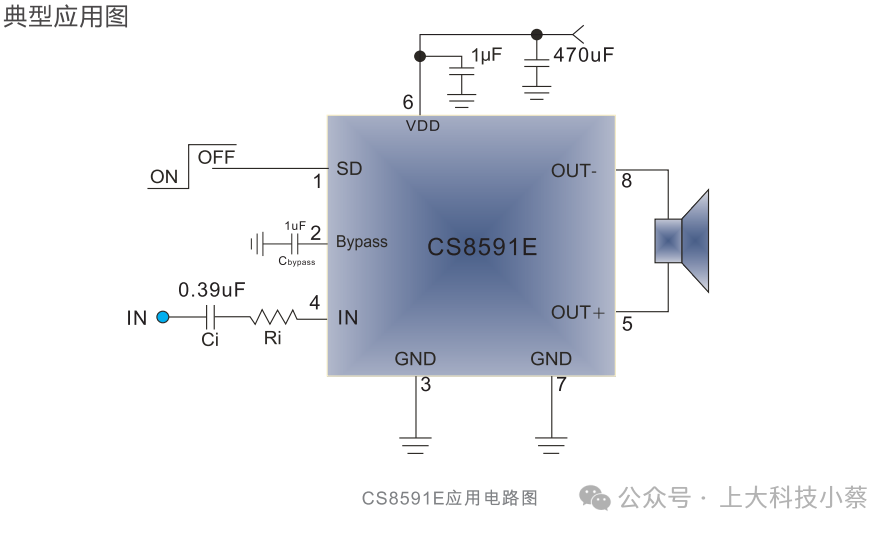
Application and PCB design points: The power supply must be paralleled with a 10μF electrolytic capacitor and a 0.1μF ceramic capacitor for bypassing. The BYPASS pin should connect to a 0.1-1μF ceramic capacitor to stabilize the bias; the recommended input coupling capacitor is 0.1-0.39μF to balance low-frequency performance and pop noise suppression. The PCB should incorporate heat dissipation design, grounding the bottom heat sink and heat dissipation area; high current paths should be short and wide. A single-sided PCB can drive 2-4Ω loads, while a double-sided board can accommodate higher power outputs. Overall, it offers high integration, low distortion, and ease of layout, providing a cost-effective power amplification solution for portable audio devices.
1 Characteristics of CS8591
Output Power
Po at 10% THD+N, VDD = 5V
RL=4Ω 3.05W
RL = 2Ω 5.00W
Po at 10% THD+N, VDD = 6.5V
RL=4Ω 5.30W
Po at 10% THD+N, VDD = 7.0V
RL=4Ω 6.00W
Note: When the supply voltage is below 5V, a single-sided PCB can drive a maximum load of 2Ω.
When the supply voltage is below 6.5V, a single-sided PCB can drive a maximum load of 4Ω.
When the supply voltage is below 7.0V, a double-sided PCB can drive a maximum load of 4Ω.
Excellent pop noise suppression capability.
Outstanding low noise suppression function.
Operating voltage range: 3.0V to 7.0V.
High power supply rejection ratio (PSRR): 72dB at 217Hz.
Fast startup time (200ms).
Low static current (5mA).
Low shutdown current (<0.1μA).
Overcurrent protection, short-circuit protection, and over-temperature protection.
Lead-free packaging compliant with RoHS standards.
2 Application Information of CS8591
1 Typical Application Diagram
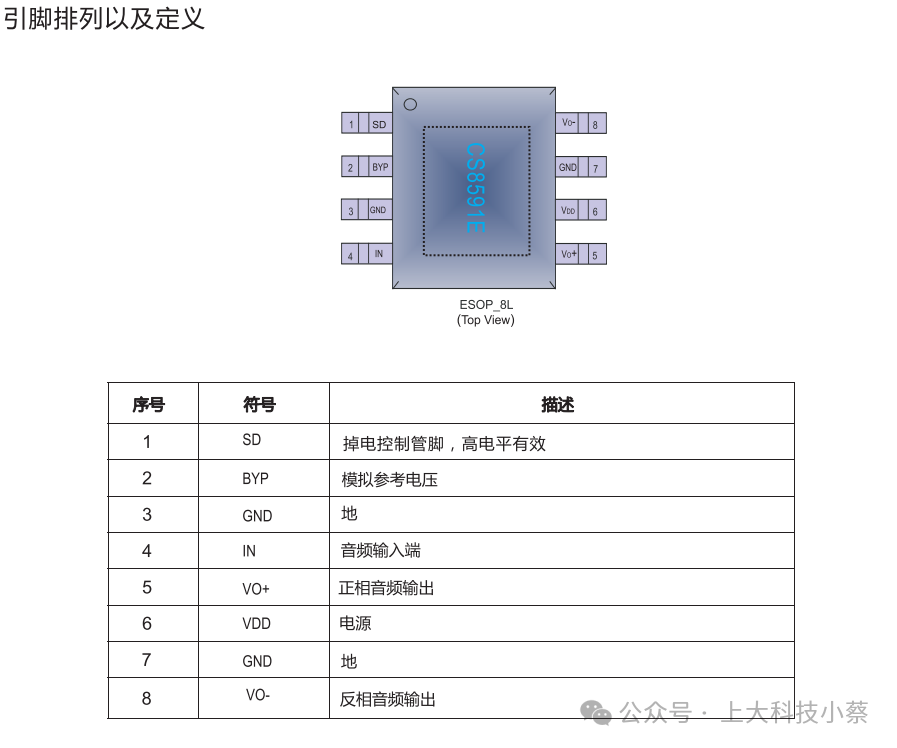
2 Pin Arrangement and Definitions
3 Basic Parameters