
1. What is PCB Corrosion?
PCB corrosion is a major cause of electronic product failures. Initially, corrosion increases the resistance of the copper traces on the circuit board, but as the level of corrosion increases, the efficiency of the PCB decreases, and it may even stop functioning.
Corrosion is an oxidation process that occurs when oxygen combines with metal, resulting in rust and causing the metal to flake off and lose its valuable chemical properties. Since PCBs are primarily made of metal and are exposed to oxygen, they are particularly susceptible to corrosion.
However, not all metals are equal when it comes to corrosion. Some metals corrode almost immediately, while others seem to never corrode.
Highly corrosion-resistant metals include:
-
Graphite
-
Gold
-
Silver
-
Copper-nickel alloy
Metals that are highly susceptible to corrosion include:
-
Tinned metal
-
Lead
-
Copper
-
Nickel-plated metal
Metals that are highly resistant to acids and corrosion, such as gold and silver, are referred to as precious metals, while metals that are easily corroded, such as copper and tin, are referred to as base metals.
2. Types of PCB Corrosion
01 General Attack Corrosion (Atmospheric Corrosion or Uniform Corrosion)


The most common type of corrosion, also known as atmospheric corrosion or uniform corrosion, is typically caused by a chemical reaction between oxygen/moisture in the air and copper.
General corrosion attacks lead to the formation of copper oxide, and low conductivity can cause problems for the PCB, but mechanical properties remain unchanged, making it relatively easy to diagnose and prevent.
02 Localized Corrosion


-
Filiform Corrosion
Moisture that penetrates below the surface finish can cause defects in copper, which may then spread to a wider area of the PCB.
-
Crevice Corrosion
Due to residual substances, areas beneath components on hardware or PCBs may corrode in these crevices. Flux, cleaning solutions, or other contaminants in these gaps often lead to this type of corrosion.
-
Pitting Corrosion
This type of corrosion is characterized by cavities or “holes” in copper. Localized electrochemical reactions lead to degradation, resulting in increased pit diameter and depth, ultimately leading to failure. The compounds that cause corrosion often conceal the pits, making them difficult to detect.
03 Galvanic Corrosion


Galvanic corrosion occurs when two different metals (such as copper and the metal of a component, gold, or tin) are coupled in a corrosive electrolyte, also known as bimetallic corrosion.
This is similar to pitting corrosion, but the main difference is that electrochemical corrosion occurs only between electrochemically dissimilar metals when they are in electrical contact and both exposed to the electrolyte.
04 Electrolytic Dendrite Formation


When ionic contamination is present in moisture, dendrites can form on copper traces. When adjacent copper traces grow dendrites, they may short-circuit and cause PCB failure.
05 Intergranular Corrosion


Intergranular corrosion occurs when chemical substances are present at the grain boundaries of copper traces. Grain boundaries typically contain higher impurities, which are more susceptible to this type of corrosion.
06 Solder Mask Residue Corrosion


Residues left by soldering have long been a major cause of corrosion. Flux is crucial during the soldering process as it prevents oxidation during soldering. Flux actually reduces the formation of metal oxides at the solder joints due to heating. It also improves the wetting of solder beads to pads.
Older flux materials contain corrosive chemicals such as chlorine and must be removed after soldering. Newer fluxes use organic acids that decompose at high temperatures.
When using reflow soldering to solder components, there is usually no solder mask residue. However, with wave soldering, the flux is less likely to reach the temperature required to decompose the acid. Any remaining flux residue is acidic and highly corrosive.
07 Micro-Movement Corrosion


In micro-movement corrosion, the action of closing the solder switch creates a wiping action that removes the surface oxide layer, allowing the underlying layer to oxidize. Ultimately, excessive rust accumulates and prevents the switch from activating.
3. Preventing PCB Corrosion
01 Cover PCB with Conformal Coating


When it is not possible to encapsulate the PCB in a housing, conformal coatings can help. Different forms of conformal coatings, such as simple solder masks, aerosol spray coatings, or epoxy coatings, are effective anti-corrosion measures. However, for PCBs with heat-generating components, such coatings may need to be applied judiciously to avoid interfering with heat management.
02 Keep PCB Dry


Make every effort to avoid moisture around the PCB. Try to place them in environments that are not affected by humidity.
03 Prevent Electrolyte from Wetting PCB


By preventing moisture or other liquids from reaching the PCB, corrosion can be effectively prevented. There are many ways to achieve this, such as placing the PCB in a housing with an appropriate IP rating.
04 Effectively Remove Flux Residues from PCB


Older flux materials are notorious for producing chlorine or other harmful halogens, which can lead to pitting of copper traces unless the flux material is removed after the soldering process. However, newer fluxes contain organic acids that do not contain halogens and decompose at higher temperatures, such as during reflow soldering. However, circuit boards undergoing wave soldering may not reach the decomposition temperature, and any remaining flux residues may need to be manually cleaned thoroughly to prevent crevice corrosion.
05 The 10 Best PCB Corrosion Protection Techniques


In many cases, developers choose not to protect circuit boards from corrosion. For example, prototypes or one-time boards that will be used immediately often do not prevent corrosion. However, developing some form of PCB corrosion protection for all circuit boards may be better. The table below lists 10 PCB corrosion protection techniques.
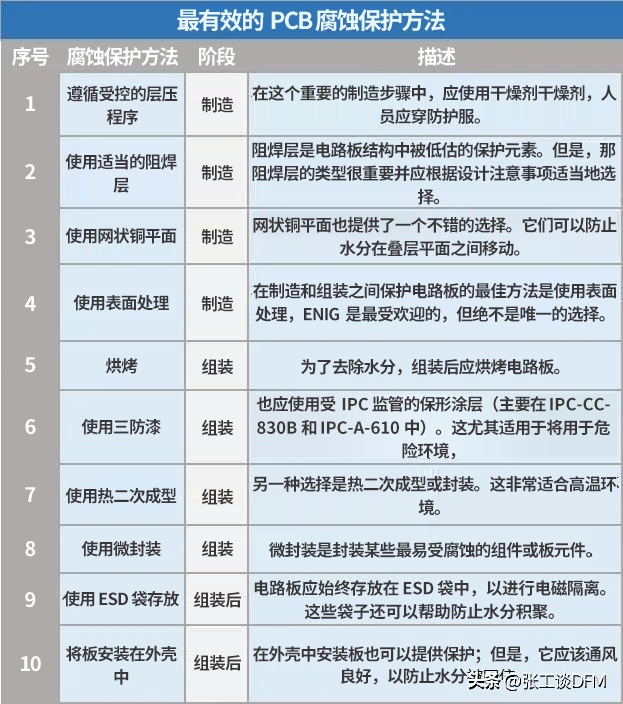
PCB Corrosion Diagram
4. Common Chemical Reagents for Removing PCB Corrosion
01 Compressed Air


Compressed air is a commonly used tool in cleaning electronic products. For simple maintenance, compressed air provides a discreet way to blow out any dust from inside electronic devices or machines. Use short bursts to blow air into vents. If you are not satisfied with the dust removal, you can open the device with a screwdriver and work around the components, carefully cleaning the circuit with air.
02 Baking Soda


Baking soda can be used to remove corrosion from PCBs. Baking soda contains sodium bicarbonate, which works to break down dirt and dust on PCBs into small particles. The mild abrasive properties of baking soda can eliminate corrosion without causing any side effects.
03 Deionized Water


When cleaning circuit boards with water, you must ensure that it is free of contaminants. Ions in regular water have conductive properties that can reduce electronic performance. In contrast, deionized water does not contain harmful contaminants or ions.
04 Distilled Water


Since there are no ions that conduct electricity in electronic devices, distilled water surpasses any other form of liquid when mixing cleaning solutions. Distilled water is specially treated to remove harmful contaminants, so it will not damage PCBs.
It can also quickly become contaminated by dirt on hands or in the air, so distilled water reserves must be sealed when not in use, and bare hand contact should be avoided.
05 Isopropyl Alcohol


When it comes to chemical cleaners, isopropyl alcohol or rubbing alcohol can remove various dirt, debris, flux, and rust from circuit boards. Isopropyl alcohol is an excellent PCB cleaner because it is inexpensive and evaporates quickly. Compared to other cleaners used for similar purposes, it contains fewer chemicals.
It is important that the isopropyl alcohol used for cleaning circuit boards is 90% or higher. High concentrations of isopropyl alcohol can have adverse effects on contact with the body, so handle it with care and use latex gloves and goggles.
5. Steps to Remove Corrosion from PCB
Once you have prepared all the necessary cleaning agents and tools for working on the circuit board, you can follow the given steps to clean corrosion from the circuit board:
Steps
1. First, open the given electrical device or appliance and isolate the PCB by disconnecting all connections and power.
2. Document the layout and configuration of the PCB, as every detail must be remembered for reassembly after cleaning.
3. When using the correct tools, refer to the user manual for proper tool usage.
4. After removing the circuit board, use cleaning solutions such as isopropyl alcohol or baking soda solution.
5. Now, apply it to the circuit board using a soft brush, continuing until the rust and dust soften.
6. Then, use a brush to remove dirt and further rinse with distilled water to remove any remaining dust and corrosion.
7. If there is still hard corrosion on the circuit board, you can apply more isopropyl alcohol, as it is a stronger reagent.
8. Finally, clean with a microfiber cloth and use an air dryer to dry the circuit board, then reinstall it back into the electrical device, removing all corrosion.
This article is sourced from: Hardware Lecture Hall