
Neutral aqueous zinc-air batteries (ZAB) show promise for extended lifespan and recyclability compared to alkaline systems, but are hindered by limited energy efficiency and slow kinetics of power output.
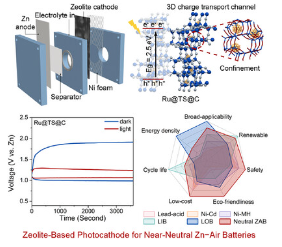
Recently, Ji-Jing Xu and Huan-Feng Wang from Jilin University reported an effective method for near-neutral ZABs based on photo-responsive titanium silicate molecular sieve TS-1.
Key Points of the Article
1)The incorporation of Ru active centers into the three-dimensional porous structure of TS@C (Ru@TS@C) significantly enhances electronic conductivity, forming interconnected conductive pathways. This unique design facilitates rapid charge transfer within the three-dimensional network, achieving excellent reaction kinetics and improving the separation efficiency of photo-generated electron-hole pairs.
2)Synergistic experimental and theoretical analyses reveal the mechanism of light-induced charge transfer in conductive zeolites, where light-driven Ru-mediated electron exchange with oxygen adsorbates accelerates the 4 e− dominated oxygen reduction reaction (ORR) kinetics. Consequently, the Ru@TS@C-based photo-assisted ZAB exhibits excellent 4 e− selectivity and reversibility, with an overpotential as low as 218 mV at 0.2 mA cm−2 under illumination (a reduction of 74% compared to dark conditions).
3)The researchers extended their results to Li-O2 batteries, where this multifunctional structure demonstrates excellent superior rate capability and cycling stability. This work pioneers the use of photoactive zeolites in metal-air batteries and establishes a universal framework for engineering photo-responsive interfaces to overcome inherent kinetic limitations in sustainable energy systems.
References
Shuang Liang, et al, Efficient Carrier Separation via Ru@TS@C Zeolite: Enabling Photo-Cathodes for High-Efficiency Photo-Assisted Metal−Air Batteries, Angew. Chem. Int. Ed. 2025, e202512477
DOI: 10.1002/anie.202512477