Dedicated to the research and development of digital twin technology
Benefiting humanity through solutions and engineering applications
Source: Simulation Ecosystem
Introduction
Industrial simulation, as the name suggests, relies on industrial simulation design software to provide customers with the best comprehensive digital simulation solutions. The scope of industrial simulation includes production line layout planning and design, factory logistics scheme evaluation and optimization, automation scheme design, physical world simulation, etc. With the continuous deepening and expansion of industrial simulation applications, digital twin, as a new label of industrial simulation, has increasingly attracted the attention of the industry.
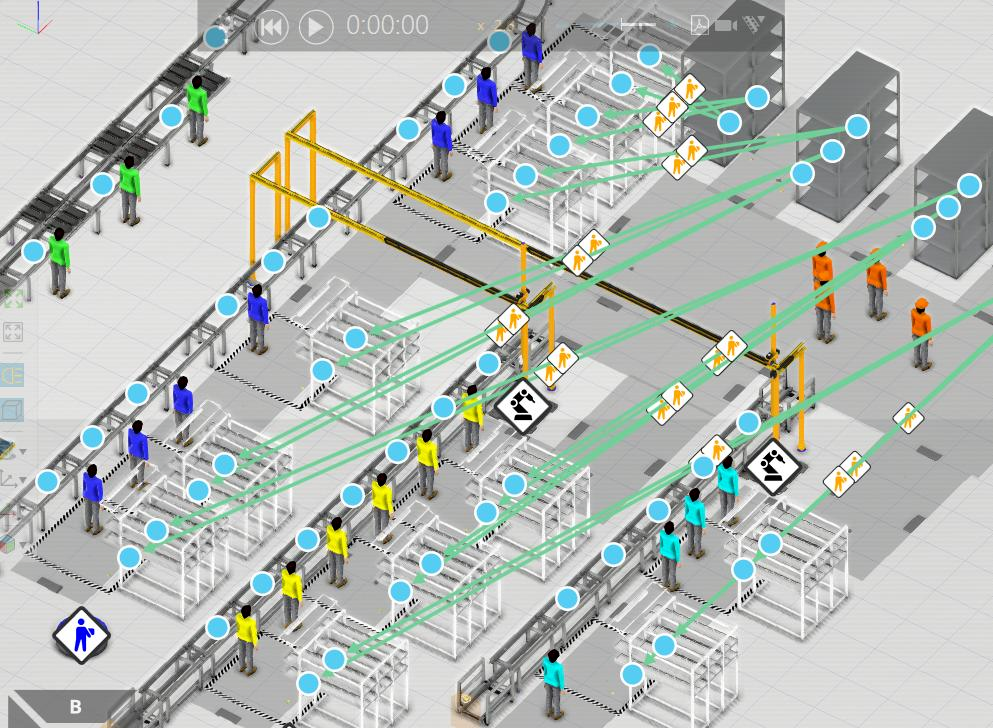
1. Understanding Industrial Simulation
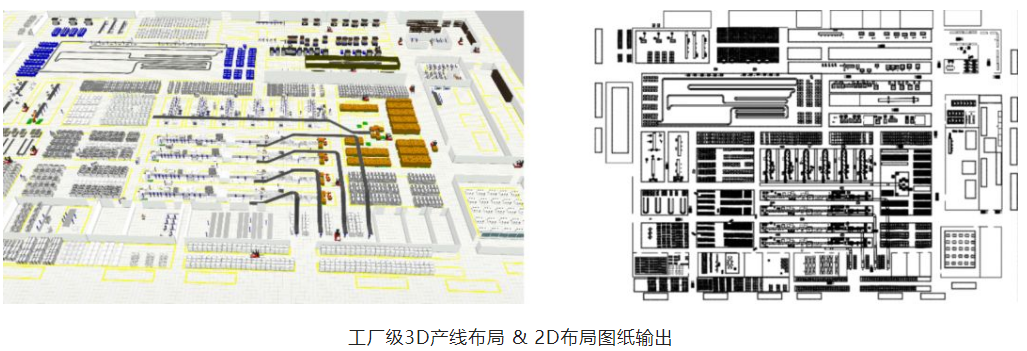
1. Layout Planning
When it comes to building or renovating factories and production lines, the first consideration is how to design the most reasonable production line layout to maximize space utilization, increase production capacity, and avoid exposing various design issues after the implementation of the production line, which would only increase resource and time costs. Traditional layout design relies on “2D drawings” and “on-site cardboard layouts,” which are not only inefficient but also lack sufficient validation. However, by utilizing the parametric 3D models provided by simulation software, the efficiency of layout design and changes can be greatly improved, and through continuous optimization and iteration, the best design for the production line layout can be achieved.
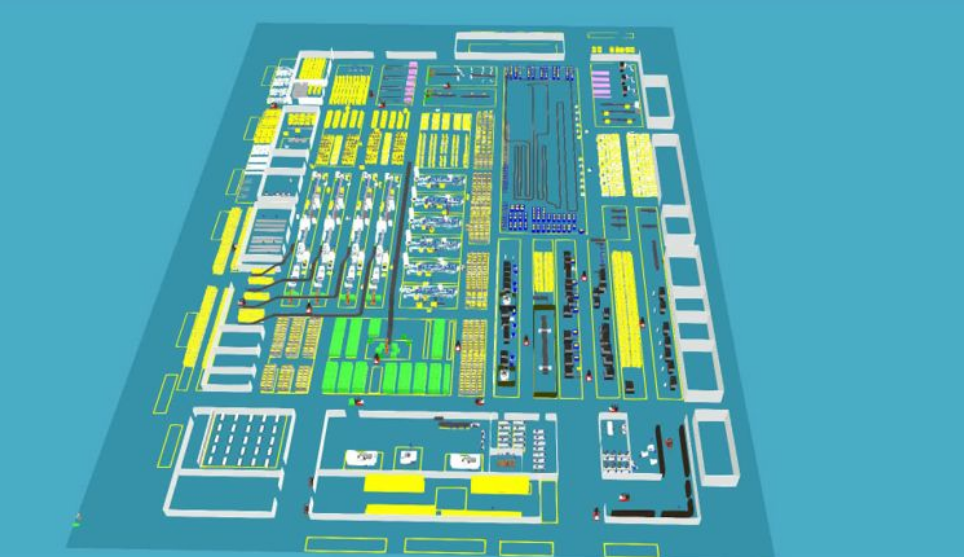
2. Production Line Logistics
Production line logistics simulation, as a traditional advantageous application module of industrial simulation, involves various aspects such as factory procurement and production planning, personnel and equipment utilization, inventory, and material transportation. Before the introduction of logistics simulation, production line logistics schemes lacked systematic and effective assessment and optimization methods. By continuously iterating and optimizing logistics schemes in a simulation environment, it is possible to save production line space, eliminate logistics breakpoints, reduce logistics delivery personnel, improve equipment utilization, and lower inventory, thereby maximizing the utilization of enterprise resources and improving production efficiency while saving costs.
 Production line logistics simulation3. Automation
Although automation can greatly improve production efficiency, current automation schemes generally suffer from long design cycles, high investment costs, and dependence on external suppliers, leading to a lack of effective design, assessment, and optimization capabilities for overall automation schemes at the factory level.
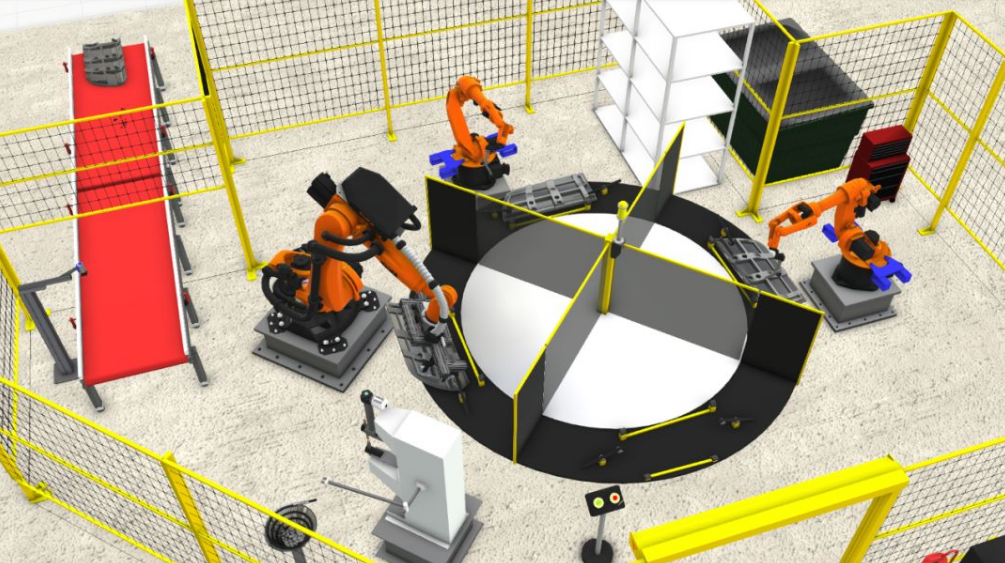
Robot simulation utilizes offline programming for robots, where the designed robot posture and motion trajectory are directly imported into the robot equipment in the simulation environment to complete the design of robot operation actions, saving a significant amount of time for robot posture debugging. By using the virtual debugging function of the software simulation, the signal logic between devices and the PLC control program can be pre-designed and verified in the simulation environment before being imported into the on-site equipment, thereby achieving the design of signal control logic between robots and devices.
Robot simulation
4. Digital Twin
With the continuous deepening of industrial digitalization, intelligent manufacturing, and the application of 5G, the high-level application of digitalization—digital twin—has become possible. Digital twin aims to build a digital simulation world that coexists in real-time with the real world. After building a 1:1 digital motion model with reality, the simulation environment is driven in real-time by data collected from reality, achieving real-time synchronization of information with the real world.
The digital twin platform integrates data with external systems such as SCADA, MES, big data, and ERP in a 3D digital twin environment, allowing for more efficient and intuitive monitoring, early warning, management, and execution of business sites. It also enables remote collaboration and optimization of scheme design, achieving results from thousands of miles away.
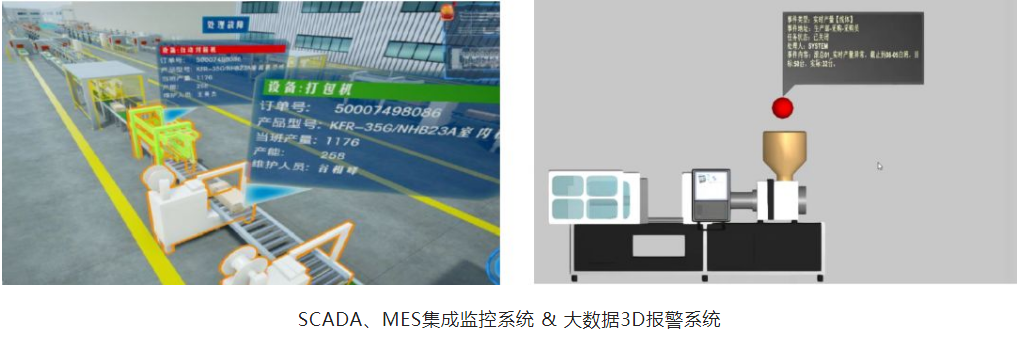
2. Industrial Simulation Technology
Industrial simulation technology is a type of intelligent simulation, a straightforward industrial software that integrates digital output capabilities. When planning a new factory layout, it can validate the factory production line layout in advance to save investment, shorten construction periods, and enhance capacity. How does it achieve this?
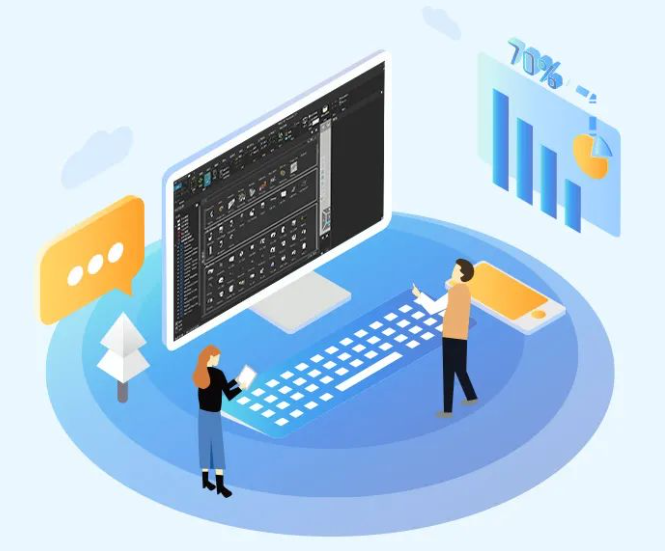
1. Scenario One: Rapid Layout Construction
Quickly build manufacturing scenarios, with an electronic component library that supports over 2600 application components and 58 data formats for import.
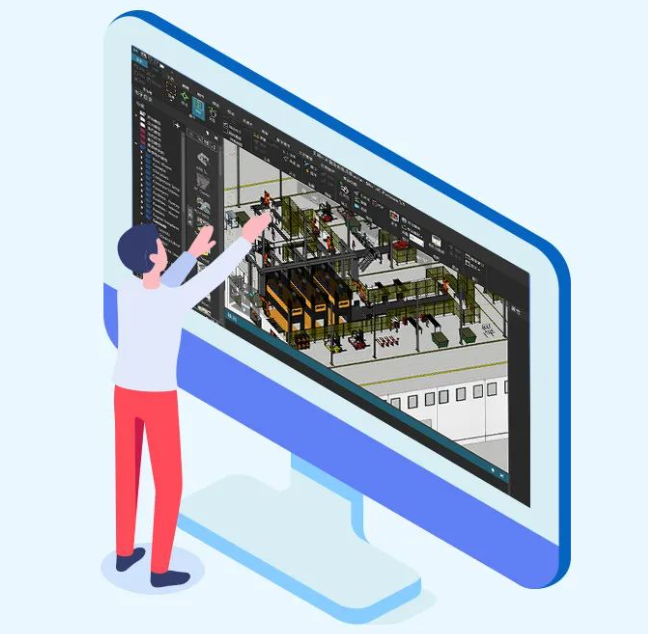
2. Scenario Two: Restoring Production Status
Quickly build production line layouts, restoring production status from products, processes to factories comprehensively.
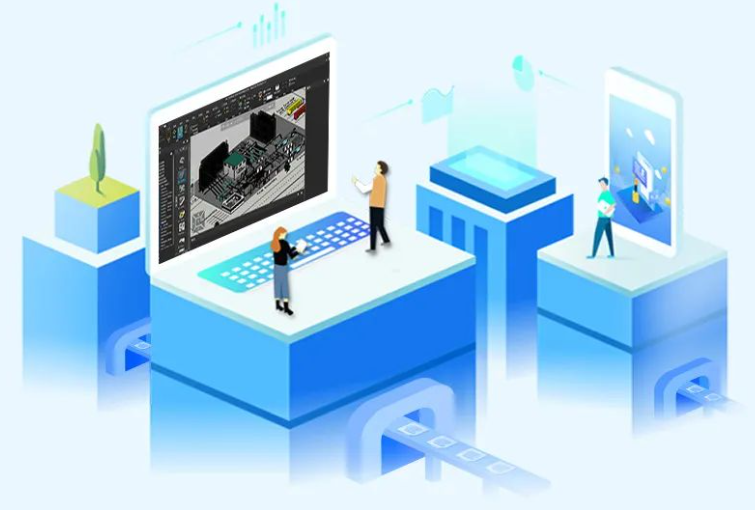
3. Scenario Three: Scheme Planning and Validation
Validate new factory planning/existing production line transformation, comprehensively streamline from entry to exit, and intelligently plan logistics paths.
4. Scenario Four: High-Definition Delivery Experience
Output high-definition images and animated videos, poster-level high-end rendering in 3D; generate 2D-CAD drawings with embedded drawing editing functions; interactive VR virtual production line interaction; support roaming the production line through mobile devices.

Chinese Industrial Simulation Software is Growing
The series of events where ZTE and Huawei were sanctioned by the United States has caused a pain of “chip shortage” that goes beyond this; China’s industrial software is even more critical.
If hardware sanctions are a blatant blow, then software sanctions are a deadly stab from behind: the development of domestic CAE/EDA design simulation software is far behind hardware. However, for new product research and development, simulation software is an absolutely essential step.
To take a step back, what would happen without simulation? It would not only greatly affect research and development efficiency but could also lead to product development failure due to experiments not passing. Simulation is the only feasible method to validate early design of products, allowing for the replacement of the majority of experiments, thereby saving costs and reducing research and development cycles.
01Importance of Industrial Software:The Soul That Makes Chips Move
If we peel away concepts such as artificial intelligence and manufacturing upgrade transformation layer by layer, what remains is industrial software.
Industrial software includes three major areas: research and design (CAD, CAE, PLM, etc.), production scheduling and process control (MES, SCADA, etc.), and business management (ERP, SCM, HRM, etc.), with research and design being the most core and critical.
For example, in aircraft manufacturing, people only know that Boeing has top-notch aircraft design and manufacturing technology globally, but they do not know that the entire development process of the Boeing 787 used over 8000 types of industrial software. Among them, only 1000 types are commercial software, while the remaining 7000+ types are proprietary software developed by Boeing over the years that are not sold externally.
If China wants to reach Boeing’s level of aircraft development, it must first possess the level of those 8000 types of industrial software.
Another example is that chip manufacturing requires software operating systems. EDA (Electronic Design Automation) is the upstream industry of integrated circuits and is known as the “mother of chips.” If chips are the shell, then EDA is the soul that makes them move. To sanction Huawei, a more brutal method would be to revoke EDA software licenses, which is also one of the current sanctions methods of the US government.
In October 2018, the US Department of Commerce imposed a ban on the domestic emerging memory company Fujian Jinhua, not only stopping hardware suppliers from supplying but also prompting US industrial software companies to cease supply, causing Fujian Jinhua, which invested 37 billion yuan, to immediately fall into paralysis.
This is the power of industrial software.
02
The New Trend of Integration: Design Equals Simulation
If industrial software is the crown of Chinese manufacturing, then industrial simulation software is a gem on that crown.
Industrial simulation is a virtual representation of physical industry, converting various modules in physical industry into data integrated into a virtual system, simulating every task and process in industrial operations and achieving various interactions.
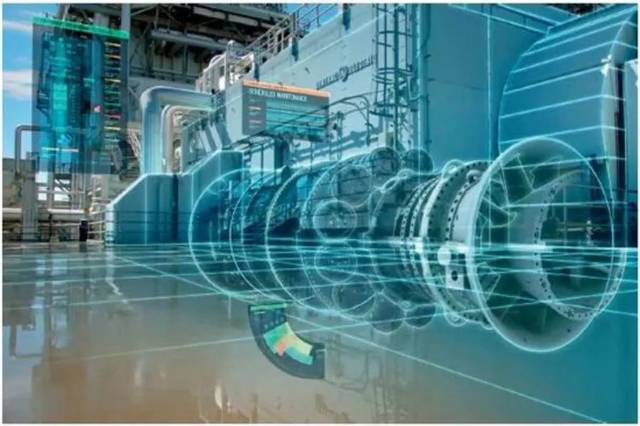
With the rapid increase in computing speed, the rapid decrease in computing costs, the popularity of mobile internet, the widespread application of the industrial internet of things, and the development of new materials (e.g., composite materials) and new processes (e.g., additive manufacturing), there is a growing trend of integration in industrial simulation technology.
For example, design equals simulation is becoming a standard in the industrial field.
The concepts of CPS, digital twin, and the integration of data and physical objects that are lively discussed in the industry reflect that design has become closely integrated with simulation. CAD (Computer-Aided Design) and CAE (Computer-Aided Engineering) used to be distinctly separate, but now they are inseparable. In recent years, Dassault Systemes, a three-dimensional experience technology development company, has focused on deepening its simulation domain, enriching its simulation brand under Dassault Systemes. Half of its acquisitions in the past five years have been for simulation software purchases.
Siemens has also been continuously acquiring simulation companies. In 2016, Siemens acquired the global engineering multi-disciplinary simulation software supplier CD-adapco for nearly $1 billion. Similar actions include the acquisition of LMS and the autonomous driving simulation software company TASS, all of which are steps toward expanding into the simulation industry.
This series of acquisitions indicates that the strength of this integration is being unprecedentedly enhanced. The traditional separation of CAD and CAE is being broken by CAD manufacturers taking the lead.
03
Expansion Path: Coexistence of Mergers and R&D
Mergers seem to be a necessary means of achieving technological expansion.
Since 2000, the global simulation market has entered a stage of large-scale mergers, with major simulation manufacturers busy with mergers and reorganizations, restructuring the market.
Table: Major Acquisitions of Global Simulation Companies in the Past Decade
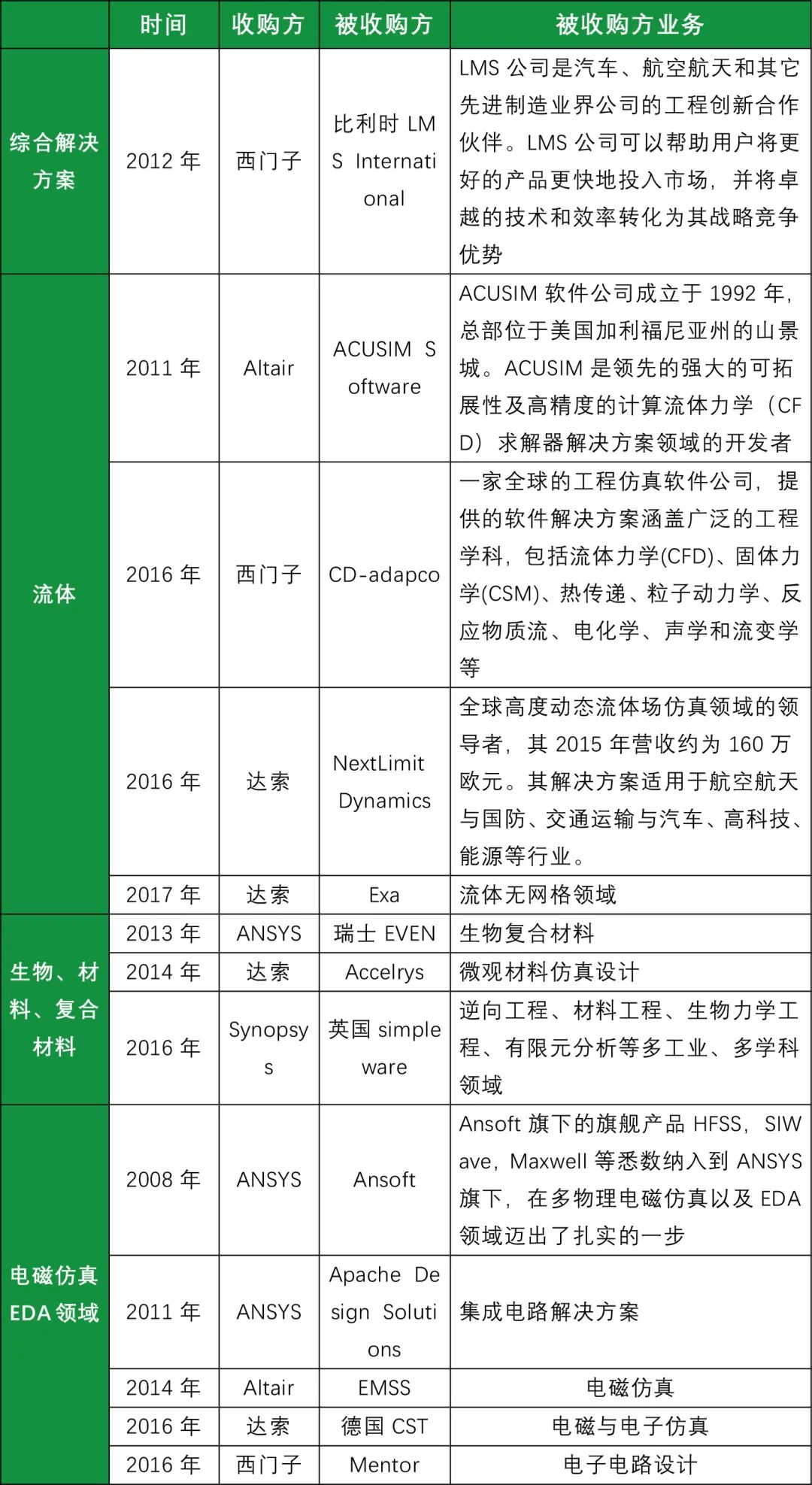
According to statistics, in the past twenty years, only five manufacturers: ANSYS, MSC, Dassault, ESI, and Siemens have acquired over 100 software companies. More than 30 of these acquisitions occurred in the last three years, indicating that the development of global simulation in the past decade has been largely driven by mergers.
In addition to mergers, international simulation software manufacturers have also launched new products through research and development and cooperation to continue leading the industry and even a new round of industrial revolution development.
Overall, the large global engineering simulation software industry pattern is relatively fixed, with international simulation software giants represented by ANSYS, MSC, Dassault Systemes, Altair, and Siemens PLM leading in technology, products, and market in various aspects.
04
New Changes: Domestic Simulation Software is Waiting to Ignite
Amid the squeeze of international giants, a group of CAE software companies dedicated to independent research and development has emerged in China.
Many companies have built their own simulation platforms, such as Ansys Asia Pacific, which is the largest partner of ANSYS in China, providing engineering consulting and building a simulation cloud platform; Zhongfang Technology integrates virtual reality technology into flight simulation while providing R&D tools and system simulation platforms; Ruifeng Xie Tong has a test data management, engineering knowledge platform, and collaborative simulation platform.
Based on platform advantages, various companies have launched system software products, notably: Suowei System has built a large number of industrial apps that can quickly construct design systems for specific products; Shanghai Suochen Information has independently developed a simulation platform, providing a series of dedicated simulation software products; Haiji Technology started with fluid simulation and developed an enterprise engineering data center, test data management platform, providing simulation software and process simulation software for multiple physical fields; Ansys Asia Pacific independently developed a lean R&D platform, developing acoustic simulation, large-scale simulation, comprehensive design simulation, demand analysis, and MBSE (Model-Based Systems Engineering) software; Anhuai Xin provides independently developed support software and consulting services, as well as simulation result verification and validation (V&V) and DFM (Design for Manufacturability) software; Midea Group acquired KUKA to obtain a powerful factory simulation software, Visual Components.
From the service field, Hangzhou Yitaida is one of the few domestic companies engaged in motor design and simulation; Tianzhou Shangyuan is dedicated to the digital R&D of high-end equipment products; Shanghai Zhizhuo (T-solution) focuses on electromagnetic simulation and engineering fields; Ansys Asia Pacific is entering the additive manufacturing field.
In addition, there are several research institutes in China that are independently developing simulation software. Currently active ones include: AVIC Aircraft Strength Research Institute (623 Institute), which has continuously improved the aviation structure strength analysis and optimization system (HAJIF) over the past 40 years, becoming the most comprehensive large-scale CAE software system in the domestic aviation industry; The High-Performance Numerical Simulation Software Center of the China Engineering Physics Research Institute has developed a series of middleware for high-performance computing and engineering simulation, as well as dedicated high-performance simulation software; China Shipbuilding Industry Corporation 702 Institute has established the Wuxi Software Company (ORIENT), which has three series of software for engineering simulation, digital testing, and scientific research business management, developing CAE pre- and post-processing, industrial APP integration, and high-performance computing software, and has also developed hydrodynamic simulation software.
Although missing 30 years and only just showing its tip, the spark of Chinese industrial simulation software has begun to ignite.
Industrial Simulation Practitioners Avoid Pitfalls Series
Computer-Aided Engineering (CAE) technology was initially developed for aerospace and automotive applications and has been in use for over 50 years. Almost every industry is using CAE simulation analysis.
Like chip design simulation in the semiconductor industry, industrial simulation should be the pearl of industrial manufacturing, but it currently occupies a very awkward position domestically.
On one side, many in the industrial and academic circles are discussing the relationships and future prospects between digital twins, intelligent manufacturing, industrial internet, industrial software, and artificial intelligence;
On the other side, many practitioners do not even have a concept of what CAE industrial simulation software is. Let alone how to drive R&D through simulation, promote business development, and accelerate product launch.
Three Main Factions in the Simulation Universe
The mainstream players in this field can be divided into three types:
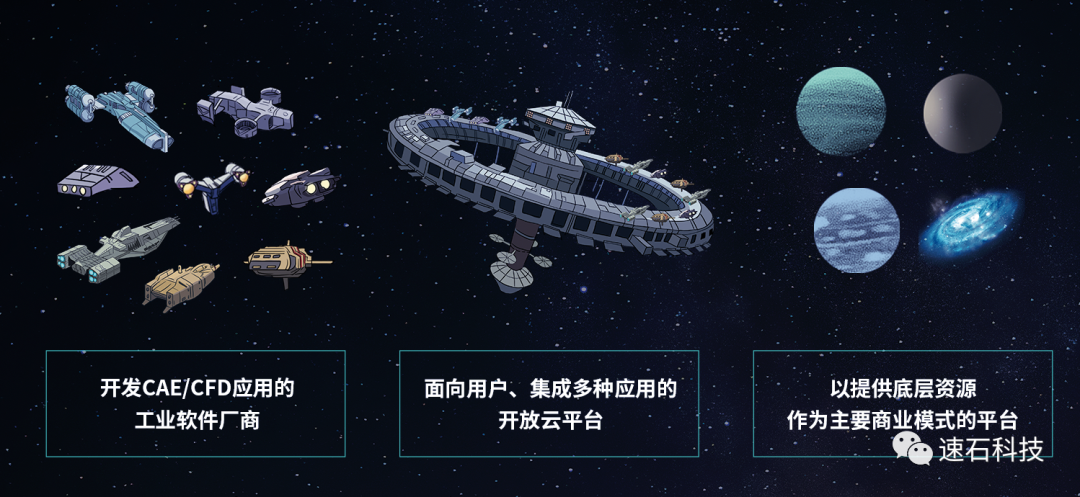
1) The first type is software vendors developing CAE applications. For example, ANSYS, MSC, Dassault, Simscale, etc.
What they are doing is applying SaaS (Software as a Service), extending downwards based on their self-developed applications, providing users with a SaaS platform that allows them to operate simulation software through a browser.
Note: For those who do not understand SaaS/PaaS/IaaS, the complete white paper Part.3 will elaborate.
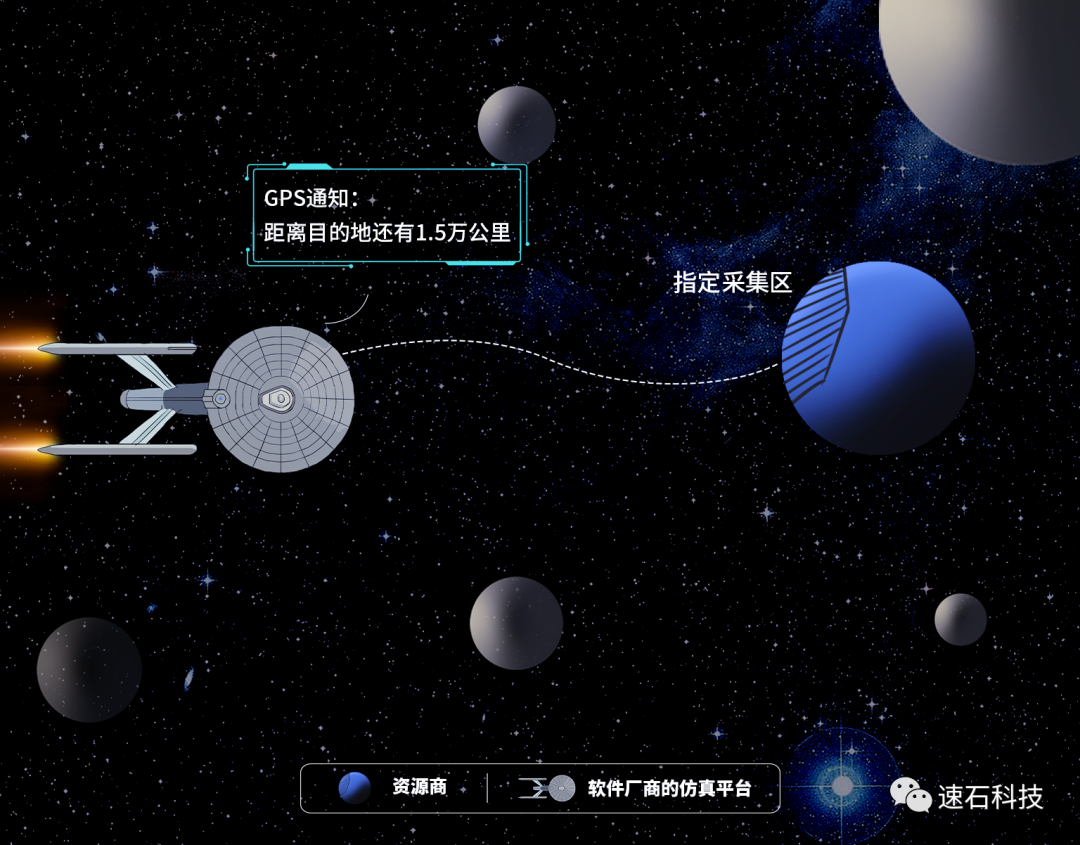
Main Characteristics:
1. A platform built on one or more self-developed CAE/CFD applications, with exclusivity;
2. Super knowledgeable, with almost unlimited support for their applications. However, since the SaaS platform provides standardized products, if users have additional needs, it will involve product-level adjustments;
3. Generally, the underlying resources are relatively weak or depend on third-party partners, with limited IT support;
4. Generally cannot cross vendors and cannot integrate with users’ local environments.
The core goal of this type of vendor is to allow as many users as possible to use their simulation software, which can be sold as software licenses or provided through a SaaS platform for user convenience.
2) The second type is open cloud platforms aimed at users that integrate various applications, such as our company, Sushite Technology.
We provide a complete set of simulation R&D environments, connecting upper-layer applications and providing support and optimization for the operation of the applications; at the same time, we connect lower-level resources to give users the ability to use resources more flexibly and efficiently.
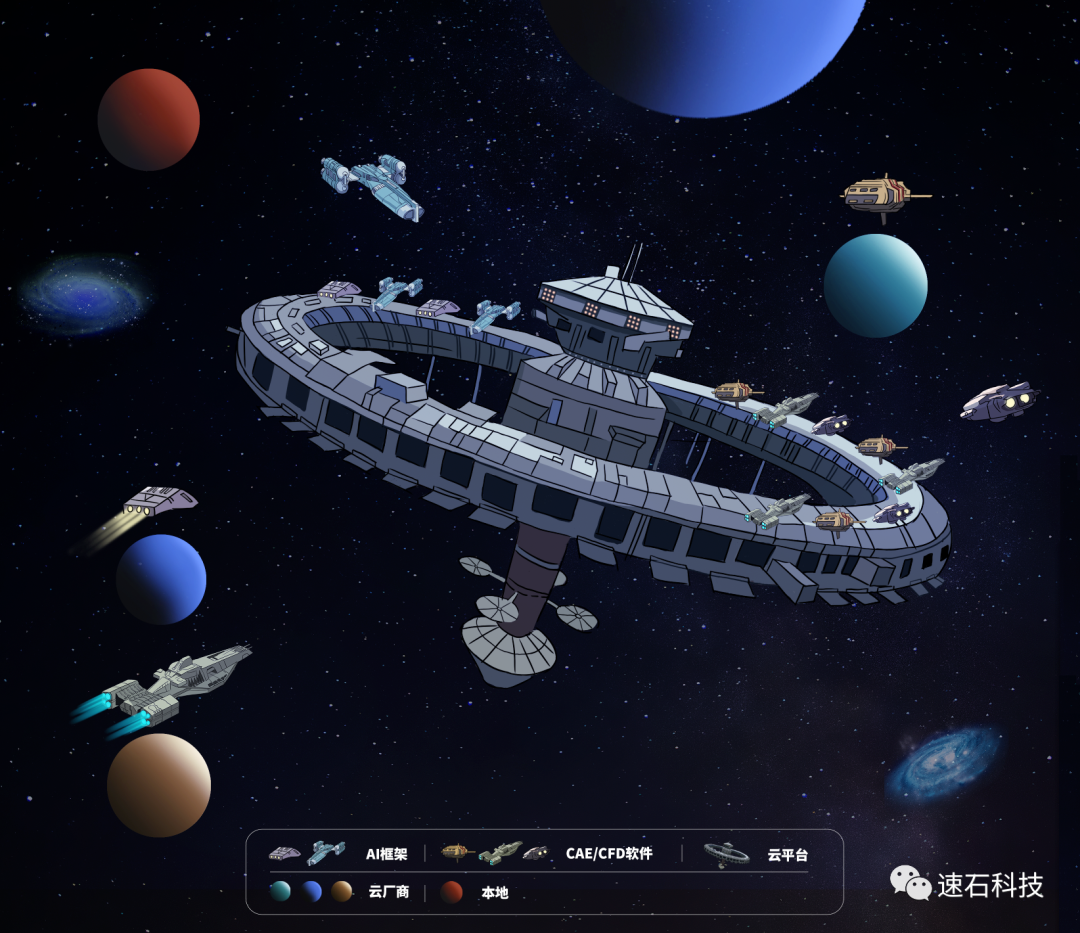
Main Characteristics:
1. Application-centric, integrating mainstream CAE software vendors’ applications. In addition, the platform also supports AI frameworks like PyTorch to meet users’ AI computing needs;
2. A complete R&D environment, providing products and professional R&D-IT service capabilities. It has a neutral property, and users have full control over all data;
3. Rich underlying resources that can be used flexibly on demand, particularly suitable for users’ “roller coaster” demand fluctuations (see white paper section 1.2); covering heterogeneous resources in multiple regions on the cloud, allowing users to choose regions freely;
4. Not only a SaaS platform but also mature PaaS products support multi-regional local and cloud multi-site collaboration.
The core goal is to revolve around CAE and even AI applications and tools, automating what was originally manual work to make simulation simpler and improve overall simulation R&D efficiency.
3) The third type is platforms that mainly provide underlying resources as their business model. Divided into three types:Hardware manufacturers, supercomputing centers, and cloud vendors.
To better sell resources, the three types based on their resources may develop different simulation platform layers for users, either by developing themselves or in collaboration with other partners, leading to significant differences.
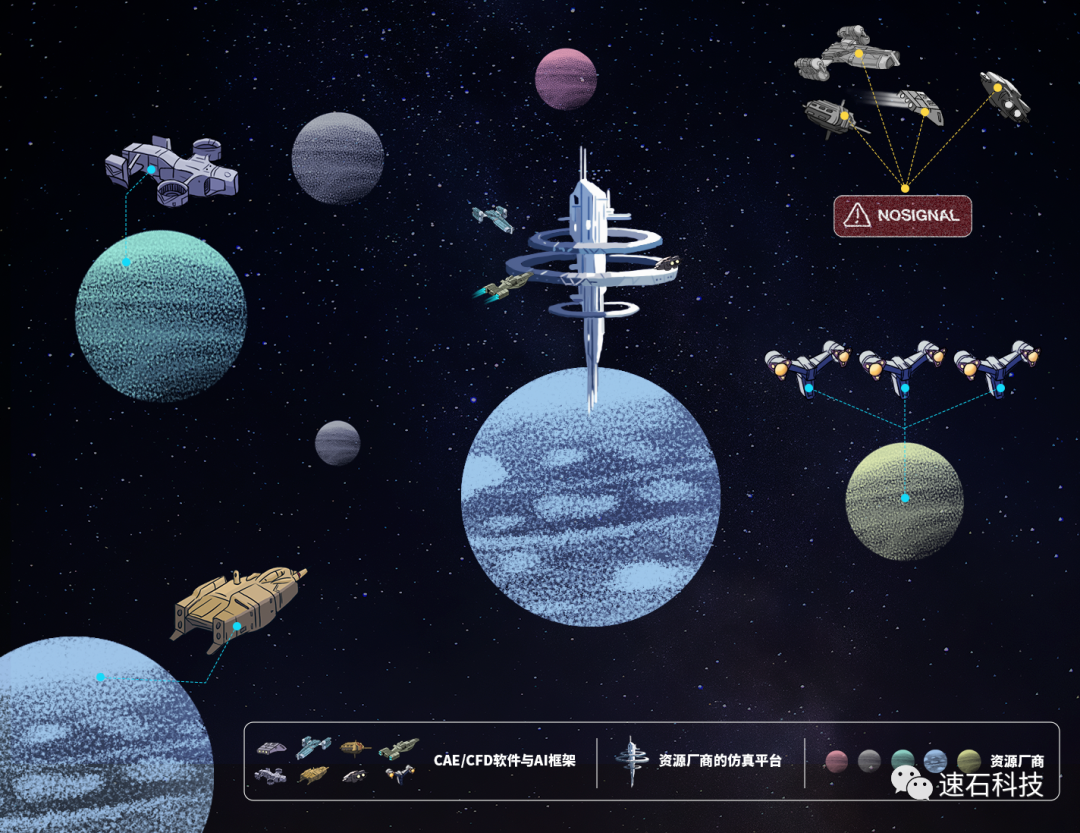
Main Characteristics:
1. Some integrate applications from some mainstream CAE software vendors and AI frameworks, while others do not, with overall limited support for applications and little understanding of R&D business;
2. Resource-oriented, but mainly based on a single vendor’s resources, unable to cross supercomputing centers or cross hardware/cloud vendors;
The difference in resource scale among different resource vendors is significant, such as the total scale difference between supercomputing centers and cloud vendors. Of course, there are many other differences. You can click to view “Domestic Supercomputing Development in Nearly 40 Years, Finally Encountering a Decent Opponent”
3. If you can directly use their resources, it counts as IaaS, but if you use their provided simulation platform, it can be considered SaaS. It can also customize solutions to solve more complex problems for users on a project basis (compared to directly usable mature products);
4. User experience can be quite complex. It either requires high capabilities from users with a high learning threshold, such as cloud vendors; or generally not usable by ordinary enterprises, with many restrictions, inflexible use, or even resources being taken away, such as supercomputing.
All three types are resource-oriented, with the core being selling machines, and limited business know-how.
Hardware vendors sell servers, supercomputing centers sell idle supercomputing resources, and cloud vendors sell cloud resources.
Of course, the boundaries between the two may not always be so clear, as the needs of different users vary greatly, depending on which direction they prefer.
In summary, the comparison among the three types of players is as follows:
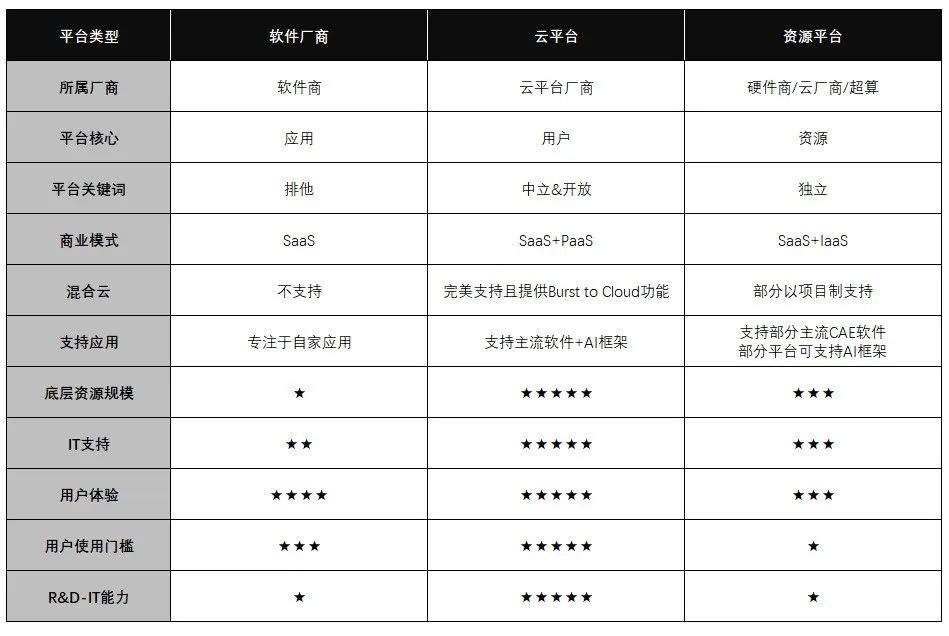
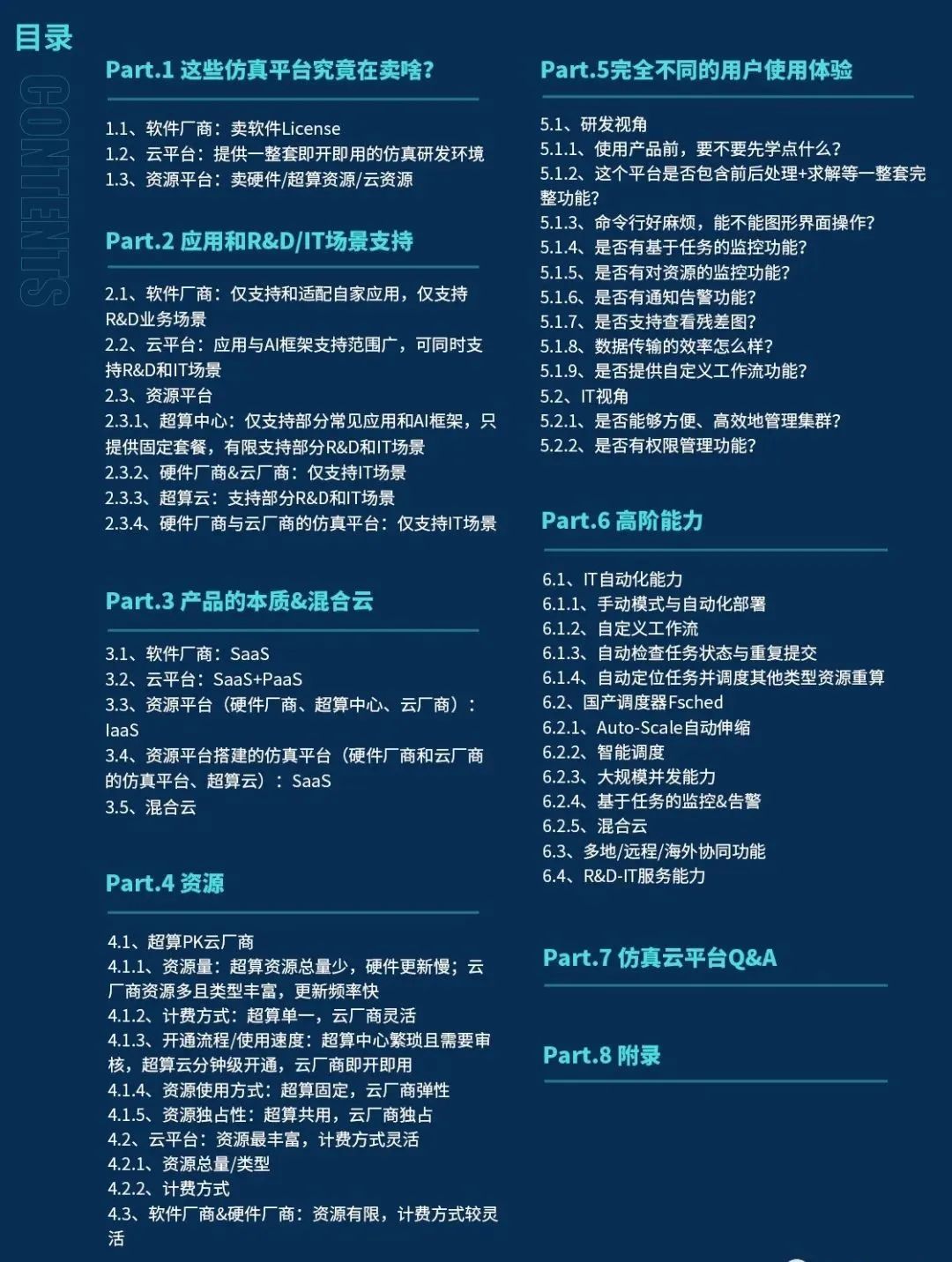
We will elaborate on each sub-item in the main part of the following white paper.
Interactive Visual Analysis Engine for High-Performance Industrial Simulation
Through simulations on high-performance computers, high-performance simulation applications can generate coupled fine geometric models and large-scale simulation datasets with millions or even billions of computational grid units, posing new challenges to the human-computer interaction force supporting simulation design and analysis. For example, the design of the casing of an aircraft engine and its inclusivity analysis is crucial, as non-inclusivity accidents can lead to catastrophic disasters. The casing is a protective cover for the engine blades, and the gap between the blades and the casing cannot be too small; otherwise, inconsistent thermal expansion and contraction may lead to blade wear, fire, or even fracture; the gap cannot be too large, as this compressed high-pressure air may backflow through the gap, not only leaking and losing efficiency but also potentially causing surge. To obtain a reasonable gap, the interactive design of the geometric shapes of the casing, blades, and other geometric model components is an important aspect of the simulation. At the same time, for the finely discretized computational grid’s inclusivity simulation results, the visual interactive capability supporting large-scale simulation result analysis is indispensable.
However, traditional scientific visualization software has weak coherent interactive capabilities for model pre-processing, simulation solving, and post-processing analysis. Scientific visualization adopts a data model centered on grid data, without focusing on the sustainable association between geometric models and computational grids in its visualization pipeline. To handle geometrically continuous expression data in the visualization pipeline, it is necessary to convert continuous geometric models into discretized grid data during the pre-processing stage. At this point, the converted discrete grid data completely loses the descriptive information of the original geometry and the logical relationships of the model components. Therefore, traditional scientific visualization software cannot meet the needs of computer-aided engineering (CAE) simulation design driven by geometric shapes.
In addition, mainstream CAE commercial software has weak visual interactive capabilities for large-scale simulation data. Although it adopts a geometric model-centered data model and processing pipeline, the simulation interactive capabilities mostly only support a limit of millions of computational grid scales, and the scalability of simulation interaction is restricted by the number of parallel cores licensed. Therefore, commercial software finds it challenging to meet the high-performance CAE simulation needs with computational grid scales of tens of millions or even billions.
To break through the human-computer interaction bottleneck of high-performance industrial simulation, this paper proposes an interactive visual analysis engine for high-performance industrial simulation. First, it constructs a three-dimensional hybrid data model based on grid segments to efficiently couple geometric models and computational grids, achieving the core data model transformation from grid data to geometric models; second, it proposes a dual-contract parallel visual analysis process for coherent simulation design, supporting the sustainable association and efficient processing of geometric model and computational grid data in the visualization pipeline; finally, through a lightweight method for extracting element data from the surface of volumetric grids, it couples GPU real-time realistic rendering to support real-time high-quality analysis of large-scale simulation data. This engine has been integrated into domestic aircraft engine CAE simulation application software, and results show that it can smoothly support design analysis of large-scale simulation applications.
1. Related Work
Industrial simulation is at the core of intelligent manufacturing. Currently, the industrial design and analysis field heavily relies on foreign commercial CAE simulation software such as ANSYS, COMSOL, and Abaqus. American ANSYS has become a global CAE software giant through technological accumulation and merger expansion, integrating structural, fluid, electric field, and magnetic field analysis, with applications spanning multiple industries including oil, energy, military, automotive, and aviation. Mainstream commercial software such as ANSYS adopts a geometric model-centered data model for the entire simulation lifecycle, supporting coherent pre- and post-processing interactive design analysis functions, and supporting human-computer interaction throughout the process driven by geometric shapes like points, edges, surfaces, and solids. ANSYS Workbench includes high-performance computing capabilities, but only supports local simulation calculations, not parallel pre- and post-processing tasks. The American EnSight software acquired by ANSYS can support third-party simulation parallel visualization, but its parallel core licensing limits the scalability of large-scale visualization.
In addition, traditional scientific visualization software is oriented towards the computational analysis process, adopting a data model centered on grid data. VTK (Visualization Toolkit) is an open-source visualization library from Kitware, Inc., widely used in computer graphics and data visualization fields. VTK supports five different data formats, but all are based on a grid data model. Mainstream open-source visualization software such as VisIt and ParaView uses the VTK grid data model at the data representation layer; although they have rich data processing functionalities and strong capabilities for processing large-scale data, they cannot support CAE simulation design and analysis centered on geometric models.
Visual analysis processes are a crucial internal mechanism of scientific visualization software, managing the entire process of data loading, transformation, display, and saving, describable as a data flow network. The visual computing process is described as a collection of executable modules, each connected by a directed graph, forming the visual analysis process. When data flows through the visual analysis process, each module performs algorithmic operations on the data, and the directed graph represents the way data flows between modules. Scientific visualization software such as VTK, ParaView, and VisIt all employ visual analysis processes in the conversion of data to images. Clearly, visual analysis processes based on grid data models can only handle data expressed in grids and cannot process geometric models that have not been discretized into grids.
On-demand driving is an effective way to interactively process large-scale scientific simulation data and is a significant feature of visual analysis processes. According to the processing needs of each module, only the required local data is loaded, which helps improve the performance of visual analysis for large-scale data. In addition, scientific visualization has a long history of using high-performance computing to process large-scale datasets, and visual analysis processes typically include parallel computing capabilities. By partitioning large-scale data into a certain number of sub-blocks, it can achieve high parallel scalability by executing the visual analysis process for each sub-block’s data simultaneously. This processing mode has been successfully applied to current supercomputers, while mainstream commercial simulation software does not possess these large-scale processing advantages.
Regarding the responsiveness requirements of human-computer interaction, CAE simulation software and scientific visualization software differ significantly due to their different tasks, which determines the graphic rendering technologies that adapt to the visual interactive capabilities of both. Scientific simulation emphasizes comparing and understanding bulk computational results, requiring moderate responsiveness for human-computer interaction and focusing more on scalable parallel processing capabilities that match large data volumes. Considering the multi-core architecture of supercomputing rendering environments, scientific visualization generally adopts a rasterization fixed rendering pipeline. The pipeline internally solidifies a complete rendering pipeline, requiring only inputting the parameters required for rendering and specifying specific switches on the CPU code side to complete different renderings. Rasterization rendering methods can efficiently parallel accelerate using multiple CPUs but only support local lighting effects on complex geometric models. Intel OSPRay software implements ray tracing rendering methods accelerated based on Intel processor architecture, supporting advanced lighting effects such as ambient occlusion.
CAE simulation applications focus on interactive design of geometric models, posing extremely high requirements for visual interactivity responsiveness. Even though parallel rendering pipelines based on multiple CPU cores are very efficient, they still struggle to achieve real-time performance. In 2001, NVIDIA launched programmable rendering pipelines. Based on programmable rendering pipelines, applications can write specific logic for vertex rendering and pixel rendering themselves to enhance interactive drawing performance or achieve global lighting effects that fixed pipelines cannot render, showcasing complex geometric features. However, due to the multi-level memory access architecture of GPUs similar to CPUs, their memory access performance slows down sequentially from registers to system memory. Therefore, how to achieve real-time interaction and scalable analysis of large-scale high-performance simulation data remains a challenge.
2. Coherent CAE Simulation Workflow
CAE simulation includes three stages: pre-processing, simulation solving, and post-processing, as shown in Figure 1. The pre-processing stage is responsible for defining the shape and topology of the geometric domain, setting physical properties, and boundary condition definitions for simulations; post-processing is responsible for the visual analysis of simulation results. This process continuously iterates with the product design process. Therefore, in the CAE simulation process, especially in the pre- and post-processing stages, maintaining a coherent transfer of geometric model information is crucial for geometric model-driven CAE simulation, referred to in this paper as coherent.
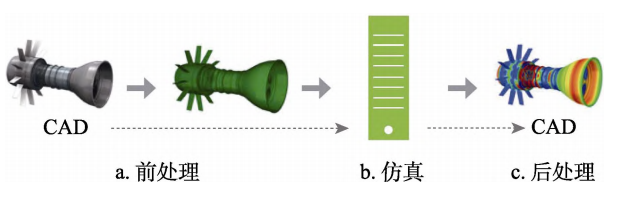 Figure 1: Coherent CAE Simulation Schematic3. The Engine Proposed in This Paper
To meet the design needs of CAE simulations driven by geometric models while enhancing the interactive performance of large-scale simulation data, this paper proposes an interactive visual analysis engine for high-performance industrial simulation. The engine’s three-layer architecture is shown in Figure 2, including a three-dimensional hybrid data model based on grid segments, a dual-contract visual analysis process for coherent simulation design, and a real-time realistic rendering method based on lightweight element data.
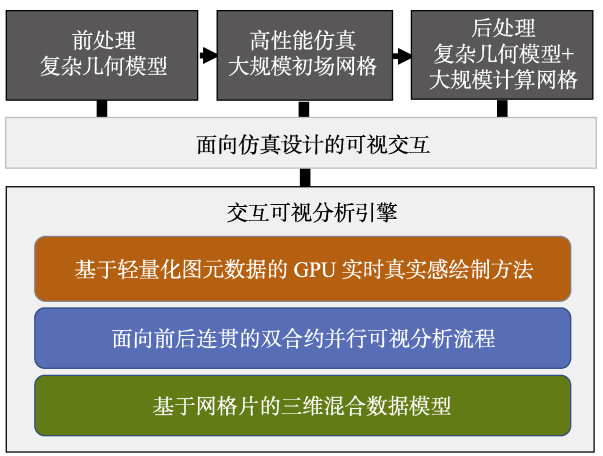 Figure 2: Architecture of the Engine Proposed in This Paper
3.1 Three-Dimensional Hybrid Data Model Based on Grid Segments
The efficient coupling of geometric models and computational grid data proposed in this paper supports the transformation of data models from “grid data-centered” to “geometric model-centered,” achieving coherence in the data representation layer of the engine.
The three-dimensional hybrid data model defined in this paper is as follows. On one hand, the hybrid model defines the spatial profile of simulation objects based on the surface description of geometric models. Geometric models describe the shape of physical or mathematical objects using geometric concepts, divided into wireframe models, surface models, and solid models. Among them, surface models describe all geometric information and connectivity of the body surface, used for various geometric operations and set operations for surfaces, edges, and points, making it the most commonly used geometric model in CAE simulations. In practical simulation applications, a geometric model can contain hundreds to thousands of geometric components.
On the other hand, the hybrid model characterizes the discrete results of simulation calculations based on three-dimensional volumetric data on computational grids and assembles simulation data based on grid segments. Grid segments are the basic scheduling units for parallel computing and are central to data storage and management. The data model based on grid segments can significantly enhance the locality of data access. As shown in Figure 3, grid segments support various types of grid elements, such as structured and unstructured grids, and their organization can form grid blocks covering complex-shaped computational areas. By adopting a multi-layer nested grid data structure of “grid block-grid segment-grid element,” it can ensure parallel visualization matches the multi-layer storage structure of high-performance computers.
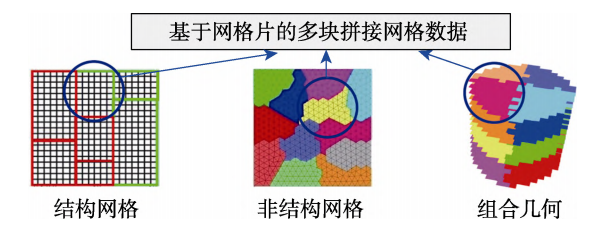 Figure 3: Multi-Block Spliced Grid Segment Data Matching High-Performance Computers
Specifically, the hybrid data model adopts a dual-layer coupling connection method for the coupling of geometric models and computational grids, as well as between geometric components and geometric information such as points, edges, surfaces, and solids, as shown in Figure 4.
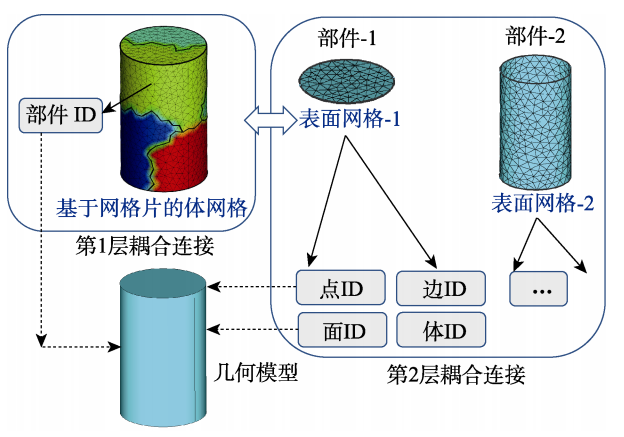 Figure 4: Hybrid Data Model Based on Grid Segments
First, this hybrid data model takes the entity number of geometric components as an attribute representation of the computational grid, achieving a coupling connection at the level of “geometric components-computational grid.” Secondly, it performs discretization of basic geometric information such as points, edges, surfaces, and solids on the surface grid based on geometric components. The geometric information number serves as an attribute representation of the surface grid of geometric components, achieving a coupling connection at the level of “geometric components-geometric information.” In practical simulation tasks, only a limited number of geometric components involved in the geometric model are usually addressed. Therefore, this paper’s data model adopts an on-demand grid discretization strategy for only the geometric components that need simulation analysis, significantly reducing the overall storage occupancy of model data.
3.2 Dual-Contract Visual Analysis Process for Coherent Design
Under the influence of large-scale data in high-performance simulations, both the data reading and processing stages in the visualization pipeline exhibit typical characteristics of data density and computational intensity, constituting core factors affecting human-computer interaction performance. The scientific visual analysis engine TeraVAP adopts a dual-contract mechanism to optimize the visualization pipeline, enabling on-demand reading and processing of large-scale data. A contract is a data structure containing metadata information such as spatial range and variables, flowing through the visualization pipeline, and summarizing the data and operational modes required by each filter in the pipeline before execution, thus achieving on-demand driving.
Based on the visual analysis process for scientific data, this paper designs a dual-contract visual analysis process adapted to complex geometric models, achieving coherence in data processing layers of the engine. It has two significant features: direct parsing of geometric models and on-demand discretization of complex models, which can avoid incrementally generating large-scale intermediate data, thereby optimizing the performance of the visualization pipeline for geometric models.
First, the engine constructs metadata for geometric models, achieving matching between complex geometric models and the dual-contract visual analysis process in the data representation layer. The metadata includes the spatial bounding box of geometric components, global interval trees, and geometric attributes required by the dual-contract mechanism during the construction of geometric models.
Secondly, the engine reconstructs the dual-contract visual analysis process to support on-demand discretization of complex models and efficient data processing. The core of the reconstruction is the contract mechanism. As shown in Figure 5, the reconstructed contract implements data pre-selection based on boundary representation, supporting the on-demand driving of the visual analysis process. In the upstream phase of the process, before discretizing the geometric model, the contract pre-selects the necessary geometric bodies for analysis, significantly reducing the amount of model grid data to be discretized in the downstream phase.
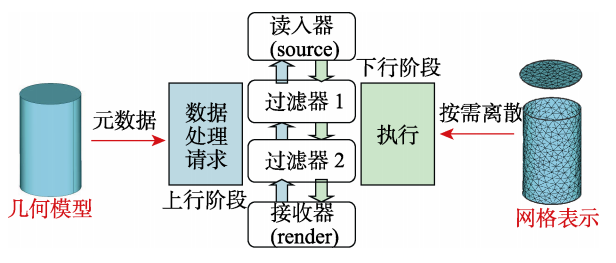 Figure 5: Dual-Contract Visual Analysis Process for Coherent Simulation Design
In the downstream phase of the process, the data operation algorithms are reconstructed, where data operations generate intermediate data only for geometric bodies that have actually changed, while other geometric bodies that have not undergone operational changes do not need to be expanded, ensuring efficient process handling.
Based on a message-passing global synchronous parallel (BSP) model, the engine can achieve efficient processing of large-scale simulation data through parallel visual analysis processes. Based on grid segment data, all processes perform local computations in parallel. This includes three stages: local computation, global communication, and synchronization. The locality of grid segment data ensures high performance for parallel data access in the visual analysis process.
3.3 Real-Time Realistic Rendering Based on Lightweight Element Data
In the human-computer interaction rendering stage, the engine implements a GPU real-time realistic rendering method based on lightweight element data to support real-time interaction and high-quality rendering of large-scale high-performance simulation data.
(1) Generation of Lightweight Element Data
Industrial simulation applications often use the outer surface of models as the default rendering object, facilitating the analysis of simulation results such as structural strength. However, these simulation results usually consist of three-dimensional volumetric grid data, containing a large amount of internal surfaces of volumetric grids that do not need rendering, leading to memory and performance overhead.
To address this, this paper implements an effective method for extracting the external surfaces of volumetric grids, as shown in Figure 6. The basic idea is to count how many times each face of the volumetric grid is used by volumetric grid units. If used twice, it indicates an internal surface, as that face is an adjacent face of two different units; if used only once, it indicates an external surface. Based on the vertex index hashing algorithm of the surface, the engine achieves fast extraction calculations for external surfaces.
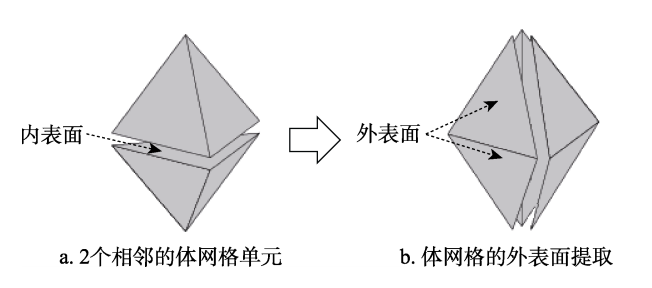 Figure 6: Schematic of Extracting External Surfaces of Volumetric Grids
(2) GPU Real-Time Realistic Rendering
Scientific visualization generally adopts a rasterization fixed rendering pipeline, which is suitable for scalable rendering of large-scale data based on multiple CPU cores but struggles to achieve real-time high-quality rendering. The interactive visual analysis engine proposed in this paper adopts GPU programmable rendering pipelines, avoiding the interactive performance bottleneck caused by large-scale element data migration from the CPU to the GPU for each frame, achieving a match between the rendering method and the multi-level memory access architecture of GPU hardware. Additionally, the engine implements multi-material and real-time shadow algorithms based on ambient occlusion, providing realistic effects that occlude diffuse light on folds, holes, and uneven surfaces of the model, enhancing the rendering depth and detail quality, aiding simulation design.
4. Experimental Testing and Analysis
Through pre-processing and post-processing tasks, this paper tests the interactive visual analysis engine’s coherent interactive processing capabilities for geometric models, coupled geometric models, and hybrid data of computational grid data, verifying visual interactive performance.
This paper tests using a server node configured with a 24-core processor, 512 GB memory, and dual NVIDIA Quadro P6000 graphics cards, as well as a PC configured with Intel Xeon processors and NVIDIA Quadro RTX 5000 graphics cards for commercial software comparison testing.
4.1 Pre-Processing
The pre-processing test uses three different scales of simulation models to verify the supporting capabilities of the interactive engine in pre-processing, involving the dual-contract visual analysis process and interactive rendering methods for coherent simulation design.
Table 1: Description of Geometric Model Features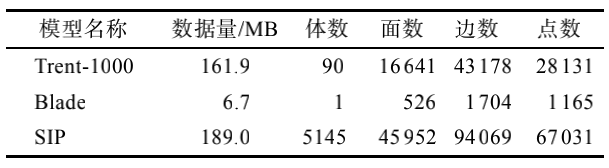
Table 1 shows the feature descriptions of the models, and Figure 7 shows the visual rendering results of each model. Trent-1000 is a civil turbofan engine developed by Rolls-Royce; the Blade single blade model is a typical application case of aerospace strength software; the SIP electronic device model is a typical application case of electromagnetic simulation software JEMS-CDS.
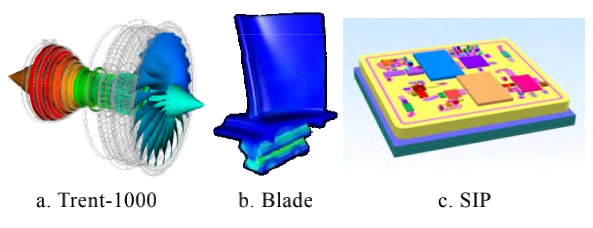 Figure 7: Visualization Results of the Engine for Geometric Models
Pre-processing interactive operations include visual interaction and geometric picking. Figure 7 shows the element data generated by the visual analysis process aimed at geometric models, and the visualization results obtained through GPU rendering. Figure 7a shows the filtering operation executed in the visual analysis process based on geometric component numbers, obtaining the engine casing part and its geometric edge drawing results, demonstrating the matching of the engine’s visual analysis process for geometric model processing.
Table 2: Visual Interactive Performance of Geometric Models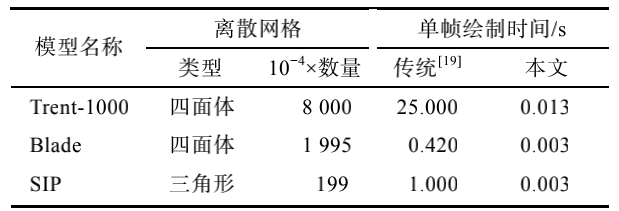
Visual interactive performance depends on the number of grid discretizations of geometric models; the performance of geometric picking depends on the number of components in the model. Table 2 shows the comparison of interactive performance between the traditional scientific engine TeraVAP and the interactive engine proposed in this paper. It is evident that the fixed rendering pipeline of the scientific engine is significantly limited by the CPU to GPU element data migration delays, and the single-frame drawing time cannot achieve real-time interaction. The interactive engine resolves the aforementioned bottleneck, improving interactive rendering performance by 2 to 3 orders of magnitude.
Table 3: Comparison of Interactive Picking Single-Frame Drawing Time for SIP Model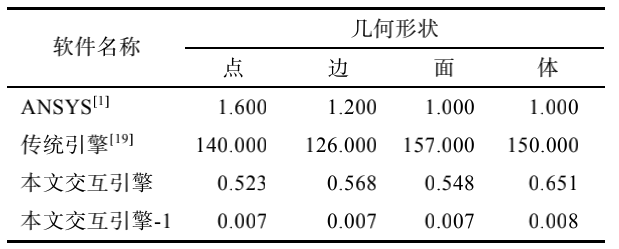
Table 3 shows the comparison of geometric picking performance between ANSYS software and the interactive engine proposed in this paper for the SIP model containing 5145 components. Geometric picking performance depends on the number of geometric components and the scale of grid discretization in the model. In Table 3, the interactive engine proposed in this paper is based on the visual analysis process that constructs an interval tree for CPU-accelerated picking performance; the interactive engine-1 employs CUDA hardware-accelerated picking performance. Clearly, the interactive engine’s picking performance outperforms that of ANSYS.
4.2 Post-Processing
The post-processing test uses the Trent-1000 whole model and the combustion chamber of the aerospace engine as two simulation cases to verify the post-processing supporting capabilities of the interactive engine. The combustion chamber also presents a challenging design issue for aircraft engines. An excellent combustion chamber design requires uniform mixing and combustion, belonging to complex flow problems under high-temperature conditions.
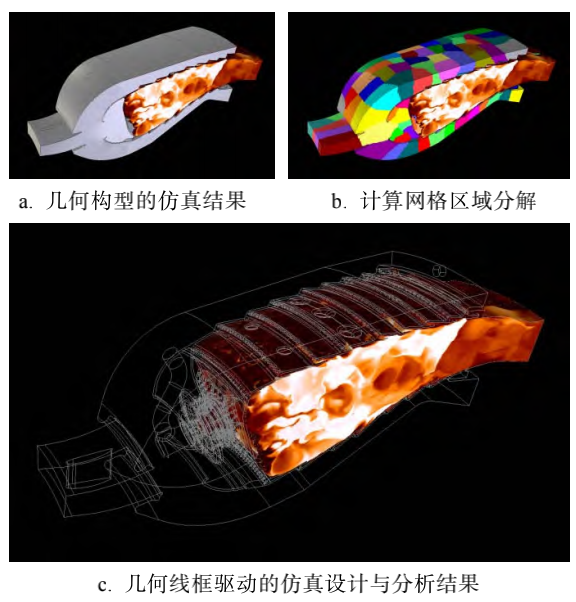
Figure 8: Combustion Design Analysis of the Combustor Aimed at Geometric Models
Figure 8 shows the combustion analysis case of the combustion chamber of the aerospace engine, containing 20.8 million hexahedral and tetrahedral mixed grids, with a single moment of simulation data reaching 12 GB. On one hand, based on the three-dimensional hybrid data model proposed in this paper, the geometric model of the combustion chamber maintains a sustainable association with the simulation computational grid in the visual analysis process, supporting the design analysis of simulation results driven by geometric models in the post-processing phase. On the other hand, this three-dimensional hybrid model adopts a design centered on grid segments, matching high-performance computers to achieve efficient parallel visual analysis. Figure 8b shows the distribution of multiple grid segments, with areas of the same color representing one grid segment.
Table 4: Lightweight Results of Simulation Cases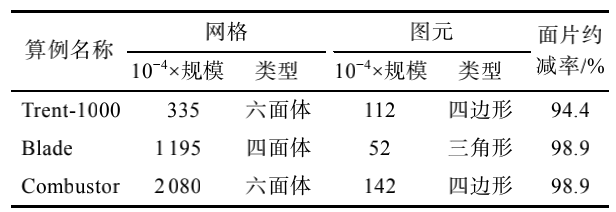
Table 4 shows the lightweight results of element data for three large-scale simulation cases based on the algorithm proposed in this paper. All three cases adopted hexahedral or tetrahedral computational grids, and after lightweight processing, generated quadrilateral or triangular surface data, with an average reduction rate of surface data reaching over 90% compared to the total number of surface data of the original volumetric grids. Figure 9 shows the simulation analysis results of the Trent-1000 turbine blade strength, which uses alloy materials and shadow rendering effects based on ambient occlusion.
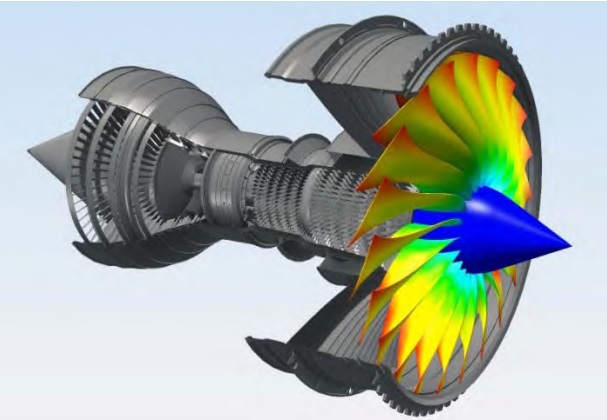 Figure 9: Simulation Analysis Results of the Turbine Blade Strength of the Trent-1000 Aircraft Engine
4.3 Comparison of Interactive Performance of Commercial Software
This paper employs computing environment 2 (personal computer) to test mainstream CAE commercial software ANSYS, COMSOL, and Abaqus. Among them, the commercial software operates under the Windows 7 operating system, while the interactive visual analysis engine proposed in this paper operates under the CentOS 7 operating system.
(1) Comparison of Rendering Effects
Comparing, it can be seen that in terms of materials and other advanced rendering, the rendering effect of Figure 10a is equivalent to that of Figure 10b; in shadow rendering, the effect of Figure 10a is superior to that of Figure 10b, providing a stronger sense of realism.
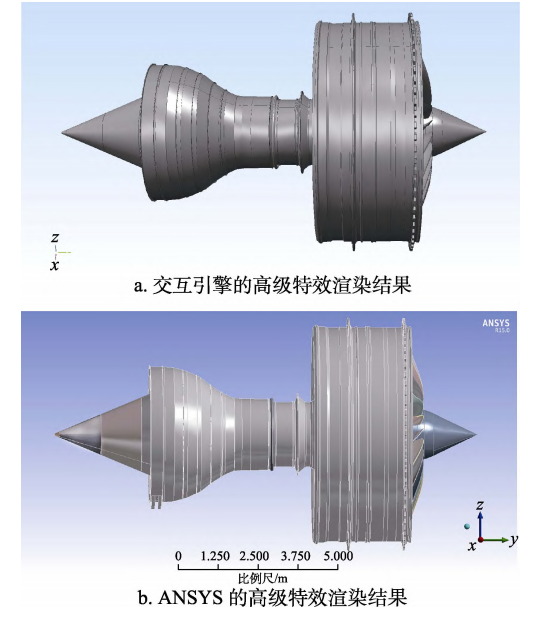 Figure 10: Rendering Results of the Trent-1000 Whole Model
(2) Comparison of Interactive Performance
Table 5 shows the real-time interactive performance comparison for the Trent-1000 whole model with 4.5 million and 20 million unstructured grid cases. Analysis shows that for million-grid scale data, both the interactive engine and commercial software interact smoothly. For ten million grid scale data, only the interactive engine and ANSYS can achieve smooth interaction.
Table 5: Comparison of Interactive Performance of CAE Commercial Software Single-Frame Drawing Time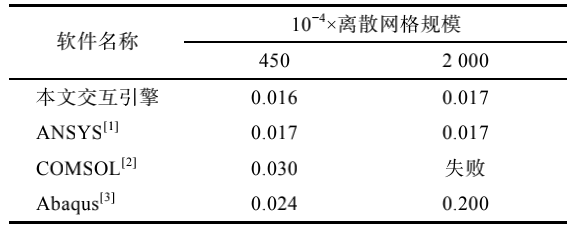
Tables 6 and 7 show the comparison of interactive performance for the Trent-1000 whole model with tens of millions of unstructured grid cases. Among them, the case with 80 million grid scale is tested using a single node of the Inspur server. Analysis shows that due to ANSYS not supporting parallel reading and processing of grid data, the time for one-click file import and drawing is much longer than that of the interactive engine proposed in this paper. It can be concluded that the one-click import performance of the interactive engine exceeds that of ANSYS commercial software by over 8 times.
Table 6: Comparison of 20 Million Unstructured Grid Cases of the Trent-1000 Whole ModelTable 7: Comparison of 80 Million Unstructured Grid Cases of the Trent-1000 Whole Model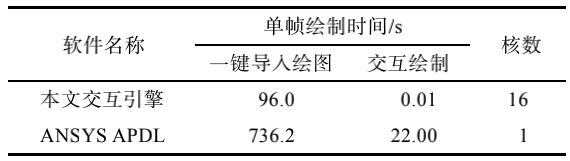 5. Conclusion
This paper proposes an interactive visual analysis engine that addresses the interaction bottleneck caused by large-scale simulation data on simulation design analysis from three levels: data representation model, visual analysis process, and element rendering method. It can smoothly support design analysis of large-scale simulation applications based on geometric models, with the one-click import interaction performance of the Trent-1000 engine model exceeding that of ANSYS commercial software by over 8 times. Currently, the interactive engine has evolved from scientific visualization engines; although it can scale to process large-scale high-performance simulation data, the one-click import drawing interactive performance still struggles to achieve real-time performance, making it unable to support time-sequenced simulation dataset analysis. In the future, it is necessary to explore the combination of data lightweighting, multi-resolution technologies, and engine data models to further optimize interactive performance.
Note: The content of this article is sourced from Zhongzhi Observation, Sushite Technology, and New Industrial Network.

Video Channel “Treading Snow Forum”
Digital Twin is the New Pinnacle of Simulation
Above video sourced from video channel
Follow “Treading Snow Forum” for exciting updates