Recently, while debugging a board equipped with an SD card and a LoRa transmission module, I noticed a distinct whining noise when sending data or writing to the storage card. Initially, I thought it was the sound from the LoRa module or the storage card, and I even suspected it might be a circuit connection issue (after all, I am not very knowledgeable about circuits). After discussing with a hardware engineer, I learned that the sound is emitted by the inductor.So, why does this whining noise occur? Here is the explanation provided by AI, which I would like to share:
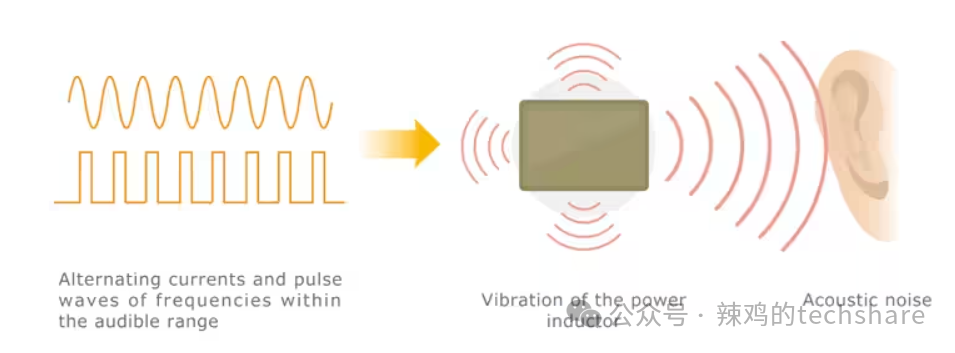
Why does the inductor make noise? This sound is actually caused by the inductor’s vibration.
The Principle of Inductor Vibration
The vibration of the inductor does not happen without reason; it is caused by current, more specifically, the AC current component flowing through the inductor.
In your board, the power management IC (PMIC) operates efficiently by switching at a very high frequency, generating pulsed current. The role of the inductor is to smooth this pulsed current into a relatively stable DC to power the subsequent chips.
During this smoothing process, the current flowing through the inductor is not absolutely stable but carries slight ripple. As the current fluctuates back and forth in the inductor coil, it creates a changing magnetic field. This magnetic field acts on the magnetic core material inside the inductor, causing it to undergo slight deformation—this is known as the magnetostrictive effect.
If this deformation occurs at a frequency that falls within the audible range (typically 20Hz to 20kHz), the inductor acts like a miniature speaker, transmitting this vibration as sound.
Why does it only whine at specific moments?
The board does not make noise continuously; it only emits sound when writing to the SD card or during LoRa module transmission. This is the best demonstration of the principle of inductor vibration.
-
Data Writing to the SD Card: When the SD card is performing read/write operations, especially when writing a large amount of data, it requires a momentary high current. This causes the power management IC to respond quickly, generating a pulse current that is much stronger than usual, resulting in a greater change in the magnetic field of the inductor, making the vibration and sound more pronounced.
-
LoRa Module Transmission: During the moment the wireless communication module transmits a signal, the power demand sharply increases. This rapid change in instantaneous current imposes a significant shock on the inductor, causing it to emit a louder “protest” sound.
What Does This Sound Indicate?
The whining noise from the inductor typically does not indicate a fatal flaw in the circuit; it is more like a “status indicator” of operation.
This sound is telling you:
-
Severe Load Changes: Your LoRa module or SD card is drawing a large amount of current from the power supply instantaneously.
-
The Power Supply is Working Hard: The power management IC is working intensively at a specific frequency to meet this sudden demand.
Although inductor whining is a common issue in power design, it can usually be effectively resolved or mitigated by optimizing inductor selection (such as using integrated inductors) or adjusting the switching frequency of the power management IC.
Here are some reference URLs:
https://www.digikey.sg/zh/blog/cn-annoying-the-noise-out-of-inductor?srsltid=AfmBOoo1RlINJseE4Y9oAkCuPpyP7TplK7cAVdsWkHoGTPKh6tKOl24Fhttps://www.denovocn.com/content/%E7%9F%A5%E8%AF%86%E5%88%86%E4%BA%AB-%E4%BB%80%E4%B9%88%E6%98%AF%E7%94%B5%E6%84%9F%E7%9A%84%E5%95%B8%E5%8F%AB%EF%BC%8C%E5%A6%82%E4%BD%95%E8%A7%A3%E5%86%B3%E5%92%8C%E9%81%BF%E5%85%8D%EF%BC%9Fhttps://product.tdk.cn/zh/techlibrary/solutionguide/acoustic-noise.html