Scientists Discover Plastic Ferromagnetic Semiconductors
Inorganic semiconductors possess a rich array of tunable functional properties, making them core materials for electronic, energy, and information devices. However, these materials typically exhibit strong brittleness at room temperature, leading to catastrophic failures. In recent years, some inorganic semiconductor materials have been discovered to possess good plasticity similar to metals, overturning the traditional perception of their intrinsic brittleness and providing material support for emerging technologies such as flexible and deformable electronic devices. However, the types of plastic inorganic semiconductor materials are limited, and their functional properties are mainly confined to electrical, thermal, and sensing applications, restricting their range of use.Traditional ferromagnetic metals exhibit good ductility/plasticity and metallic conductivity, while inorganic ferromagnetic semiconductors combine excellent ferromagnetism and semiconductor properties, making them ideal materials for the development of spintronic devices. However, currently, inorganic ferromagnetic semiconductors generally exhibit intrinsic brittleness, which limits their processability and potential applications in flexible devices.
Recently, researchers from the Shanghai Institute of Ceramics, Chinese Academy of Sciences, discovered a new type of plastic ferromagnetic semiconductor, CrSiTe3 crystals.CrSiTe3 is a layered ferromagnetic semiconductor material, and the research team grew bulk CrSiTe3 single crystals using a self-flux method. Mechanical property tests showed that the bulk single crystal of CrSiTe3 exhibited good plasticity at room temperature, withstanding tensile strains of up to 12% and bending strains of 15% in the in-plane direction, and compressive strains of 40% in the out-of-plane direction, comparable to reported typical plastic inorganic semiconductor materials.
To reveal the mechanism of its plastic deformation, the research team conducted first-principles calculations and found that the excellent plasticity of CrSiTe3 originates from its Te-Te interlayer slip energy barrier of 47 mJ m-2, and a dissociation energy of 418 mJ m-2, allowing for easy interlayer sliding without triggering dissociation. Chemical bond analysis indicates that during the sliding process, the interlayer Te-Te interactions maintain a certain strength of chemical bond connection, making the material difficult to dissociate.
Magnetic measurements show that the Curie temperature of the samples of CrSiTe3 after rolling and bending treatment remains stable at 34 K, and the saturation magnetization and coercivity also do not show significant changes. Monte Carlo simulations reveal that interlayer sliding leads to the formation of metastable structures such as AAC stacking, after which the ferromagnetism of CrSiTe3 remains stable, with magnetic anisotropy still aligned along the c axis direction with only slight deviations, and the material exhibits a Curie temperature close to the original ABC stacking (35±1 K). These results indicate that the plastic deformation of the material has minimal impact on its macroscopic ferromagnetic properties.
This research expands the functional characteristics and application scope of plastic inorganic semiconductor materials, achieving a synergistic coexistence of plasticity, semiconductor properties, and intrinsic ferromagnetic order in bulk inorganic semiconductors, providing new material support for the development of flexible spintronic devices.
The related research results were published in Advanced Materials. The research work was supported by the National Natural Science Foundation of China, the Ministry of Science and Technology, the Chinese Academy of Sciences, and Shanghai City.
Paper link
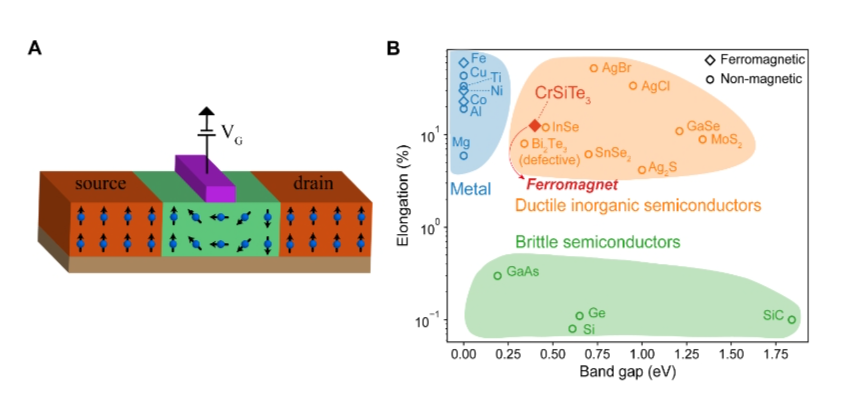
(A) Schematic diagram of spin field-effect transistors;(B) Typical non-magnetic/ferromagnetic material tensile ratio—Bandgap comparison chart
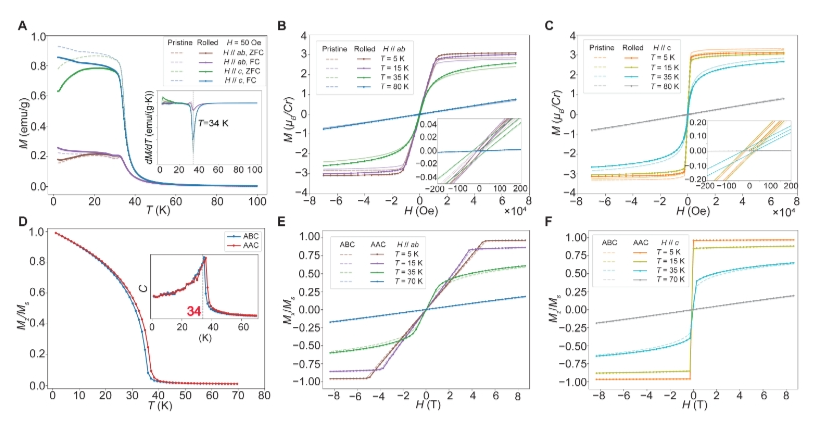
Experimental and theoretical exploration of the impact of plastic deformation on theCrSiTe3ferromagnetic properties