
Authors: Yang Kang, Liu Di, Simone Baldi, Yu Wenwu, Lü Chen
Affiliations: Southeast University, Nanyang Technological University, Singapore
Article Status: Published in IEEE T-ITS
Article Link: https://ieeexplore.ieee.org/document/10704981
Decoupling-Based Resilient Control of Vehicular Platoons Under Injection of False Wireless Data
1
Research Significance
With the rapid development of Internet of Vehicles (IoV) technology, vehicle platooning has gained significant attention due to its potential to enhance traffic efficiency and safety. Vehicle platooning technology achieves efficient and stable convoy driving through Cooperative Adaptive Cruise Control (CACC), but its reliance on V2V communication may become a target for hackers. False data injection attacks can tamper with communication data between vehicles (such as acceleration or control commands), leading to loss of control of the platoon and even collisions. Existing solutions typically rely on switching to non-networked modes (such as ACC) or complex observer designs, but they have the following limitations:
〇 Performance degradation from mode switching: Exiting CACC mode results in the loss of cooperative advantages of the platoon.
〇 Observer sensitivity to noise: Traditional methods struggle to operate stably in noisy environments.
〇 Ignoring inherent characteristics of platooning: The system theoretical characteristics of CACC (such as disturbance decoupling) are not fully utilized.
Therefore, it is crucial to develop a strategy that can resist attacks while maintaining platoon performance.
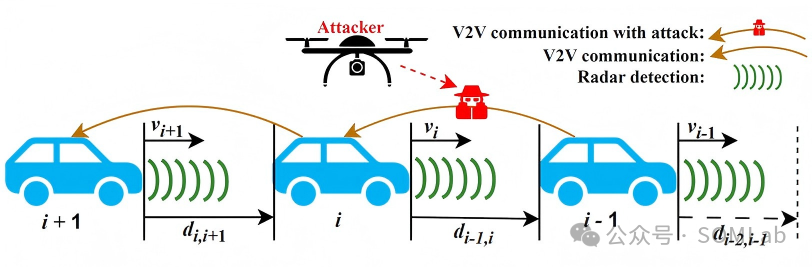
Figure 1. CACC vehicle platoon under false data injection attacks
2
Work of This Paper
To address the aforementioned challenges, this paper proposes a novel resilient decoupling control strategy for CACC, with core contributions including:
〇 Application of disturbance decoupling theory: It is proven that the CACC protocol inherently possesses disturbance decoupling characteristics, meaning that spacing errors can be independent of the acceleration disturbances of the leading vehicle. This characteristic can be used for real-time attack detection.
〇 Adaptive compensation strategy: By introducing an adaptive learning mechanism, the attack signal can be estimated and compensated online without switching to ACC mode, and it is robust to sensor noise.
〇 Attack detection: By monitoring whether the spacing error deviates from the ideal dynamics, it can be identified whether the communication data has been tampered with.
〇 Support for heterogeneous platoons: The strategy can be adapted to different vehicle dynamic parameters (such as time constants and transmission efficiencies), ensuring the stability of the platoon.
〇 Theoretical analysis proof: Theoretical proofs demonstrate that this strategy not only restores vehicle platoon performance but also guarantees “serial stability” (i.e., disturbances do not amplify within the platoon).
3
Experimental Results
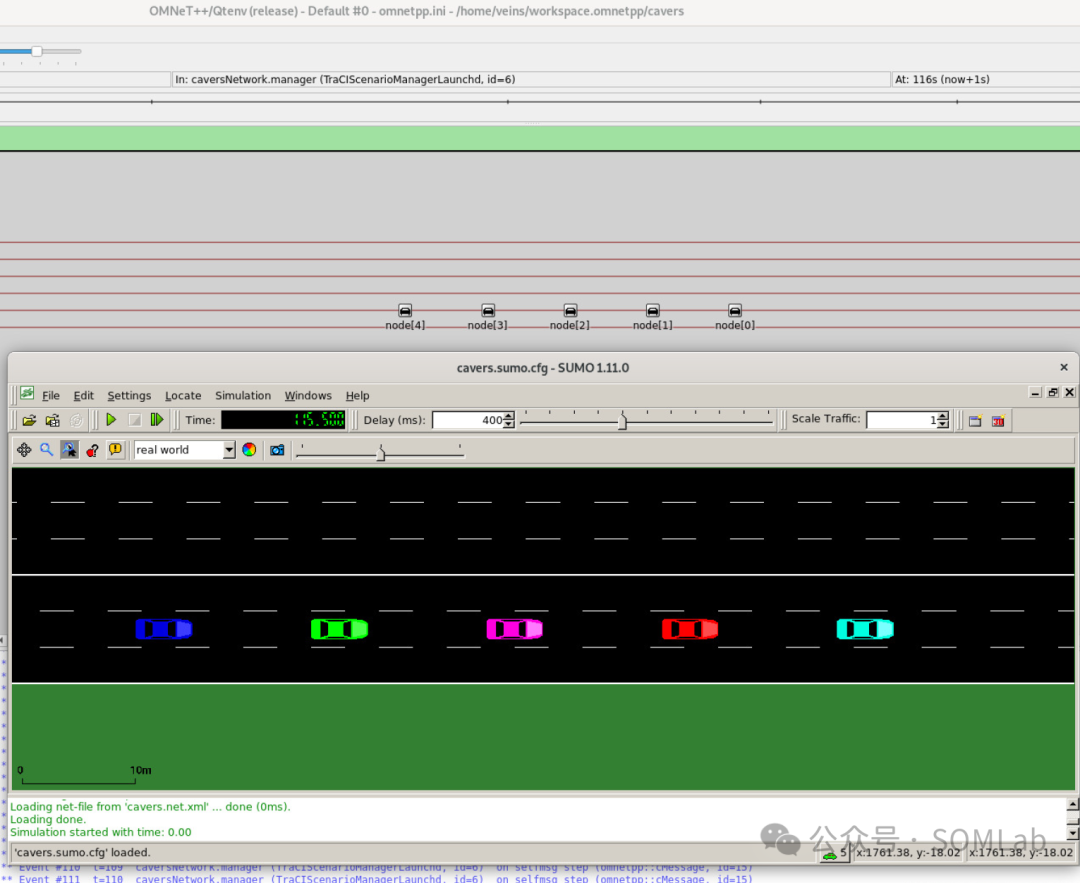
Figure 2. CACC simulation verification under network attacks based on CAVers (SUMO-Veins)
This paper verifies the effectiveness of the proposed strategy through the SUMO-Veins joint simulation platform, and the proposed strategy has the following advantages:
〇 Attack resistance: Without compensation, constant value attacks will lead to a sudden decrease in vehicle spacing (Figure 2a), and wavelet attacks will cause oscillations between the platoon (Figure 3a); by applying the resilient control strategy proposed in this paper for compensation, rapid convergence of spacing errors can be achieved (Figure 2b), and oscillations can be eliminated (Figure 3b).
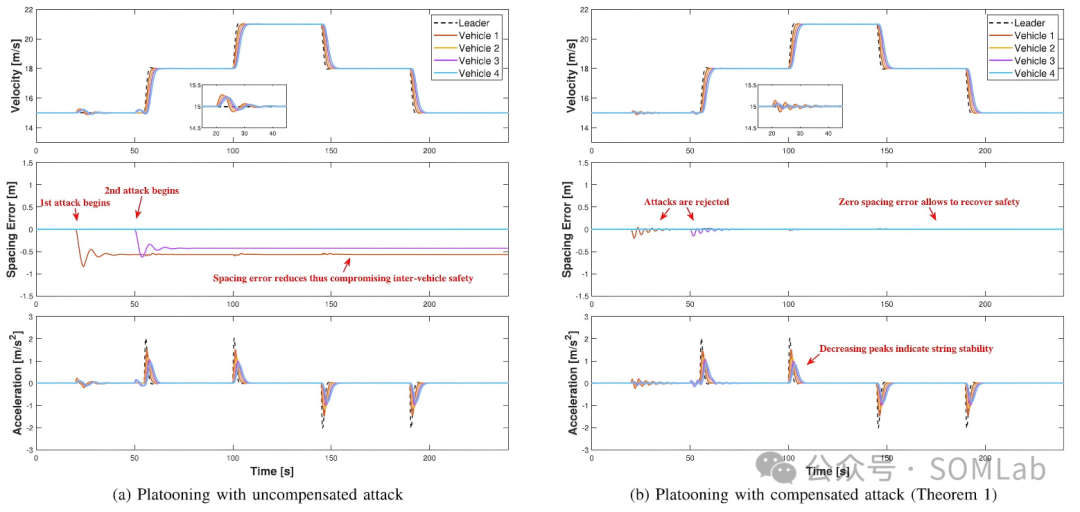
Figure 3. CACC vehicle platoon simulation results under false data injection attack (constant value)
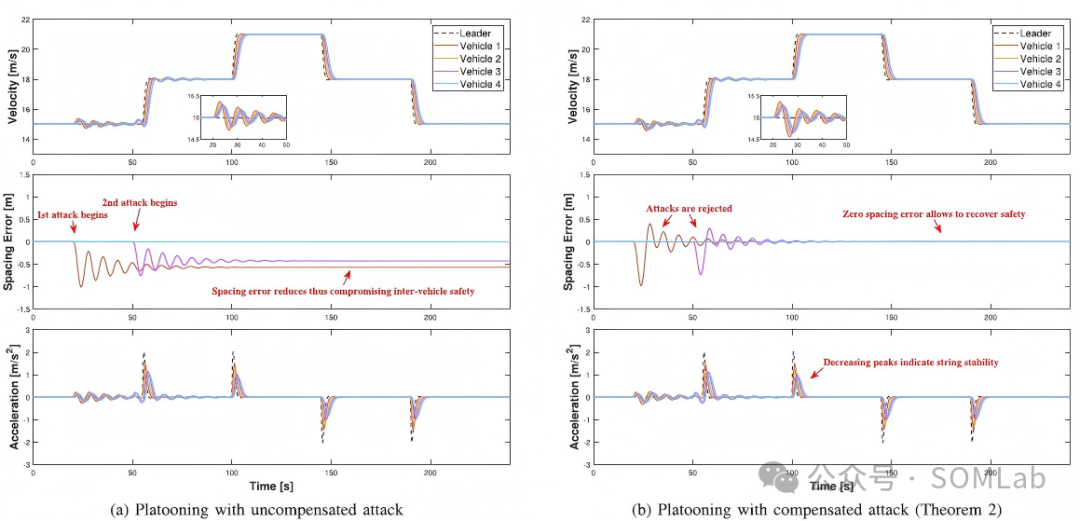
Figure 4. CACC vehicle platoon simulation results under false data injection attack (wavelet)
〇 Heterogeneous platoon testing: In SUMO-Veins, vehicles with different parameters are simulated, and the proposed compensation strategy can be extended to heterogeneous platoons while still restoring vehicle platoon performance (Figure 4).
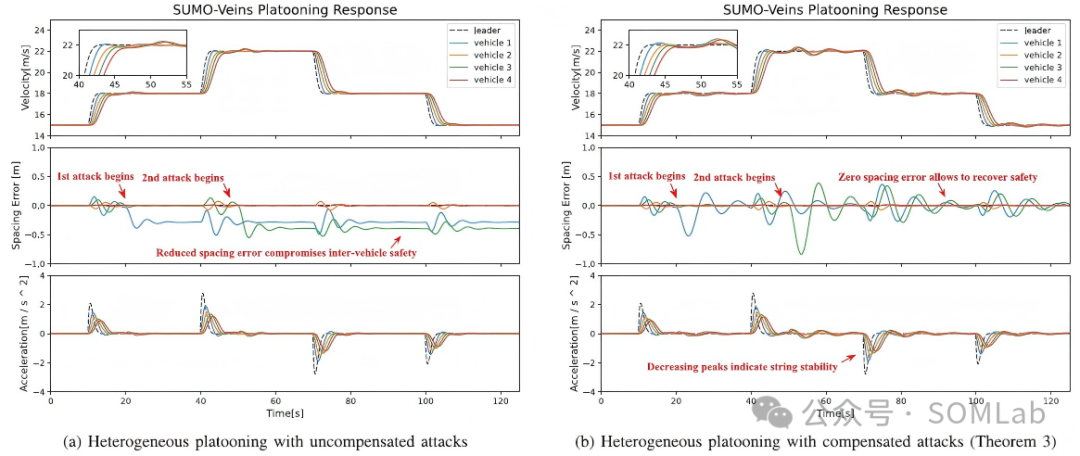
Figure 5. CACC heterogeneous vehicle platoon simulation results under false data injection attacks
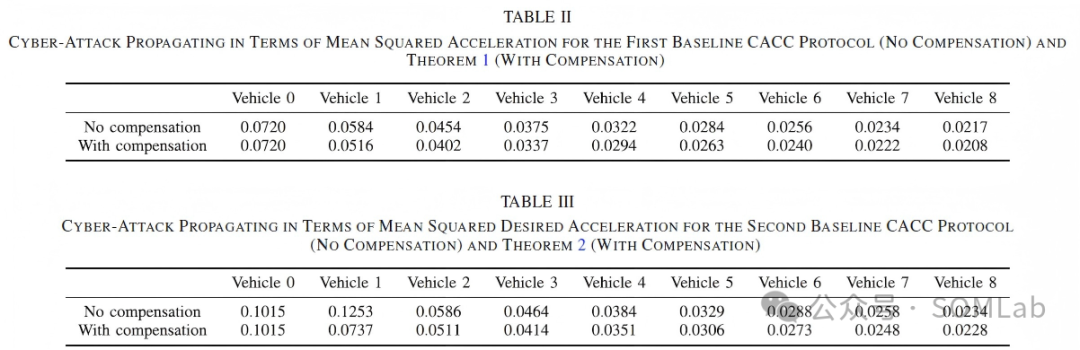
〇 Serial stability: Experiments also show that the mean square value of acceleration decreases from vehicle to vehicle under the compensation strategy (as shown in the table below), proving that serial stability is maintained.
Copywriter | Yang Kang
Layout | Su Dongdong
Review | Liu Di