Introduction
In the field of cancer treatment, antibody-drug conjugates (ADCs) are hailed as “biological missiles” that can precisely deliver high concentrations of chemotherapy drugs to tumor cells, enhancing efficacy while reducing damage to normal tissues. Among them, trastuzumab deruxtecan (T-DXd, also known as DS-8201), which targets the HER2 protein, has become a significant breakthrough in the treatment of HER2-positive breast cancer.
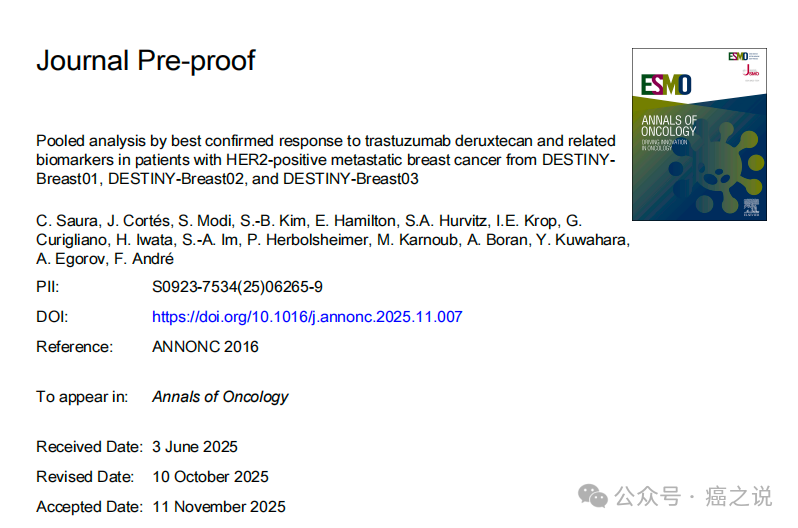
So, which patients can achieve better efficacy with these ADC drugs? A recent analysis summarizing three international clinical trials provides us with important clues.

01
Significant Efficacy Differences
—— Substantial Survival Extension for Complete Responders


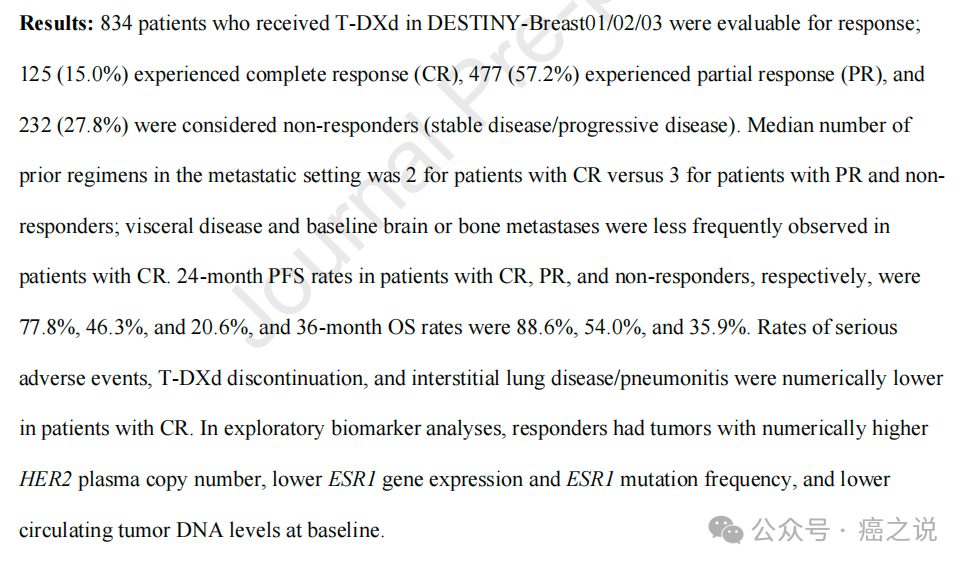
Research has found that among patients receiving T-DXd treatment, approximately 15% achieve “complete response” (CR), meaning imaging tests show the tumor has completely disappeared; 57% achieve “partial response” (PR), with significant tumor shrinkage; while 28% have poor treatment outcomes.
The long-term survival differences among these three patient categories are enormous:
-
The 24-month progression-free survival rate for complete responders is as high as 77.8%, meaning nearly 80% of patients have not experienced disease progression two years later;
-
For partial responders, it is 46.3%; while for non-responders, it is only 20.6%. In terms of overall survival, the survival rate for complete responders at 36 months reaches 88.6%, significantly higher than the other two groups.
-
This indicates that patients who achieve deep tumor remission can indeed achieve more durable disease control, and ADC treatment offers them hope for long-term survival.

02
Characteristics of Advantageous Patient Groups


Analysis shows that the following types of patients are more likely to achieve ideal results from T-DXd treatment:
-
🎯 Patients Treated Early Complete responders have received fewer prior treatment regimens (median of 2 lines), while partial responders and non-responders are mostly in the 3rd line. This suggests that using ADC drugs when patients are in good physical condition and the tumor has not accumulated too many resistant mutations yields better results. As T-DXd continues to advance in clinical application, even entering first-line treatment, it is expected to allow more patients to achieve deep remission.
-
🎯 Patients with Low Tumor Burden Complete responders often exhibit more favorable disease characteristics: lower rates of visceral metastasis (60% vs 85%), fewer brain metastases (4% vs 18%) and bone metastases (9.6% vs 39.2%), and smaller total diameters of target lesions (median 31mm vs 52mm), with lower baseline ctDNA levels. These indicators collectively reflect a lower tumor burden. Just like in a battle, attacking when the “enemy” is fewer and has not established strong “positions” naturally makes it easier to achieve complete victory.
-
🎯 Patients with High HER2 Expression Although tissue HER2 testing is positive, the proportion of strong HER2 positivity (IHC 3+) is higher in the complete response and partial response groups (86.4% and 82.2% vs 79.3%). In plasma testing, responders also have higher HER2 copy numbers. This confirms the “precision strike” characteristic of ADC drugs—higher target expression makes it easier for the drug to locate and eliminate tumor cells.
-
🎯 HR-Negative or Low ESR1 Expression Patients The study found that among the hormone receptor-positive (HR+) subgroup, patients with lower ESR1 (estrogen receptor gene) expression or without ESR1 mutations respond better to T-DXd. This may reveal the complex interactions between HER2 and hormone receptor signaling pathways, providing ideas for future combination therapy strategies.

03
Safety Considerations
—— Efficacy and Tolerability Can Coexist


Encouragingly, the study showed that complete responders, despite longer treatment durations (median of 27.4 months), had lower rates of severe adverse events, drug interruptions, and occurrences of interstitial lung disease/pneumonia. This indicates that while achieving good efficacy, treatment tolerability has not worsened due to prolonged therapy, alleviating concerns about the long-term safety of ADC drugs.

Implications for Patients


This study has significant guiding implications for clinical practice:
-
First, timing is crucial. Once HER2-positive advanced breast cancer is diagnosed, ADC drugs should be considered early at the appropriate treatment stage, rather than waiting until multiple lines of treatment have failed.
-
Second, comprehensive assessment is important. Doctors will consider factors such as tumor burden, metastatic sites, and HER2 expression levels to determine the likelihood of patient benefit from ADC treatment.
-
Most importantly, personalized treatment is the future direction. With the discovery of more biomarkers, we may be able to accurately predict efficacy based on patients’ genetic characteristics, tailoring the best treatment plans for different patients.

Looking Ahead


For patients with primary resistance to T-DXd, the scientific community is actively exploring new treatment strategies, including combinations of ADC drugs with other targeted therapies and immunotherapy. Meanwhile, more ADC drugs are under development, targeting different sites and cancer types, bringing continuous hope to cancer patients.
ADC drugs represent a significant advancement in tumor treatment, and understanding which patients can benefit the most brings us one step closer to the goal of precision medicine. As research deepens, we hope to enable more patients to achieve long-term survival with a manageable quality of life, potentially turning cancer into a manageable chronic disease.

References


1. Dempsey N, Rosenthal A, Dabas N, Kropotova Y, Lippman M, Bishopric NH. Trastuzumab-induced cardiotoxicity: a review of clinical risk factors, pharmacologic prevention, and cardiotoxicity of other HER2-directed therapies. Breast cancer research and treatment. 2021;188(1):21-36.
2. Khoury K, Meisel JL, Yau C, Rugo HS, Nanda R, Davidian M, et al. Datopotamab-deruxtecan in early-stage breast cancer: the sequential multiple assignment randomized I-SPY2.2 phase 2 trial. Nature medicine. 2024;30(12):3728-36.
3. Seban RD, Champion L, De Moura A, Lerebours F, Loirat D, Pierga JY, et al. Pre-treatment [18F]FDG PET/CT biomarkers for the prediction of antibody-drug conjugates efficacy in metastatic breast cancer. European journal of nuclear medicine and molecular imaging. 2025;52(2):708-18.
4. Shatsky RA, Trivedi MS, Yau C, Nanda R, Rugo HS, Davidian M, et al. Datopotamab-deruxtecan plus durvalumab in early-stage breast cancer: the sequential multiple assignment randomized I-SPY2.2 phase 2 trial. Nature medicine. 2024;30(12):3737-47.
5. Xue C, Liao Q, Huang R, Huang Y, Chen R, Yang Z, et al. Prognostic index for predicting outcomes of trastuzumab deruxtecan in HER2 expressing metastatic breast cancer: a real-world multicenter study. The oncologist. 2025;30(8).

Author Biography



Li Xiaobing
Hubei Cancer Hospital
Doctor of Oncology
-
Associate Chief Physician
-
Outstanding Doctor Supported by Hubei Cancer Hospital
-
Member of the Difficult Tumor Committee of the Chinese Medical Education Association
-
Standing Committee Member of the Oncology Prevention and Treatment Committee of the Hubei Provincial Association of Science Writers
-
Standing Committee Member of the Youth Expert Committee of the Hubei Provincial Clinical Oncology Society
-
Member of the Immunotherapy Expert Committee of the Hubei Provincial Clinical Oncology Society
-
Member of the Biological Therapy Committee of the Hubei Provincial Immunology Society
-
Founder of the Oncology Public Account “Cancer Talk”
Contact Information
🛄 Outpatient Address:
3rd Floor, Outpatient Department, Hubei Cancer Hospital
Immunotherapy Outpatient
🕒 Outpatient Hours:
Every Thursday afternoon14:00-17:00


More Information Scan to Follow